-
-
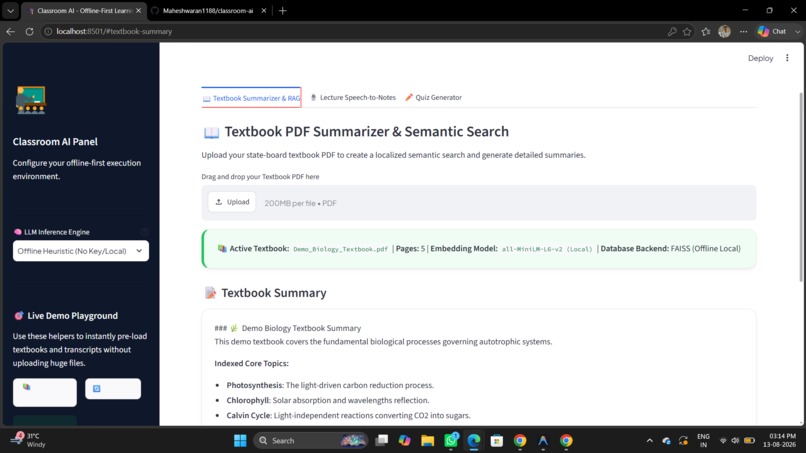
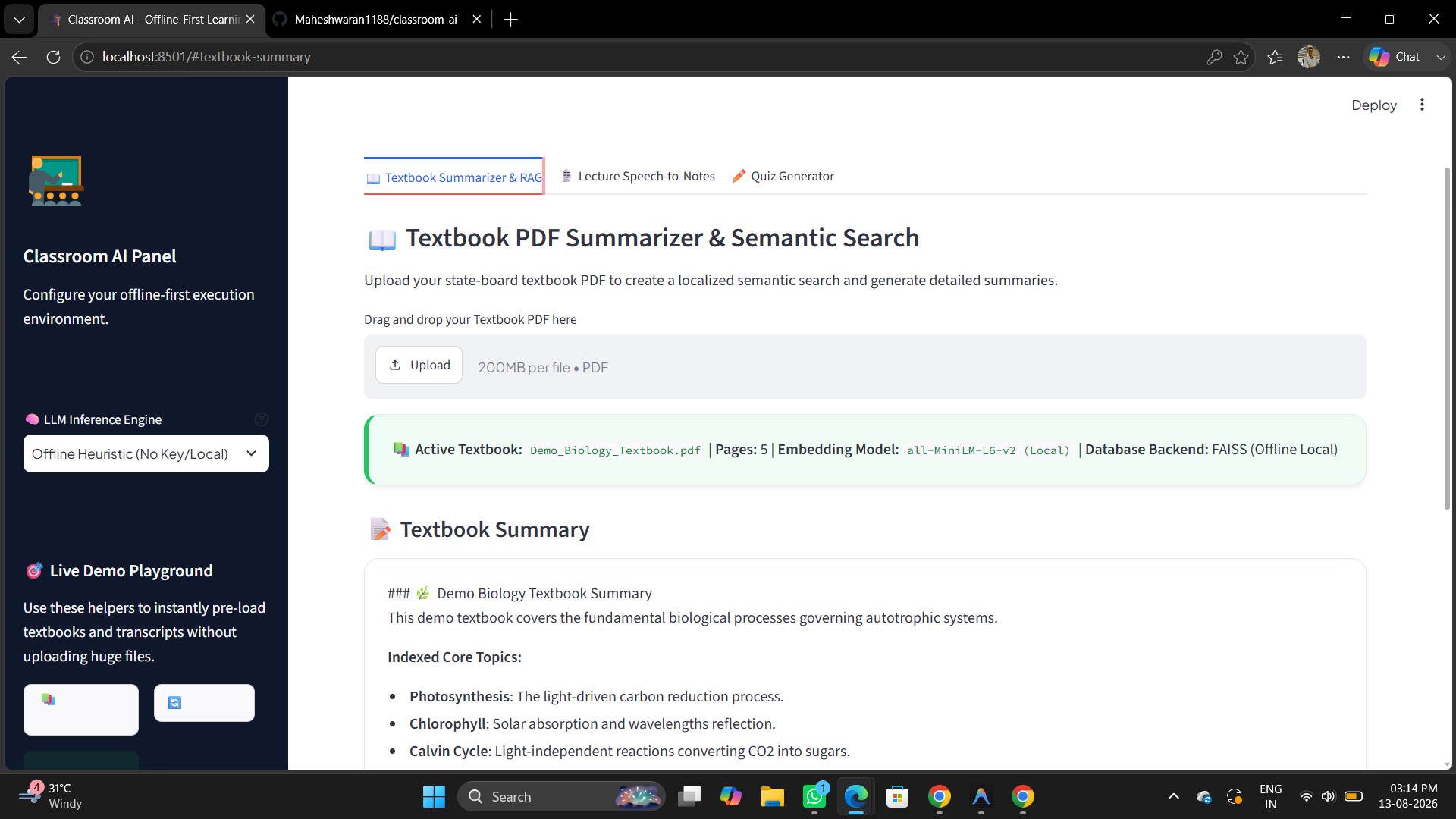
this page is for getting summaries of the textbook and ask doubts to the chat bot. Also we can integrate open ai for online using API.
-
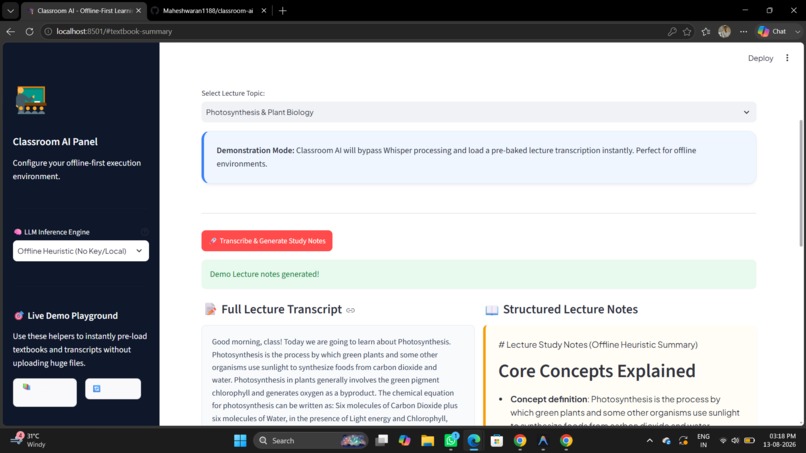
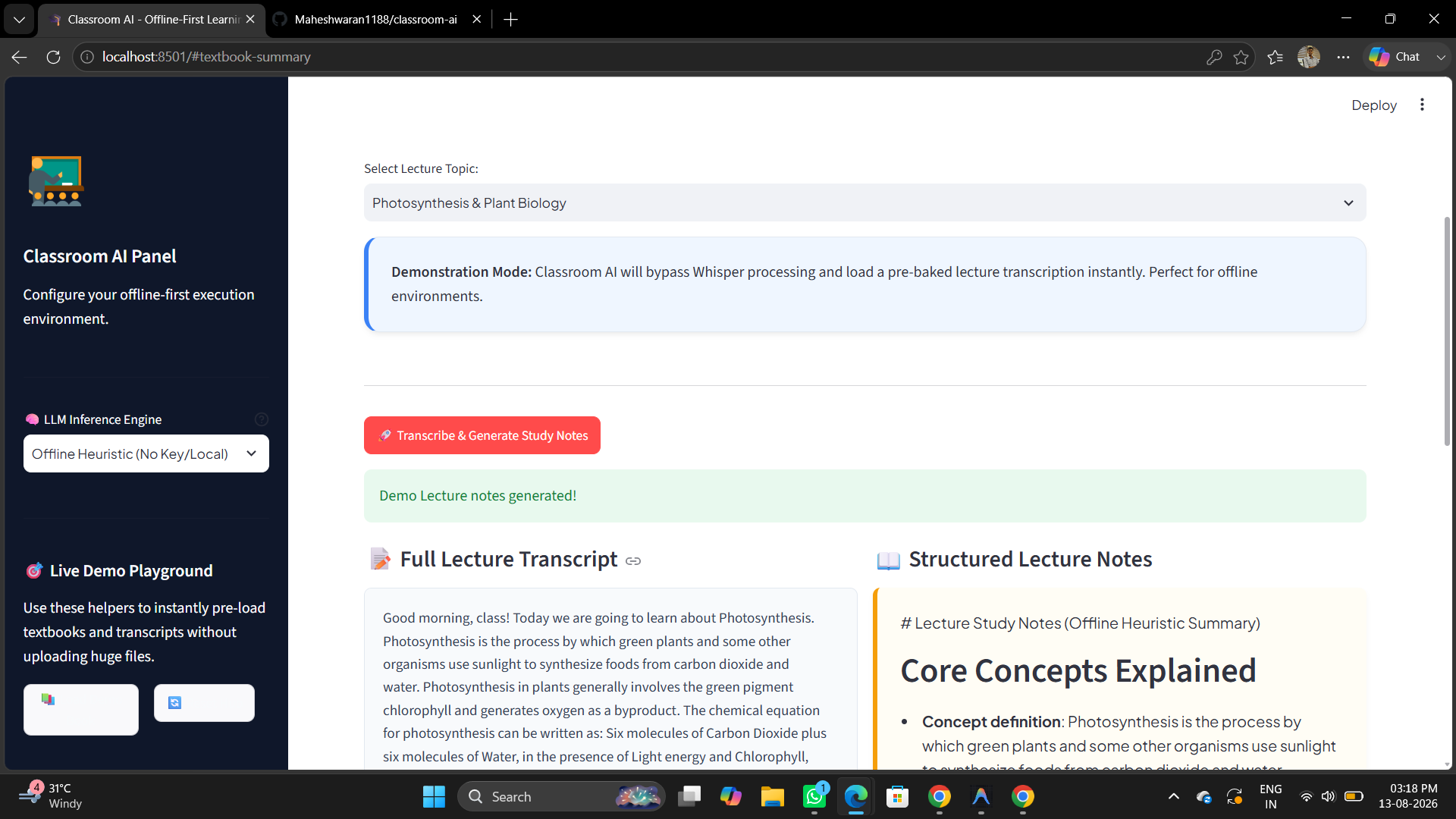
in this page we can provide audios and convert them into a notes
-
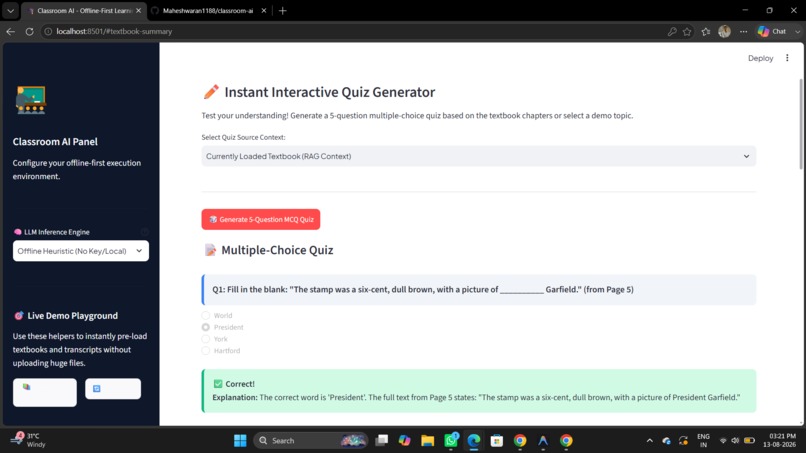
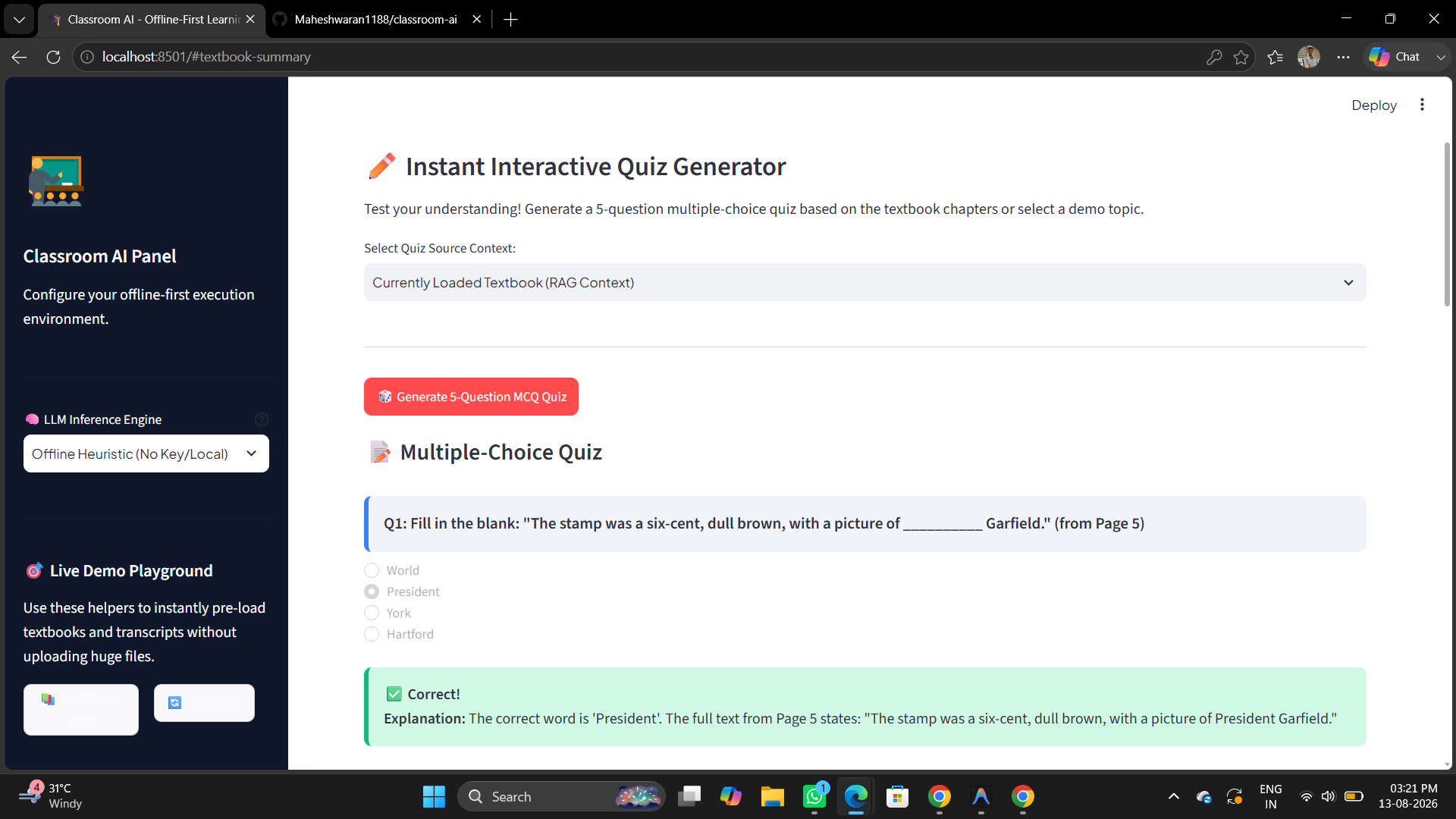
this page is for convert the lecture notes into Quiz for IQ tests
Inspiration
In many regional and state-board educational ecosystems, students face a significant digital divide. While generic AI tools excel at processing standard English materials, they often struggle with regional syllabus structures, mixed-language nuances (such as Tamil and English code-mixing), and complex textbook layouts. Furthermore, high-bandwidth internet isn't always reliable in every rural or semi-urban classroom.
We were inspired to build Classroom AI—a lightweight, localized, and offline-first study companion designed to equalize access to personalized learning. Our goal was to create a tool that turns any textbook PDF or recorded classroom lecture into bite-sized summaries, structured notes, and self-assessment quizzes without complex setup.
What it does
Classroom AI acts as a localized multimodal study assistant for students and educators:
Syllabus Processing & Summarization: Converts dense textbook chapters into clear, accessible study guides tailored for regional language contexts.
Automated Assessment Engine: Generates interactive practice quizzes, multiple-choice questions (MCQs), flashcards, and instant step-by-step explanations directly from study materials.
Lecture-to-Notes Transcriber: Processes recorded audio from classroom lectures into structured, searchable bulleted study notes.
Offline-First Retrieval: Uses lightweight vector indexing to allow continuous study access without relying on high-speed cloud connections.
How we built it
We engineered Classroom AI using a modular, low-latency processing architecture:
Document Engine & Retrieval: Uploaded state-board PDFs are parsed and split into semantic chunks. We built a local Retrieval-Augmented Generation (RAG) pipeline using LangChain and ChromaDB / FAISS vector storage to index concepts locally.
Localization & Summarization Layer: We integrated fine-tuned multilingual NLP models (IndicBERT / multilingual LLMs) to extract core ideas and output contextual explanations in clear regional language syntax.
Audio Processing Pipeline: Recorded classroom lectures are processed through OpenAI Whisper for high-accuracy speech-to-text conversion, followed by automated NLP extraction to yield bulleted takeaways.
User Interface: Built a clean, intuitive dashboard using Streamlit / React allowing students and teachers to drag-and-drop materials and interact with generated study modules seamlessly.
Challenges we ran into
Handling Complex PDF Layouts: State-board textbooks often contain multi-column text, embedded diagrams, and non-standard Tamil/English font encodings. Ensuring clean text extraction required fine-tuning our PDF parsing and chunking rules.
Context Retention in Regional Speech: Local classroom audio recordings frequently feature regional accent variations and ambient background noise. Optimizing Whisper parameters and post-processing text tokens was essential to maintain high transcription accuracy.
Balancing Latency & Model Performance: Running local vector search and LLM inference quickly on standard hardware required optimizing our chunk sizes and embedding dimensions to maintain real-time responsiveness.
Accomplishments that we're proud of
End-to-End Pipeline Integration: Successfully connected document parsing, speech transcription, vector indexing, and quiz generation into a single continuous workflow.
High Regional Accuracy: Achieved clear, context-aware summarization that respects local state-board syllabus structures and language nuances.
Offline Capability: Delivered a functional prototype that operates without continuous high-bandwidth internet dependency.
What we learned
Effective RAG Design: Designing precise semantic chunking strategies dramatically improves the accuracy and relevance of generated study materials.
Accessibility-First UX: Keeping the user interface minimal and scannable makes complex NLP tools immediately intuitive for both students and educators.
Multimodal Orchestration: Chaining audio transcription, semantic vector search, and automated text generation provided invaluable hands-on experience in modern AI workflow design.
What's next for Classroom AI
WhatsApp & Low-Bandwidth Bot Integration: Deploying a WhatsApp interface so rural students can send voice notes or text prompts to receive study summaries over simple mobile data.
Multi-Language Expansion: Expanding native fine-tuning support to additional regional Indian languages beyond Tamil.
Interactive Analytics Dashboard: Adding progress-tracking dashboards for teachers to view class performance based on quiz results generated by the system.

Log in or sign up for Devpost to join the conversation.