-
-
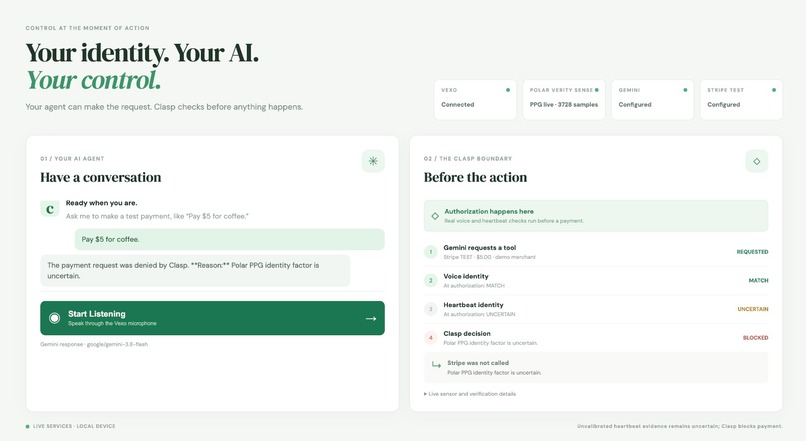
AgentControl Dashboard
-
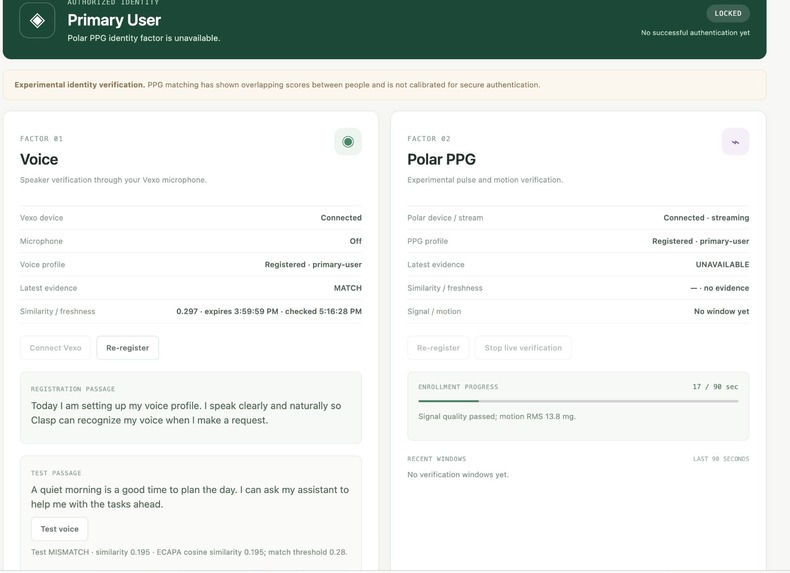
User Biometric registration
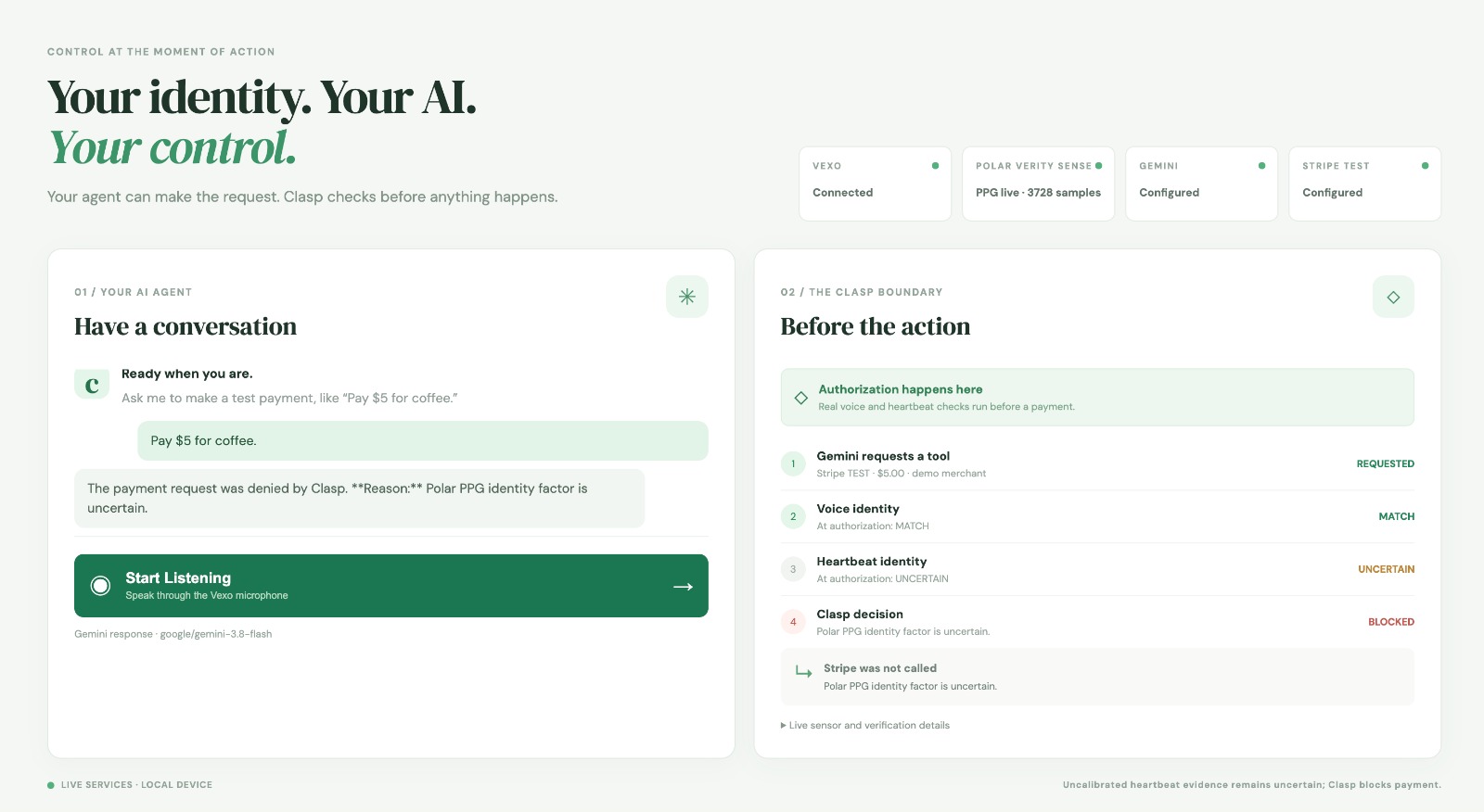
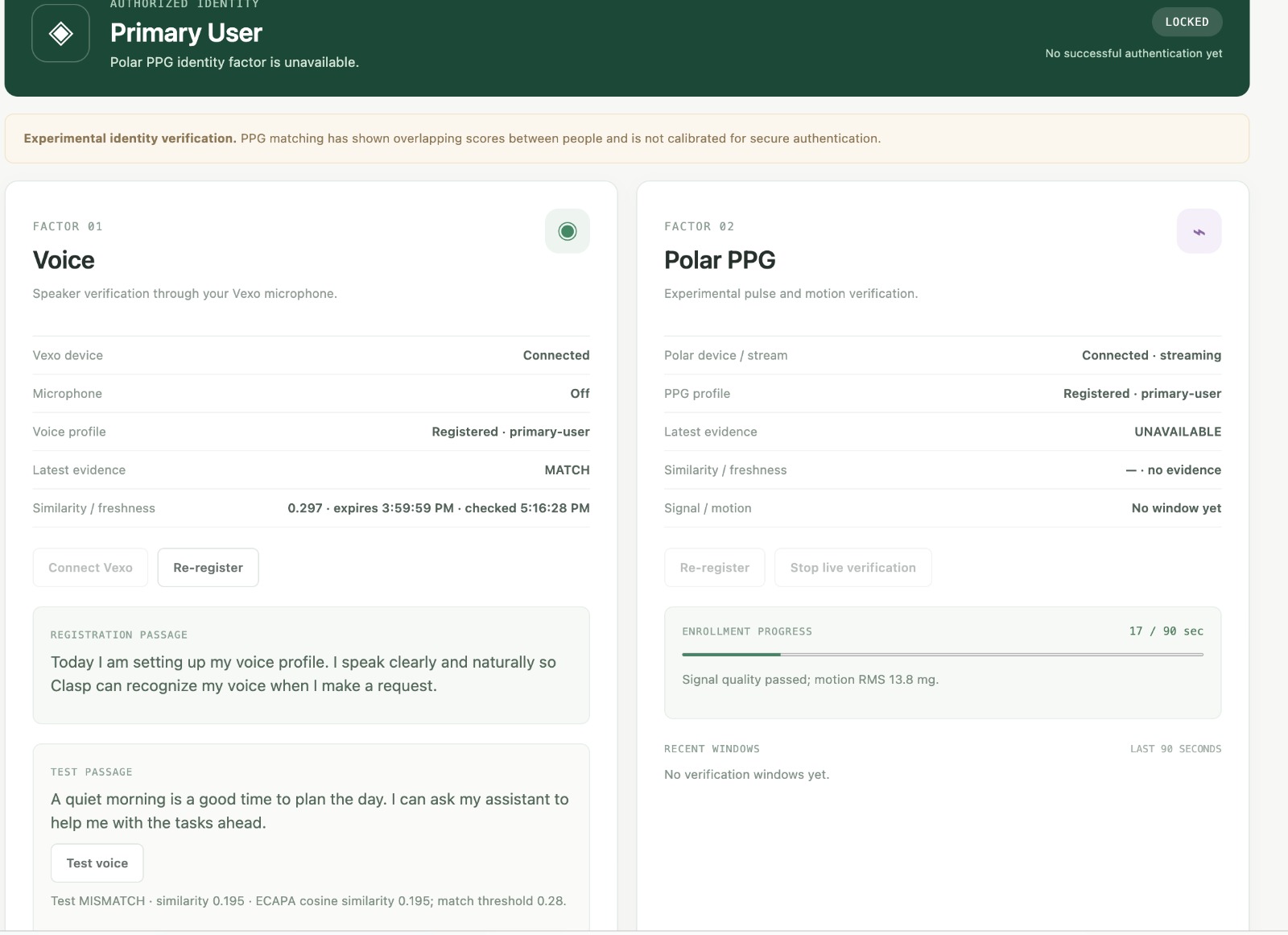
Clasp — Permission has a pulse. Your presence powers AI.
Inspiration
AI agents are moving beyond answering questions. They can now execute tools, access personal information, and perform actions on our behalf.
But that introduces a fundamental problem:
How does an AI agent know that the person asking it to take an action is actually you?
Most AI assistants rely on authenticated sessions. Once someone gains access to that session, the agent may have no reliable way to distinguish the account owner from someone else using it.
We wanted to explore a different approach: What if your AI agent could recognize you through wearable devices and use your identity and presence to determine whether it should act?
That idea became Clasp, a biometric identity and authorization layer for AI agents.
Our vision is simple: Permission has a pulse. Your presence powers AI.
What It Does
Clasp explores a new approach to AI agent security: connecting an agent's permissions to the identity and presence of the human behind it.
Instead of relying solely on a one-time login, Clasp brings together two independent biometric signals:
Voice Identity: A wearable microphone captures speech, while a pretrained speaker recognition model compares it against the enrolled user's voice profile.
Heartbeat Identity: A wearable optical sensor captures photoplethysmography (PPG) signals. A pretrained physiological foundation model generates embeddings from pulse waveforms to evaluate their similarity to the enrolled user's profile.
Our goal is to combine these signals into a unified identity decision that can determine whether an AI agent is authorized to execute sensitive actions.
Being logged in shouldn't automatically mean being authorized to act.
Clasp introduces an authorization checkpoint between an AI agent's requested action and the tool that executes it.
Our current prototype demonstrates this authorization boundary using a simulated identity session, alongside separately developed biometric verification components using real wearable data.
Together, these components establish the foundation for identity aware AI agents, where permissions are tied to the human they represent rather than simply an active session.
How We Built It
We brought together wearable technology, pretrained machine learning models, and AI agent authorization to explore how biometric identity could become part of autonomous AI systems.
1. Wearable Biometric Capture
We worked with two wearable biometric modalities:
Vexo Wearable Microphone: Captures speech for voice-based identity verification.
Polar Verity Sense: Captures PPG pulse waveforms and accelerometer data for physiological identity experiments.
We developed a Python integration for the Polar sensor to capture physiological signals over Bluetooth.
We also incorporated motion aware signal quality checks to help distinguish usable recordings from measurements affected by movement.
2. Biometric Identity Models
Rather than training models from scratch, we explored pretrained models capable of extracting meaningful identity related features.
Voice Verification — SpeechBrain ECAPA-TDNN
We used a pretrained speaker recognition model to generate voice embeddings and compare them against an enrolled voice profile.
Heartbeat Verification — PaPaGei-P
We evaluated PaPaGei, a pretrained physiological representation model, to extract embeddings from PPG recordings and compare them against an enrolled physiological profile.
We also implemented a handcrafted feature-based baseline to evaluate alternative approaches.
Both modalities explore different aspects of human identity, with the long-term goal of combining them into a more robust verification system.
3. Biometric Identity Experiments
We designed a guided sensor placement experiment to understand how real-world wearing conditions affect biometric verification.
Our experiments included:
- Capturing PPG and accelerometer signals from the Polar Verity Sense.
- Evaluating signal quality and motion-related interference.
- Comparing biometric similarity scores across sensor placements.
- Investigating whether genuine-user recordings could be distinguished from impostor recordings.
We found that biometric similarity varied with sensor placement, and some genuine-user and impostor scores overlapped.
These findings helped us identify important limitations in applying pretrained physiological models to identity verification.
4. AI-Agent Authorization Layer
We built an authorization checkpoint that operates immediately before a protected AI-agent tool executes.
The architecture separates three responsibilities:
- AI Agent: Determines which action it wants to perform.
- Clasp Authorization Layer: Evaluates whether the requested action is authorized.
- Protected Tool: Executes only after the authorization checkpoint permits it.
We integrated a Gemini powered AI agent with a protected Stripe test mode tool to demonstrate this architecture.
This architecture is designed to be extensible across different AI agents and sensitive tools, rather than being limited to any single application.
5. Identity Dashboard
We developed a dashboard to make authorization decisions visible and understandable.
The interface provides visibility into authorization state, protected actions, and execution outcomes.
An audit trail records authorization requests, decisions, and their reasons during the demonstration.
Our goal is to eventually bring wearable connectivity, biometric confidence, and agent authorization into a unified, observable experience.
Challenges We Faced
1. Making Heartbeat Identity Reliable
One of our biggest challenges was discovering that clean physiological recordings don't necessarily translate into reliable biometric identity verification.
During testing, PPG similarity scores varied across sensor placements, and genuine-user and impostor scores sometimes overlapped.
This revealed an important insight:
A model that understands physiological patterns is not automatically a reliable identity authenticator.
Our initial experiments were limited in scale, highlighting the need for broader datasets, stronger enrollment methods, and further validation.
2. Distinguishing Voice Identity From Live Presence
Our voice experiments highlighted another challenge: recognizing someone's voice doesn't necessarily prove that the person is physically present.
Recorded speech may still be recognized as belonging to an enrolled speaker.
This reinforced the importance of incorporating liveness detection and spoofing resistance into future biometric authorization systems.
3. Bringing Wearable Hardware and AI Together
Integrating real wearable sensors introduced challenges involving Bluetooth connectivity, signal quality, sensor placement, and reliable data capture.
We encountered unexpected behavior during Polar sensor streaming and resolved it by investigating the SDK and testing individual sensor streams.
This experience reinforced the importance of reliable hardware integration when building systems that depend on real-world physiological data.
4. Separating AI Autonomy From Human Authorization
One of our most important design challenges was determining where an AI agent's autonomy should end and human authorization should begin.
An agent can decide which action to perform, but it shouldn't independently decide whether it has permission to execute that action.
We addressed this by designing an independent authorization checkpoint at the tool-execution boundary.
The result is an architecture where an agent's capability to act is separate from its authority to act.
Accomplishments That We're Proud Of
Designed a human centered identity layer for AI agents: Explored how wearable biometrics could connect autonomous AI permissions to the identity and presence of the user.
Built an independent authorization checkpoint: Demonstrated how an AI agent's tool execution can be governed by a separate authorization layer.
Integrated real wearable hardware: Developed a Python integration for capturing physiological signals from the Polar Verity Sense.
Implemented biometric verification experiments: Explored voice identity using SpeechBrain ECAPA-TDNN and heartbeat identity using PaPaGei, alongside a handcrafted PPG baseline.
Built an observable AI-agent prototype: Connected a Gemini-powered agent to a protected demonstration tool and developed a dashboard for monitoring authorization decisions.
Investigated real-world biometric limitations: Evaluated sensor placement, signal quality, and identity similarity rather than assuming pretrained models would automatically provide reliable authentication.
What we're most proud of is bringing together wearable technology, biometric AI, and agent authorization to explore a problem that will become increasingly important as AI agents gain more autonomy.
What We Learned
Building Clasp taught us three important lessons.
First, identity matters at the moment an AI agent acts.
An authenticated session doesn't necessarily establish that the rightful user is still present or authorizing a particular action.
Second, biometric recognition and biometric security are not the same thing.
Voice and heartbeat signals offer interesting opportunities for identity verification, but each must be evaluated for reliability, spoofing resistance, and real world usability.
Third, pretrained models are a starting point, not a security guarantee.
Foundation models make sophisticated biometric experiments possible without training models from scratch. However, their representations require careful validation before being used for security-sensitive decisions.
Most importantly:
An AI agent's ability to perform an action is not the same as having permission to perform it.
What's Next for Clasp
Our next goal is to connect Clasp's biometric verification components with its AI-agent authorization layer.
We plan to:
Unify biometric identity verification: Connect voice and heartbeat identity signals to the authorization checkpoint.
Improve heartbeat recognition: Evaluate larger datasets, multiple users, and different wearing sessions.
Strengthen liveness detection: Explore methods to detect recorded speech, wearable handoffs, and potential spoofing attempts.
Expand AI-agent compatibility: Extend Clasp's authorization model across different AI agents, tools, and applications.
Improve security and observability: Strengthen authorization enforcement, credential isolation, and persistent audit logging.
Refine the user experience: Explore how biometric authorization can remain secure without interrupting legitimate agent workflows.
Our long term vision is to make Clasp a reusable identity and authorization layer for autonomous AI agents, where human presence and identity remain central to an agent's authority.
The future of AI agents isn't just about what they can do. It's about knowing who they're doing it for.
Built With
- bluetooth-low-energy-(ble)
- ecapa-tdnn
- gemini-api
- google-gemini
- html
- javascript
- node.js
- numpy
- papagei
- polar-verity-sense
- python
- pytorch
- scipy
- speechbrain
- stripe
- typescript
- vexo
