-
-
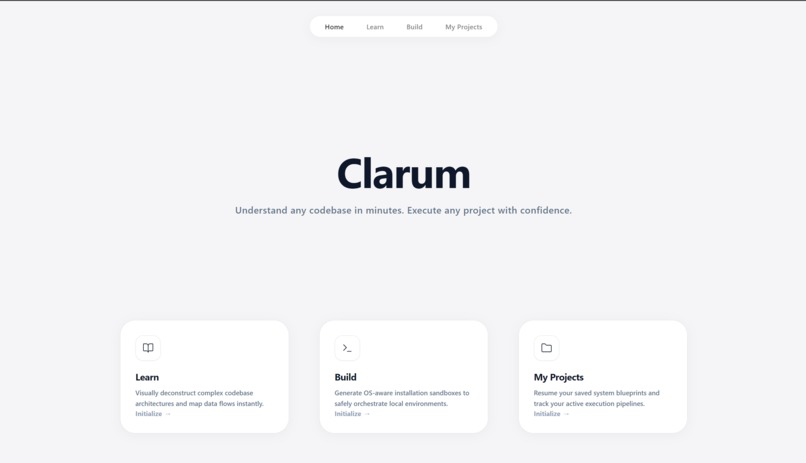
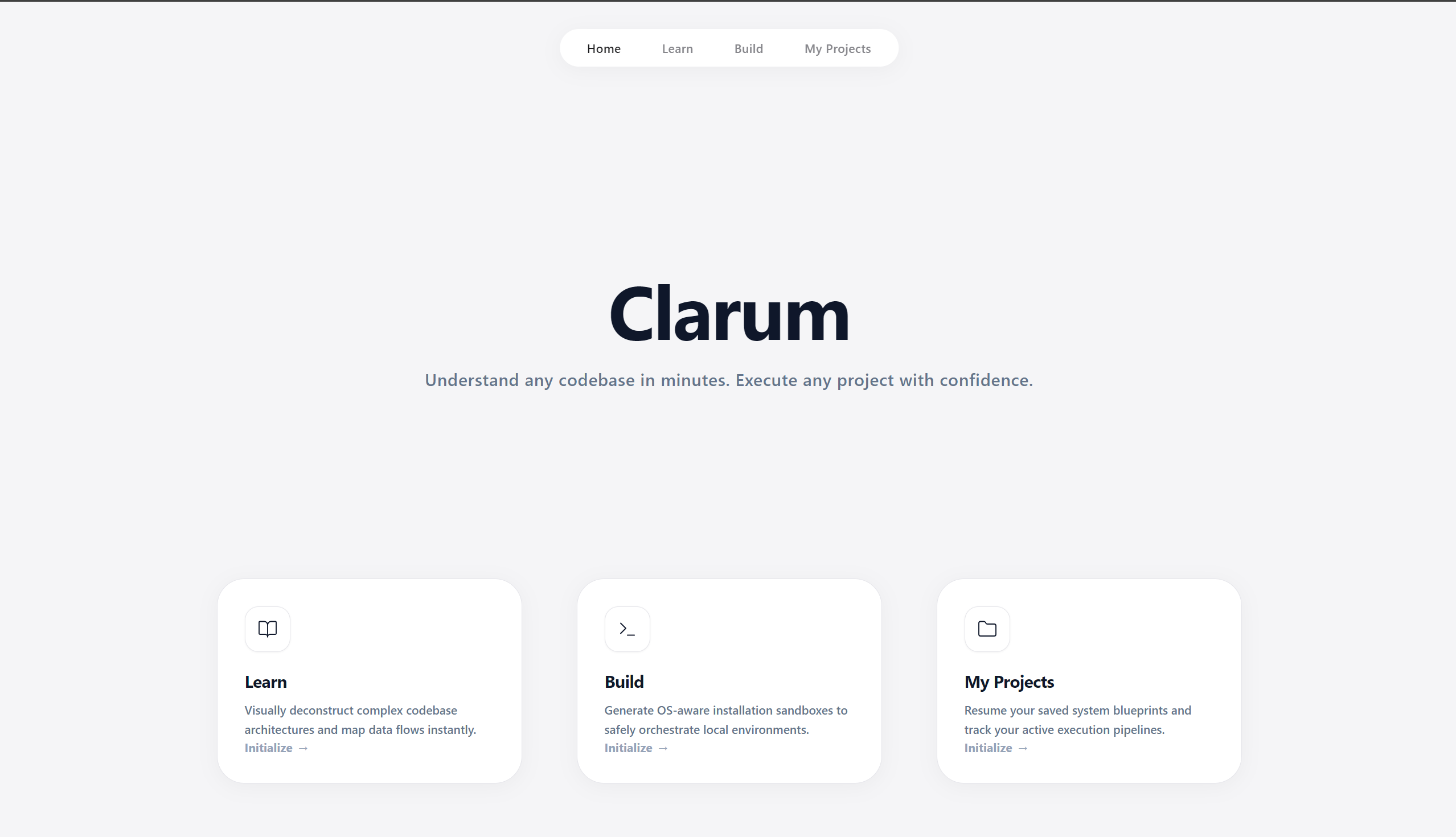
Home Page
-
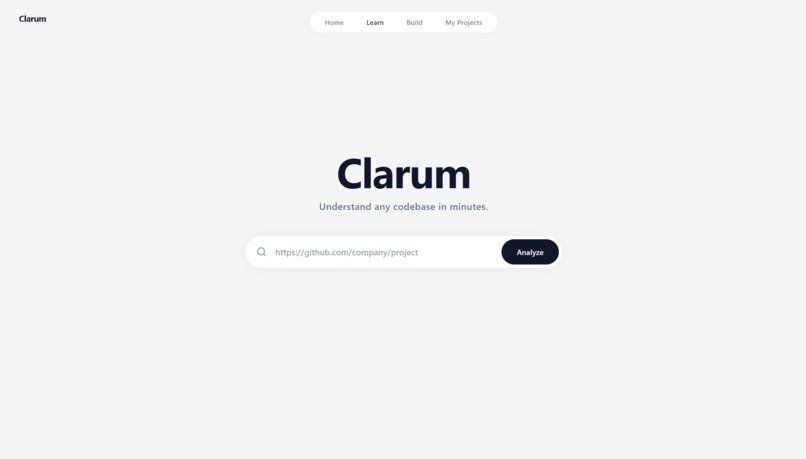
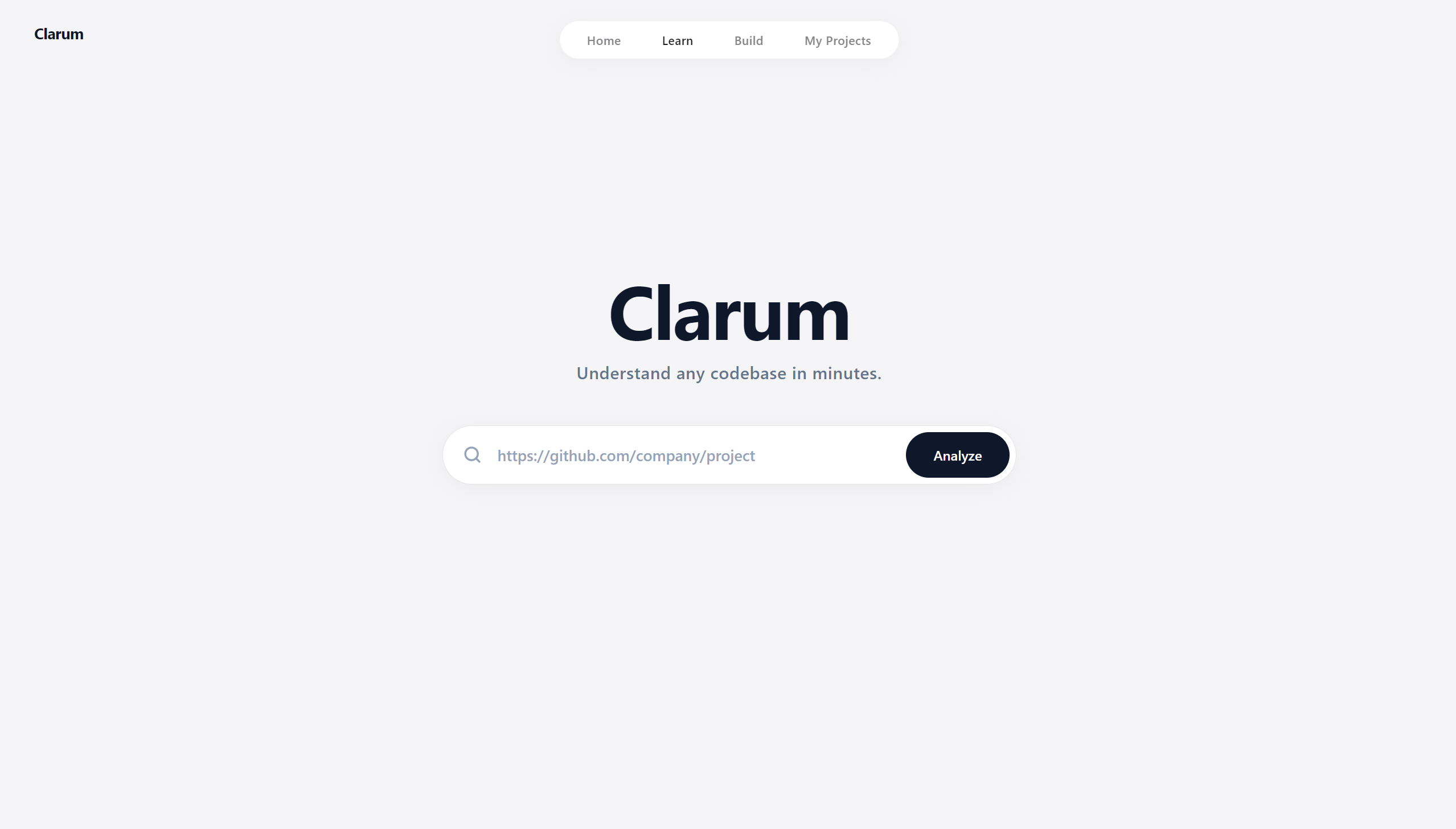
Learn Page
-
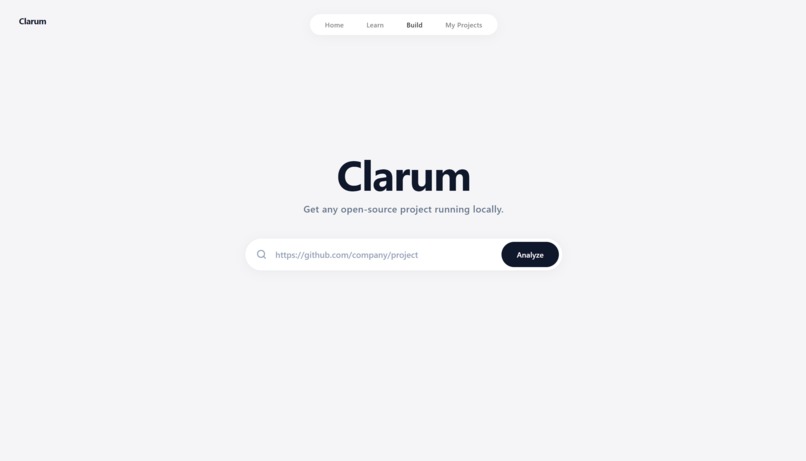
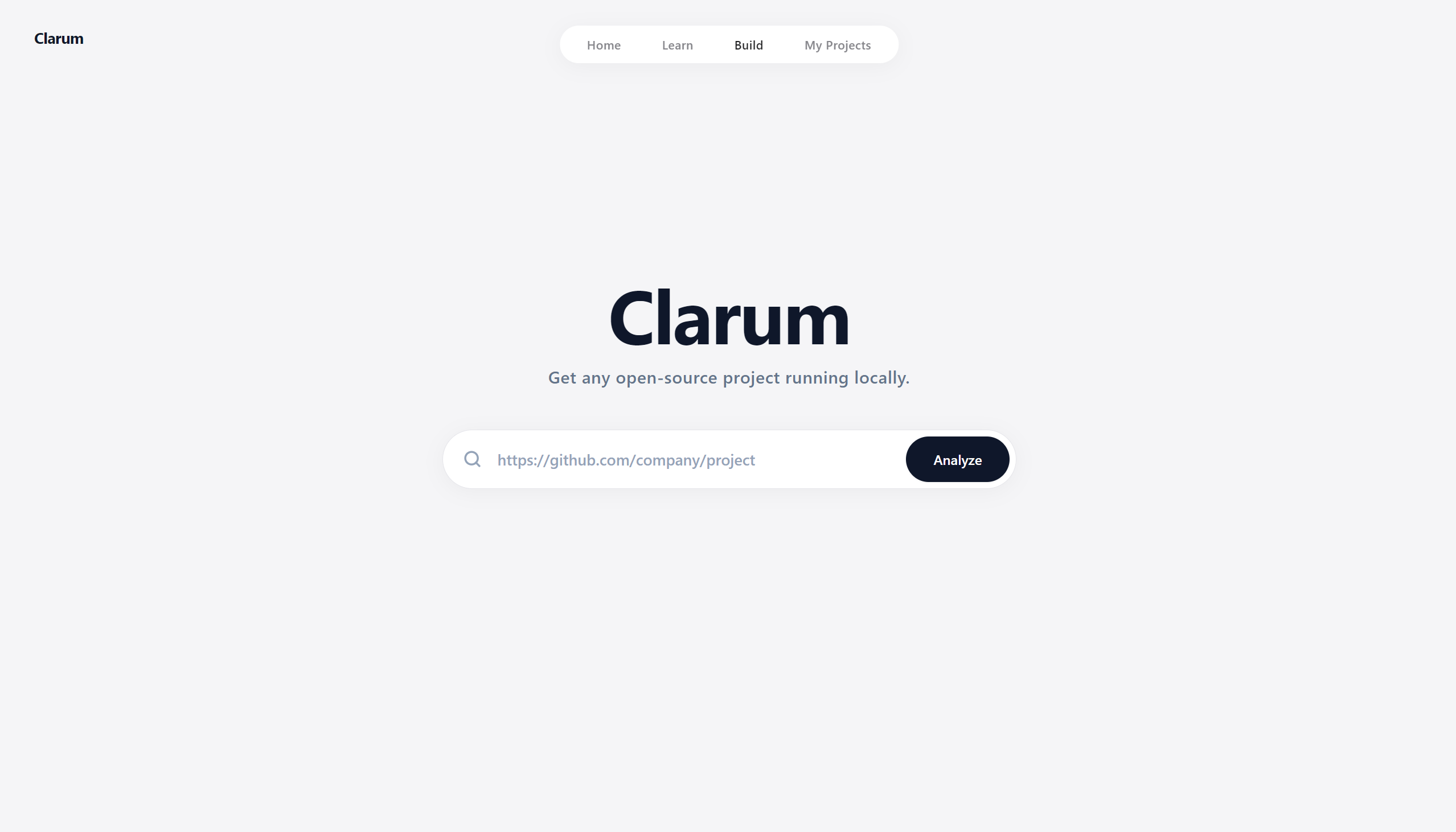
Build Page
-
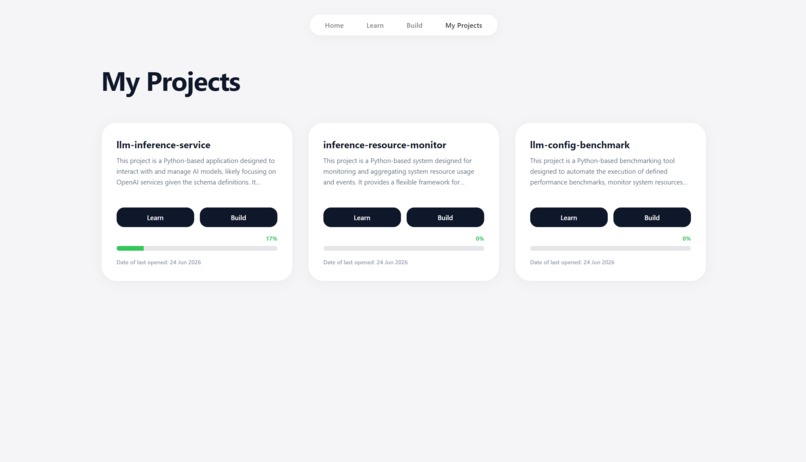
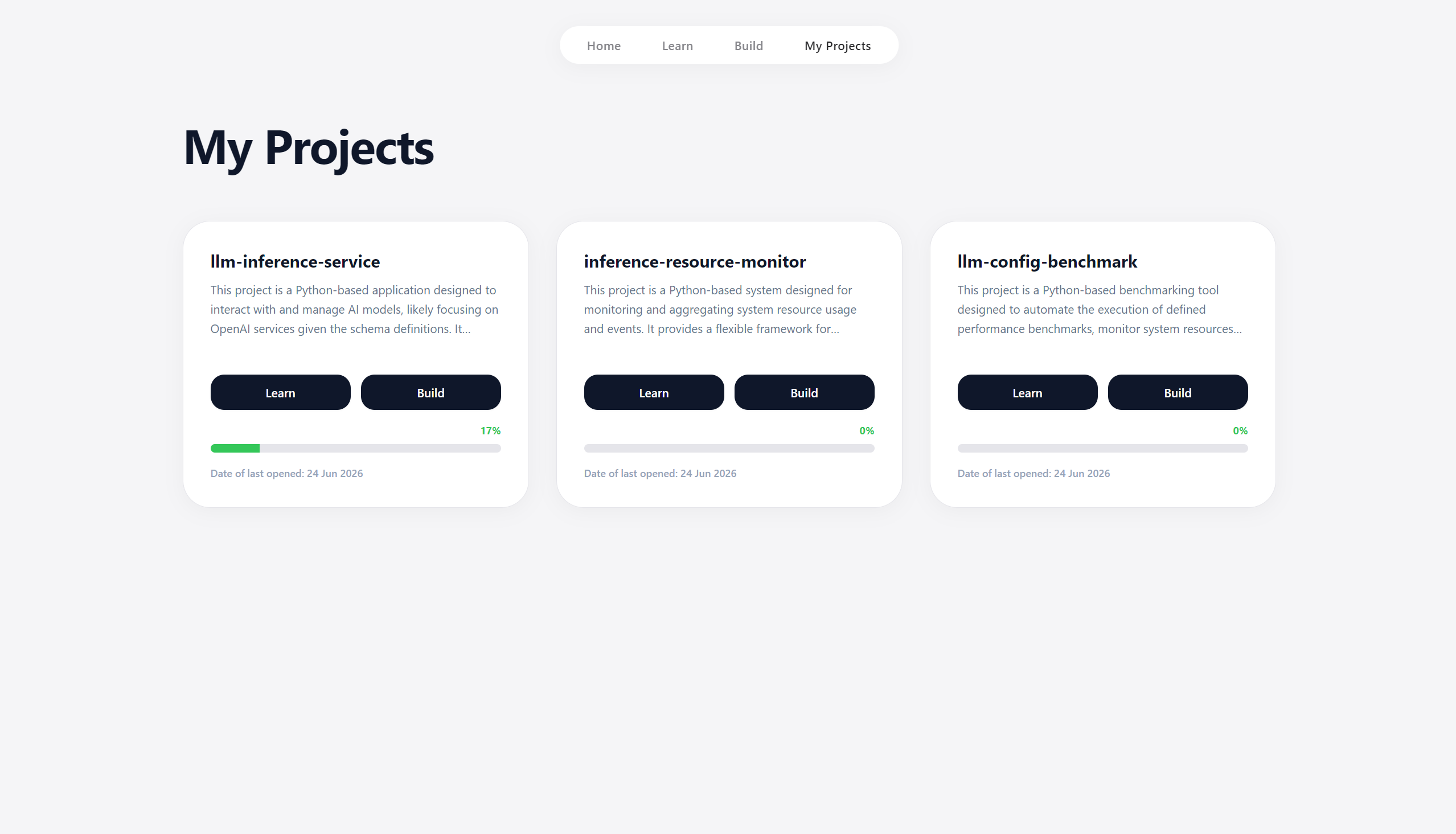
My Projects Page
Inspiration
Open source has changed the world. Some of the best software available today is free, community-driven, and only a GitHub link away. Yet for millions of people, it remains inaccessible.
Whether you're a student, a hobbyist, or someone simply curious about trying a project, you're often met with unfamiliar code, installation guides, and technical jargon before you ever get to use the software.
Clarum was built around one simple belief:
Open source belongs to everyone.
Our goal is to bridge the gap between people and open-source software by making repositories understandable, approachable, and runnable—regardless of someone's technical background.
What it does
Clarum transforms any public GitHub repository into an interactive onboarding experience.
Simply paste a repository URL, and Clarum automatically generates:
- A Mission Brief explaining what the project does.
- A System Blueprint visualizing how the repository is connected.
- A Guided Learning Path showing where to begin and why.
- A personalized installation protocol with project-specific requirements, troubleshooting, and progress tracking.
Instead of expecting users to understand an unfamiliar codebase first, Clarum builds that understanding for them.
How we built it
Clarum uses a React + Vite frontend with a FastAPI backend.
When a repository is submitted, GitPython clones the repository locally. The backend analyzes the project structure, extracts meaningful files, builds dependency relationships, and gathers metadata about the codebase.
This structured information is then provided to Gemini 2.5 Flash, which generates consistent JSON outputs describing the project's architecture, learning path, installation workflow, and onboarding experience.
On the frontend, React Flow visualizes dependency graphs, while Tailwind CSS and Framer Motion provide a clean, minimal interface focused on clarity rather than complexity.
Challenges we ran into
The biggest challenge wasn't generating AI responses—it was designing an experience that people could actually follow.
Large repositories naturally contain hundreds or thousands of files, making it easy to overwhelm users with information.
We spent most of our time refining the interface so every page answered a single question:
- What is this?
- How does it work?
- Where do I begin?
- How do I run it?
Keeping the experience simple while still presenting meaningful technical information became the hardest design challenge.
Accomplishments that we're proud of
We're proud that Clarum feels like a complete product rather than a collection of AI features.
Every page is generated directly from the repository itself—from the mission brief and dependency graph to the learning path and installation protocol.
Most importantly, Clarum demonstrates that AI can be used to reduce the barrier to open source instead of simply generating text.
What we learned
One of the biggest lessons from this project was that AI performs far better when reasoning over structured information instead of raw source code.
Rather than asking a language model to understand an entire repository, we first perform deterministic analysis, extract meaningful relationships, and then ask the model to explain those relationships.
This produced significantly more reliable and consistent results while keeping the overall experience intuitive.
What's next for Clarum
This prototype proves the concept, but there is plenty of room to grow.
Future versions will support additional programming languages, richer dependency analysis, interactive learning experiences, automatic command execution where appropriate, and more intelligent installation workflows.
Ultimately, we want Clarum to become the easiest way for anyone to discover, understand, and use open-source software.
Judge Notes
To ensure reliable evaluation during judging, two repositories are bundled into Clarum's local cache.
If external AI services experience downtime, API quota limits, or temporary rate limiting, the complete onboarding experience—including the Mission Brief, System Blueprint, Guided Learning Path, and Installation Protocol—will continue to function for the following repositories:
- https://github.com/BlazeeeXD/llm-inference-service
- https://github.com/BlazeeeXD/llm-config-benchmark
These repositories are fully pre-analyzed and demonstrate the complete Clarum workflow without relying on live API requests.
Built With
- axios
- dagre
- fastapi
- framer-motion
- github
- gitpython
- google-gemini-2.5-flash
- networkx
- pydantic-v2
- python-3.12
- react-18
- react-flow
- render
- sqlalchemy
- sqlite
- tailwind-css
- uvicorn
- vercel
- vite


Log in or sign up for Devpost to join the conversation.