Inspiration
Claro started from a real family problem. Bryan’s dad had been paying for insurance for years, but when hospital bills came, the coverage did not work the way the family expected. The painful part was not just the bill. It was realizing that the gaps were already inside dense documents and conversations that were hard to understand before signing. We built Claro for that moment before someone acts on financial advice.
What it does
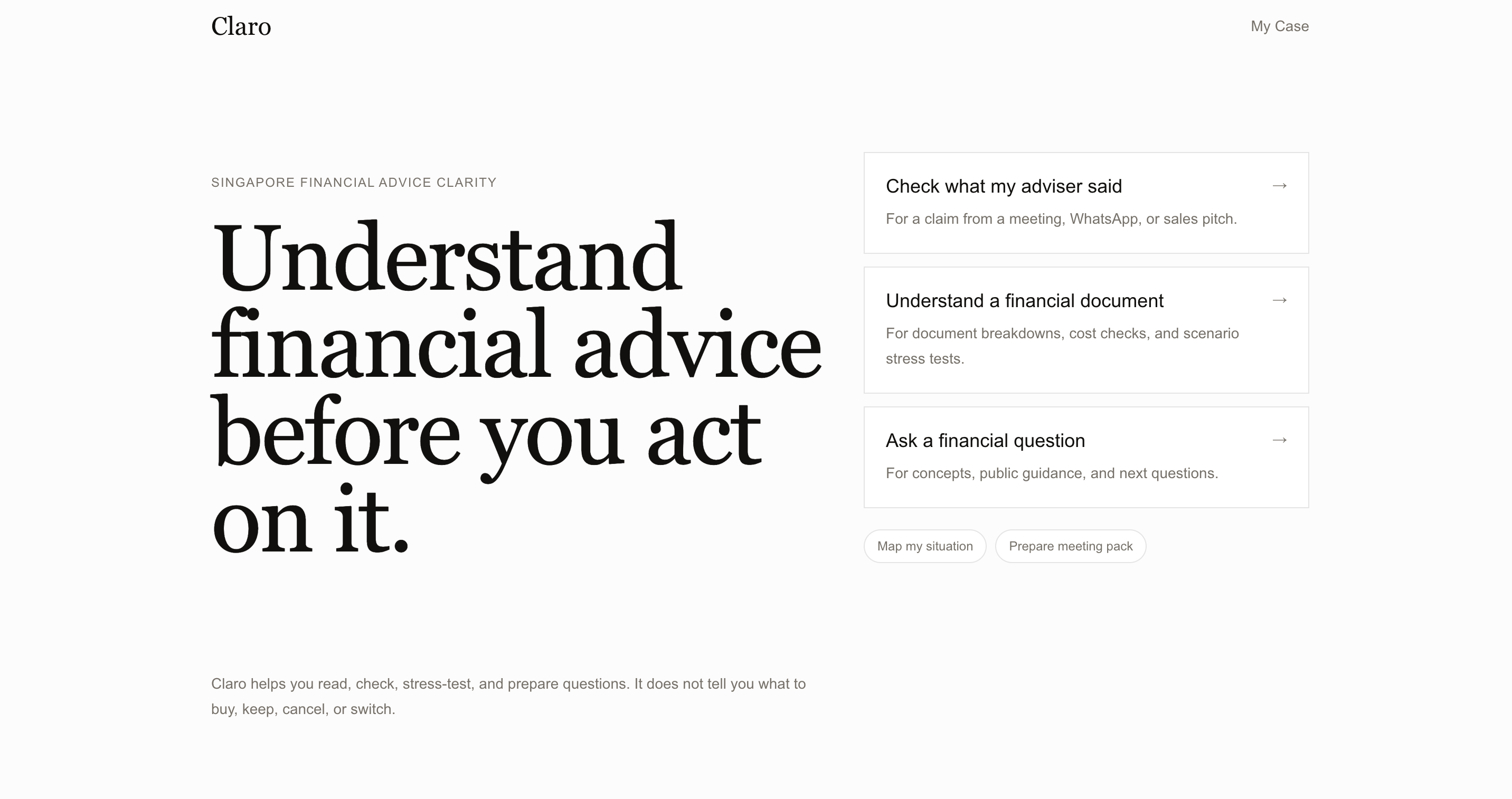
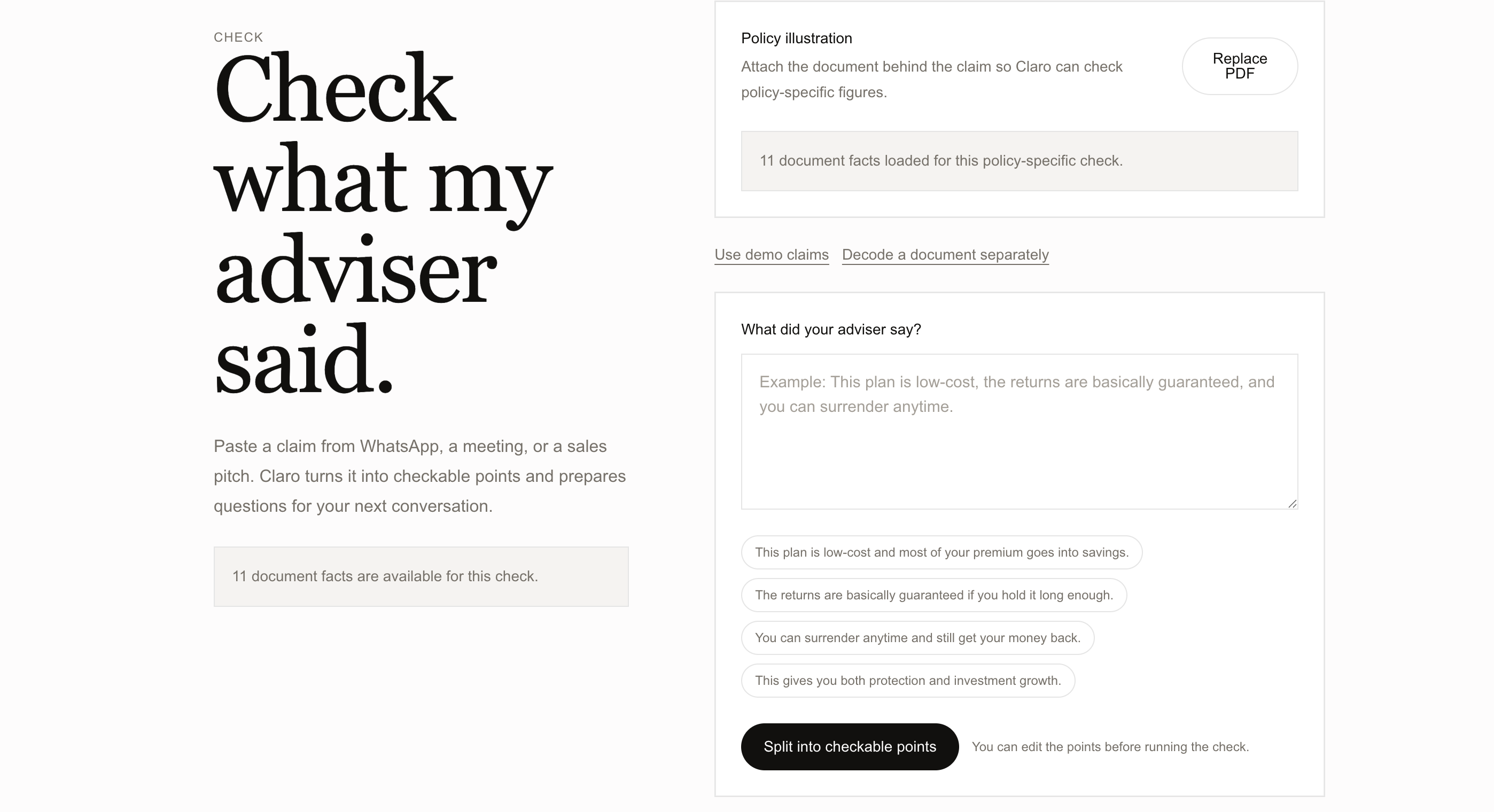
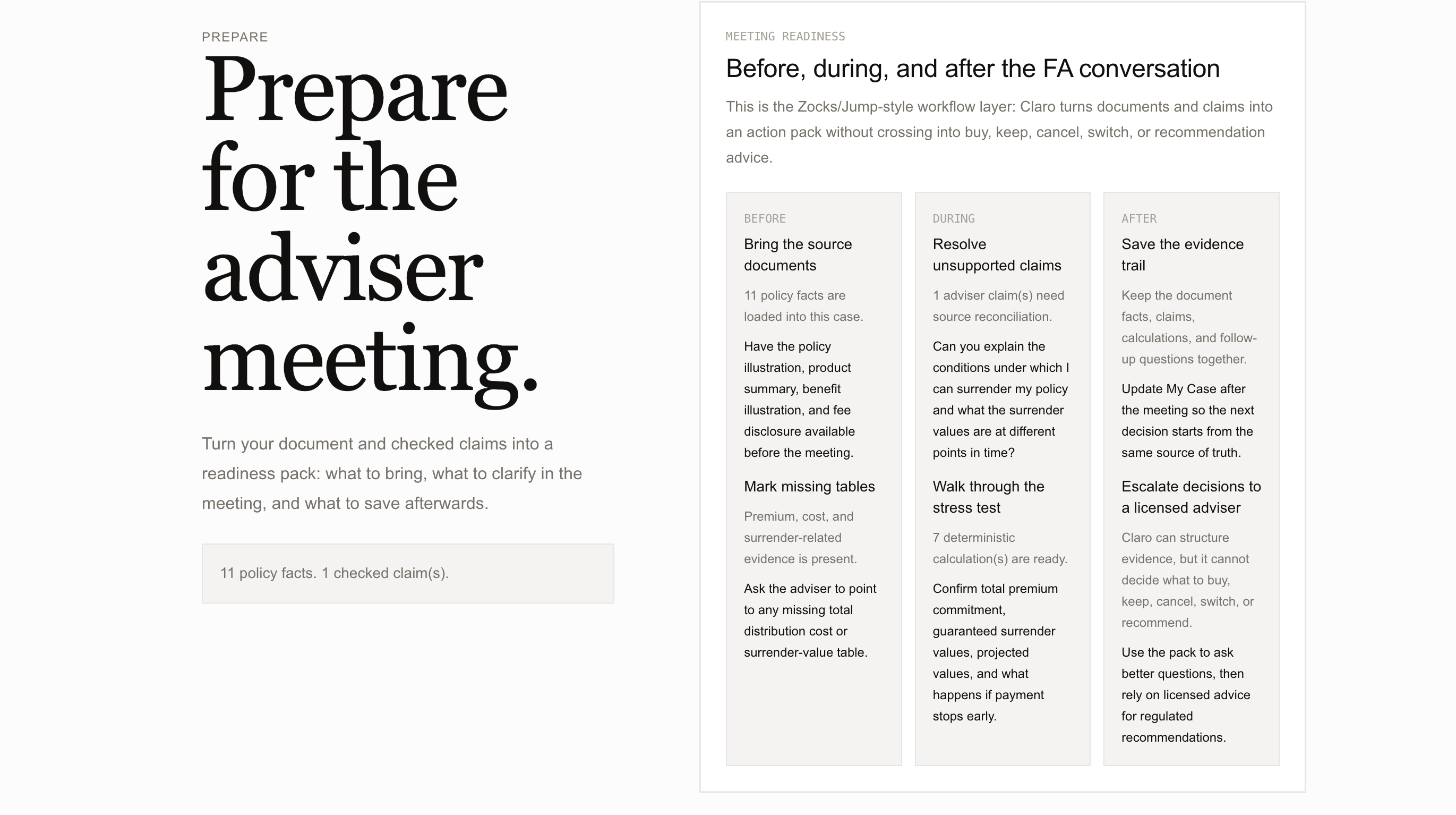
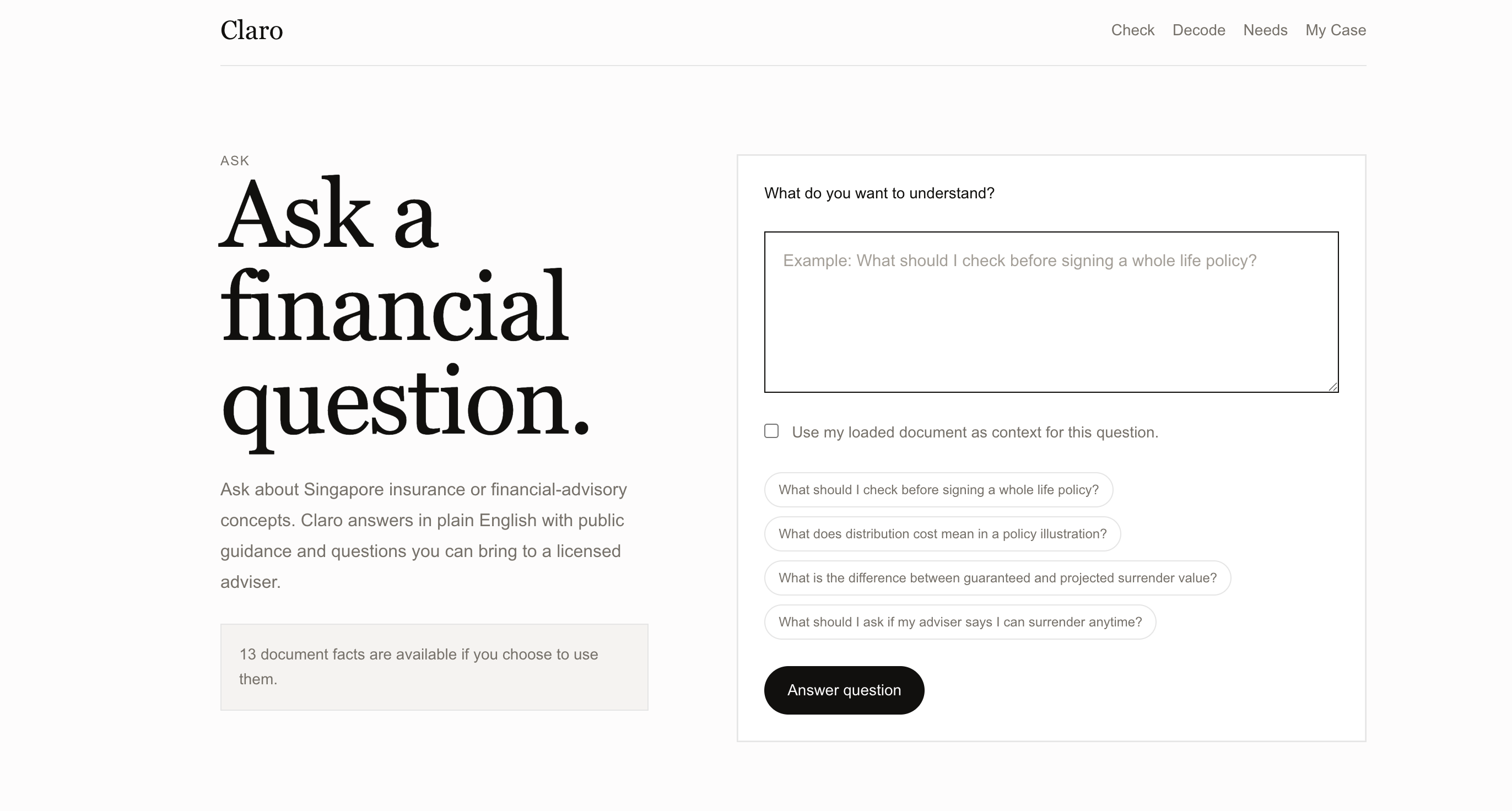
Claro helps Singapore consumers understand financial advice before they act on it. Users can upload a policy illustration, check what an adviser said, ask financial-advisory questions, and prepare better questions for a licensed adviser.
Claro extracts document facts, runs deterministic calculations, compares adviser claims against evidence, and explains financial concepts in plain English. It does not recommend what to buy, keep, cancel, switch, or surrender.
How we built it
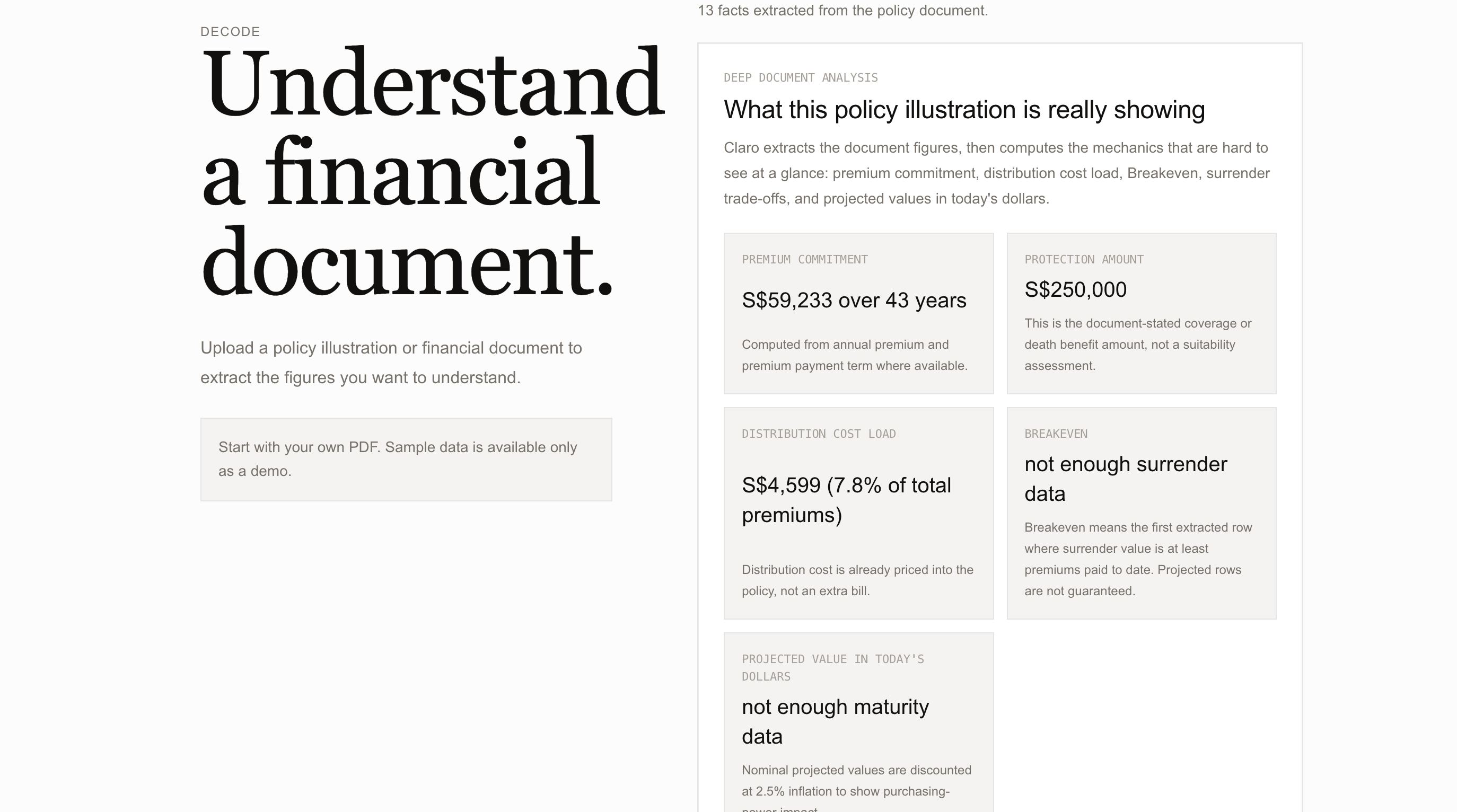
We built Claro as a Next.js app with AI-powered document and language understanding. Policy illustrations are parsed into structured facts, then key figures like premium commitment, distribution cost load, surrender mechanics, and projected versus guaranteed values are calculated in code.
The product also includes a compliance boundary: Claro stays on facts, calculations, explanations, and questions for licensed advisers instead of giving regulated financial advice.
Challenges
The hardest part was balancing usefulness with compliance. A generic chatbot can easily drift into advice, so we had to design Claro as an evidence workflow rather than a recommendation engine.
We also had to make dense insurance documents feel understandable without overwhelming the user. That shaped the final product around three simple routes: check what my adviser said, understand a financial document, and ask a financial question.
What we learned
We learned that the best AI products in regulated spaces are not just wrappers around a model. They need structure, guardrails, deterministic calculations, and a clear user workflow.
For Claro, the key insight was simple: consumers do not always need an AI to decide for them. Often, they just need help understanding what was said, what the document actually says, and what to ask next.
What it does
CLARO helps Singapore consumers understand financial advice before they act on it. Users can upload a policy illustration, check what an adviser said, ask financial-advisory questions, and prepare better questions for a licensed adviser.
The project was inspired by a real experience from Bryan’s family. His dad had been paying for insurance for years, but when hospital bills came, the coverage did not work the way the family expected. CLARO is built for that moment before someone signs, when they need to understand what the document actually says.
How we built it
We built CLARO as a Next.js app with AI-powered document and language understanding. Policy illustrations are parsed into structured facts, then key figures like premium commitment, distribution cost load, surrender mechanics, and projected versus guaranteed values are calculated in code.
We also built a compliance boundary into the product. CLARO can explain, extract, compare, calculate, and prepare questions, but it does not recommend what to buy, keep, cancel, switch, or surrender.
Challenges we ran into
The hardest challenge was making CLARO useful without crossing into regulated financial advice. A generic chatbot can easily drift into recommendations, so we designed CLARO as an evidence workflow instead of an advice engine.
We also had to make dense insurance documents understandable without overwhelming the user. That led us to the three-route structure: check what my adviser said, understand a financial document, and ask a financial question.
Accomplishments that we're proud of
We are proud that CLARO became more than a PDF summarizer. It extracts real policy facts, runs deterministic calculations, checks adviser claims against evidence, and turns the result into questions users can bring to a licensed adviser.
We are also proud of the product framing. CLARO gives consumers more confidence in financial-advisory conversations while respecting the role of licensed advisers.
What we learned
We learned that strong AI products in regulated spaces need more than model output. They need structure, source-backed reasoning, deterministic calculations, and clear safety boundaries.
We also learned that consumers do not always need AI to decide for them. Often, they need help understanding what was said, what the document actually says, and what to ask next.
What's next for CLARO
Next, we want CLARO to become a broader financial-advice clarity workspace for Singapore consumers. The first wedge is pre-signing clarity for insurance policies, but the same workflow can expand into policy vaults, annual reviews, family coverage maps, and meeting preparation.
Over time, CLARO can become the place people go before making high-stakes financial-advisory decisions.
Built With
- css
- github
- javascript
- next.js
- openai-api
- pdf.js
- react
- render
- typescript
- vercel

Log in or sign up for Devpost to join the conversation.