-
-
Clarity Report
-
Clarity Report
-
Novus Dashboard Proof
-
landing page
Inspiration
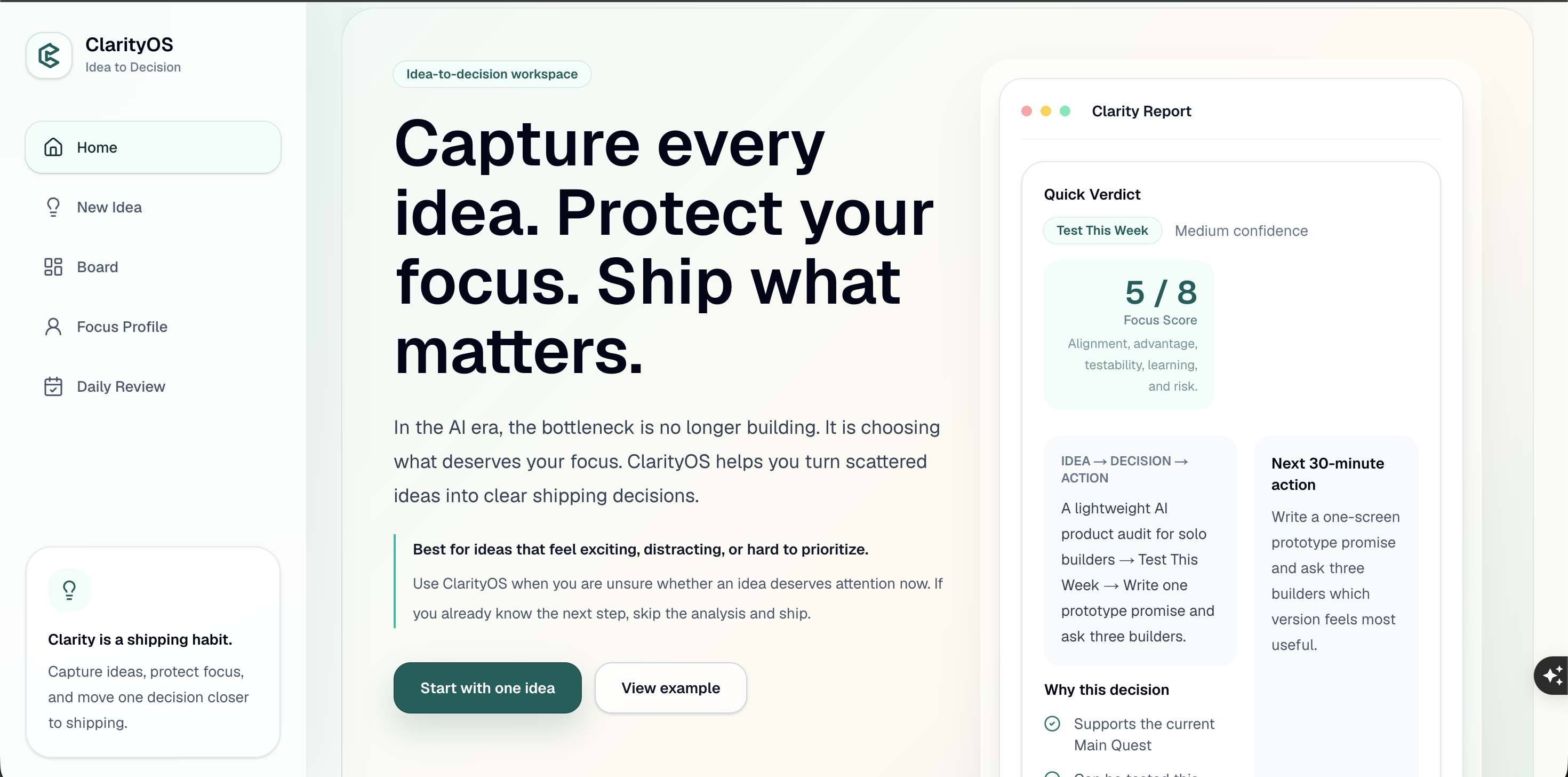
In the AI era, building is becoming easier than ever. With AI tools, solo builders can prototype websites, apps, and products much faster than before.
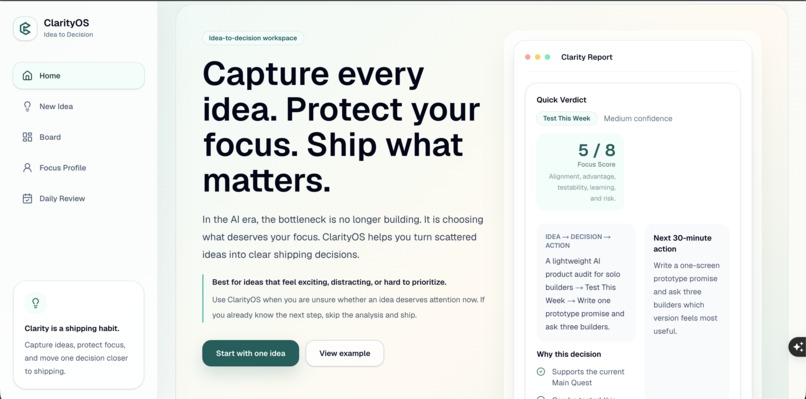
But this creates a new problem: the bottleneck is no longer only building. The harder question is choosing what actually deserves your focus.
Many builders, creators, and students have too many ideas. Every idea feels exciting, but not every idea deserves immediate action. This often leads to overthinking, scattered energy, and unfinished projects.
ClarityOS was inspired by this problem. I wanted to build a simple decision layer between idea capture and execution, so a person can turn one messy idea into a clear decision and a smallest next action.
What it does
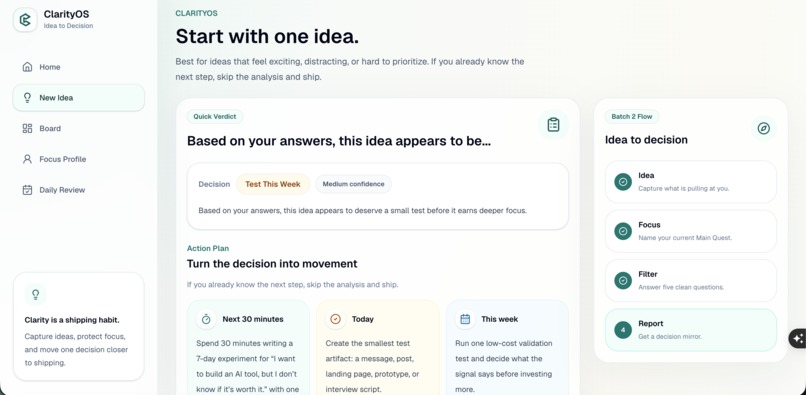
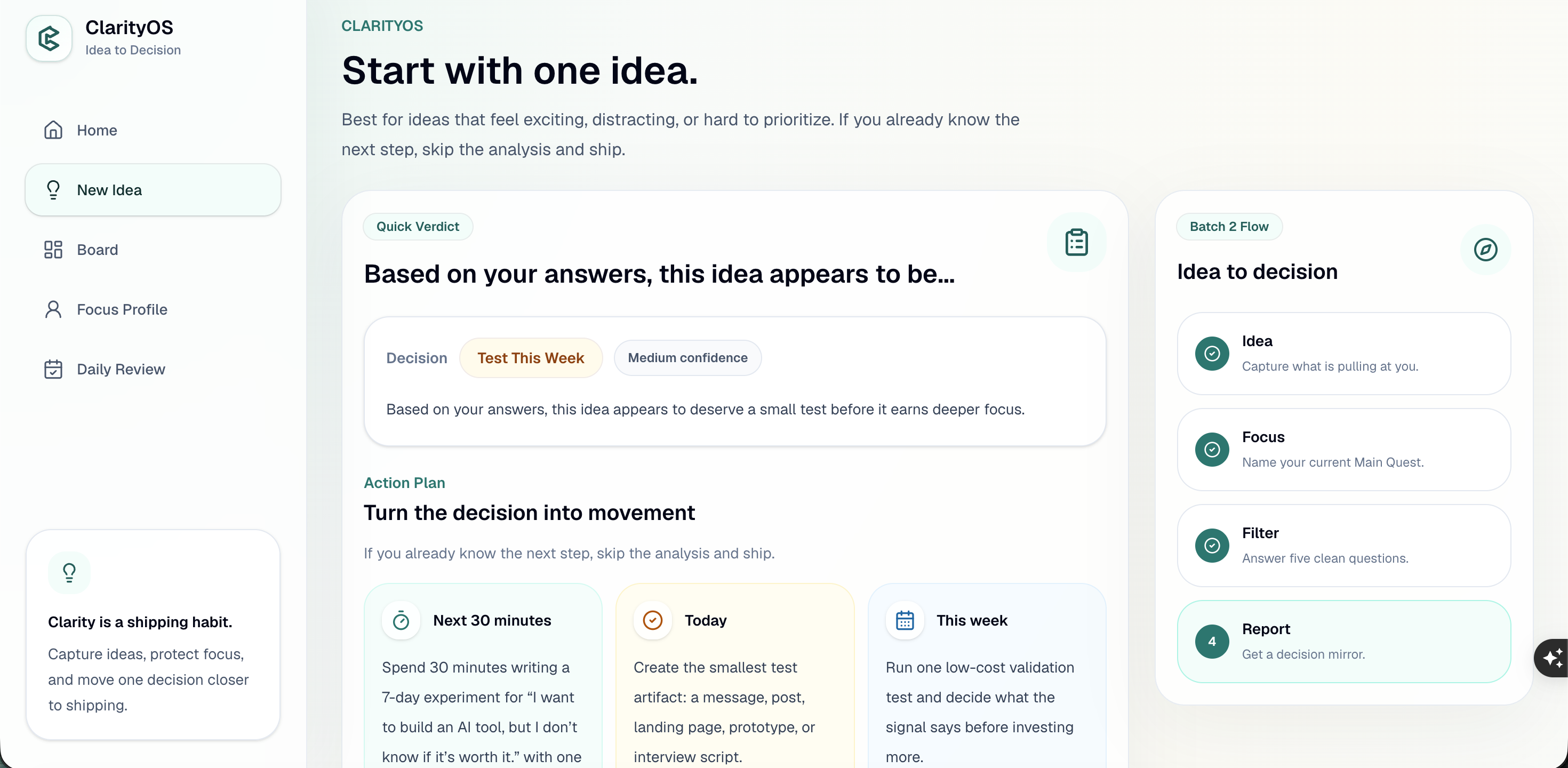
ClarityOS helps users evaluate one idea against their current focus and turn it into an actionable next step.
The core flow is:
- Capture one idea.
- Choose a current focus or Main Quest.
- Answer five lightweight Focus Filter questions.
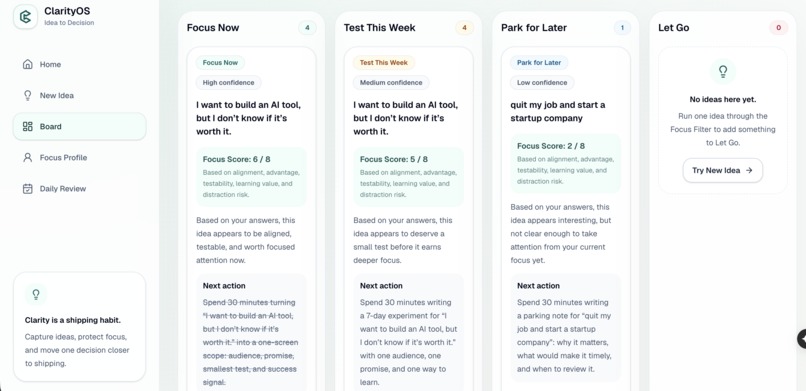
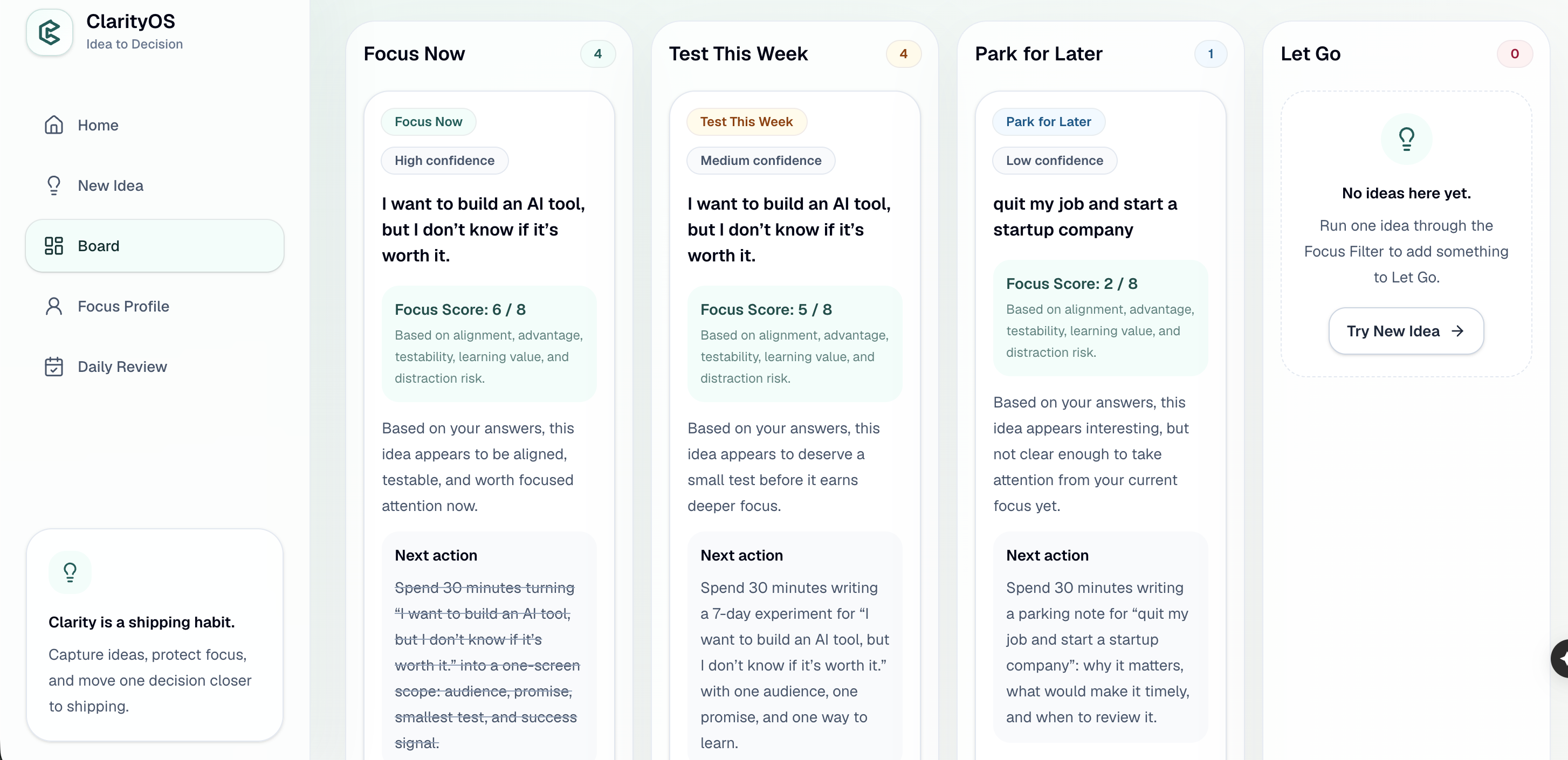
- Receive a decision: Focus Now, Test This Week, Park for Later, or Let Go.
- Get an action plan for the next 30 minutes, today, and this week.
- Save the idea to the Clarity Board.
The Clarity Board helps users organize their ideas by decision category. Users can complete the next action, move ideas between categories, reopen actions, or delete ideas.
ClarityOS also includes two optional support loops:
The Focus Profile helps users define their Main Quest, top priorities, Not-To-Do List, and decision rule, so future ideas can be judged with better context.
The Daily Review helps users reflect on what they completed, what distracted them, and what deserves focus tomorrow.
The goal is not to store more notes. The goal is to help users protect their focus and ship what matters.
How we built it
ClarityOS was built as a web app using Next.js, React, TypeScript, and Tailwind CSS.
The app uses a localStorage-first approach so users can save their Focus Profile, Clarity Board, and Daily Reviews directly in the browser without requiring an account.
The project was deployed on Vercel.
I used Codex as an AI development assistant to help structure the product, implement the core flows, polish the interface, and prepare the final submission materials.
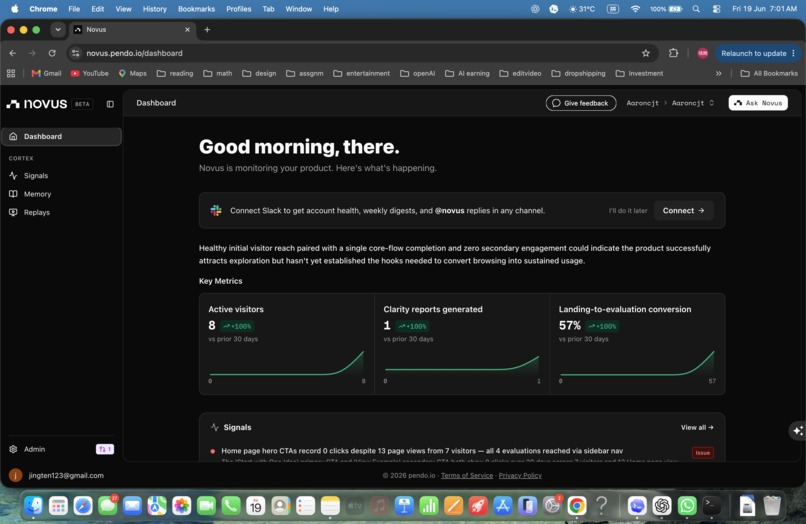
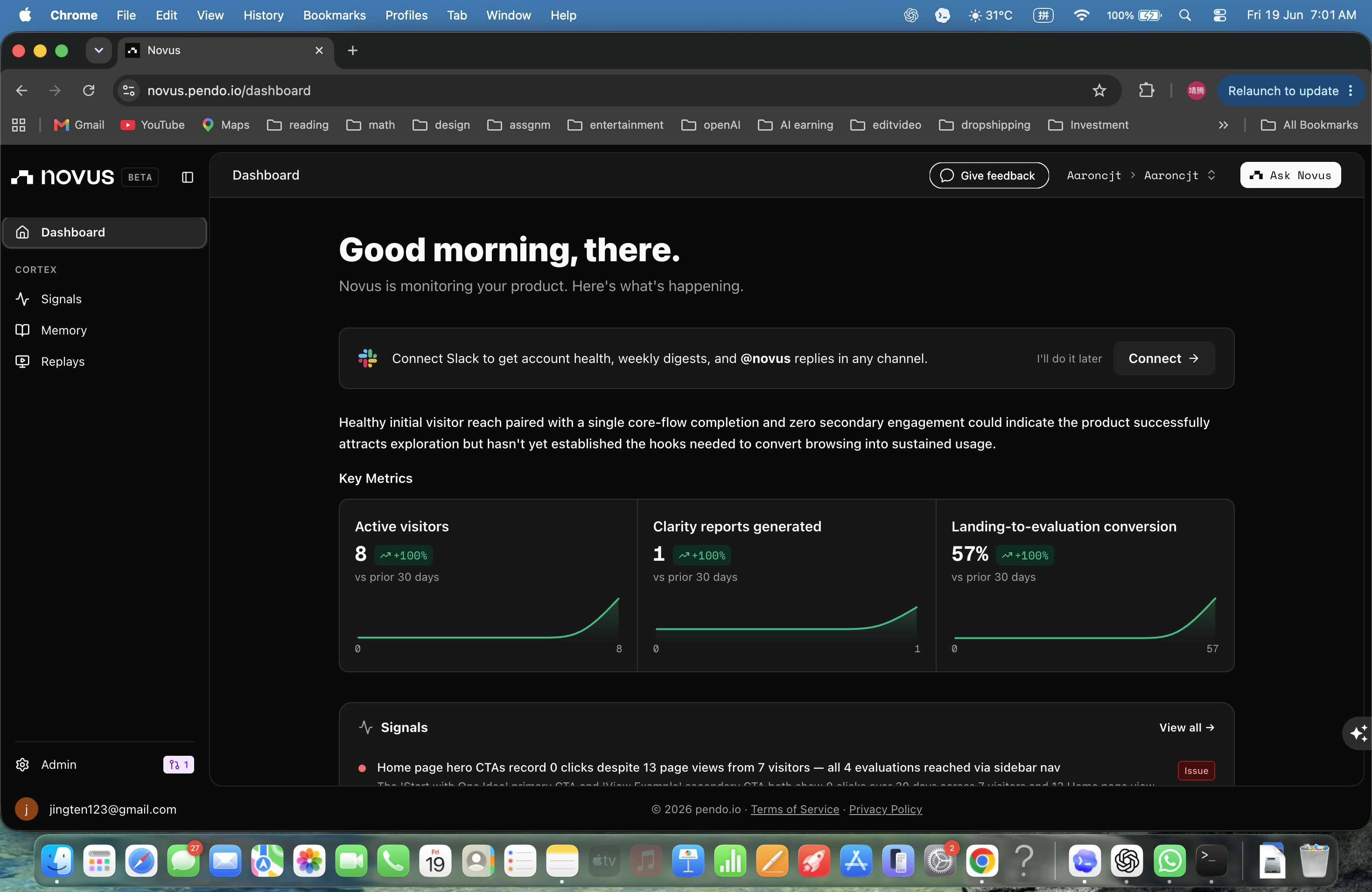
For the hackathon analytics requirement, I connected Novus/Pendo analytics. The app tracks privacy-safe product events such as visitors, clarity reports generated, and landing-to-evaluation conversion, while avoiding raw idea text, private Focus Profile content, or Daily Review reflections.
Challenges we ran into
One major challenge was scope control. It was easy to make ClarityOS too big, because the idea touches notes, tasks, goals, reflection, and decision-making. I had to keep bringing the product back to one core promise: help the user decide what to do with one idea.
Another challenge was making the result useful. The first version felt too much like a report. After feedback, I changed the result page to focus more on action: what to do in the next 30 minutes, today, and this week.
I also had to clarify who the product is for. ClarityOS is most useful when a user has an exciting or distracting idea and does not know whether it deserves focus now. It is not meant to replace action when the next step is already obvious.
Another challenge was connecting analytics in a privacy-safe way. I wanted to prove product usage through Novus/Pendo without tracking users’ private idea text or reflection content.
Accomplishments that we're proud of
I am proud that ClarityOS became a complete end-to-end MVP instead of just a concept.
A user can start with a messy idea, evaluate it through the Focus Filter, receive a clear decision and action plan, save it to the Board, and continue the loop through Focus Profile and Daily Review.
I am also proud of making the product more action-oriented after feedback. Instead of only giving a score or label, ClarityOS now gives practical next actions for the next 30 minutes, today, and this week.
The app is also deployed publicly, mobile-friendly, and connected with Novus/Pendo analytics.
What we learned
I learned that in AI-assisted building, speed is no longer the only advantage. Direction matters even more.
A product that helps people think should not create more overthinking. It should reduce the decision cost and move the user toward action.
I also learned that users do not always need a long report. Sometimes the most valuable output is a small next step that feels easy enough to do immediately.
Another key learning is that optional context is better than forced onboarding. Focus Profile and Daily Review are helpful, but the core product still needs to work even when a user starts with only one idea.
What's next for ClarityOS
The next step for ClarityOS is to make the decision experience more conversational and adaptive.
Future improvements could include:
- AI-powered follow-up questions based on the user’s idea.
- More personalized action plans.
- Better review reminders for parked ideas.
- Optional user accounts and cross-device sync.
- Deeper Novus/Pendo analytics to understand where users gain or lose clarity.
- More testing with solo builders, students, and creators.
Long term, ClarityOS could become a lightweight operating system for personal focus: a place where ideas are captured, filtered, and converted into meaningful action. Novus/Pendo proof is included in the project media gallery as a dashboard screenshot showing active visitors, clarity reports generated, and landing-to-evaluation conversion.
Built With
- codex
- css
- localstorage
- next.js
- novus
- react
- tailwind
- typescript
- vercel

Log in or sign up for Devpost to join the conversation.