Inspiration
ClarityFlow AI was inspired by how overwhelming career decisions can feel when a person has too much information and no clear way to compare it. Students, young professionals, and career changers often hear advice from everywhere: finish school, get a job now, try a bootcamp, self-teach, move, earn a certificate, or start over completely. The problem is not always a lack of motivation. Many people are stuck because every option has real tradeoffs involving money, time, risk, transportation, family responsibilities, credentials, and long-term stability.
We wanted to build something that does not just give generic AI advice. ClarityFlow AI helps users slow the decision down, organize their options, and create a clearer first-step plan before making major commitments.
What it does
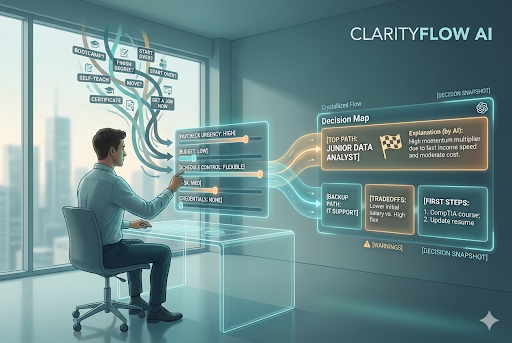
ClarityFlow AI is a career decision-support web app. The user enters what they are stuck between, adds an optional career direction, chooses a clarity mode, and adjusts sliders for paycheck urgency, budget pressure, schedule control, risk, and credential needs.
The app compares those priorities against structured career-path data and creates a decision map with a top path, backup path, tradeoffs, warnings, first steps, and a decision snapshot. An OpenAI LLM API then explains the result in plain language so the user can understand why that path surfaced.
The goal is not to replace mentors, advisors, counselors, or workforce workers. The goal is to help users show up to those trusted humans with a clearer plan and better questions.
How we built it
We built ClarityFlow AI with Python and Streamlit. The app is hosted on Streamlit Cloud and managed through GitHub.
The project has several connected parts:
app.py controls the Streamlit user interface. econ_mode.py handles the scoring engine. decision_engine.py handles decision rules, option detection, warnings, and Responsible AI guardrails. ai_brain.py handles the OpenAI LLM explanation layer. data/career_paths.csv stores the prototype career-path dataset.
The scoring engine compares user priorities against career-path factors such as cost, time to result, income speed, flexibility, risk, and credential strength. We also added decision metrics such as overall match, confidence level, life pressure, cost stress, risk exposure, decision clarity, and momentum.
One concept we used was a momentum-style comparison:
$$ \text{Momentum Multiplier} = \frac{\text{Expected Career Movement}}{\text{Initial Burden}} $$
This is not meant to predict guaranteed success. It is a comparison tool that helps the app explain whether a path may create meaningful movement compared to the cost, time, and risk involved.
The LLM does not choose the recommendation by itself. The Python scoring engine ranks the options first, and then the OpenAI LLM API explains the structured result in a clear and supportive way.
Challenges we ran into
One of the biggest challenges was turning separate pieces of logic into one working app. The scoring engine, decision rules, AI explanation layer, CSV data, Responsible AI guardrails, and Streamlit interface all had to work together.
Another challenge was building the scoring engine in a way that felt understandable. We wanted the app to compare options using real user priorities, but we also needed the result to be explainable. Jana helped think through the scoring logic, data structure, and evaluation concerns.
Keeping the AI focused was another challenge. We did not want the LLM to randomly make decisions for the user. We had to separate the scoring engine from the AI explanation layer so the LLM explains the result instead of taking over the decision.
We also learned that user wording matters. Terms like “flexibility” or “risk” can be too vague, so we adjusted the interface to use clearer labels and min/max explanations for each slider.
Accomplishments that we're proud of
We are proud that ClarityFlow AI is more than a basic chatbot. It combines a structured scoring engine, user priorities, decision explanations, safety warnings, human review reminders, and an AI explanation layer.
We are also proud that the app is working as a deployed prototype. Users can enter a decision, adjust priorities, receive a result, review tradeoffs, see warnings, and report harmful output.
Most importantly, we are proud that the app was designed around Responsible AI from the beginning. The system is built to support decision-making, not replace human judgment.
What we learned
We learned that AI decision-support tools need structure. A helpful AI app should not just produce a confident answer. It should show how the result was created, explain uncertainty, surface tradeoffs, and encourage verification.
We also learned that technical architecture and user experience have to work together. Even if the scoring logic works, users still need simple labels, readable warnings, and clear explanations.
Finally, we learned that Responsible AI is not just a paragraph in the submission. It has to appear inside the product through guardrails, human review reminders, verification notices, and report options.
What's next for ClarityFlow AI
Future versions of ClarityFlow AI could include:
Verified labor-market, salary, school, cost, and job-demand data Supabase or PostgreSQL for saved sessions and feedback reports A human review dashboard for mentors, advisors, or workforce workers Stronger accessibility testing Multilingual support More career paths and customized user scenarios A stronger feedback loop for harmful, biased, confusing, or unsafe outputs
ClarityFlow AI started as a career decision simulator, but the larger idea is a safer way to help people think through real-life decisions when the options feel overwhelming.

Log in or sign up for Devpost to join the conversation.