Team Info
Team 15 - kopi-o-kosong
Inspiration
Navigating the Civil and Family Justice Tracking System (CJTS) and managing legal document workflows can be overwhelming, time-consuming, and prone to human error. During legal proceedings, legal teams and self-represented litigants waste hundreds of hours manually reviewing case files, extracting key facts, and formatting tribunal submissions. We were inspired to build CJTS Legal Co-Pilot to bridge the gap between complex legal procedure and modern automation—democratizing legal intelligence and drastically speeding up civil claim processing for the SMU LIT Legal-Tech Hackathon 2026.
What it does
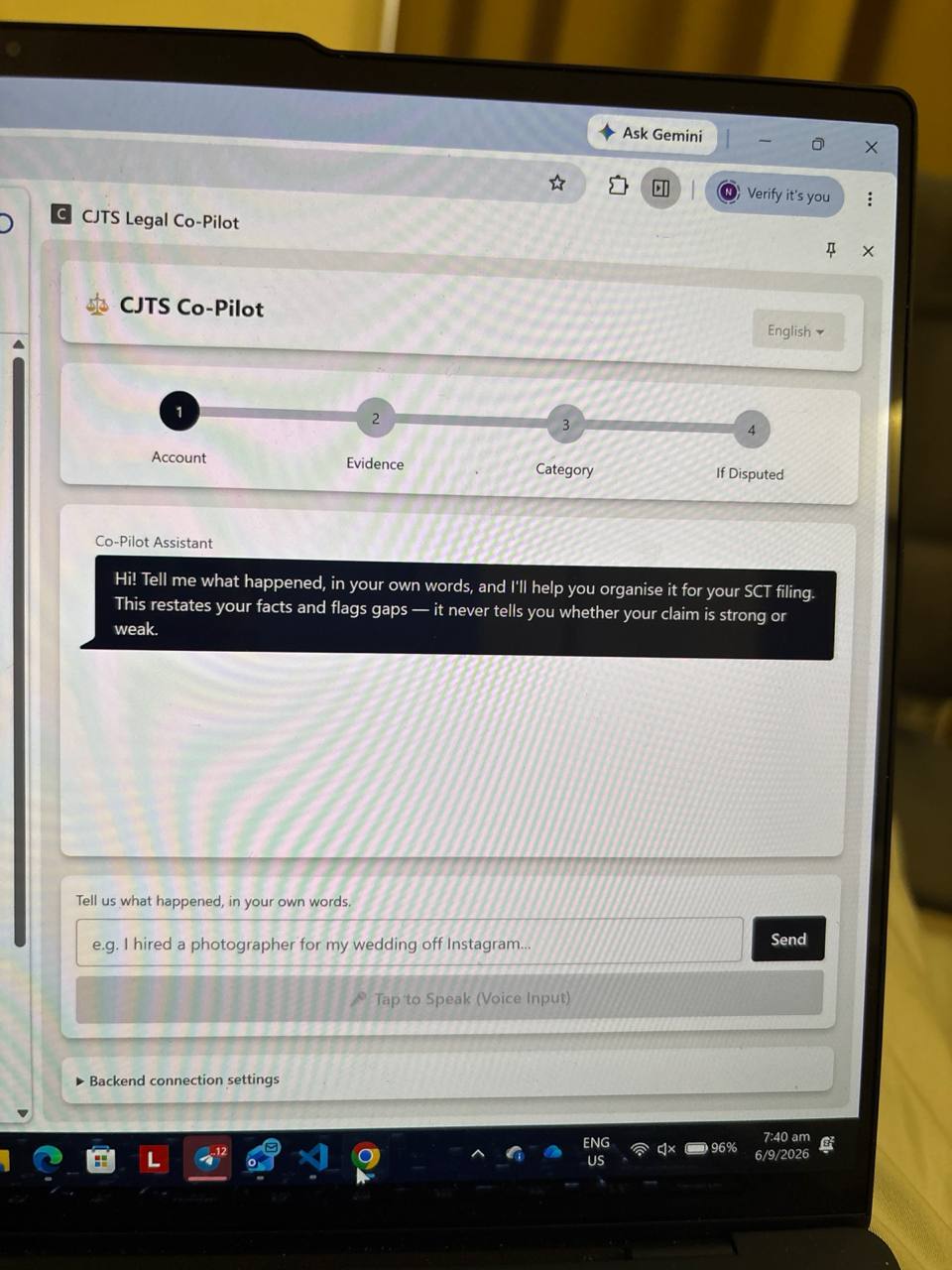
CJTS Legal Co-Pilot is an end-to-end legal assistant built as both a web platform and an integrated Chrome extension. It allows users to: Automate Document Analysis: Instantly analyze, summarize, and extract critical facts, dates, and claims from legal filings and uploaded PDFs. Contextual Co-Pilot Sidebar: Interact with a live AI sidebar while browsing online court portals or legal databases to get real-time procedure guidance.
How we built it
Frontend: Built a responsive, clean user interface (index.html, modern CSS, JavaScript) paired with a Manifest V3 Chrome Extension architecture for sidepanel browser integration.
Backend: Powered by a high-performance Python FastAPI server (main.py) handling asynchronous request routing and document parsing pipelines.
AI Engine & Retrieval: Integrated Large Language Model (LLM) APIs alongside custom prompt engineering to process, summarize, and structure legal text accurately.
Local Development Pipeline: Structured with isolated environment management (venv, PEP 668 compliance) and lightweight local HTTP file-serving for rapid iteration.
Challenges we ran into
Environment Isolation & Deployment: Navigating PEP 668 strict environment management on Linux (Penguin) while orchestrating dependencies (FastAPI, Uvicorn, Pydantic).
Cross-Origin & Extension Communications: Ensuring seamless, low-latency API communication between local file environments (file://), extension sidepanels, and the FastAPI local server (http://127.0.0.1:8000).
Document Extraction & Context Precision: Structuring prompt constraints so the LLM yields accurate, hallucinatory-free legal summaries based strictly on user-uploaded case files.
Accomplishments that we’re proud of
Full-Stack Execution: Successfully bridging a browser extension sidepanel with a robust Python backend in a seamless local dev flow. Instant Legal Extraction: Achieving sub-3-second responses for complex legal document summarization and form pre-filling. User-Centric UX: Designing an interface that abstracts away complex legal jargon into clear, actionable next steps for civil claims.
What we learned
Modern Python Backend Architecture: Deepened our expertise in FastAPI, asynchronous request handling, and CORS configuration for client-side extensions.
Browser Extension Mechanics: Gained hands-on experience with Manifest V3 Chrome Extensions, active tab context sharing, and sidepanel APIs.
Legal-Tech Domain Nuances: Learned how to translate rigid procedural workflows (CJTS rules) into user-friendly automated tools without sacrificing accuracy.
What’s next for Test
Multi-Language Support: Integrating real-time translation for non-English court documents to assist non-native litigants.
RAG Legal Database Vectorization: Implementing Retrieval-Augmented Generation (RAG) over official Singapore court judgments and CJTS practice directions for hyper-accurate case matching.
Automated PDF Annotation: Expanding the Chrome extension to highlight and annotate PDF evidence directly within the browser window.
Built With
- chatgpt-(openai)
- chrome-extension-api-(manifest-v3)
- claude-(anthropic)
- fastapi
- gemini-(google)
- git
- html5/css3
- javascript
- openrouter-api
- pydantic
- python
- uvicorn

Log in or sign up for Devpost to join the conversation.