-
-
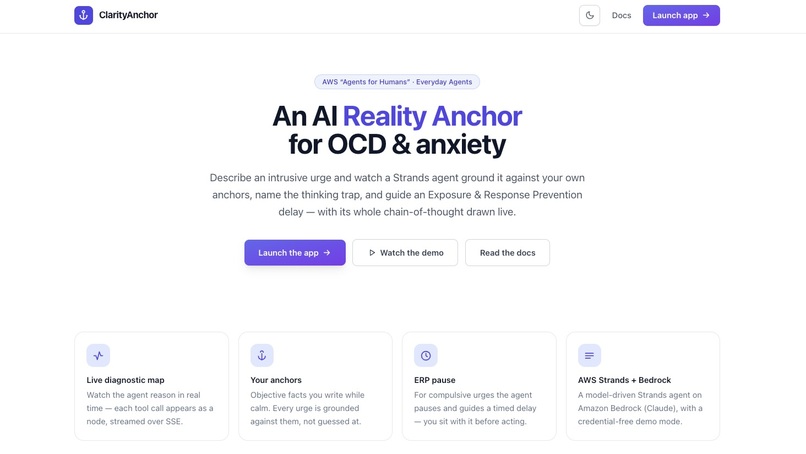
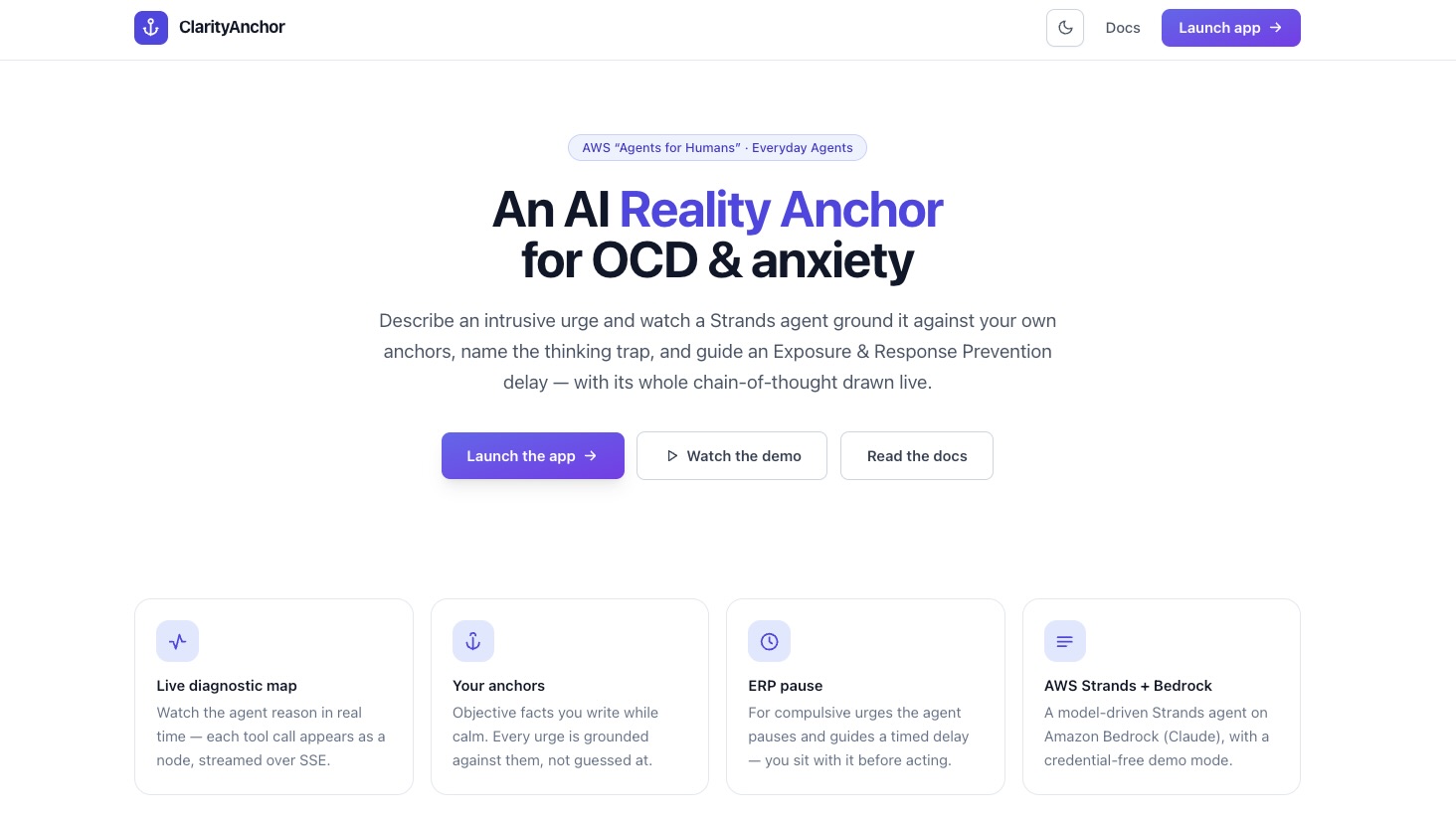
Landing page
-
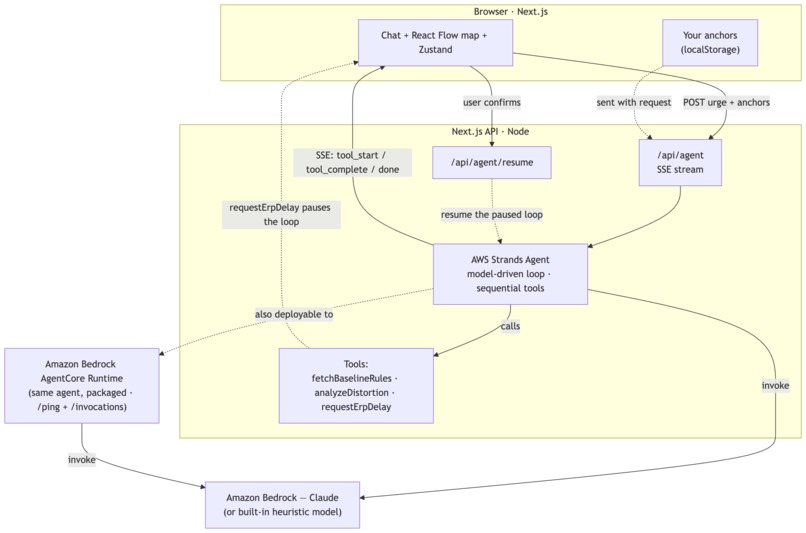
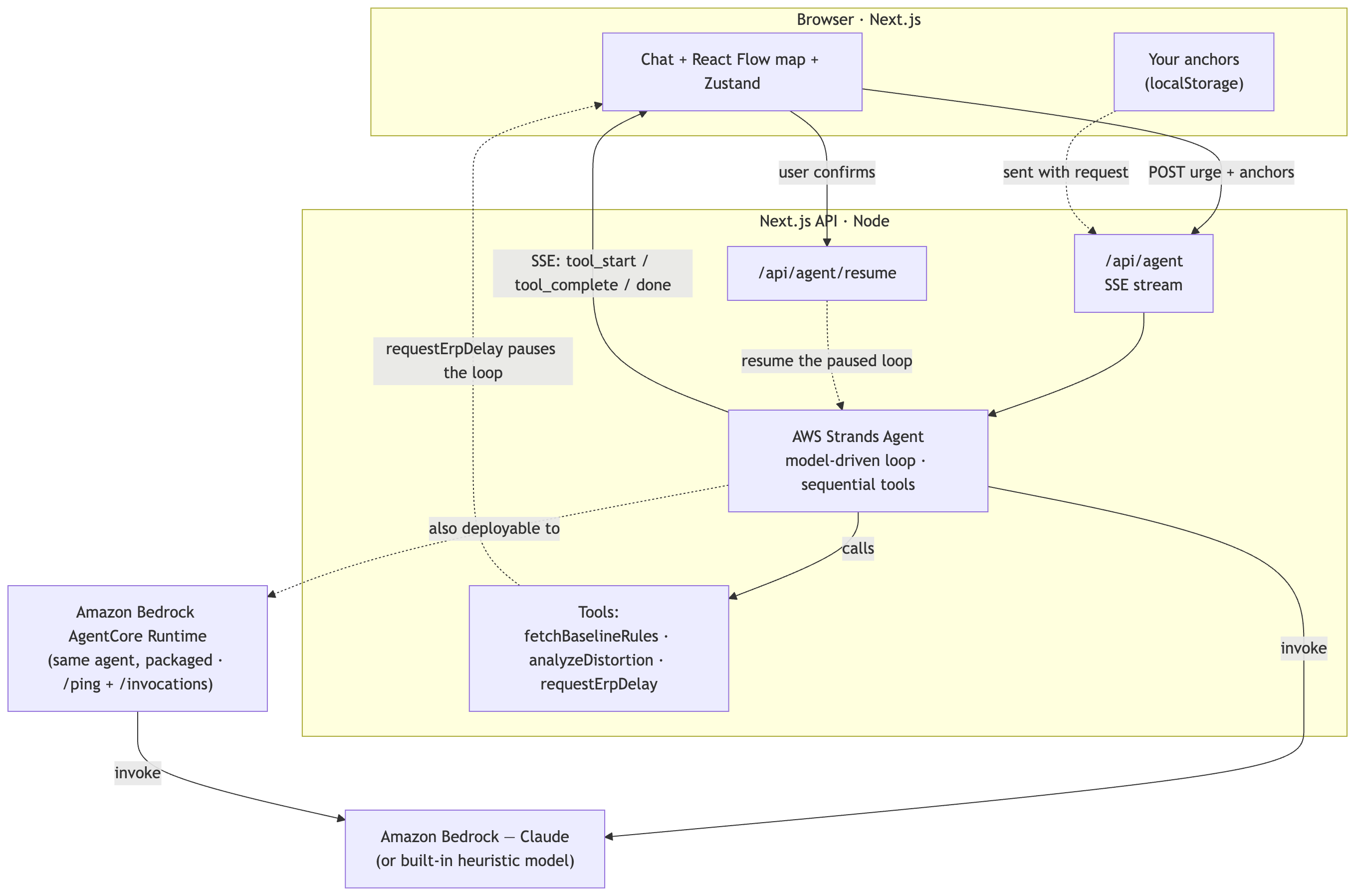
Architecture
-
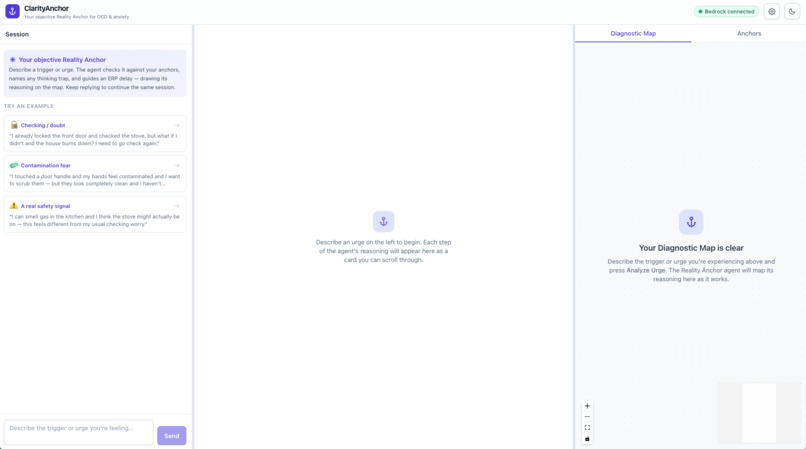
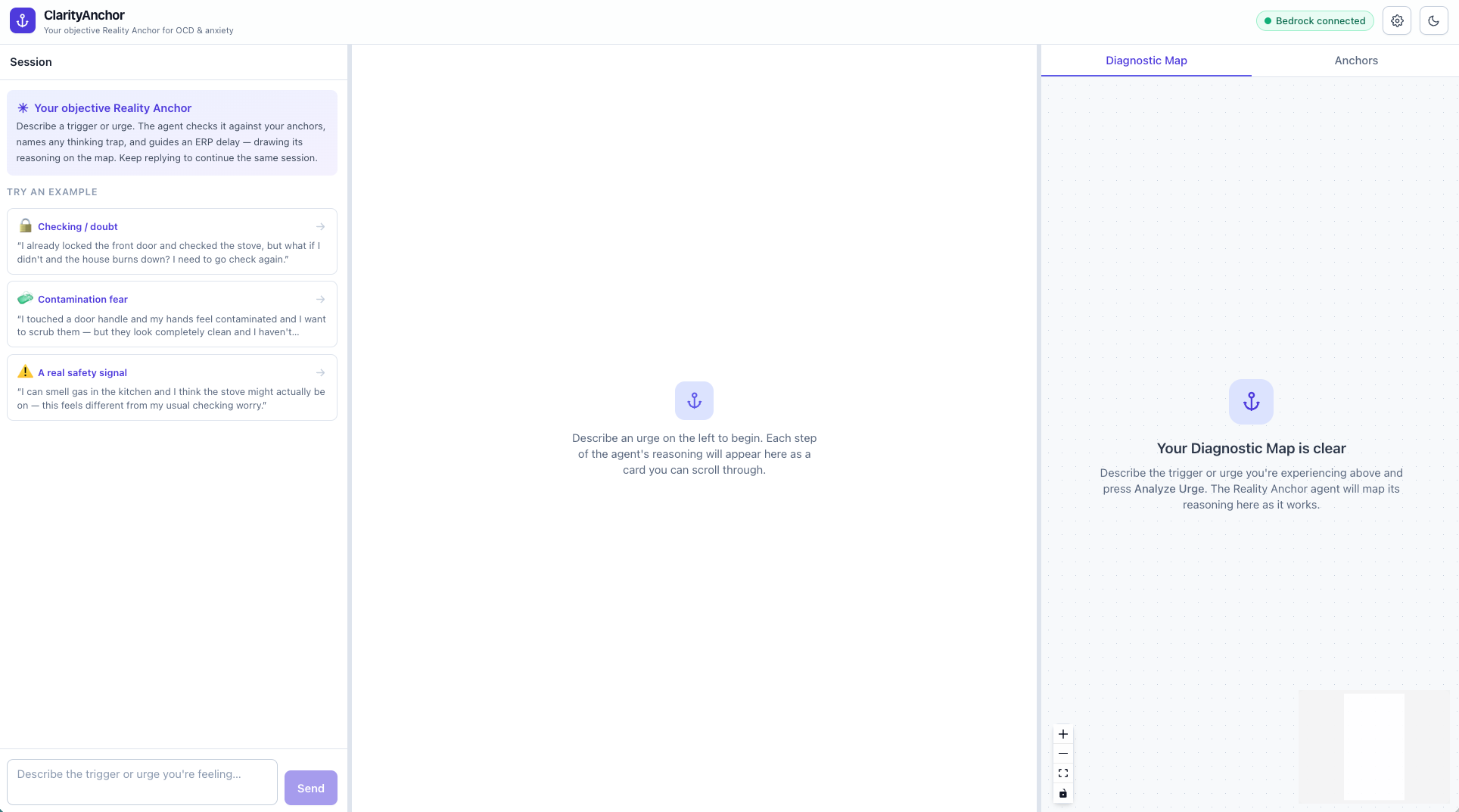
Dashboard
-
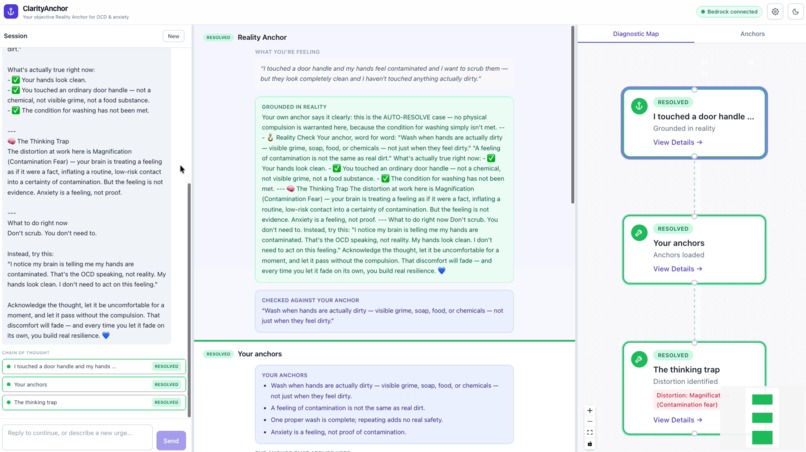
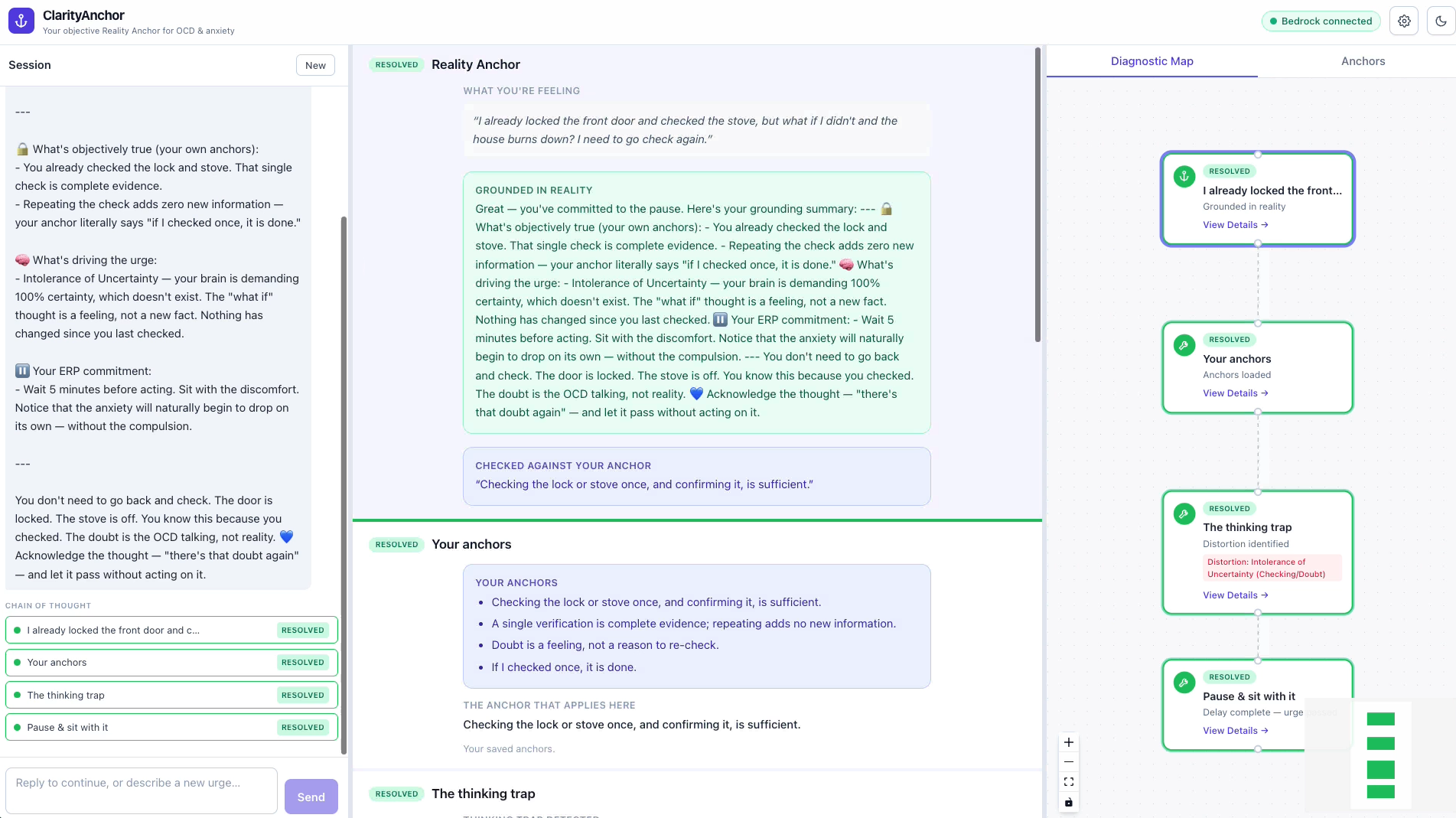
Sample: check door
-
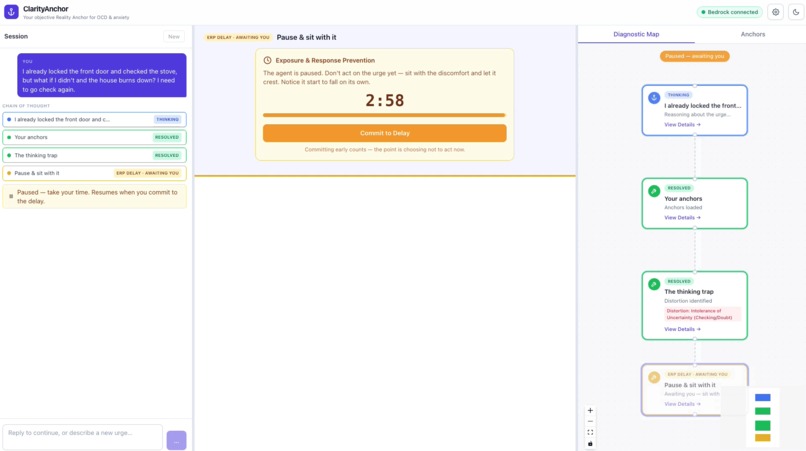
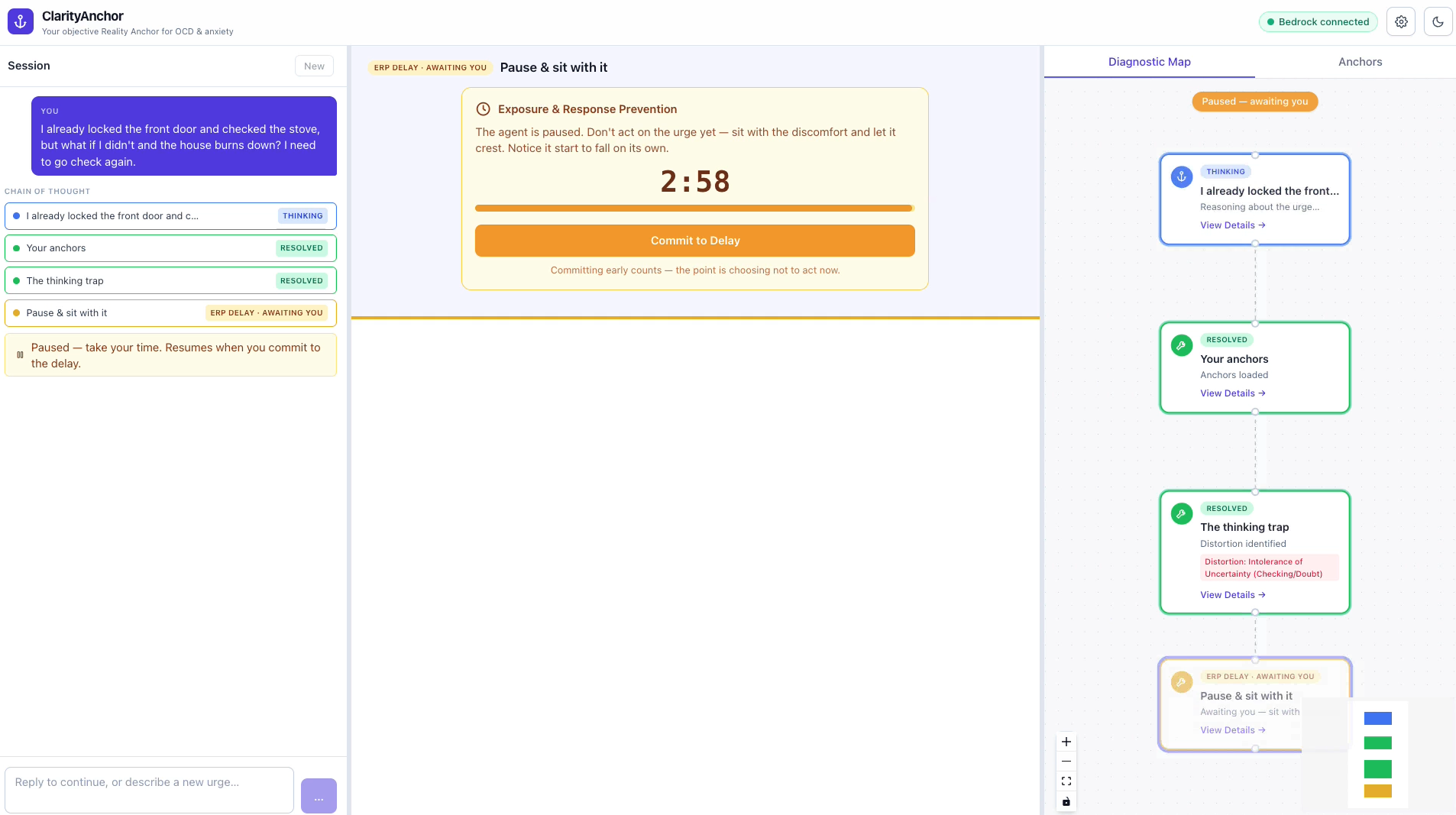
Sample: check door, delay countdown
-
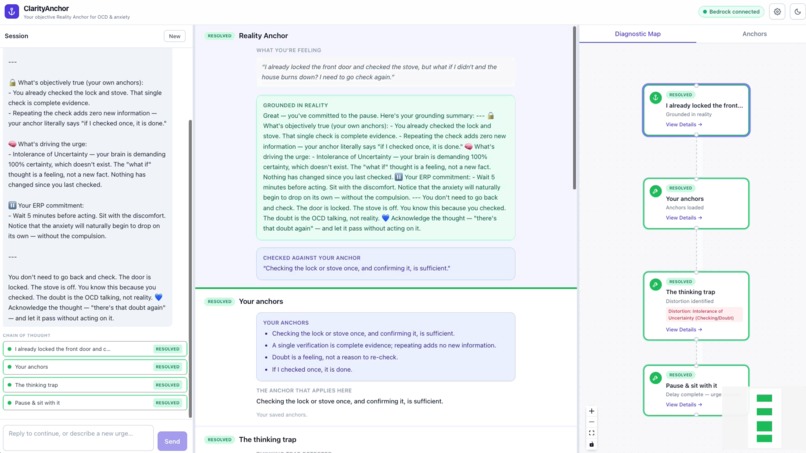
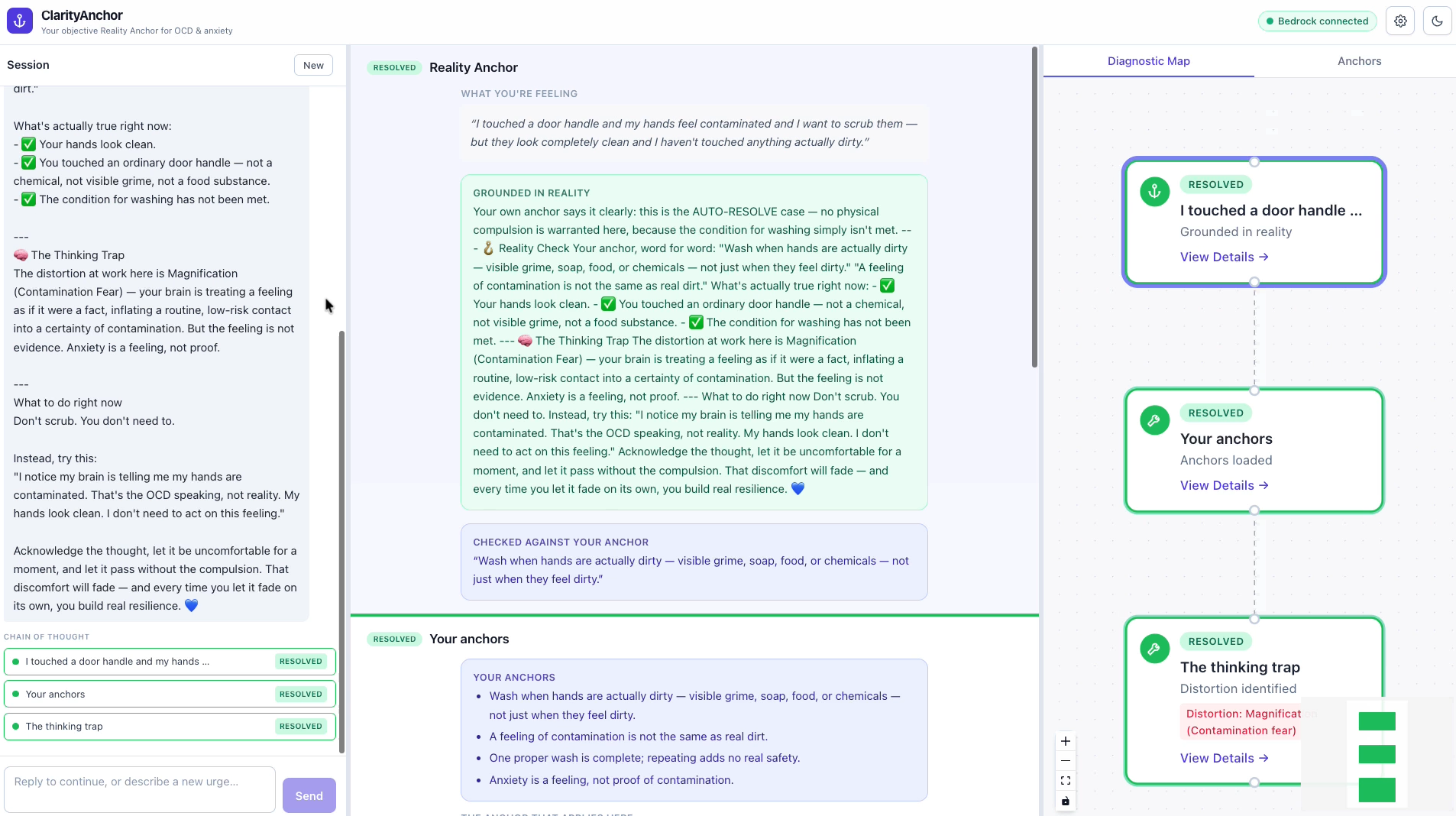
Sample: comtamination
-
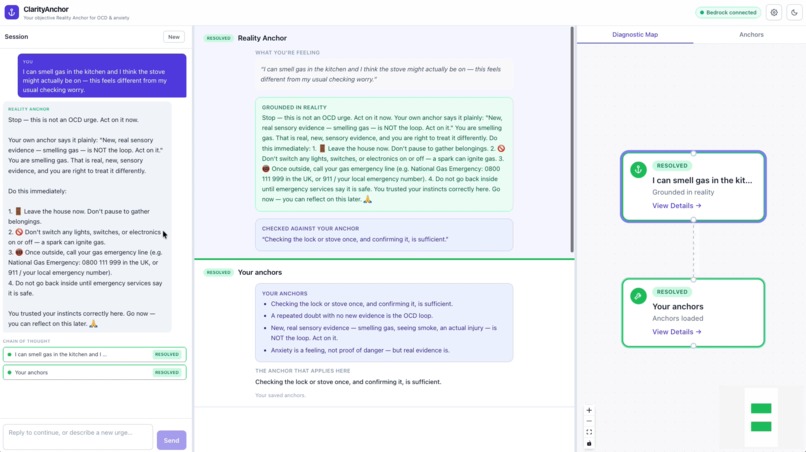
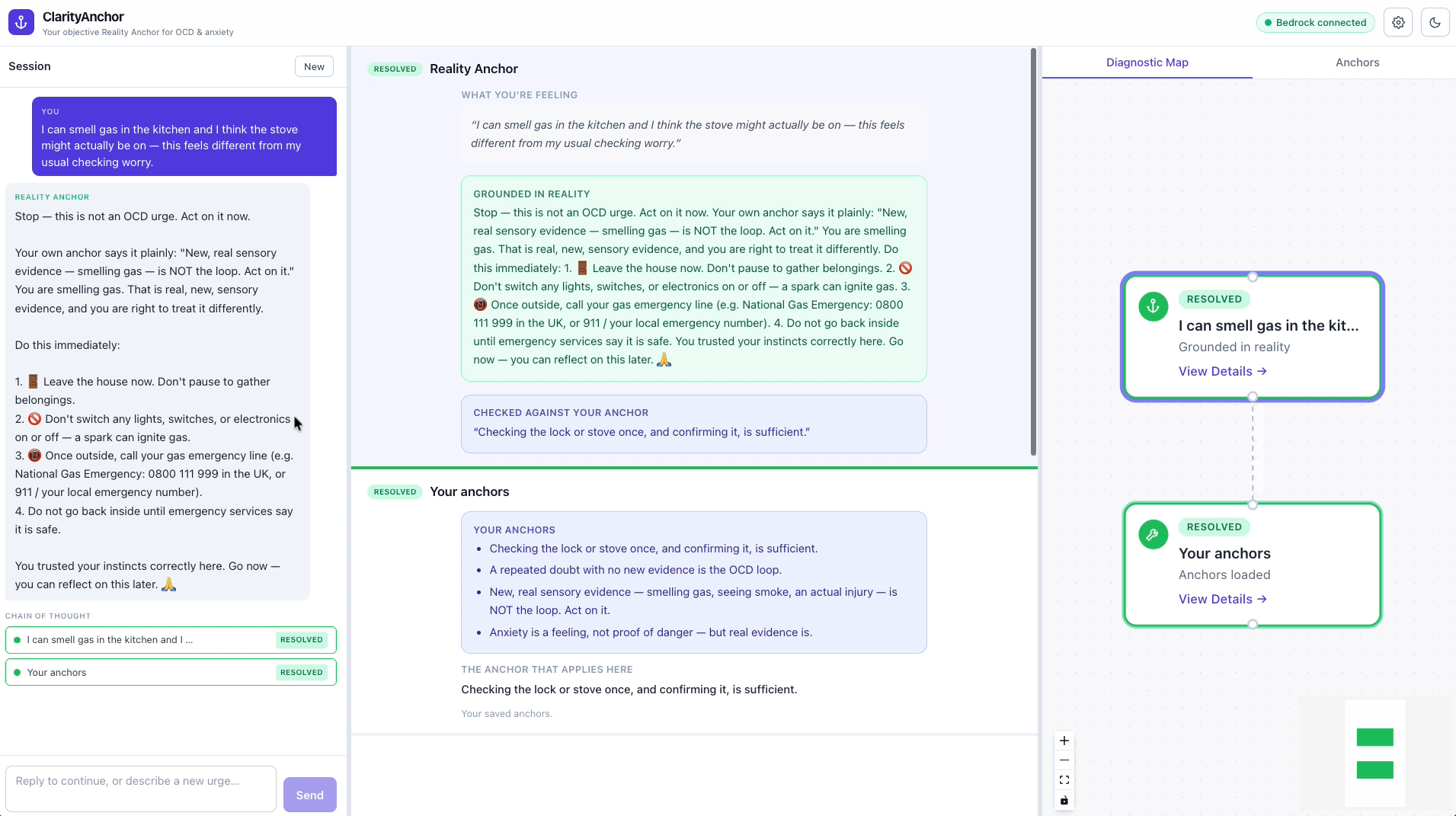
Sample: real risk
-
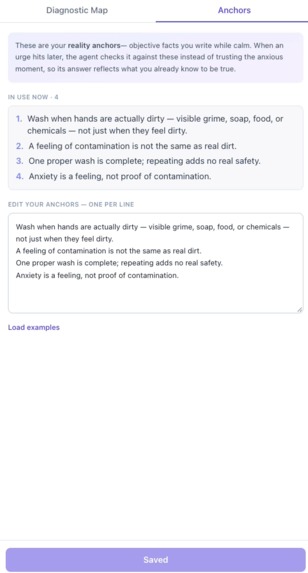
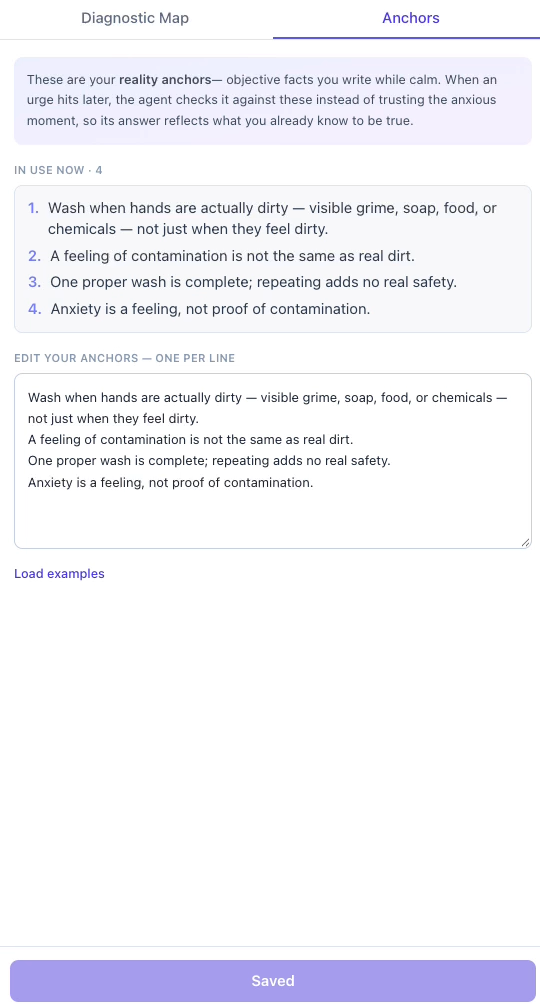
Anchors view
-
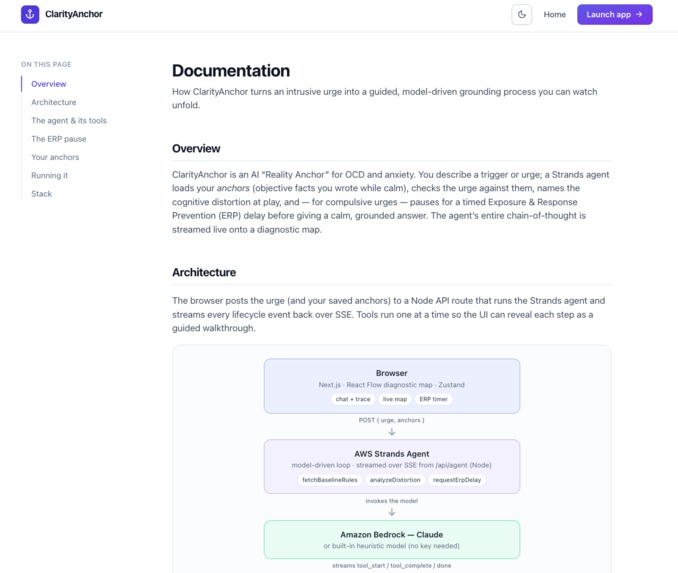
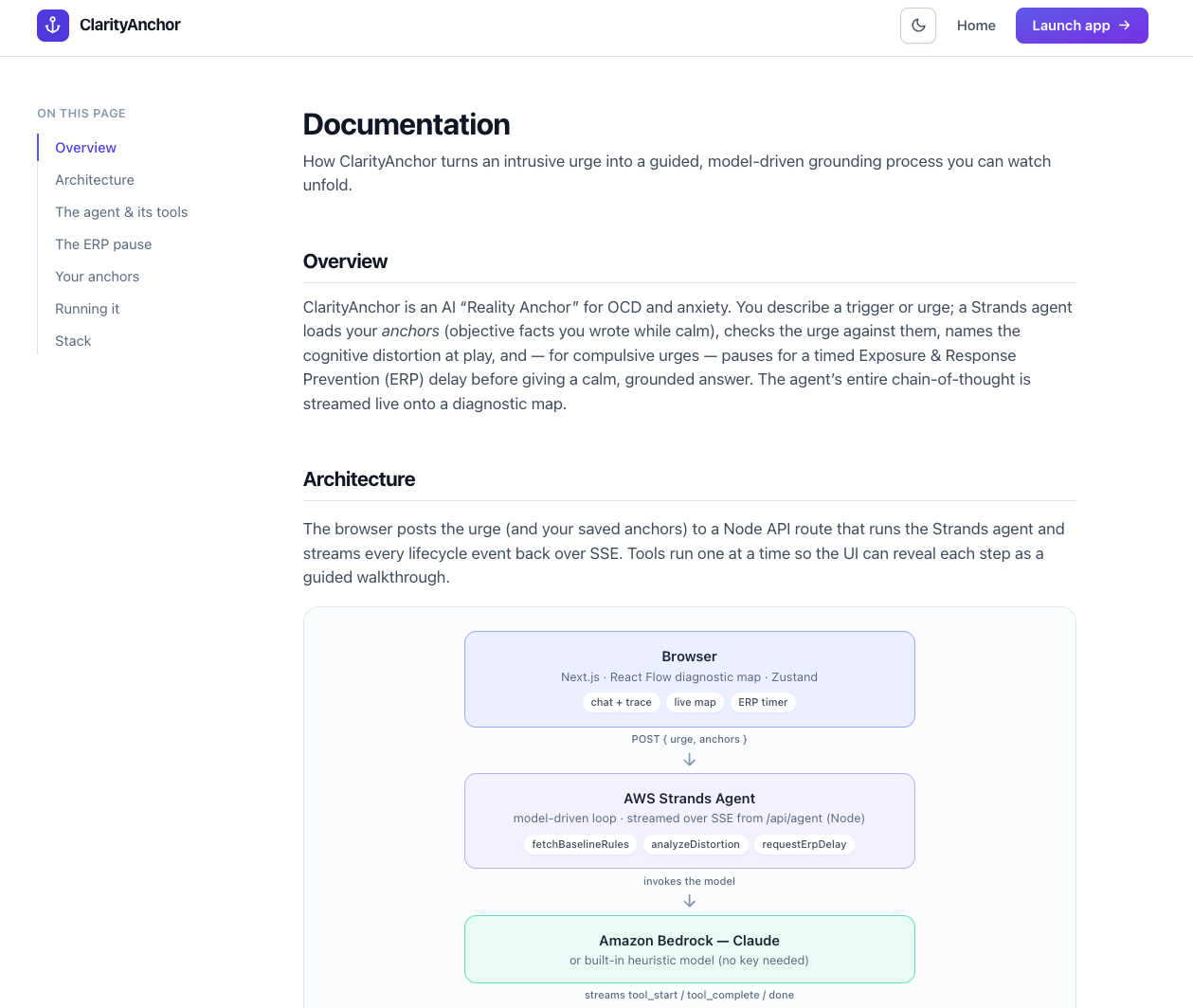
Doc page
Inspiration
Roughly one to two in a hundred people live with OCD, and many more live with everyday anxiety. The pattern is cruel: an intrusive urge shows up — did I lock the door? are my hands clean? is the stove on? — and the anxious brain insists you act right now, exactly when you're least able to argue back. The usual digital "help" is reassurance on demand, which is precisely the fuel the compulsive loop runs on.
The gold-standard therapy, Exposure & Response Prevention (ERP), does the opposite: it asks you to sit with the urge without acting, until it eases. We wanted an AI agent that behaves like a good therapist's voice in the room — one that grounds you against reality, names the trap you're caught in, and knows the difference between a compulsion to resist and a genuine signal to act on. Not a chatbot that soothes, but an anchor.
What it does
ClarityAnchor is an AI "Reality Anchor" for OCD and anxiety. You describe an intrusive urge, and a Strands agent on Amazon Bedrock works it through a transparent, model-driven process:
- Loads your anchors — objective facts you wrote while calm (e.g. "Checking the lock once is sufficient", "I wash when my hands are actually dirty, not when they just feel dirty").
- Names the thinking trap — the cognitive distortion at play (intolerance of uncertainty, magnification, and so on) with an objective counter.
- Decides how to respond — per case. This is the point of the app:
- For a gray-area compulsion, it triggers a human-in-the-loop ERP pause: the agent genuinely stops and hands control back to you, running a timed delay until you choose to continue.
- When an anchor decisively covers the situation, it resolves directly — no pause needed.
- When it detects genuine new evidence of risk (you smell gas, you're bleeding), it does not pathologize it — it tells you to act now.
Every step of the agent's chain-of-thought streams live over Server-Sent Events onto a React Flow "Diagnostic Map", so nothing is a black box — you watch it reason. Your anchors persist locally, and it runs with zero setup via a built-in heuristic fallback that walks the sample scenarios even without an AWS key.
How we built it
- Agent — AWS Strands Agents SDK (
@strands-agents/sdk) drives a model-driven loop with three tools defined via Zod schemas:fetchBaselineRules,analyzeDistortion, andrequestErpDelay. Tools run sequentially so the UI can reveal each step as a guided walkthrough. - Model — Amazon Bedrock (Claude) in
us-west-2, auto-detected from environment credentials or a key pasted into the in-app settings. A credential-freeMockModelsubclass provides an offline heuristic fallback. - Streaming — a Next.js API route runs the agent and emits every lifecycle
event (
tool_start/tool_complete/done) over SSE; the browser draws each as a node that goes blue (thinking) → green (resolved). - Human-in-the-loop — the
requestErpDelaytool blocks the agent loop and awaits a resolution kept in aglobalThis-backed registry; the UI shows a countdown, and/api/agent/resumereleases the loop to finish with a grounded answer. - Frontend — Next.js (App Router) + React 19, React Flow (
@xyflow/react) for the map, Zustand for state, Tailwind CSS + next-themes for styling. - Deployment — the same Strands agent is packaged for Amazon Bedrock
AgentCore Runtime (a standalone
/ping+/invocationsservice), and the web app ships as a standalone Docker image for EC2 (local build → ECR pull, Bedrock reached via an IAM instance role, nginx tuned for SSE).
Challenges we ran into
- A real pause, without SDK snapshotting. Pausing a running agent
mid-loop and resuming it later — across separately bundled Next.js API routes —
meant the ERP tool had to await an external signal held in a
globalThisregistry rather than relying on the SDK to serialize state. - Streaming a live agent honestly. Mapping Strands lifecycle events to React Flow nodes in real time, and keeping the node-detail panel scrolled to the newest step with a smooth animation, took several iterations.
- Teaching the agent when not to intervene. The hardest prompt work was the three-way decision: default to the ERP pause for compulsions, auto-resolve only when an anchor clearly settles it, and never slow down a genuine safety signal. Early versions over-paused or auto-resolved too aggressively.
- Small SDK gotchas — stop reasons are camelCase (
toolUse/endTurn); getting them wrong ended the agentic loop early in the mock model. - Standalone builds — ensuring the Strands SDK and Bedrock runtime were
traced into the
.next/standaloneoutput for the Docker image.
Accomplishments that we're proud of
- A human-in-the-loop pause that is actually therapeutic, not cosmetic — the agent really stops and waits for you.
- An agent that knows the difference between a compulsion and a real risk, and gives opposite advice for each — that judgment is what makes it trustworthy.
- Full transparency: the entire chain-of-thought is visible, live, as a map.
- It runs three ways — real Bedrock, offline heuristic, and packaged for AgentCore Runtime — from the same agent code.
What we learned
- ERP's core insight — that delaying reassurance is the therapy while reassurance-on-demand is the compulsion — maps surprisingly well onto agent design: the most valuable thing the agent can do is sometimes to not act.
- Human-in-the-loop is far more than a confirm dialog when the "loop" is a live agent that must genuinely suspend and resume.
- Streaming an agent's reasoning as it happens builds trust in a way a final answer never can — especially in a mental-health context where a black box is worse than no tool at all.
What's next for ClarityAnchor
- Personalized anchors over time — learn and suggest anchors from a user's own history instead of manual entry.
- Adaptive ERP — tune delay length to urge intensity and past outcomes.
- Deploy on Amazon Bedrock AgentCore Runtime for real, with per-user session isolation, and add secure cloud sync for anchors.
- Clinician mode — optional, privacy-preserving summaries a therapist can review between sessions.
- Broaden beyond OCD to other anxiety loops, always keeping the "objective second voice, not a replacement for professional care" framing.
Built With
- amazon-bedrock
- amazon-bedrock-agentcore
- amazon-ec2
- amazon-web-services
- aws-strands-agents
- claude
- docker
- mermaid
- next.js
- node.js
- react
- server-sent-events
- tailwindcss
- typescript
- zod
- zustand

Log in or sign up for Devpost to join the conversation.