-
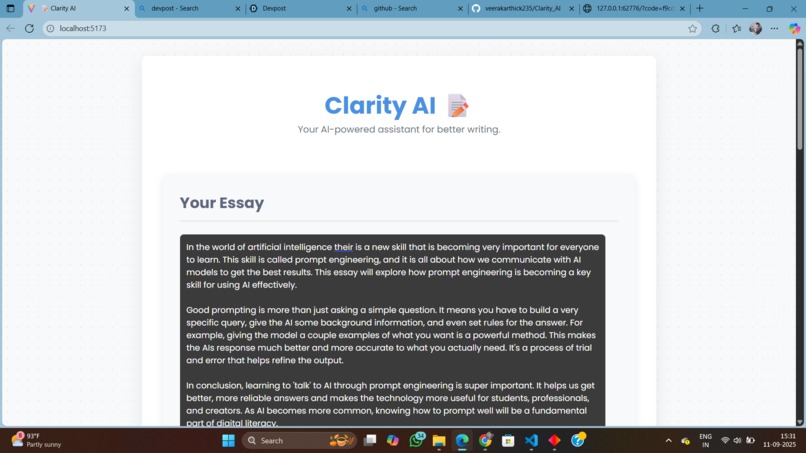
Input
-
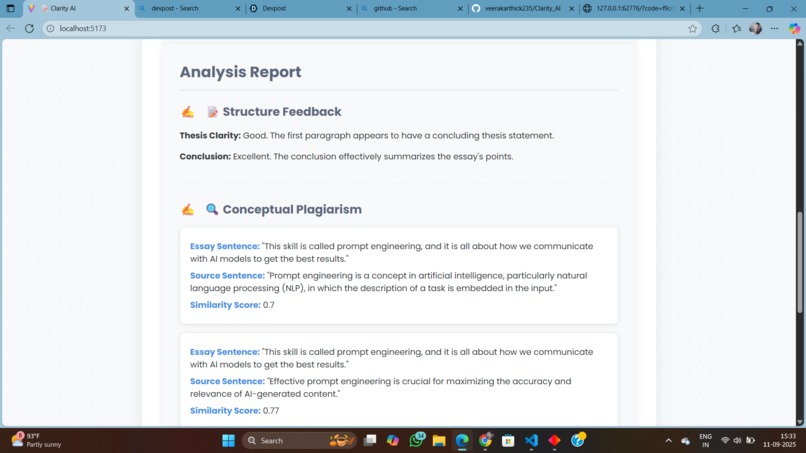
Report
Inspiration
As students and tech enthusiasts, we've seen how valuable feedback is for learning. We were inspired by the challenges both students and teachers face: students wait days for feedback, while teachers spend countless hours on repetitive grading. We wanted to use AI to bridge this gap, creating a tool that not only corrects errors but actively teaches students how to improve their writing and understand academic integrity. The 'Virtu Hack' theme of empowering education was the perfect catalyst for this idea.
What it does
Clarity AI is an intelligent web application that acts as an AI-powered teaching assistant for writers. A user can paste their essay and a source text, and our tool provides a comprehensive analysis in three key areas: Grammar & Spelling: It identifies and explains grammatical mistakes. Structural Analysis: It gives high-level feedback on the essay's structure, checking for a clear thesis and a concluding summary. Conceptual Plagiarism Detection: This is our core feature. Instead of just matching identical text, it uses Natural Language Processing (NLP) to detect when ideas have been paraphrased too closely, helping students learn to synthesize information properly.
How we built it
We built Clarity AI as a full-stack web application with a decoupled architecture. Backend: We used Python with FastAPI to create a robust and fast API. For the core NLP tasks, we leveraged powerful libraries like spaCy for text processing, sentence-transformers for creating vector embeddings to calculate semantic similarity, and language-tool-python for comprehensive grammar checking. Frontend: The user interface is a modern, responsive single-page application built with React and Vite. We used Axios to handle communication with our FastAPI backend. The frontend sends the essay and source text to the backend, which performs the analysis and returns a structured JSON response for the frontend to display beautifully.
Challenges we ran into
Our biggest challenge was implementing the conceptual plagiarism detector. It required deep diving into NLP concepts like sentence embeddings and cosine similarity to get meaningful results. We also faced significant challenges setting up the development environment, particularly with managing Python dependencies in a virtual environment and configuring the language-tool-python library, which had a hidden dependency on Java. Finally, setting up the Git repository and resolving a series of configuration errors to successfully push to GitHub was a great learning experience in version control.
Accomplishments that we're proud of
We're incredibly proud of building a functional full-stack application from scratch in a short timeframe. Our biggest accomplishment is the conceptual plagiarism feature; it's a non-trivial NLP task, and getting it to work reliably was a major milestone. We are also proud of the clean, intuitive user interface we created, which makes the complex analysis easy for anyone to understand. Successfully debugging and deploying the entire stack has been a huge confidence booster.
What we learned
This project was a massive learning experience. We deepened our understanding of full-stack development, particularly the interplay between a React frontend and a Python API. We learned how to apply advanced NLP concepts to solve a real-world problem. Most importantly, we learned the value of systematic debugging and the importance of a well-configured development environment. This hackathon taught us resilience and the power of breaking down a complex problem into manageable steps.
What's next for Clarity_AI
We see a lot of potential for Clarity AI. In the future, we'd love to expand its capabilities by:
Providing more granular feedback: Suggesting specific ways to rephrase sentences to improve clarity and flow.
Supporting more document types: Allowing users to upload .docx or PDF files.
Adding user accounts: Allowing users to track their writing progress over time.
Integrating with educational platforms: Creating a browser extension or add-on for Google Docs to provide real-time feedback as students write.
Built With
- fastapi
- javascript
- python
- react

Log in or sign up for Devpost to join the conversation.