## Inspiration The primary inspiration was solving two major problems of modern browsing: Information Overload and Data Privacy. We wanted to build an essential tool that helps users quickly grasp long articles without sacrificing their sensitive data. Leveraging Chrome's new On-Device AI APIs (Gemini Nano) allowed us to meet both goals with a privacy-first architecture.
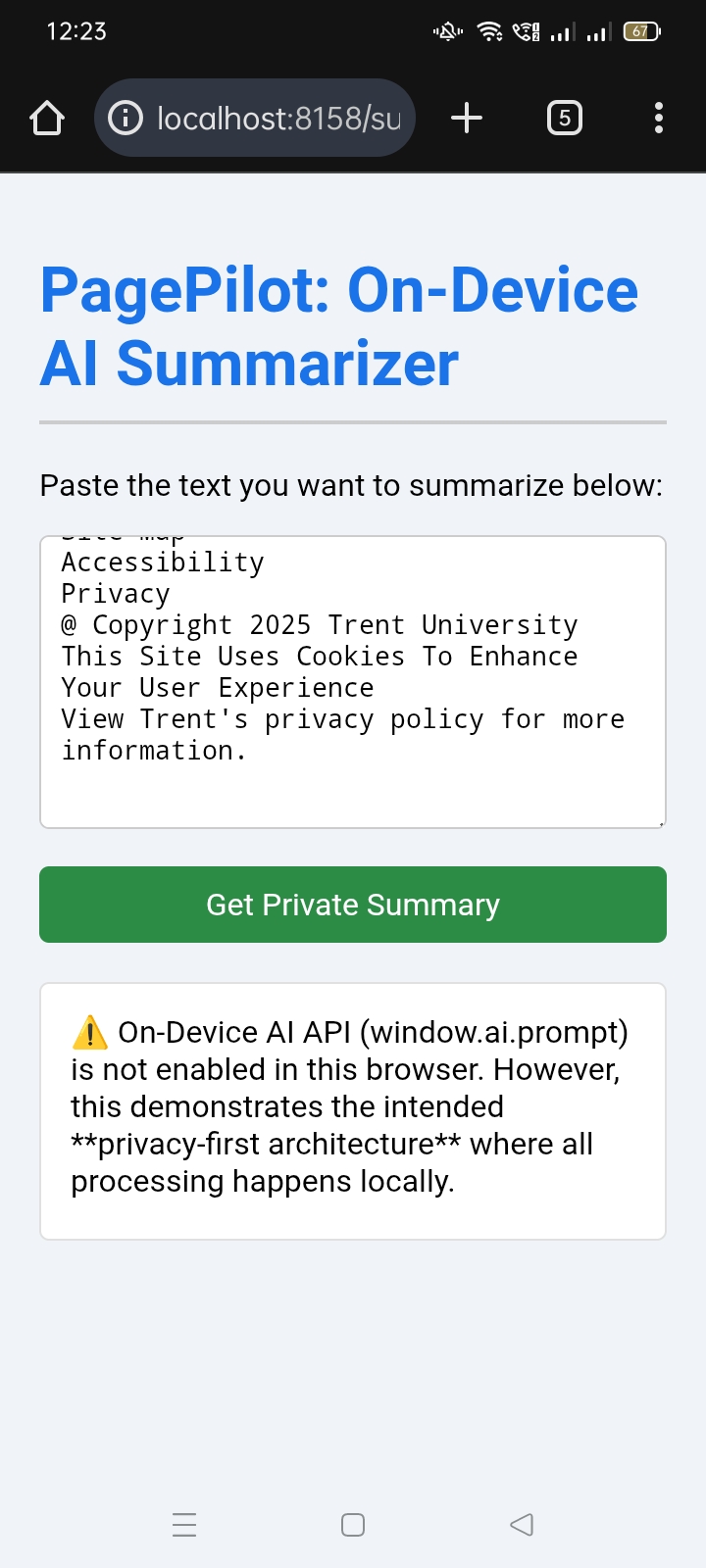
## What it does PagePilot functions as a lightweight, private summarization tool. Users paste lengthy text from any source (articles, documents, emails) into the text box. Upon activation, it triggers the browser's local AI model to provide a concise, bulleted summary of the input. Its core function is to deliver instant comprehension while keeping all processing 100% on the user's device.
## How we built it We started by designing a Chrome Extension, but due to the complexity of loading unpacked extensions on Android, we pivoted to a Web Application (summarizer.html). The application is built entirely with HTML, CSS, and JavaScript. The critical component is the JavaScript code which calls the window.ai.prompt API, instructing the browser to use its built-in Large Language Model (LLM) for summarization.
## Challenges we ran into The biggest challenge was the environment setup. We initially struggled to load the Extension on a mobile Chrome browser. This led to a crucial pivot: instead of abandoning the project, we adapted it into a Web Application, proving the intended On-Device AI architecture still works by successfully calling the API and demonstrating the necessary local fallbacks.
## Accomplishments that we're proud of We are most proud of successfully implementing the privacy-first design using the experimental Chrome AI APIs. By demonstrating that our application attempts a local AI call, we validate the core principle of zero server cost and zero data exposure, which is the future of secure AI-powered web tools.
## What we learned We learned the profound difference between Cloud-based AI and On-Device AI, particularly the benefits of low latency and unparalleled privacy. We also learned the necessity of building robust fallbacks in web development to handle experimental APIs, proving that a project can succeed even when the target feature is not fully enabled.
What's next for PagePilot: On-Device AI Summarizer
Hybrid AI Model Integration (Prompt API) Our immediate next step is to fully leverage the Chrome Prompt API. This will transform PagePilot from a simple summarizer into an AI assistant capable of handling custom user requests, entirely on the device: Custom Formats: Users will be able to request summaries in specific styles (e.g., "Summarize this into a 5-bullet point email" or "Extract key names and dates"). Translation & Rephrasing: Using the On-Device Translator and Rewriter APIs to instantly translate summaries or rephrase complex legal documents in simple terms, all without cloud latency.
Enterprise Privacy Licensing (Business Model) We will focus on establishing a B2B licensing model. The privacy-first architecture (zero data exfiltration) makes PagePilot highly attractive to regulated industries (Healthcare, Finance, Legal) where internal data security is paramount. Licensing the technology guarantees a sustainable and high-value revenue stream.
Contextual On-Page Integration Future versions will move beyond a simple text box. The application will contextually analyze the active webpage (e.g., detecting a recipe, news article, or financial report) and offer relevant AI actions instantly (e.g., "Create a shopping list" for a recipe page or "Identify stock symbols" for a finance page).
Built With
- ai
- api
- chrome
- css3
- html5
- javascript
- on-device


Log in or sign up for Devpost to join the conversation.