✨ Inspiration
Looking inwards, the team wanted to think of a human sensory experience that hasn’t been explored. We wanted to explore something fantastical and seemingly unreal. That’s how we decided on Deja Vu. Through researching deja vu, we learned that people with cognitive impairments often experience deja vu more often. We wanted to find a way to help not just bring up the nostalgia of memories, but also help those who are are dealing with memory loss. This is how we came up with Clarity. In this project, we imagine a world where it is possible to detect different environmental sensory data as well as brain activity to determine someone is having a deja vu event.
📱 What is Clarity?
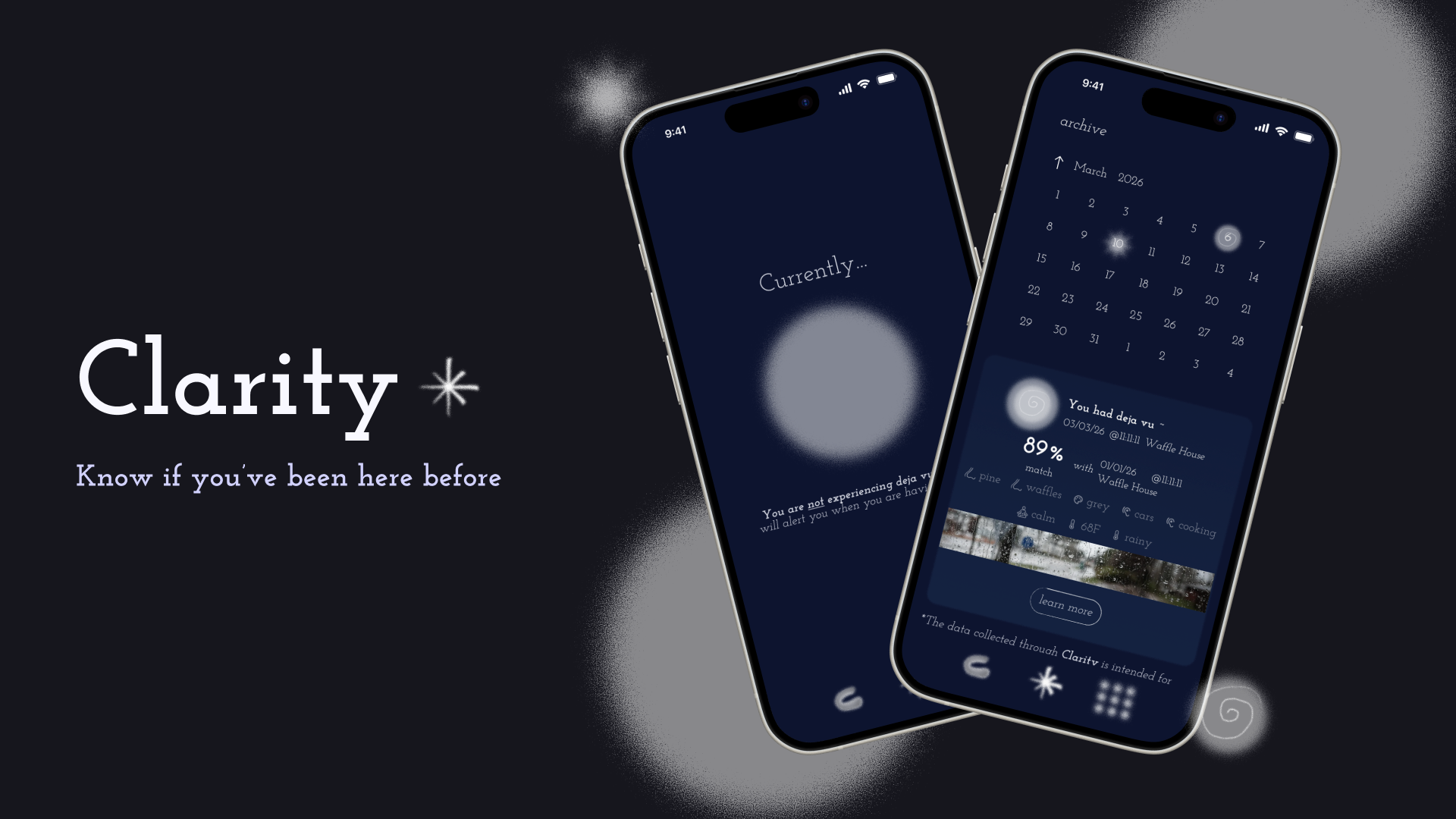
Introducing Clarity. Clarity aims to help people with cognitive impairments by helping them keep track of their memories. Using the newest technology, the Clarity earcuff keeps track of moments of deja vu and false familiarity (memory glitches). By showing the data within the Clarity app, we hope to bring confidence back into our users daily lives, allow for easy tracking of experiences for personal or medical use, and encourage people to take start early preventative measures to prevent decline.
👥 User Group
Clarity’s main user group are those that are facing cognitive impairments due to temporal epilepsy, Alzheimer’s, or the cognitive decline that comes with age. Clarity can also be used by the general public for those that are interested in learning more about themselves.
🧠 Sensory Experience
Clarity addresses the sensory experience of deja vu. For the majority of individuals, déjà vu is a temporary fleeting experience. For people with neurological conditions or declining memory, these moments can cause doubt between real experiences and false familiarity. Aiding people in differentiating between the two supports increase daily confidence in decisions and supports safer living.
Within this app we refer to deja vu as the experience of there being a familiar memory that matches your current state or the real experience. While false familiarity, or a memory glitch, is when you think there is something familiar but it is actually a new state, there is actually no past familiar memory.
🔗 Links
📖 References
[1] Towards a conflict account of déjà vu: The role of memory errors and memory expectation conflict in the experience of déjà vu [2] The Fascinating Science of Déjà Vu [3] That Strange Feeling of Déjà Vu — Explained [4] Déjà Vu: Meaning, Definition, And Why It Happens
Built With
- figma


Log in or sign up for Devpost to join the conversation.