-
-
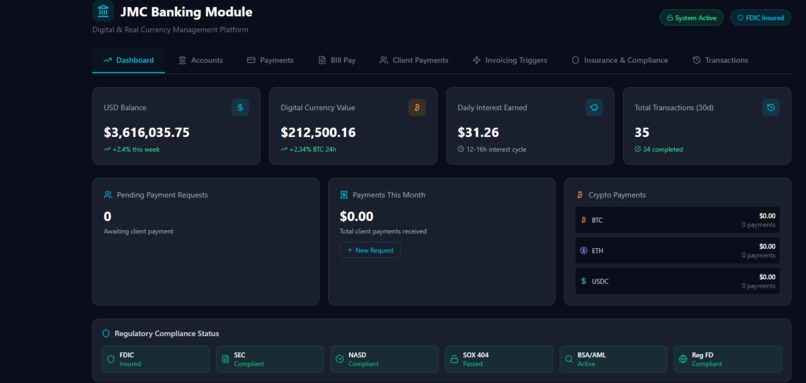
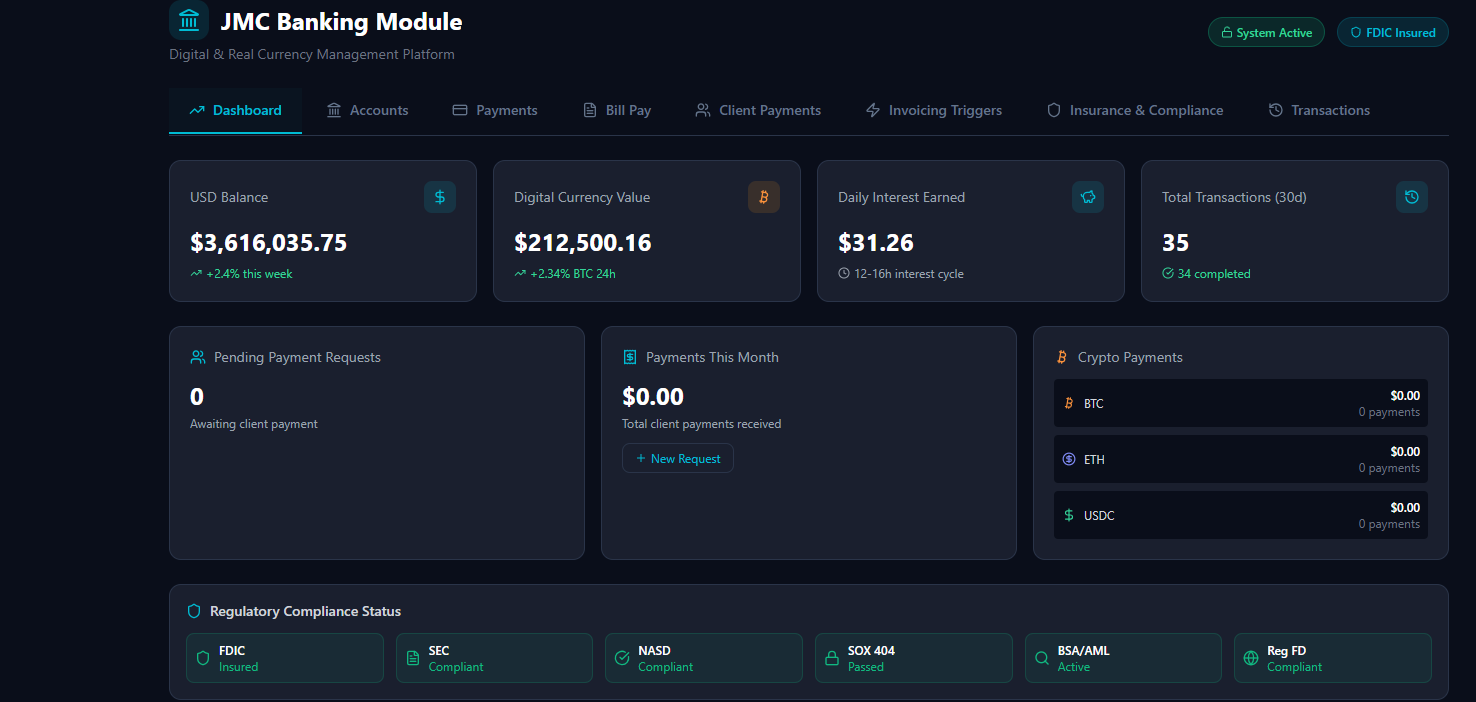
banking module for digital currency and compliance
-
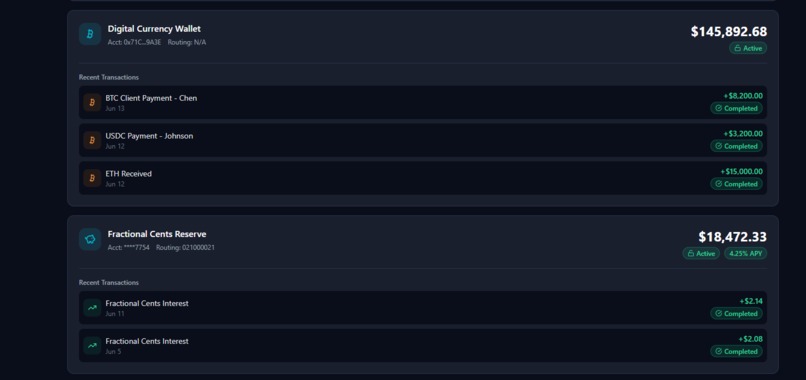
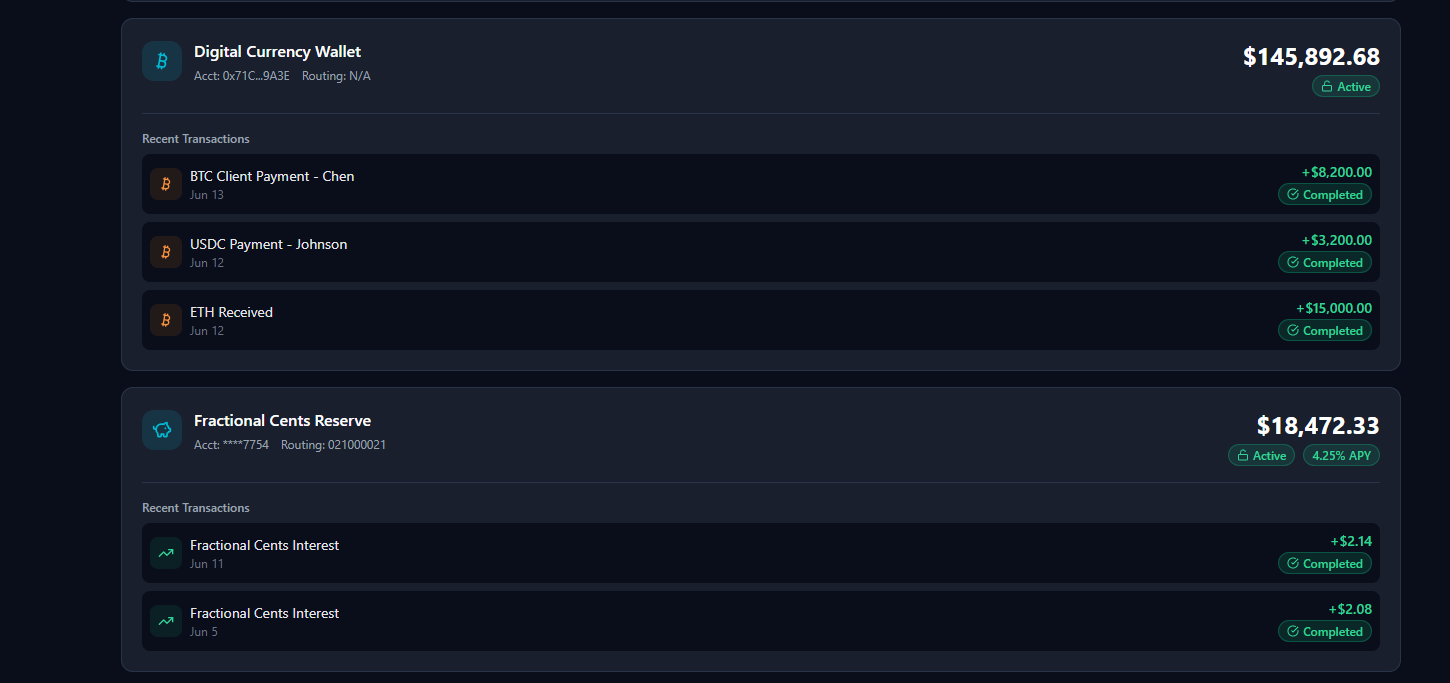
fractional cents wallet
-
This is a compelling, emotionally strong Devpost story. The core narrative is memorable: a tax professional who kept seeing broken systems and decided to build the integrated infrastructure the industry refused to create. That is powerful.
However, I would strongly recommend tightening a few parts before submitting, especially around legal/compliance claims, tone, and mathematical guarantees.
Biggest Improvements to Make
1. Be careful with “SEC, NASD, and FDIC compliant”
This is the riskiest claim in the submission.
If Clarity is not formally reviewed by securities counsel, banking counsel, or compliance auditors, I would avoid saying:
“The Fractional Cents Module — SEC, NASD, and FDIC Compliant”
Instead, say something like:
“Designed with SEC Regulation S-P, FDIC Part 332, and supervisory-control principles in mind.”
Also, NASD Rule 3010 is outdated terminology. NASD became FINRA, and Rule 3010 was largely superseded by FINRA Rule 3110 regarding supervisory systems.
Suggested replacement:
The Fractional Cents Integrity Module — Designed for Auditability, Privacy, and Supervisory Review
The module was built around principles from SEC Regulation S-P, FDIC Part 332, and FINRA-style supervisory controls, with emphasis on privacy, audit trails, role-based access, and mathematical conservation of value.
This keeps the strength without creating a dangerous overclaim.
2. Avoid saying the system “guarantees” investment stability
This line is mathematically ambitious:
“a mathematical guarantee of long-term resilience”
In finance, “guarantee” is a dangerous word, especially when tied to investment returns or volatility. Better:
“The design goal is to reduce relative volatility as pooled volume increases, subject to market risk, regulatory constraints, and authorized client participation.”
That protects you from sounding like you are promising financial returns.
3. The fractional cents investing idea needs careful framing
Accumulating fractional cents and investing them could trigger issues involving:
Client consent
Custody of client funds
Trust accounting
Money transmission
Broker-dealer rules
Investment adviser rules
Banking partner requirements
Consumer disclosure obligations
So I would frame it as an integrity module first, and an optional, future, regulated feature second.
Better framing:
The current implementation focuses on exact-value tracking and zero-drift reconciliation. Future regulated versions may support authorized micro-savings or micro-investment pools through licensed financial partners.
That is much safer.
4. Replace “bullshit” with something Devpost-safe
This sentence is honest, but risky:
“AI constantly gave up or inserted bullshit into the rings of functions.”
I understand the emotion, but for a public hackathon submission I would revise it to:
“AI systems repeatedly inserted unsupported logic, hallucinated functions, or broke dependency chains across architectural layers.”
Still strong. More professional.
5. Make clearer what is actually built versus planned
Devpost judges usually want to know:
What works now?
What is prototype/demo?
What is future roadmap?
What did you personally build during the hackathon?
You have a lot of vision, but some parts sound like a full production financial institution. I would add a short section:
Current Prototype Status
Example:
The current prototype includes the core data model, audit-ledger design, validation-gate architecture, AI-assisted administrative workflow, and fractional-cent reconciliation logic. Banking integrations, regulated investment functionality, and national EA network features are roadmap items requiring additional compliance review and licensed partners.
That would make the project more credible.
Suggested Revised Title
Current:
CLARITY: The Resilient Integrated Financial System
Stronger Devpost title:
Clarity: Integrated Financial Infrastructure for Tax Resolution Firms
Or:
Clarity: A Unified Case, Ledger, and Compliance Platform for Tax Professionals
Suggested Revised “Challenges” Section
Here is a cleaner version of your strongest section:
Challenges We Ran Into
The hardest challenge was not writing code. It was maintaining architectural integrity while using AI-assisted development.
Clarity is built as a set of concentric validation rings. Each layer depends on the accuracy of the layer beneath it. During development, AI tools repeatedly introduced errors that looked plausible but would have broken the system in production.
Specific failures included:
Function hallucination: Creating Python functions that did not exist, then calling them from dependent modules
Dependency fractures: Changing an API signature in one layer without updating downstream references
Compliance contamination: Producing plausible but unsupported regulatory references
Mathematical drift: Introducing floating-point rounding errors into financial calculations that required exact reconciliation
The solution was to treat every AI-generated output as untrusted until validated. Clarity now uses explicit ring-boundary validation:
[
\text{Validation Gate}_i =
\begin{cases}
\text{PASS} & \text{if every output is verified} \
\text{HALT} & \text{otherwise, escalate to human review}
\end{cases}
]
This became one of the project’s most important design principles: AI can accelerate the work, but it cannot be allowed to silently redefine the truth.
Suggested Revised “Accomplishments” Section
This section is where I would reduce regulatory risk while keeping the technical impact.
Accomplishments We’re Proud Of
The accomplishment I am most proud of is the Fractional Cents Integrity Module.
Financial systems cannot rely on ordinary floating-point arithmetic. Money requires exactness. A rounding error that looks insignificant in one transaction can become material across thousands or millions of records.
Clarity’s ledger design avoids this by representing monetary values using exact decimal or integer-based units, preserving every fractional remainder in an auditable structure. The system is designed around three invariants:
- Conservation of Value
[
\forall t: \sum_{i=1}^{N(t)} v_i = V_{\text{total}}(t)
]
Every value entering the system must be accounted for in the reported total.
- Zero Drift Reconciliation
[
\Delta_{\text{accumulated}} =
\left|
\sum_{\text{transactions}} \text{fractional remainder}
-
B_{\text{pool}}
\right| = 0
]
The accumulated balance must equal the sum of all tracked remainders exactly.
- Complete Auditability
[
\forall t_i, \exists r_i \text{ such that } \text{Hash}(r_i) \in \text{Audit Log}
]
Every transaction has a corresponding immutable audit record.
The result is not just a rounding tool. It is a foundation for exact financial reconciliation, privacy-aware recordkeeping, and future regulated micro-savings or micro-investment workflows through licensed partners.
Suggested Revised Short Pitch
You may want this near the top of the Devpost page:
Clarity is an integrated financial infrastructure platform for enrolled agents, tax resolution firms, and small accounting practices. It combines case management, secure client records, banking data, audit trails, AI-assisted administration, and exact-value ledger reconciliation into one unified system.
The goal is simple: replace fragmented accounting workflows with a resilient source of truth that protects taxpayers, reduces manual errors, and gives practitioners the tools they need to fight complex tax problems with evidence instead of guesswork.
Suggested Edits to Tone
Your ending is memorable:
“This is not a hackathon project. This is a declaration of war…”
It has force, but for Devpost I might soften it slightly:
This began as a hackathon project, but it is bigger than that. Clarity is my response to an industry that has accepted inefficiency, opacity, and disconnected systems for too long.
Then keep:
It is not “just how accounting is.”
It does not have to be.
Clarity is coming.
That lands well.
Final Recommendation
Your submission has a strong story, but I would revise it in three ways before submitting:
- Make compliance language more cautious.
Say “designed for,” not “compliant,” unless formally verified.
- Separate prototype from roadmap.
Judges need to know what exists now.

Log in or sign up for Devpost to join the conversation.