Inspiration
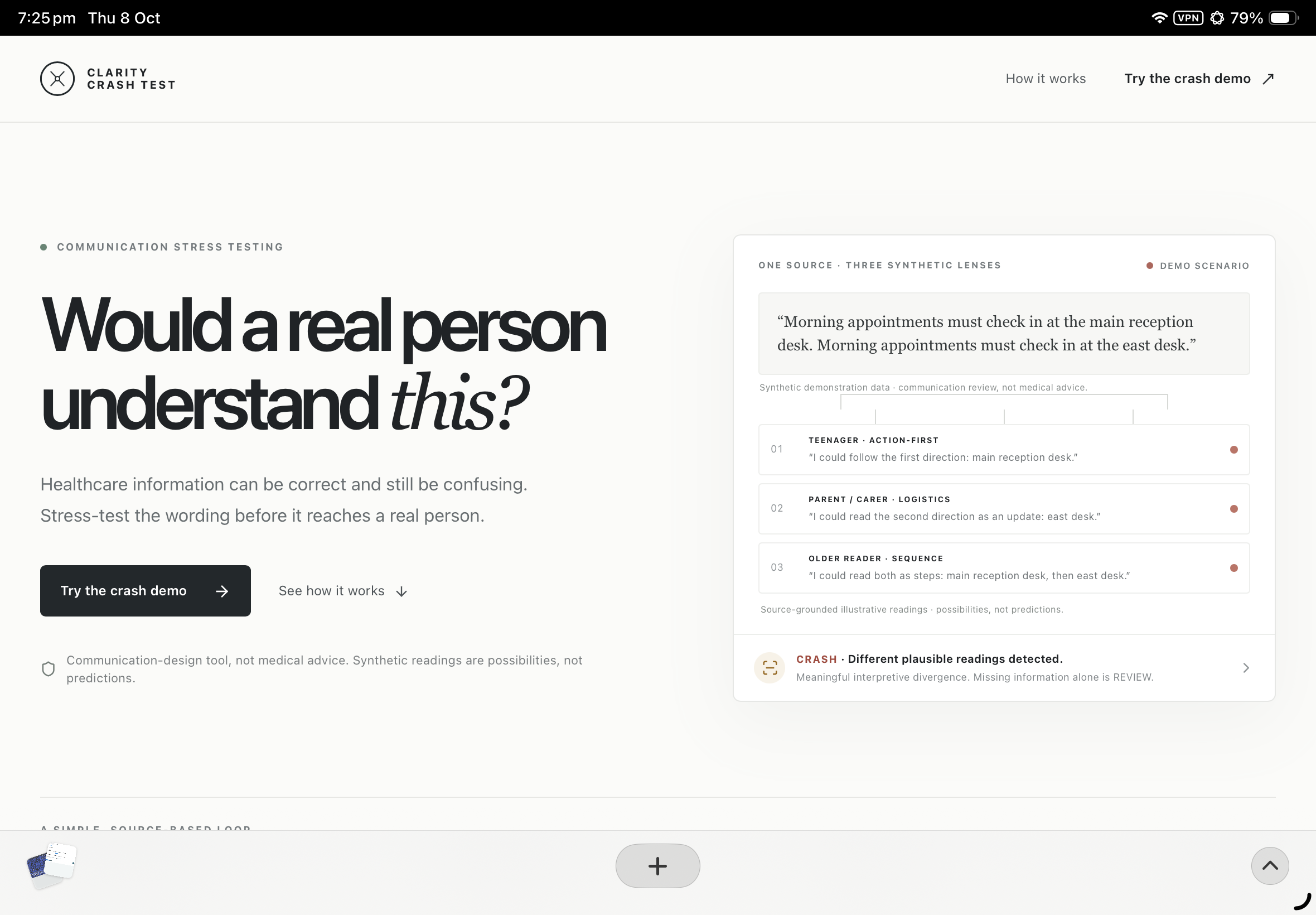
Healthcare information can be factually correct and still be difficult to act on.
A patient-facing instruction might make perfect sense to the person who wrote it, but a different reader can focus on a different part of the same sentence, interpret an instruction differently, or realise that an important detail was never actually specified.
That gap between what the author intended and what a reader could reasonably understand is what inspired Clarity Crash Test.
I wanted to explore whether AI could be used not as a doctor or medical chatbot, but as a tool for stress-testing communication before it reaches a real person.
What it does
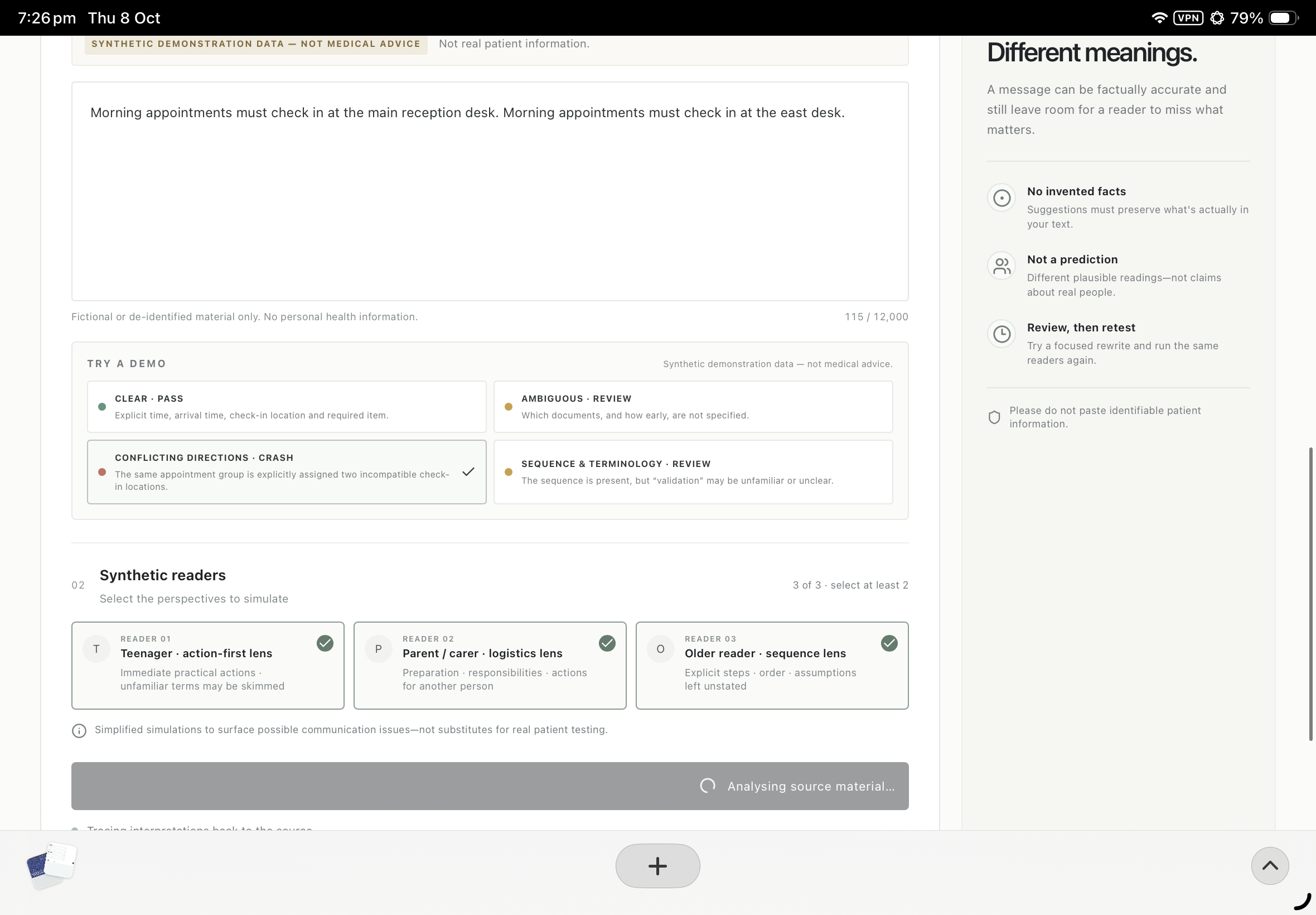
Clarity Crash Test takes patient-facing healthcare communication and evaluates it through several synthetic reading lenses:
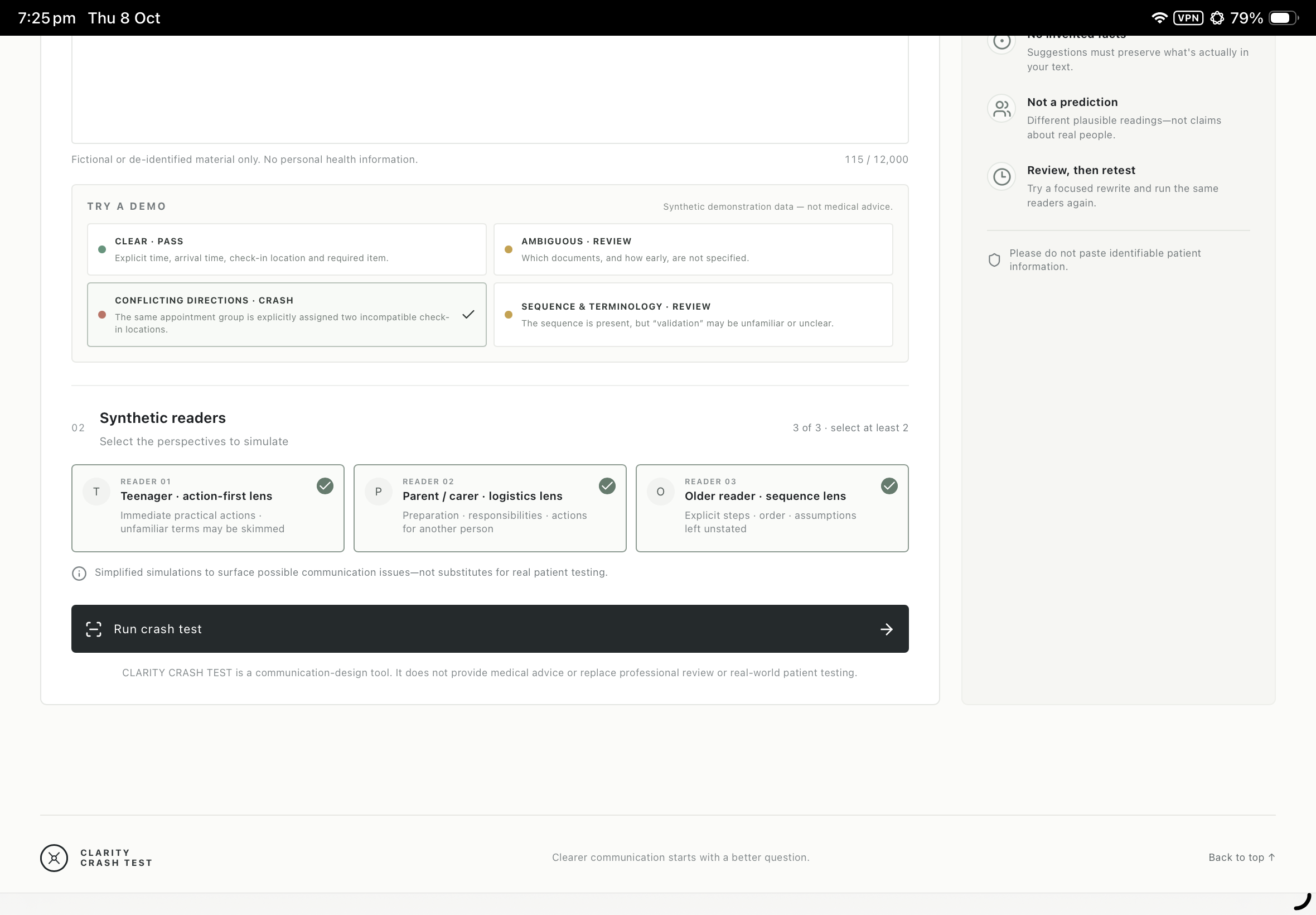
- a teenager / action-first lens
- a parent or carer / logistics lens
- an older-reader / sequence lens
These are not predictions about demographic groups. They are simplified synthetic reading strategies designed to surface different plausible ways wording could be understood.
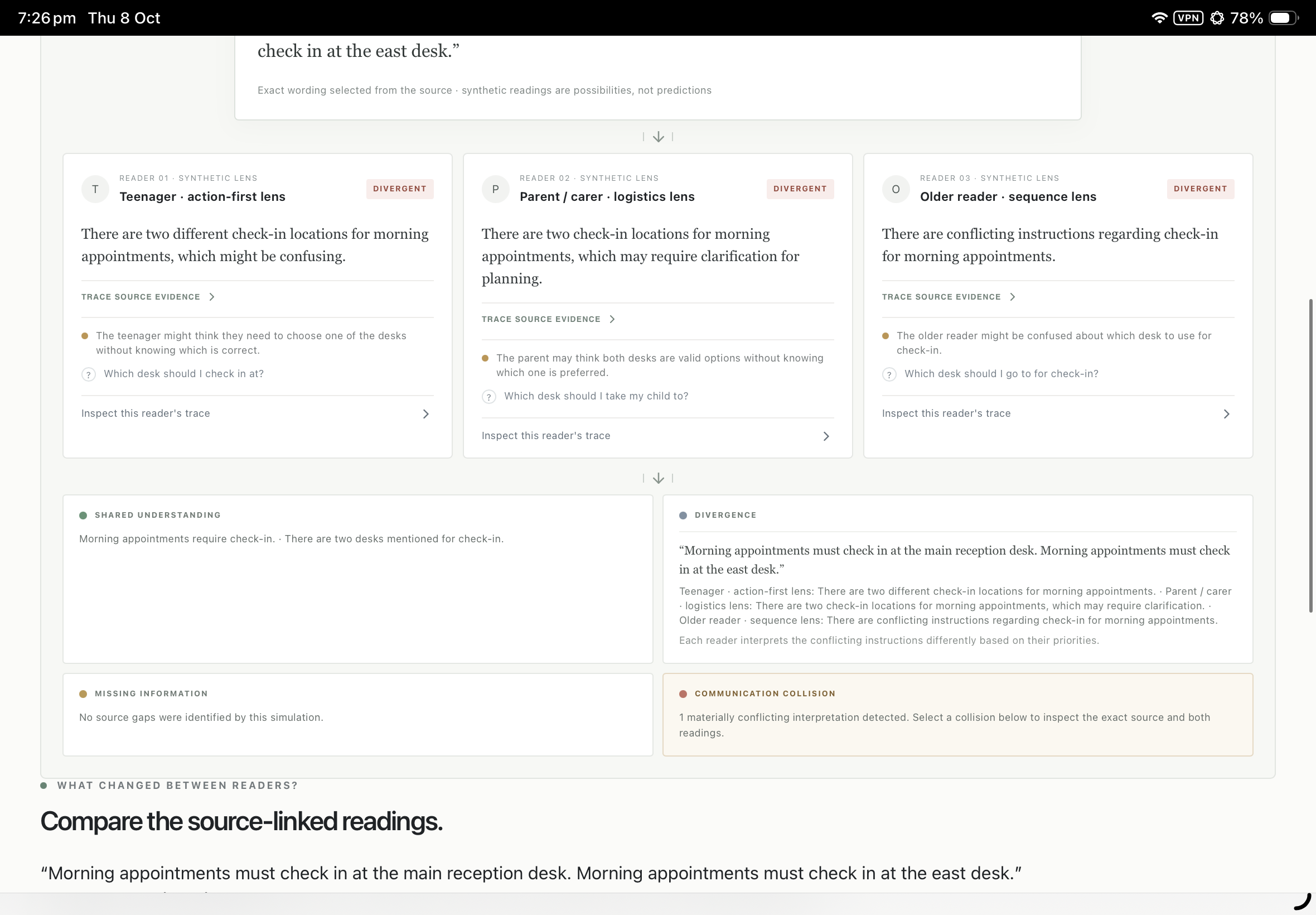
The system then compares the resulting interpretations and separates them into:
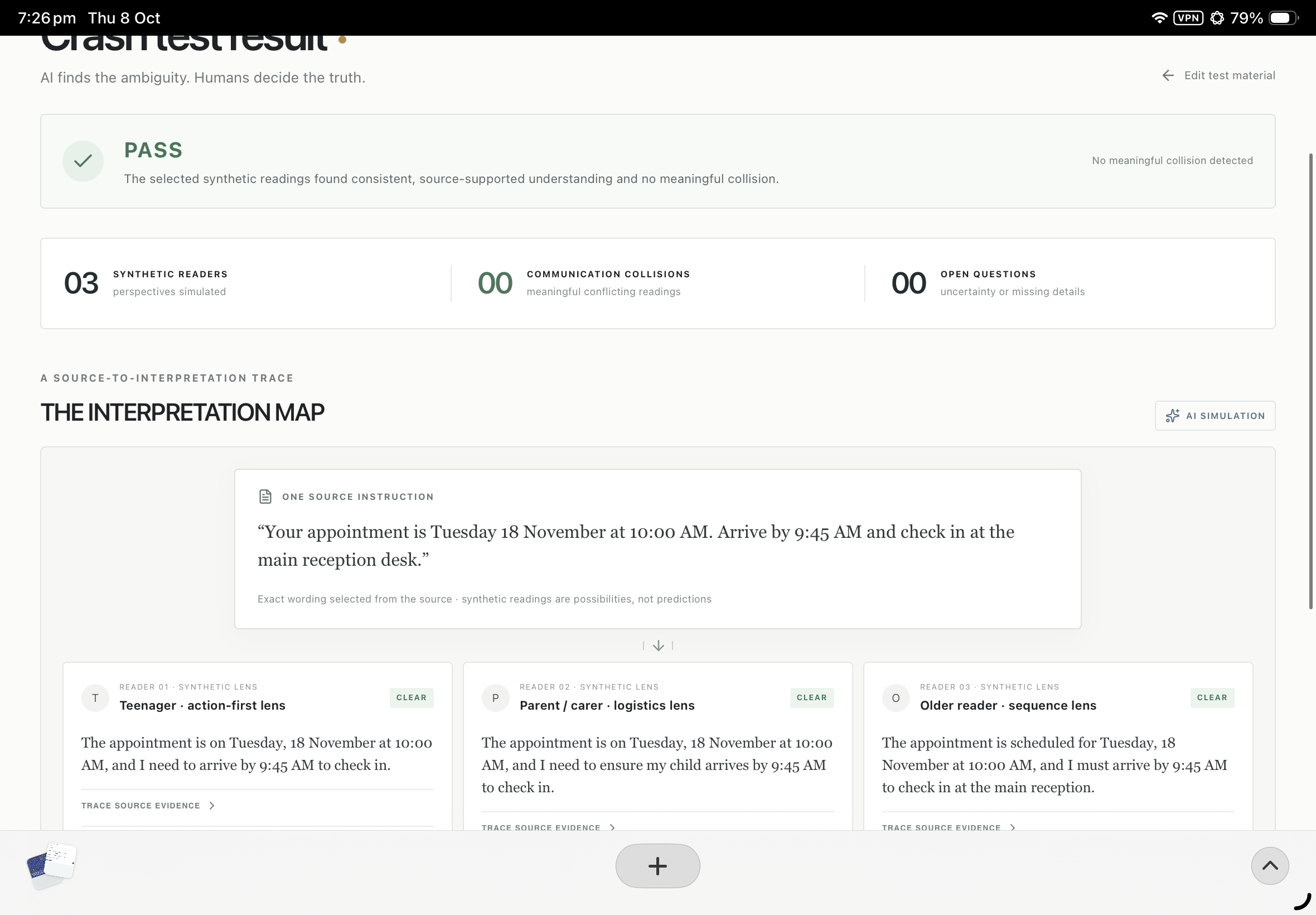
PASS — no meaningful communication collision detected.
REVIEW — uncertainty, ambiguity, or missing information that should be checked.
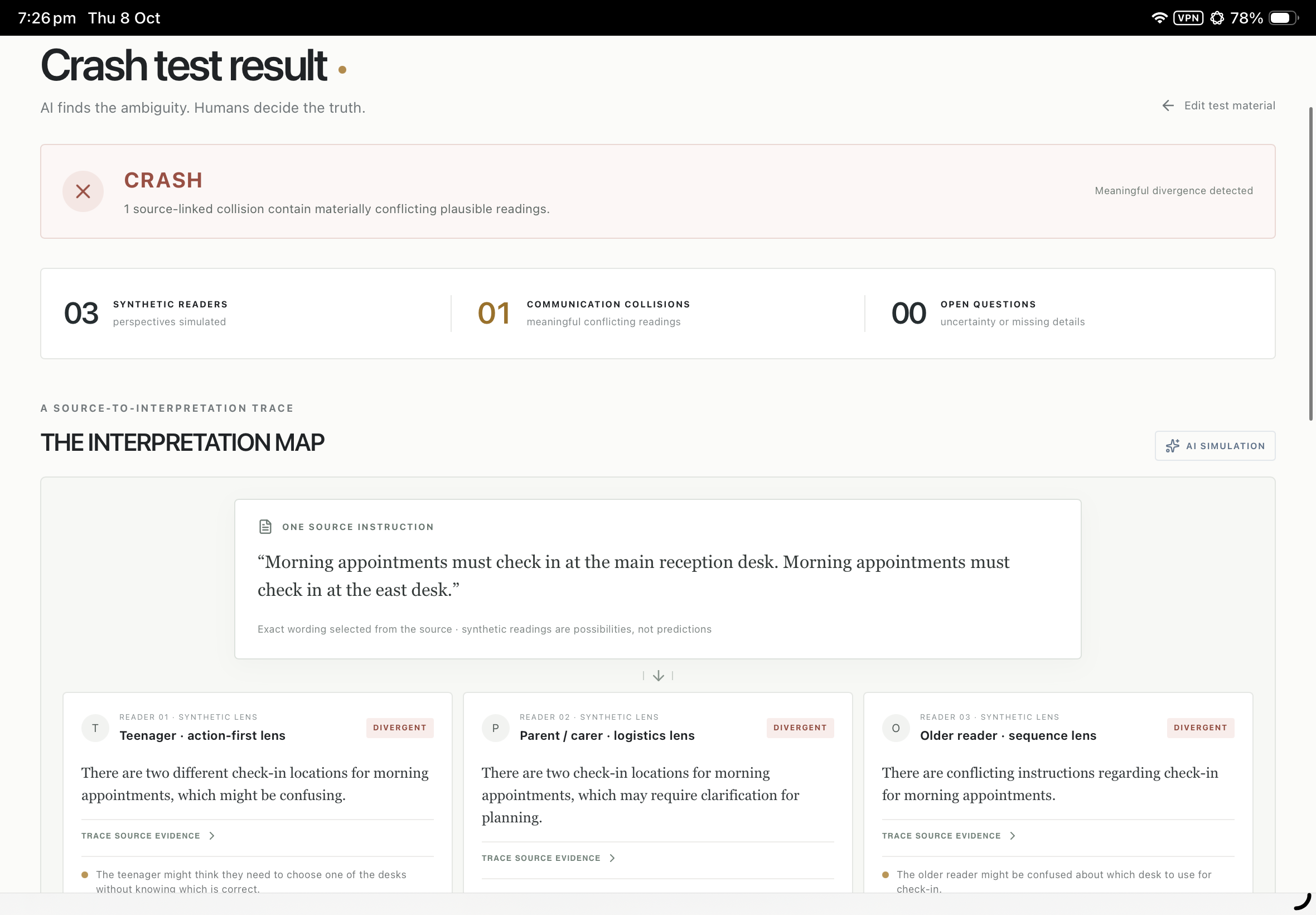
CRASH — a meaningful divergence where plausible interpretations conflict.
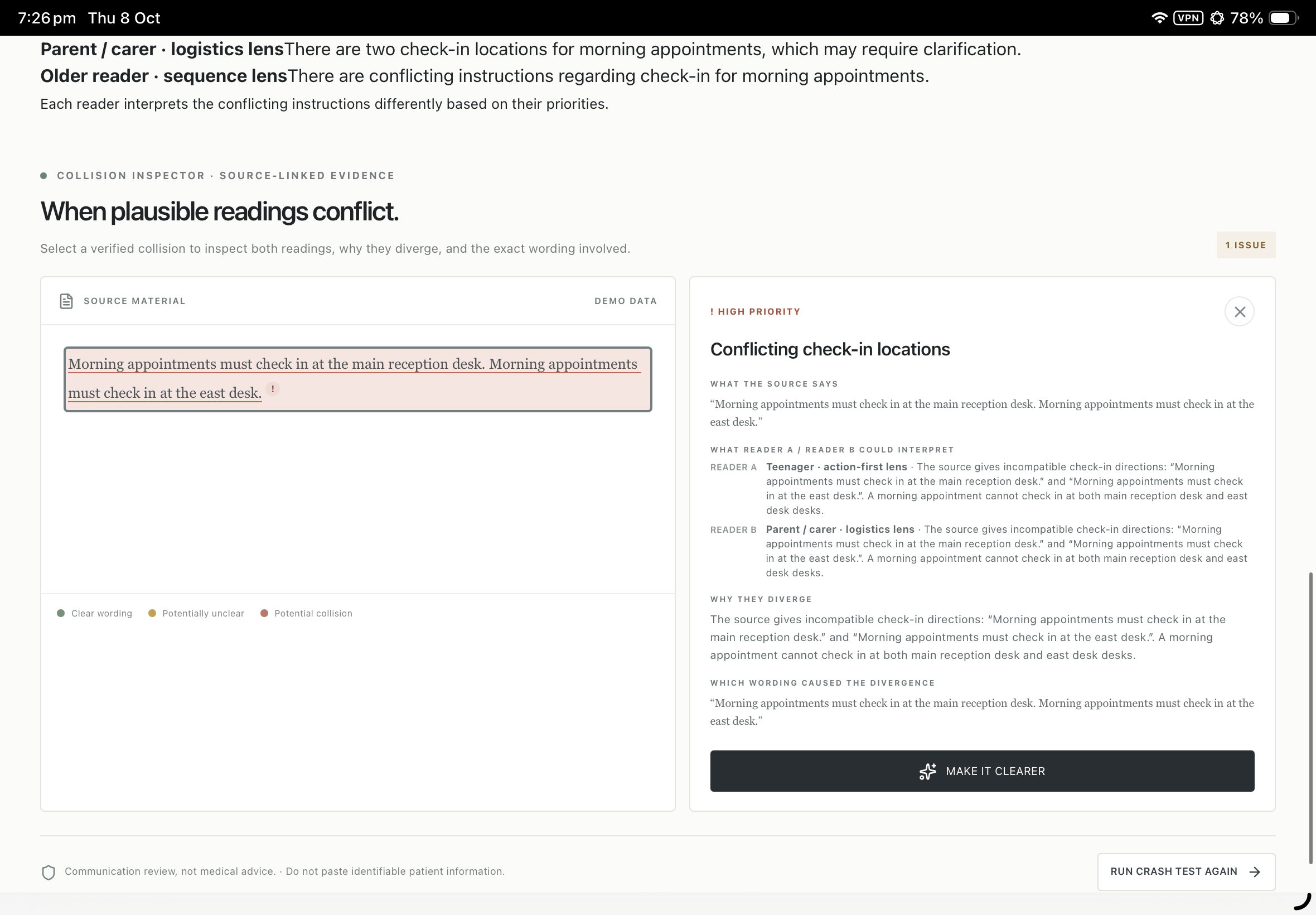
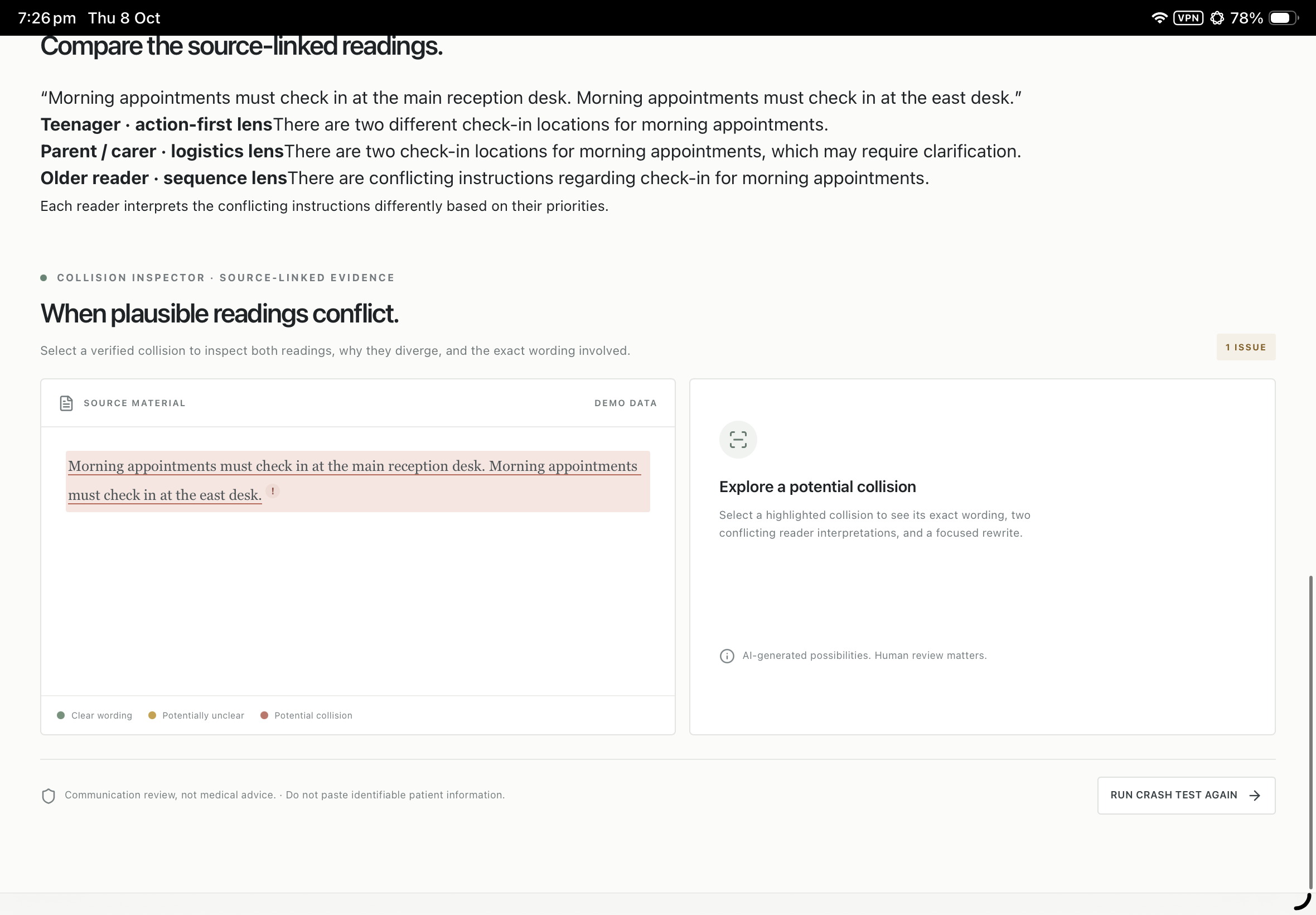
The key part of the experience is the Interpretation Map. It connects the original source wording to the different synthetic interpretations and allows the user to trace a potential problem back to the exact wording that caused it.
When an issue is found, the system can suggest a clearer rewrite while preserving the factual information present in the source.
If the source does not contain enough information to safely rewrite something, the system does not invent the missing detail. Instead, it asks for author input.
The central principle of the project is:
AI finds the ambiguity. Humans decide the truth.
How I built it
I built Clarity Crash Test as a web application with AI at the centre of the analysis workflow.
The interface was designed around a deliberately simple loop:
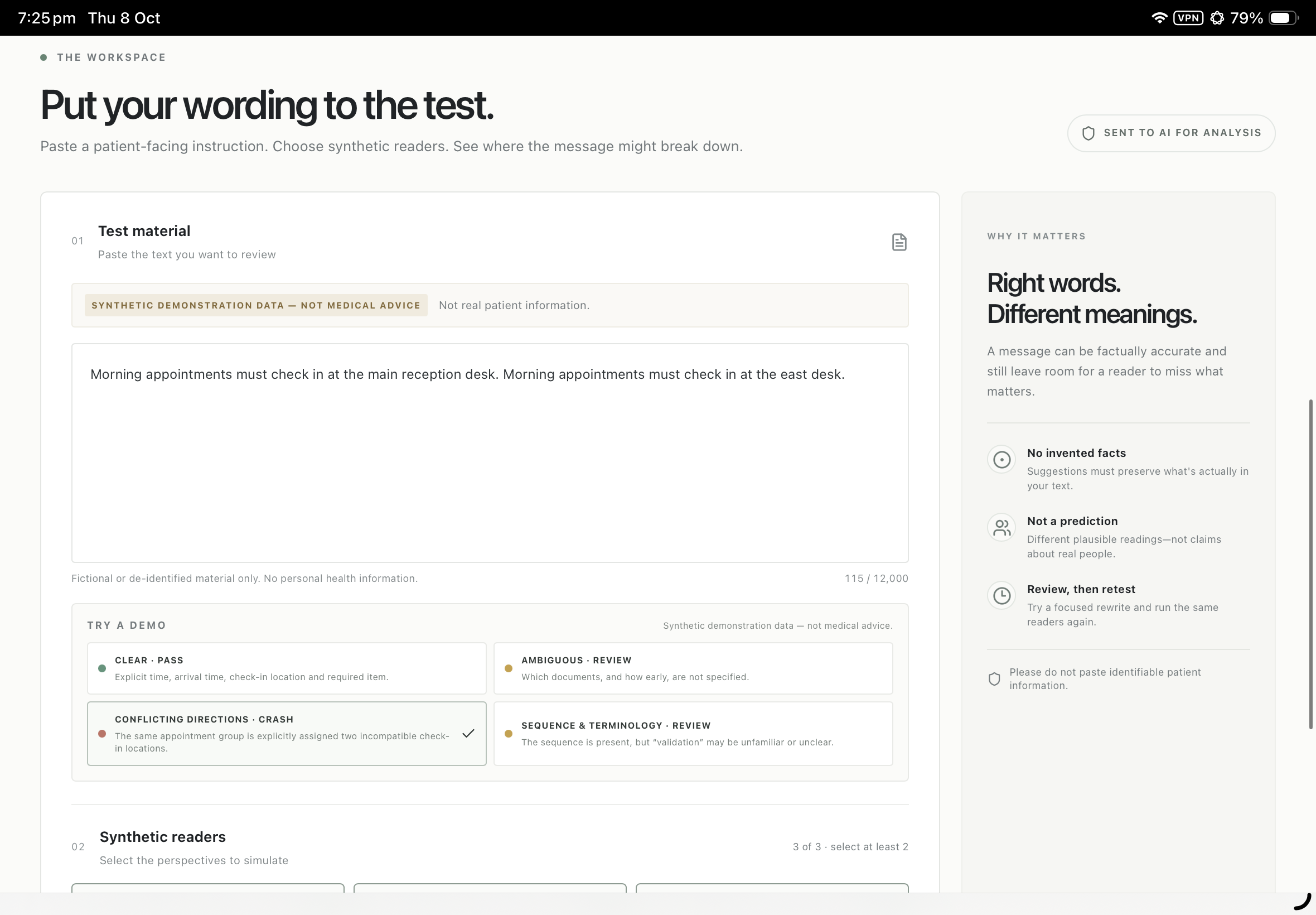
Paste material → choose synthetic readers → run crash test → compare interpretations → inspect the collision → clarify the wording → re-test.
I focused heavily on the interaction design because I wanted the AI's reasoning to be visible rather than hidden inside a generic chat interface.
The result is a visual workflow where the source, interpretations, evidence and outcome are connected.
The project was built with AI-assisted development and a modern TypeScript-based web interface.
What I learned
One of the biggest things I learned was that adding AI to a product is not enough.
The AI needs to perform a task where its ability to reason across possibilities actually adds value.
I also learned that healthcare AI needs strong boundaries. Clarity Crash Test deliberately avoids diagnosis, treatment recommendations and medical decision-making. It analyses communication rather than health conditions.
Another important lesson was that uncertainty and conflict are not the same thing.
A sentence can be vague without creating two genuinely conflicting interpretations. Because of that, the system distinguishes between missing information, uncertainty, divergence and a real communication collision instead of treating every unclear sentence as an error.
Challenges
The hardest challenge was making the synthetic reading experience useful without pretending that AI can accurately predict how real people will behave.
I addressed this by treating the readers as synthetic lenses rather than representations of real demographic groups, by tracing interpretations back to source evidence, and by making the product explicit that simulated readings are possibilities rather than predictions.
Another challenge was preventing the AI from "fixing" missing information by inventing it. Clarity Crash Test therefore uses source-grounded rewriting: when a safe rewrite requires facts that are not present, the system asks the author to provide them instead.
What's next
The current version focuses on the core communication stress-testing loop.
Future versions could support more types of patient-facing material, stronger accessibility-oriented testing, richer source formats such as PDFs, and evaluation against real-world patient usability research.
The goal would not be to replace human testing, but to make it easier for healthcare teams to identify communication problems earlier and decide what deserves human review.

Log in or sign up for Devpost to join the conversation.