-
-
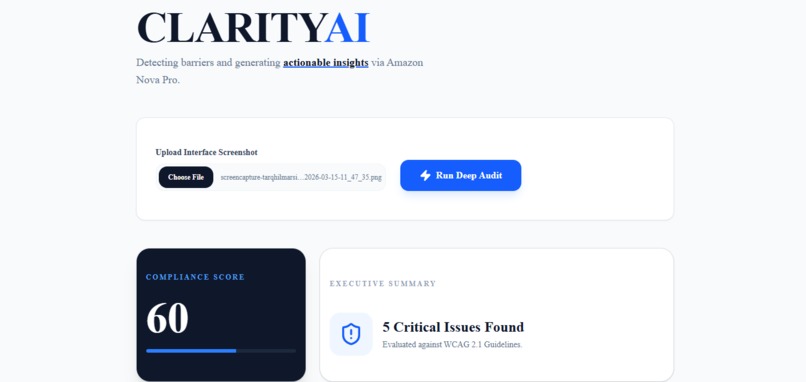
Clarity AI
Inspiration
Digital inclusivity is often treated as an afterthought, yet millions of users with disabilities struggle to navigate the web daily. Manual Web Content Accessibility Guidelines (WCAG) auditing is a bottleneck it’s expensive, slow, and requires niche expertise. I was inspired by the multimodal "vision" capabilities of Amazon Nova Pro to bridge this gap. My goal was to democratize accessibility by creating an AI-driven consultant that can perceive UI barriers just like a human expert, making inclusive design accessible to every developer.
What it does
Clarity AI is a serverless auditing platform that transforms static UI screenshots into comprehensive accessibility reports. By simply uploading an image, users receive:
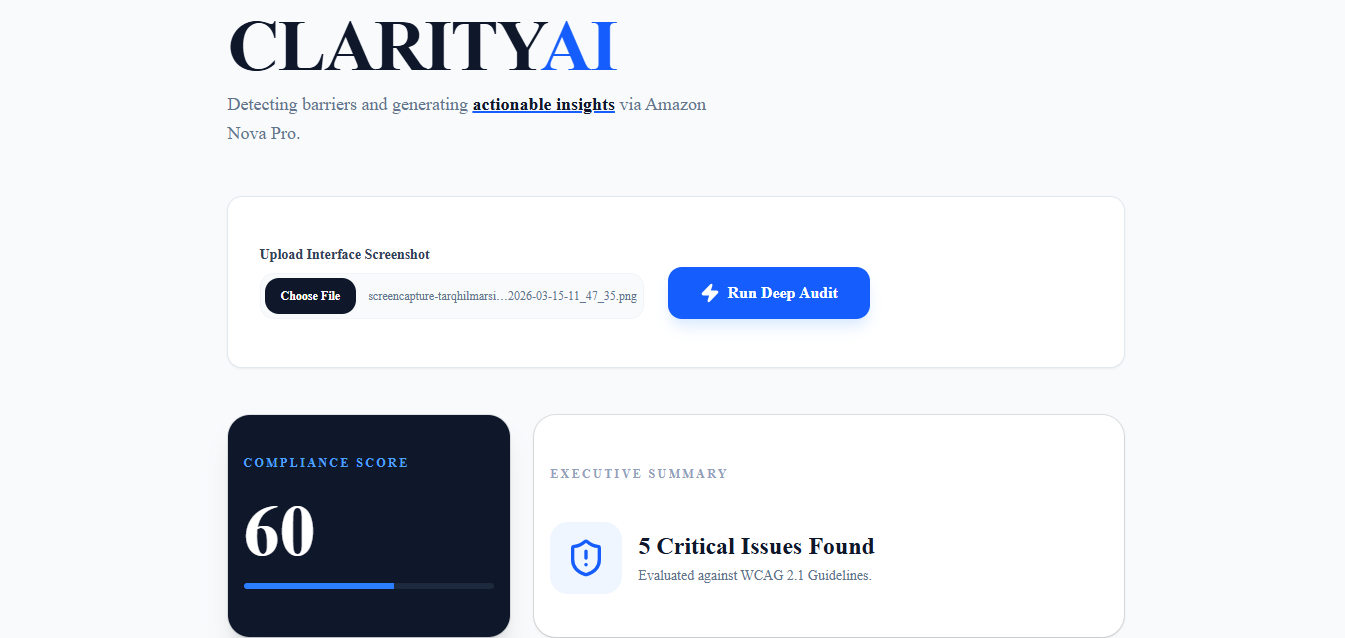
- Clarity Score: An instant enterprise-grade compliance rating.
- Executive Summary: A high-level overview of detected barriers.
- Actionable Findings: Detailed identification of issues (like low contrast or missing labels) categorized by WCAG POUR principles (Perceivable, Operable, Understandable, Robust) with specific severity levels and remediation advice.
- Exportable Reports: Professional PDF exports for seamless team collaboration.
How we built it
The project is built on a 100% AWS-native serverless architecture:
- AI Core: Amazon Bedrock provides the backbone, utilizing the Amazon Nova Pro model for its superior multimodal reasoning and visual perception.
- Backend: Developed with Python and hosted on AWS Lambda, using Amazon API Gateway to manage RESTful requests.
- Frontend: A modern, responsive interface built with Next.js 14, Tailwind CSS, and Lucide Icons for a clean, accessible user experience.
- Integration: Used the Amazon Bedrock Converse API to facilitate structured, stable communication between the application logic and the AI model.
Challenges we ran into
The primary technical hurdle was managing the integration between the frontend and the AI model within a serverless environment. Initially, we faced AWS Lambda timeouts and 502 Bad Gateway errors because the deep visual reasoning performed by Nova Pro required more processing time than the default settings. I successfully resolved this by optimizing the Lambda execution timeout and refining the payload handling to ensure a stable, resilient connection that could handle high-latency AI inference without breaking the user experience.
Accomplishments that we're proud of
- Stable Parsing Engine: Successfully engineered a robust prompt-response cycle that consistently parses complex AI analysis into a structured, user-friendly UI.
- Contextual Intelligence: Fine-tuning the interaction with Nova Pro so it doesn't just "detect" but actually "understands" WCAG principles, providing meaningful advice rather than generic labels.
- Enterprise-Ready UI: Delivering a polished, professional dashboard that makes complex accessibility data easy to digest at a glance.
What we learned
Building Clarity AI taught me the intricacies of Multimodal Prompt Engineering specifically how to guide an AI model to interpret spatial UI elements accurately. I also gained deep experience in AWS Serverless optimization, learning how to balance Lambda's transient nature with the heavy lifting of generative AI workloads. Most importantly, I learned that AI’s greatest value lies in its ability to scale human empathy and inclusivity.
What's next for Clarity AI
The roadmap for Clarity AI includes moving from static images to dynamic interactions. I plan to utilize Amazon Nova's advanced video understanding to allow users to upload screen recordings of their apps. This will enable the AI to detect dynamic accessibility issues, such as keyboard focus traps, navigation logic errors, and flashing content that could trigger seizures creating a truly holistic audit tool for the modern web.
Built With
- amazon-api-gateway
- amazon-bedrock
- amazon-nova
- aws-lambda
- javascript
- next.js
- python
- tailwind-css
- typescript


Log in or sign up for Devpost to join the conversation.