Inspiration
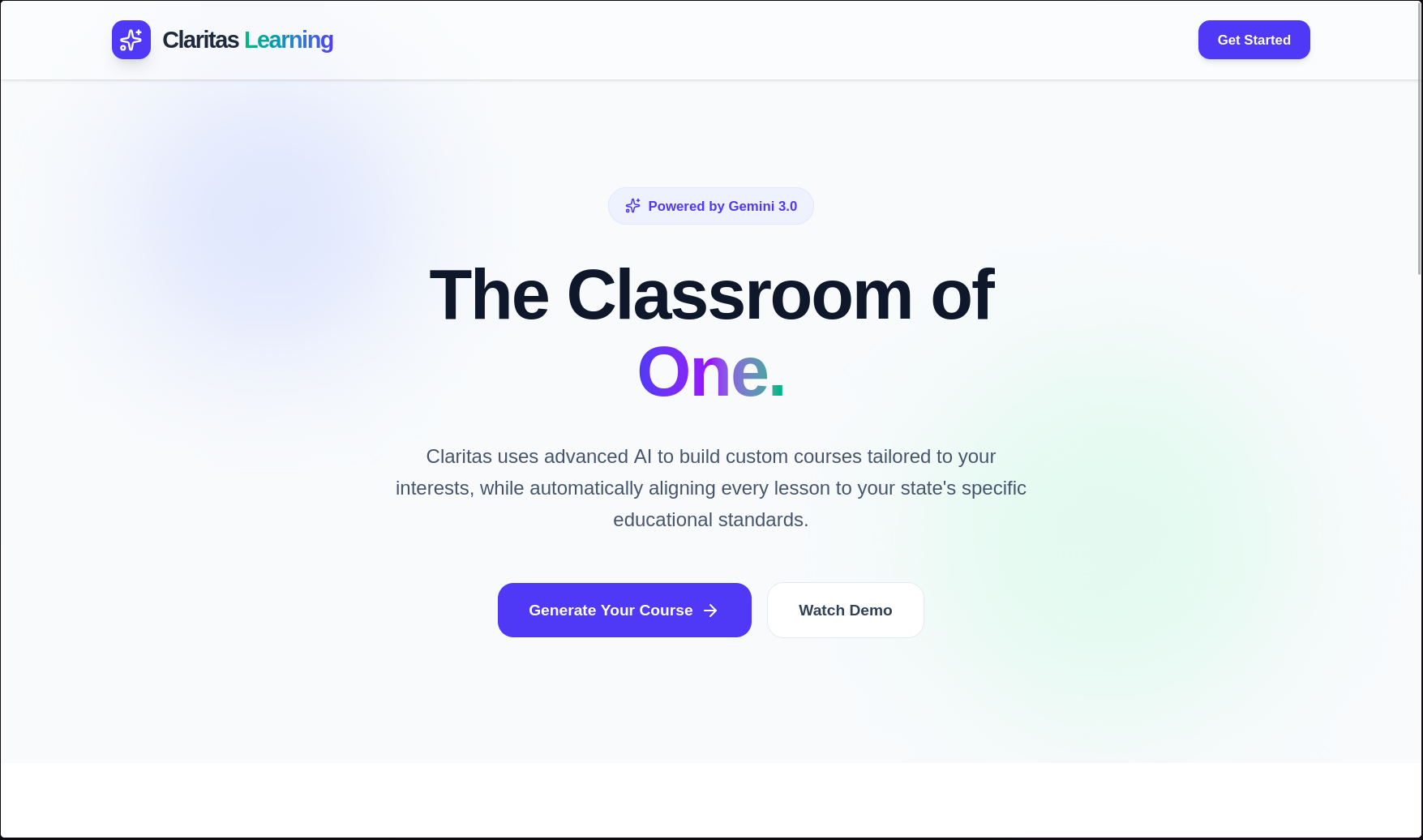
Education is the cornerstone of progress, but traditional classrooms often struggle to accommodate the unique interests, paces, and learning styles of every student. We wanted to build a new system of learning, that adapts the curriculum to the user and not the other way around. By leveraging the power of Gemini, we wanted to bridge the gap between generic AI generated content and high quality, state aligned educational standards, making personalized learning accessible to everyone.
What it does
Claritas Learning is an AI-driven platform that:
- Generates Tailored Courses: Creates full-scale course plans based on a user's chosen topic, age group, and skill level.
- State Standard Alignment: Automatically aligns lesson plans with specific educational standards from states like California (NGSS), Texas (TEKS), New York (Regents Master), and more.
- Interactive Modules & Topics: Breaks down courses into manageable units and subtopics, generating detailed content for each.
- Adaptive Assessment: Features module-level quizzes with both Multiple Choice (MCQ) and Free Response (FRQ) questions. It tracks "weak subtopics" to help students focus on areas needing improvement.
- Socratic Tutor: Includes an AI-powered tutor that uses the Socratic method to guide students through difficult quiz questions without giving away the answers.
- Progress Tracking: Enrolled students can track their completion status and quiz scores across multiple courses.
How we built it
- Frontend: Built with Next.js, TypeScript, and Tailwind CSS 4. We used Lucide React for iconography, Framer Motion for smooth UI interactions, and React Markdown with KaTeX for beautiful rendering of educational content and mathematical formulas.
- Backend: A FastAPI (Python) server handles the heavy lifting, including prompt orchestration, rate limiting (via SlowAPI), and API routing.
- AI Core: Powered by the Gemini 3.0 Flash model via the latest google-genai SDK. We developed specialized prompt templates for course planning, content generation, and Socratic tutoring.
- Database & Storage: Supabase is used for user authentication, storing course progress, quiz attempts, and caching generated JSON course plans via Supabase Storage.
- Deployment: The backend is containerized with Dockerfile and ready for cloud deployment.
Challenges we ran into
- Prompt Engineering for Structure: Ensuring Gemini consistently returned valid, deeply nested JSON for complex course plans required rigorous prompt refinement and schema validation.
- Socratic Tutoring Logic: It was challenging to programmatically ensure the AI tutor never gave away the answer while still being helpful and encouraging. We achieved this through strict system instructions and few-shot examples.
- State Alignment Accuracy: Mapping generic topics to specific state-level standards like TEKS or NGSS required a "bridge" logic to ensure the AI stayed within the pedagogical boundaries of those frameworks.
- Adaptive Retakes: Implementing a system that remembers a student's past mistakes and generates a "retake" quiz specifically targeting those weaknesses required complex database queries and prompt injection.
Accomplishments that we're proud of
- True Personalization: Building a system that can turn any topic—from "The History of Jazz" to "Quantum Computing for 4th Graders"—into a structured, pedagogically sound course.
- The Socratic Tutor: Seeing the AI successfully guide a student through a difficult concept by asking probing questions rather than just providing the solution.
- Seamless Integration: Successfully combining a modern Next.js frontend with a robust Python backend and Supabase for a full-stack educational experience.
- Visual Design: Creating a clean, modern, and accessible UI that makes learning feel engaging and intuitive.
What we learned
- AI as a Pedagogical Tool: We learned that AI's greatest strength in education isn't just generating content, but acting as a reasoning partner through methods like Socratic dialogue.
- Data Persistence in AI Apps: Handling large amounts of generated AI data (like full courses) requires a smart caching and storage strategy to ensure performance and cost-efficiency.
- Prompt Sensitivity: We discovered how much small changes in age-group or skill-level metadata can dramatically shift the tone and complexity of the generated curriculum.
What's next for Claritas Learning
- Full 50-State Support: Expanding our state-standard bridge to cover all US states and international standards (like IB or GCSE).
- Multimedia Integration: Automatically generating or sourcing relevant images, videos, and interactive simulations for each topic.
- Teacher Dashboard: Creating a suite of tools for educators to oversee student progress, assign courses, and customize generated content.
- Voice-Activated Learning: Integrating voice-to-text and text-to-speech for a hands-free, conversational Socratic tutoring experience.
Built With
- docker
- fastapi
- florida-b.e.s.t.
- framer-motion
- gemini-2.0-flash
- google-genai
- katex
- lucide-react
- next.js
- ngss
- postcss
- postgresql
- pydantic
- pyjwt
- python
- python-multipart
- react
- react-markdown
- regents-master
- rehype-katex
- remark-math
- slowapi
- supabase
- supabase-auth
- supabase-storage
- tailwind-css-4
- teks
- typescript
- uvicorn

Log in or sign up for Devpost to join the conversation.