-
-
Thumbnail
-
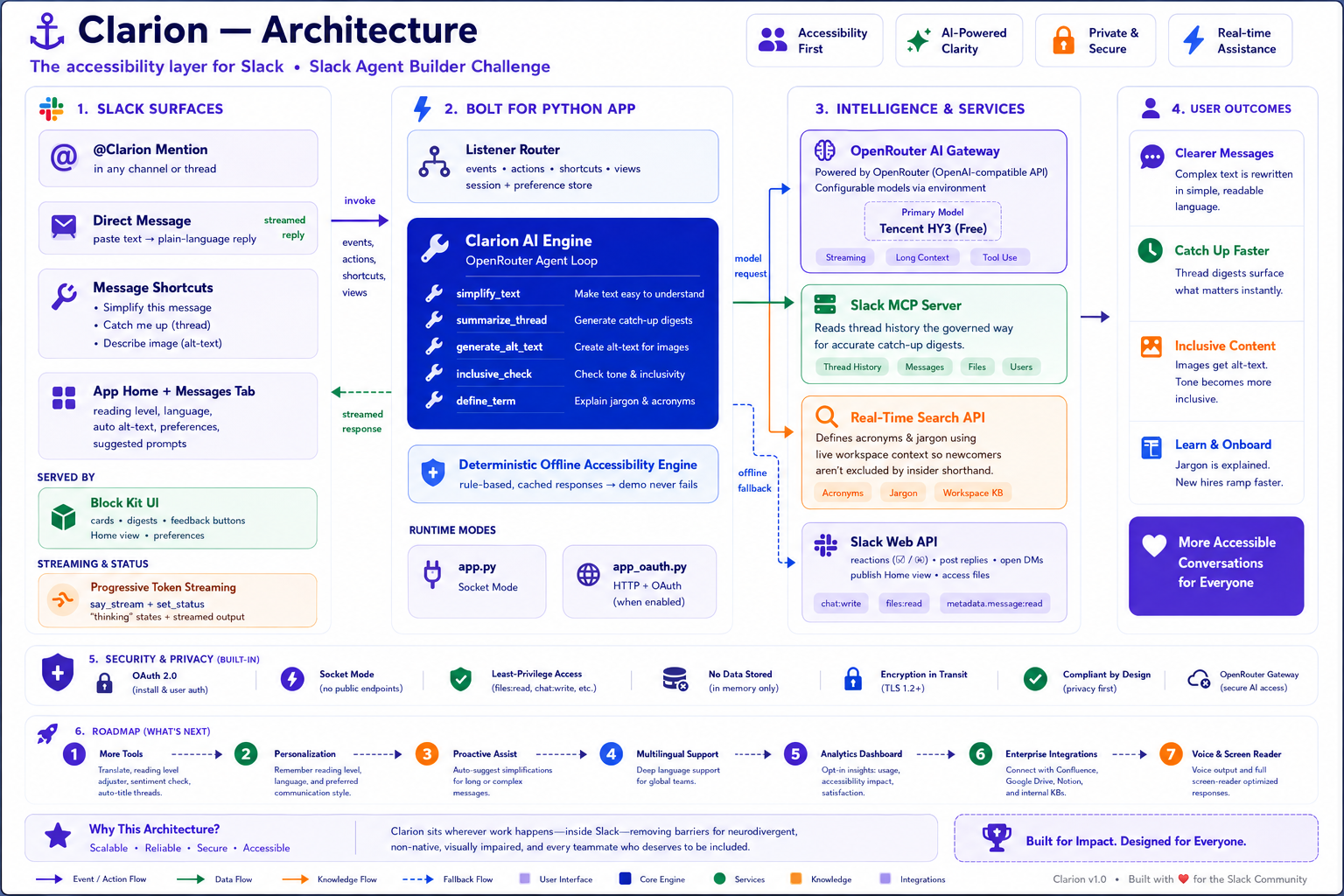
Architecture
-
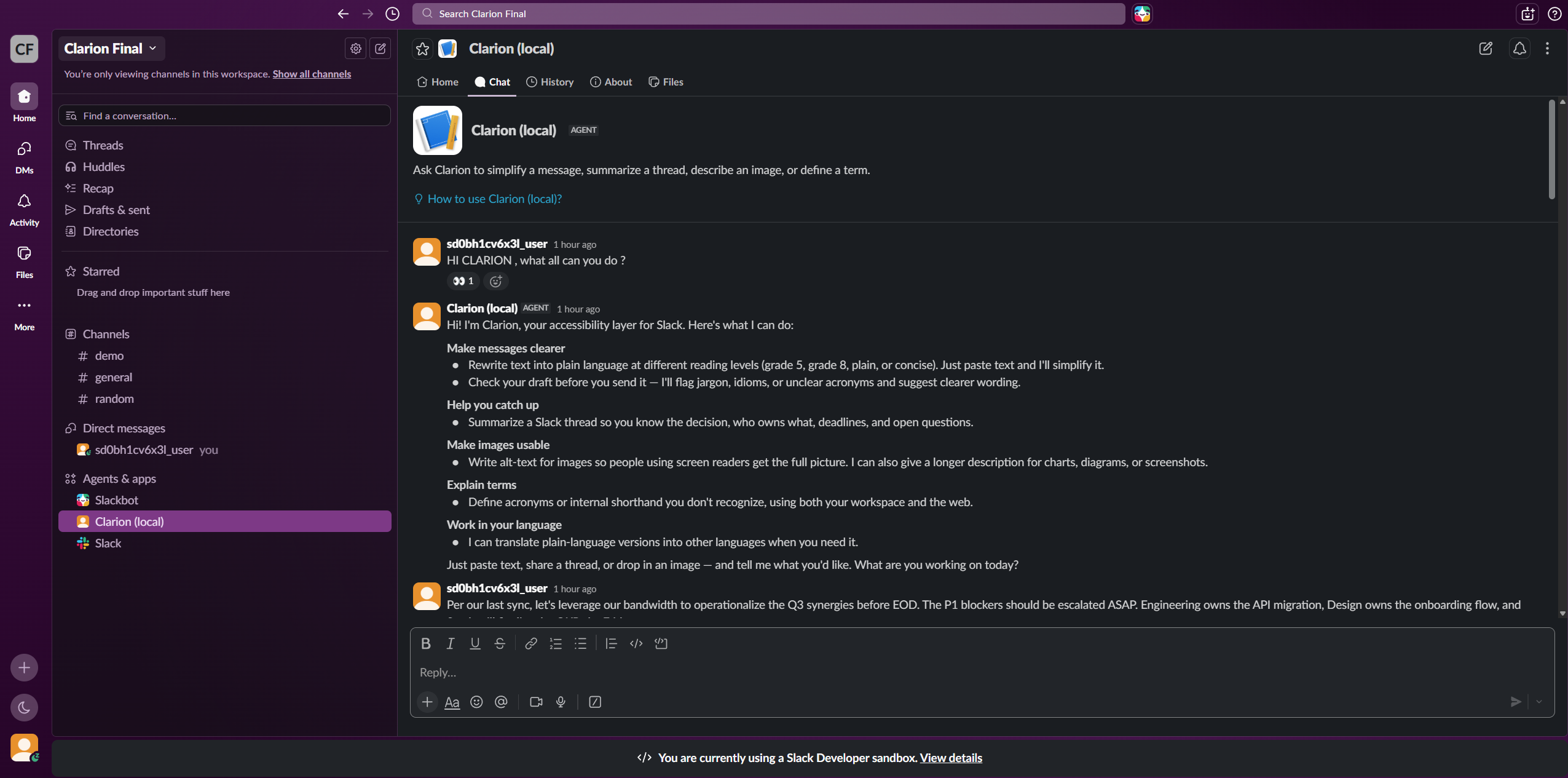
Intro - Clarion
-
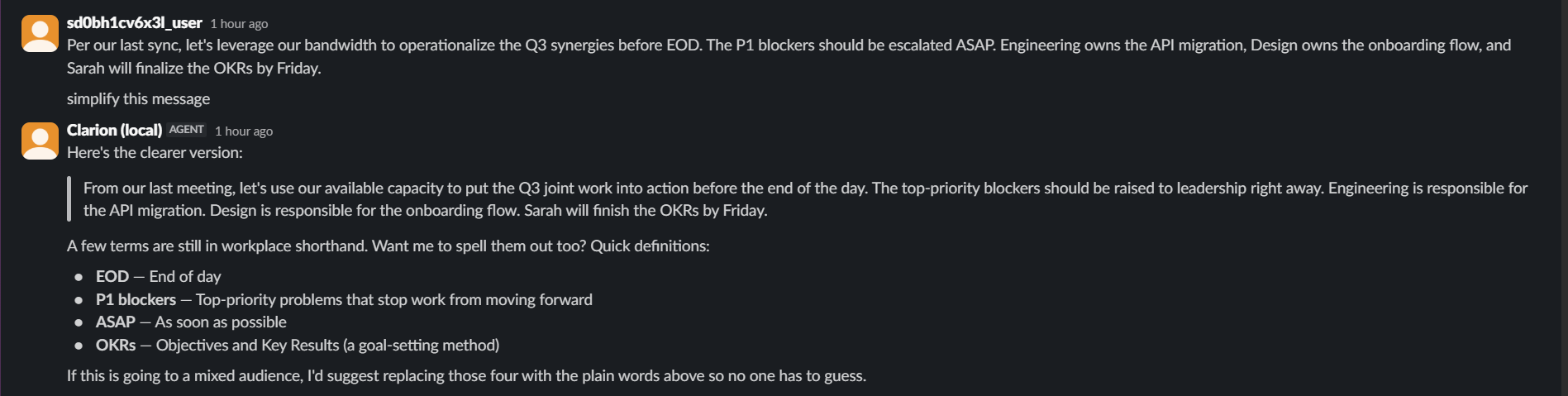
simplify message
-
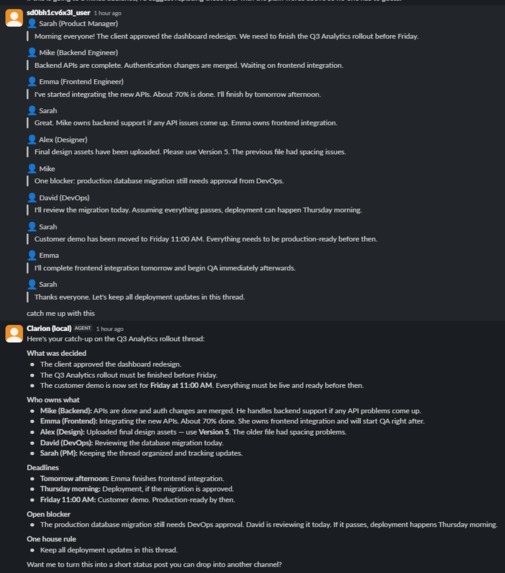
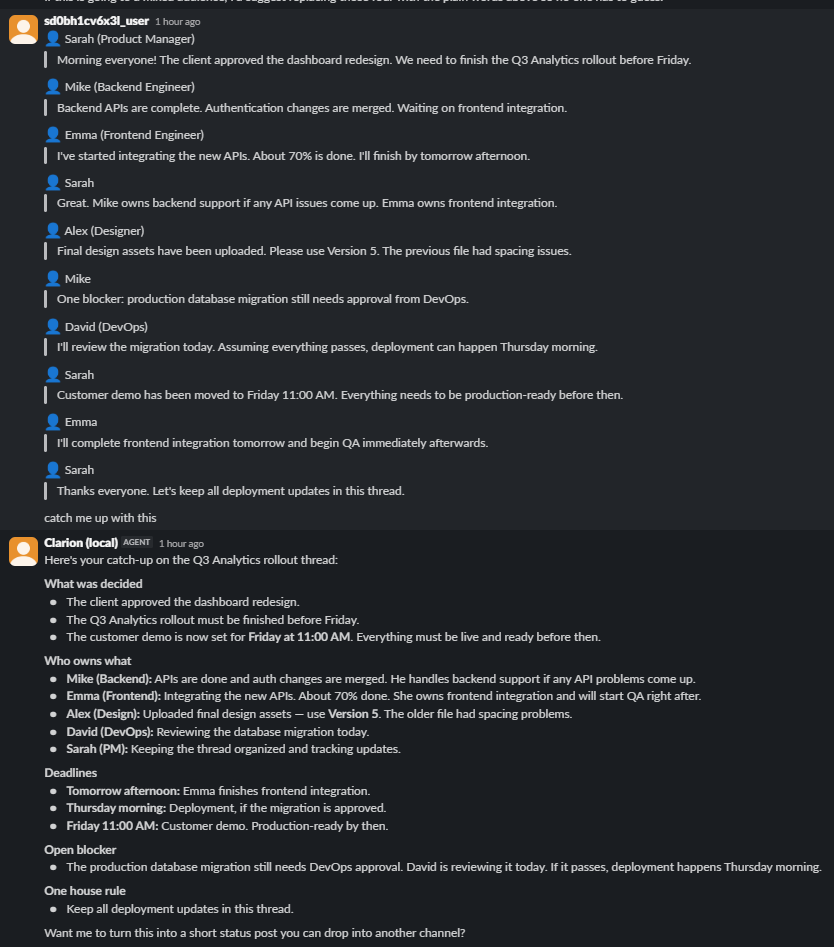
catch up message
-
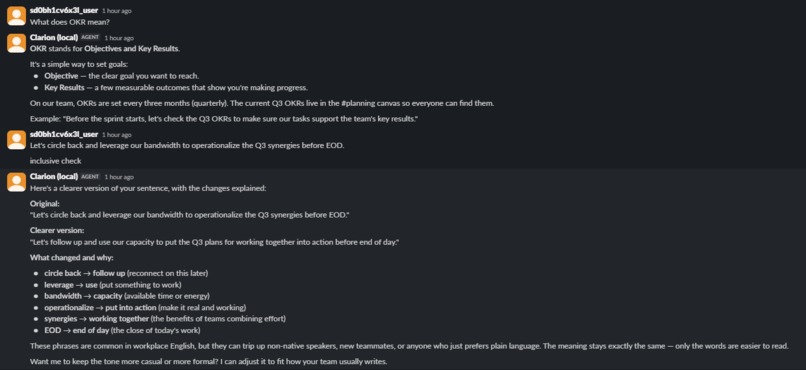
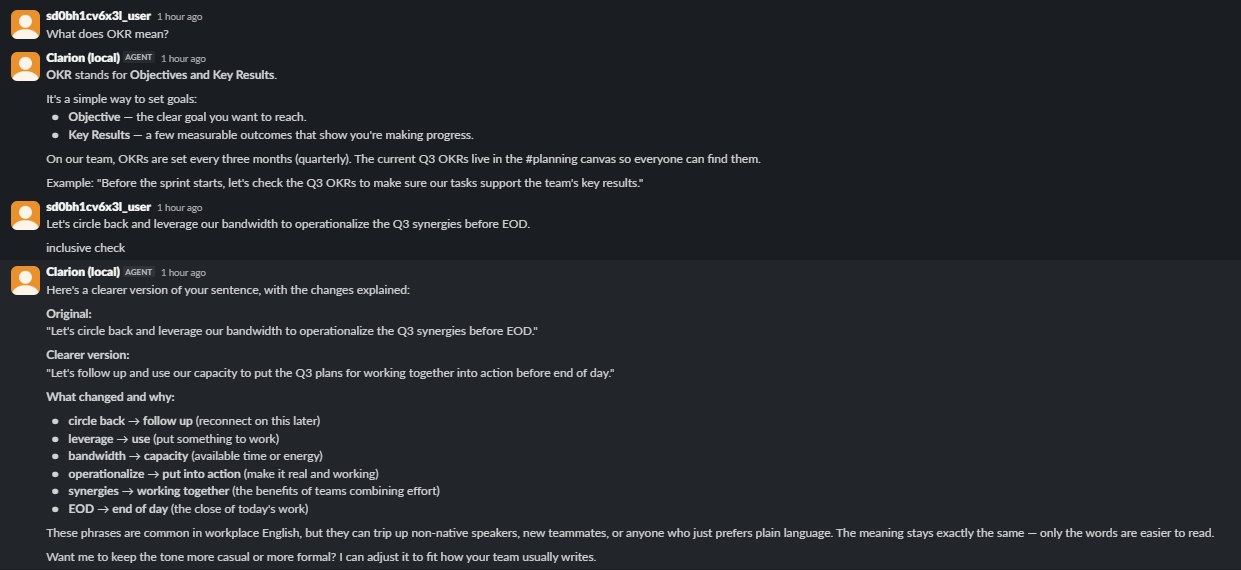
acronyms , work abbreviations & inclusive checks
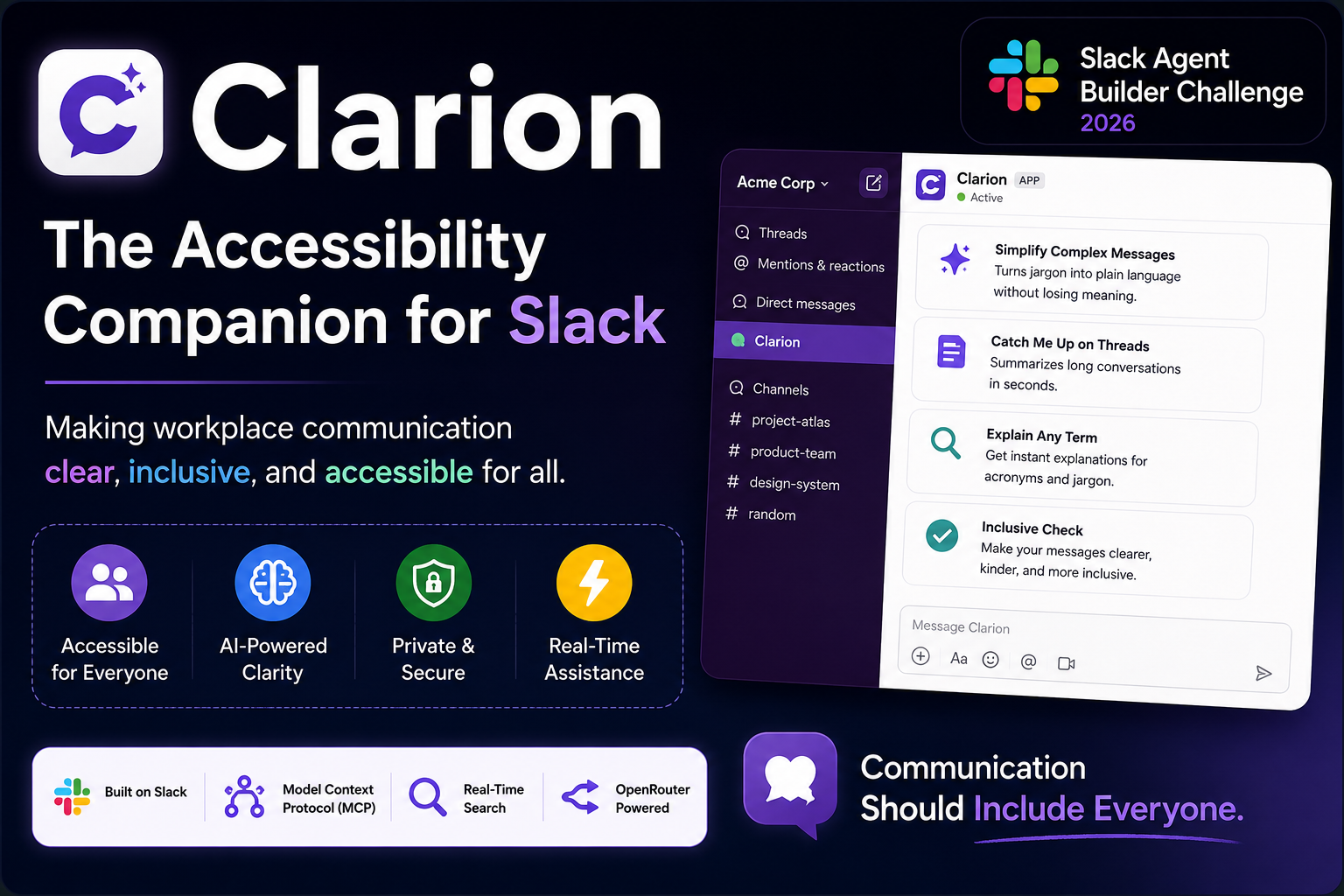
Clarion — The Accessibility Companion for Slack
Inspiration
Workplace communication should be accessible to everyone—not just those already familiar with company jargon or fast-moving conversations. Yet Slack conversations are often filled with acronyms, idioms, lengthy discussion threads, and unexplained context that create barriers for new hires, non-native English speakers, neurodivergent teammates, and people using assistive technologies.
We wanted to build something that doesn't ask people to change how they work. Instead, we asked a simple question:
What if Slack itself could make every conversation easier to understand?
That idea became Clarion—an accessibility companion that transforms complex workplace communication into clear, inclusive, and actionable conversations while keeping teams inside the tools they already use every day.
What it does
Clarion is an AI-powered accessibility companion built for Slack.
It helps make workplace communication clearer and more inclusive through five core accessibility features:
✨ Simplify
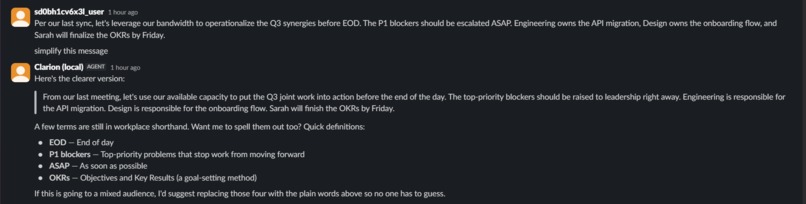
Rewrites complex or jargon-heavy Slack messages into plain language while preserving important details, owners, priorities, and deadlines.
🧵 Catch Me Up
Summarizes long Slack threads into concise digests containing:
- Key decisions
- Action items
- Deadlines
- Open questions
📚 Define Terms
Explains workplace acronyms and internal terminology using Slack's Real-Time Search capabilities, helping new employees quickly understand conversations.
♿ Inclusive Check
Reviews draft messages and suggests clearer, more inclusive wording that is easier for everyone to understand.
⚙️ Personalized Accessibility
Allows users to customize reading style, preferred language, and accessibility preferences directly from the App Home.
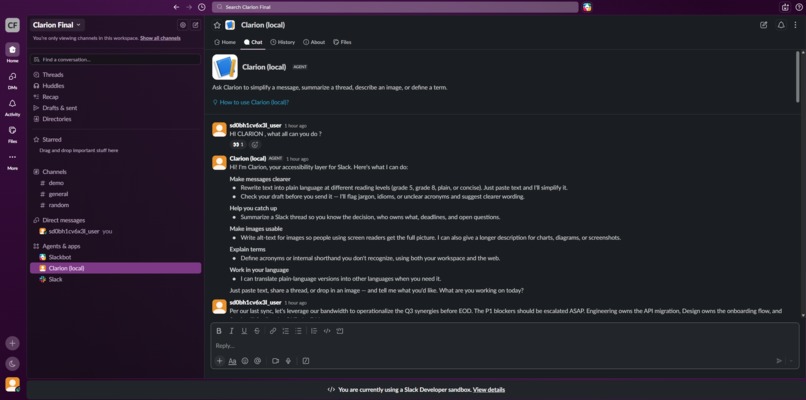
Clarion integrates directly into Slack through direct messages, shortcuts, App Home, and threaded conversations, making accessibility part of everyday collaboration rather than an additional tool.
How we built it
Clarion was built using the modern Slack Platform with an accessibility-first architecture.
Core Technologies
- Slack Bolt for Python
- Slack Agent Platform
- Slack Socket Mode
- Slack Block Kit
- Slack Model Context Protocol (MCP)
- Slack Real-Time Search
- OpenRouter (OpenAI-compatible API)
- Python
Architecture
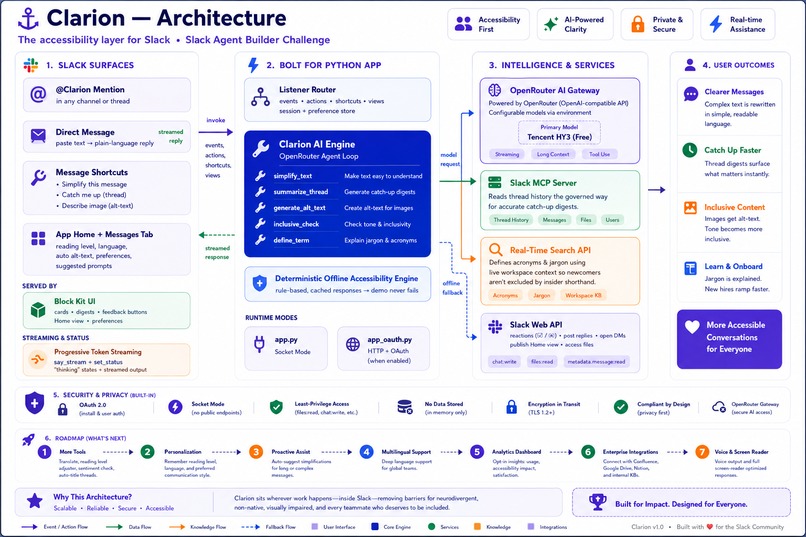
Our application follows a modular architecture where each accessibility capability is implemented as an independent AI tool:
- Simplify
- Catch Me Up
- Define Terms
- Inclusive Check
- Image Accessibility (architecture ready)
A central agent routes requests to the appropriate capability while maintaining a consistent user experience.
To improve responsiveness, Clarion streams AI responses directly into Slack instead of waiting for complete generations.
We also implemented graceful offline fallbacks so demonstrations remain functional even if external AI services become unavailable.
Challenges we ran into
This project presented both technical and product-design challenges.
Some of the biggest hurdles included:
- Learning and integrating Slack's modern Agent Platform.
- Configuring a complete Slack Developer Sandbox environment.
- Migrating from Anthropic's SDK to OpenRouter while preserving streaming responses.
- Handling Slack's event-driven architecture and Socket Mode.
- Designing prompts that consistently generate structured, accessibility-focused outputs.
- Building reliable fallback behavior for AI failures.
- Creating a product that feels like a natural extension of Slack rather than another chatbot.
Each challenge helped us improve both the architecture and overall user experience.
Accomplishments that we're proud of
We're especially proud that Clarion treats accessibility as a first-class feature instead of an afterthought.
Some highlights include:
- Successfully integrating all required Slack challenge technologies into one cohesive experience.
- Delivering a polished Slack-native workflow with streaming responses, shortcuts, and customizable App Home preferences.
- Building a consistent product identity around "Clarion — the accessibility companion for Slack."
- Designing a modular architecture that can easily support future accessibility capabilities.
- Creating a solution that benefits multiple groups simultaneously—including new employees, non-native English speakers, neurodivergent teammates, and anyone catching up on conversations.
Most importantly, we're proud that Clarion solves a real workplace problem while fitting naturally into existing Slack workflows.
What we learned
This project reinforced an important idea:
Accessibility isn't only about visual interfaces—it's also about making communication understandable.
Along the way, we gained hands-on experience with:
- Slack Bolt architecture
- Slack Agent Platform
- Socket Mode
- Model Context Protocol (MCP)
- Real-Time Search
- Streaming AI responses
- Prompt engineering
- Building resilient AI applications with graceful fallbacks
We also learned that the best AI experiences are often the ones users barely notice because they integrate seamlessly into existing workflows.
What's next for Clarion
We're excited to continue evolving Clarion into a comprehensive accessibility platform for workplace communication.
Our roadmap includes:
- 🖼 Vision-powered image understanding for high-quality screen-reader descriptions.
- 🌍 Real-time multilingual translation while preserving workplace context.
- 🎤 Voice-based accessibility features.
- 🧠 Personalized accessibility profiles that adapt to each user's communication preferences.
- 📊 Team-wide accessibility insights that help organizations improve communication quality over time.
- 🔗 Expansion beyond Slack to additional workplace collaboration platforms.
Our long-term vision is simple:
Make every workplace conversation understandable, inclusive, and accessible—regardless of language, background, or ability.
Built With
- accessibility
- ai
- api
- block
- bolt
- cli
- kit
- mcp
- mode
- openai
- openrouter
- python
- real-time
- realtime-ortc
- search
- slack
- socket


Log in or sign up for Devpost to join the conversation.