-
-
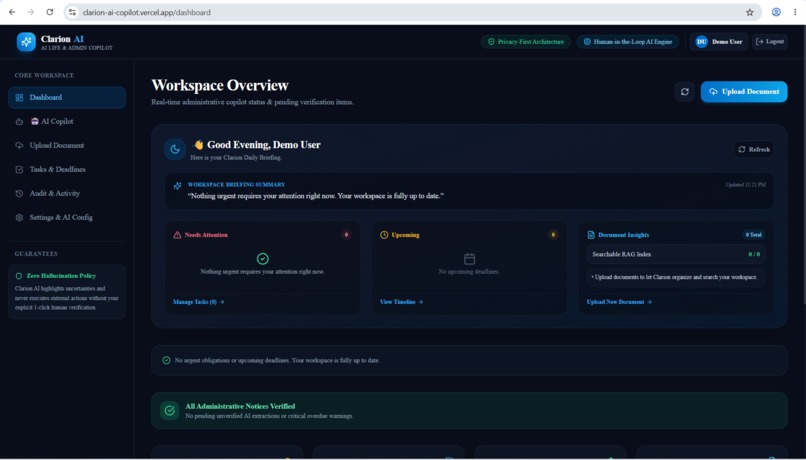
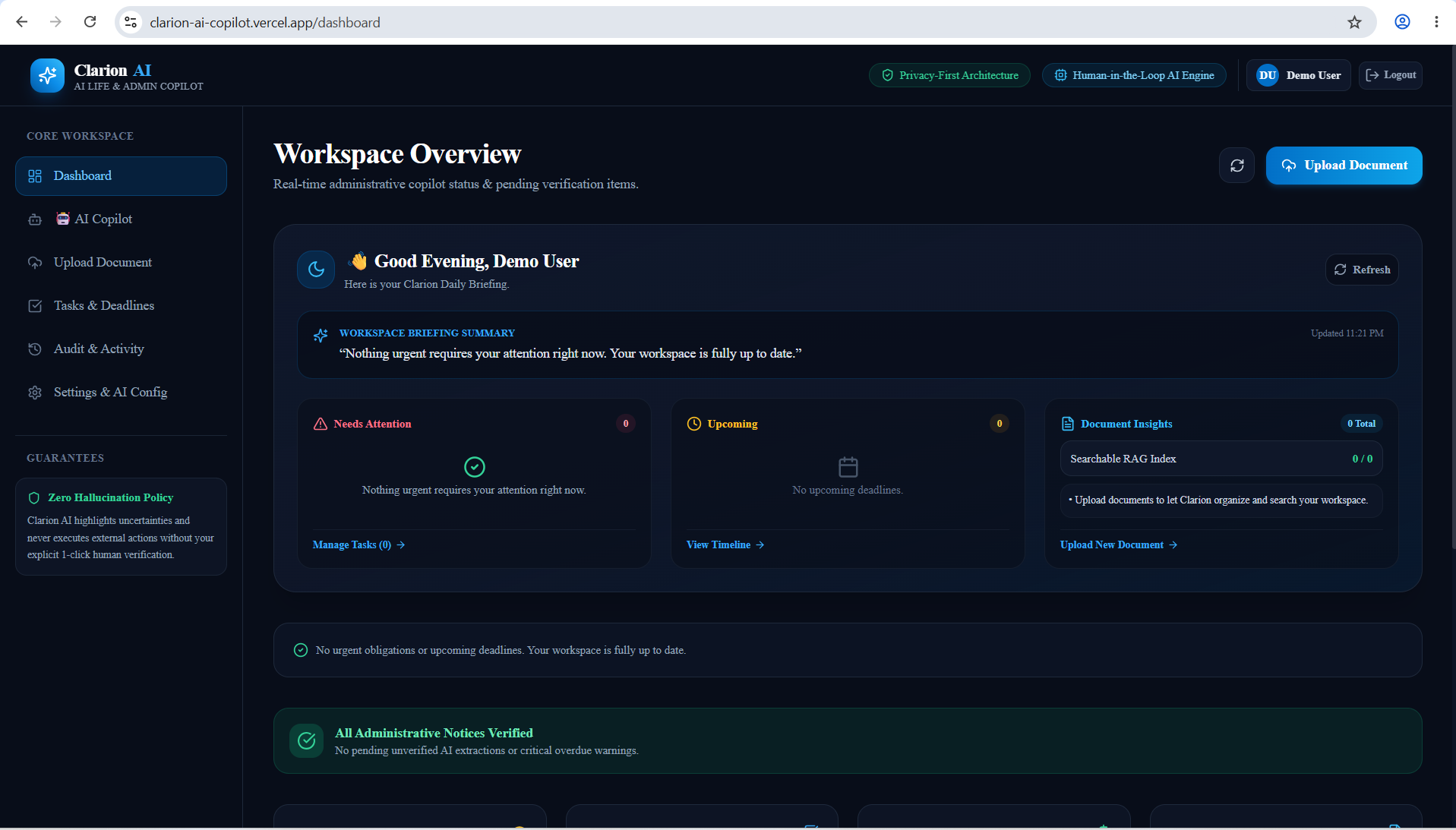
Clarion AI workspace dashboard with privacy-first controls, deadline intelligence, and document insights.
-
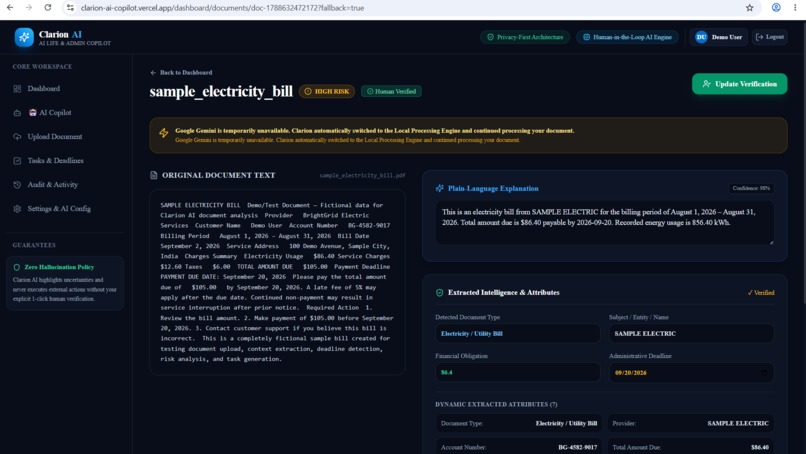
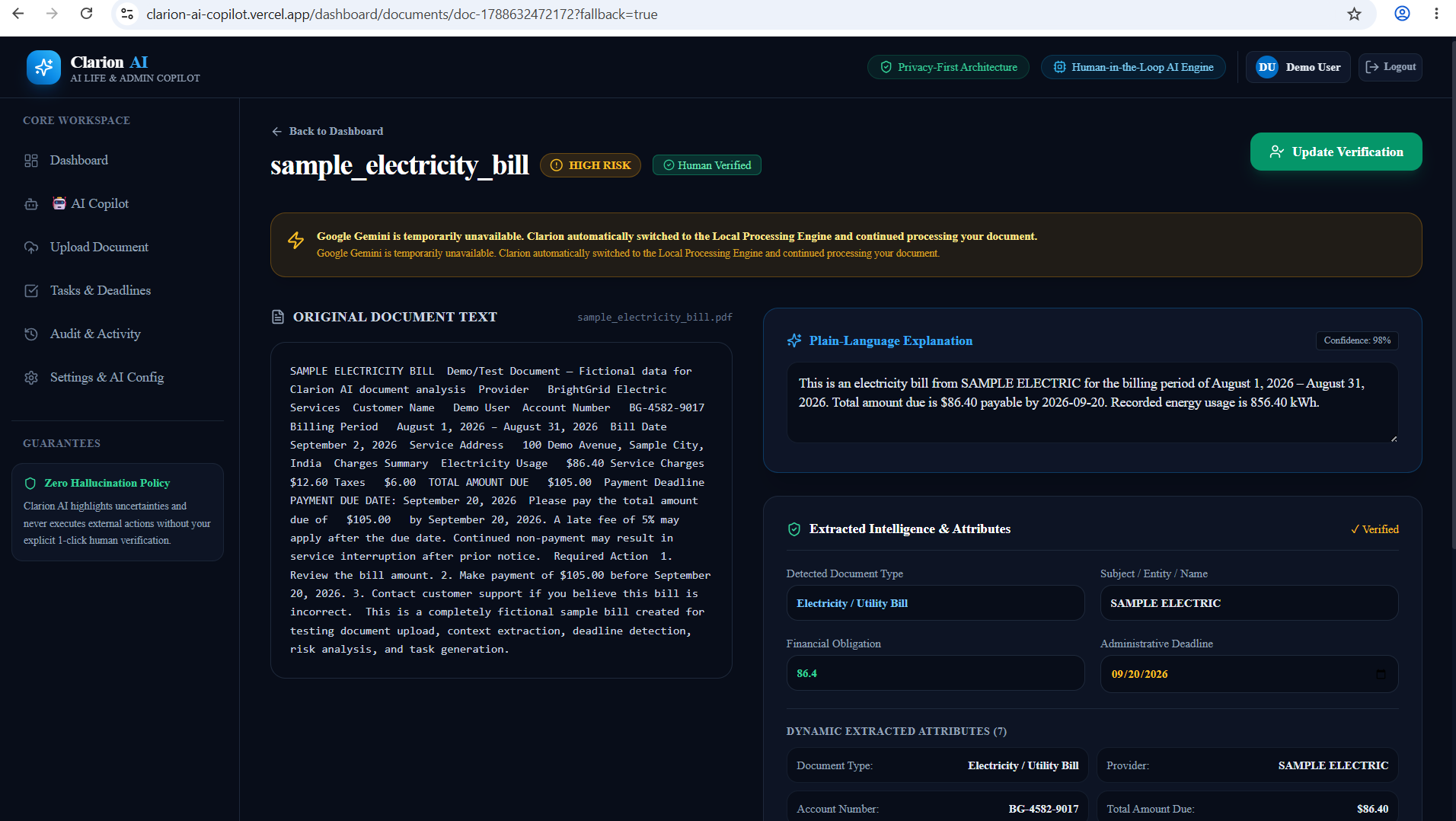
AI-powered document extraction with structured attributes, confidence scoring, verification, and resilient local processing fallback.
-
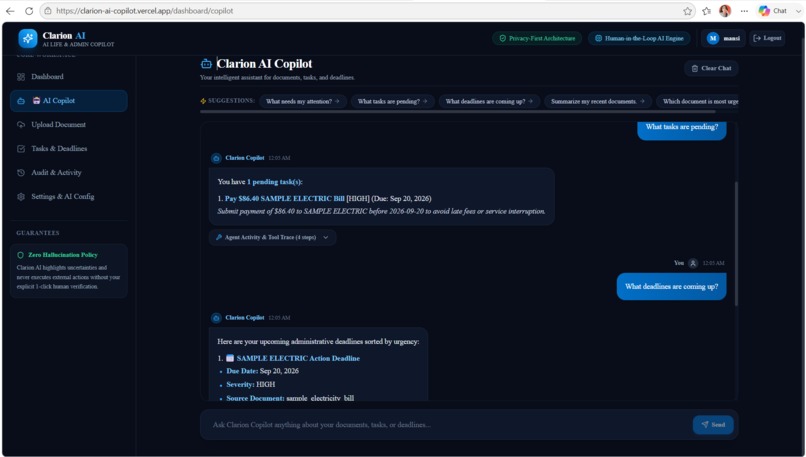
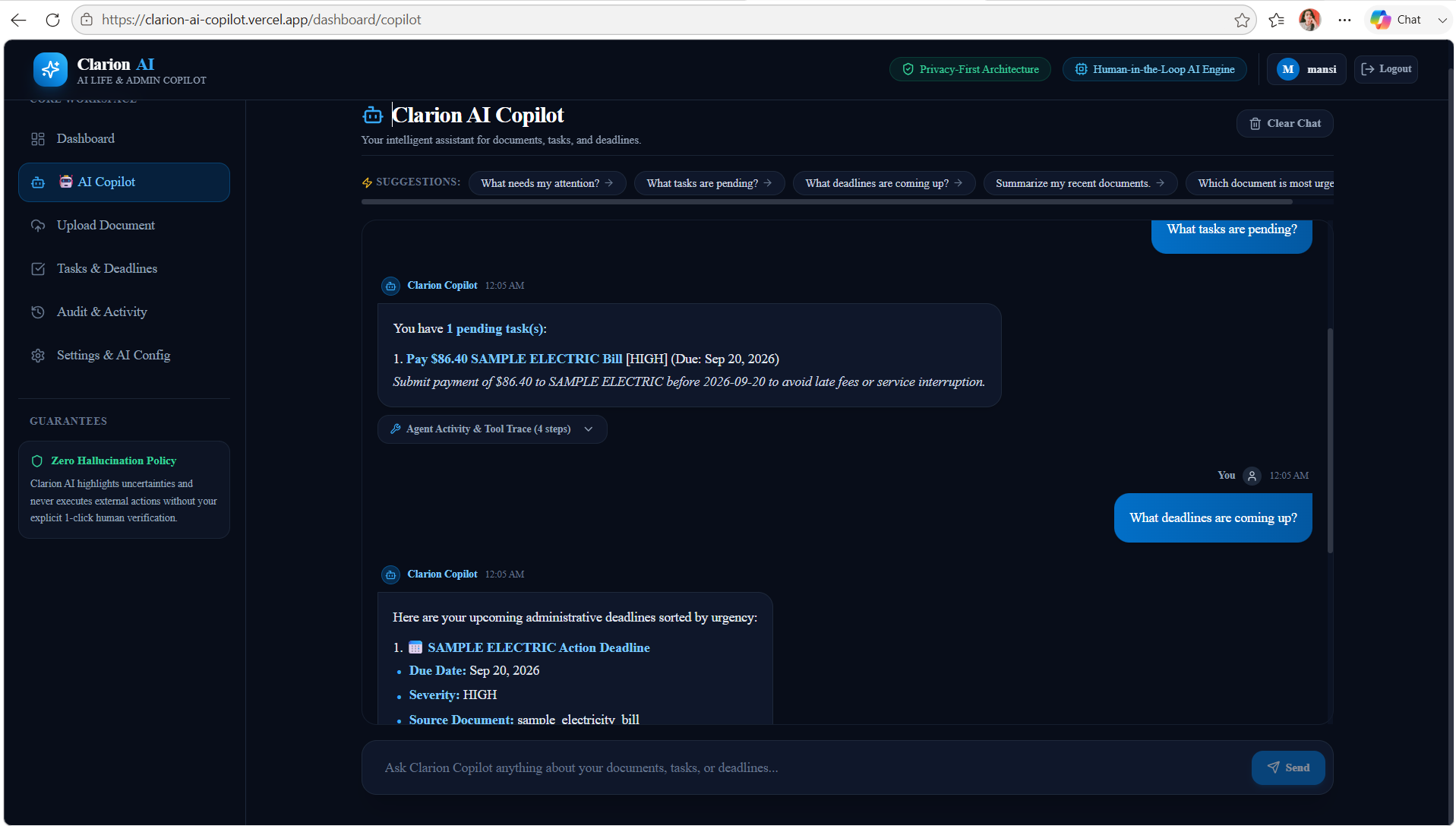
AI Copilot — Pending Tasks & Upcoming Deadline Detection
Inspiration
Managing bills, contracts, notices, renewals, and other personal administrative tasks can become difficult when important information is scattered across documents. We wanted to build an AI assistant that does more than simply answer questions — one that understands important obligations, proactively identifies what needs attention, and helps users take action while keeping humans in control.
What it does
Clarion AI is a privacy-first AI Life-Admin Copilot that turns messy personal documents into structured information and actionable insights.
Users can upload documents such as bills, contracts, notices, and leases. Clarion extracts important facts such as the issuer, amount due, payment deadline, and account information.
The AI Copilot provides grounded answers using user-scoped RAG with document source citations and maintains conversation context across follow-up questions.
Clarion also identifies urgent and upcoming obligations, generates smart recommendations, and proposes actions such as creating tasks. Consequential actions always require explicit human confirmation before execution.
How we built it
Clarion AI was built using Next.js 14, TypeScript, React, Prisma, PostgreSQL with pgvector, Google Gemini, Tailwind CSS, and Lucide Icons.
The system combines document extraction, semantic RAG, vector embeddings, conversation memory, deadline intelligence, and a decision layer.
Document text is chunked and embedded for semantic retrieval. Retrieval is strictly scoped to the authenticated user, and responses include source citations so users can see the evidence behind an answer.
A human-in-the-loop action layer separates AI recommendations from state-changing operations. Confirmed actions are recorded in an audit ledger, while an idempotency mechanism helps prevent duplicate execution.
The application also includes deterministic fallback behavior when Gemini is unavailable, helping the core experience remain reliable.
Challenges we ran into
One of the biggest challenges was making the AI proactive without allowing it to behave unpredictably.
We needed to ensure that AI responses were grounded in real document evidence, that users could not access another user's data, and that consequential actions could never happen silently.
We also had to handle AI/API failures gracefully and make sure the application could continue operating without exposing raw API errors to users.
Accomplishments that we're proud of
We are proud of building a complete end-to-end AI administrative workflow rather than just a chatbot.
Clarion can extract information from documents, retrieve grounded evidence through RAG, maintain conversation context, identify important deadlines, generate recommendations, require human confirmation for actions, execute confirmed tasks, and maintain an auditable action history.
We also successfully verified strict user isolation and the complete workflow on the live production deployment.
What we learned
We learned that building a useful AI application is not only about generating good responses. Reliability, grounding, user isolation, confirmation boundaries, and auditability are equally important.
Working on Clarion AI gave us practical experience combining RAG, vector search, structured extraction, AI decision-making, conversation memory, human-in-the-loop workflows, and secure multi-user application architecture.
What's next for Clarion AI — Autonomous AI-Life-Admin Copilot
The next step is to expand Clarion into a more capable personal administrative operations assistant.
Future improvements include support for more document types, richer deadline forecasting, smarter personalized recommendations, additional integrations with calendars and productivity tools, improved document understanding, and more configurable user workflows.
The long-term goal is to make Clarion a trusted AI assistant that helps users stay ahead of everyday administrative responsibilities while keeping privacy, transparency, and human control at the center.
Built With
- neon
- next.js
- postgresql
- prisma
- rag
- react
- typescript
- vercel
