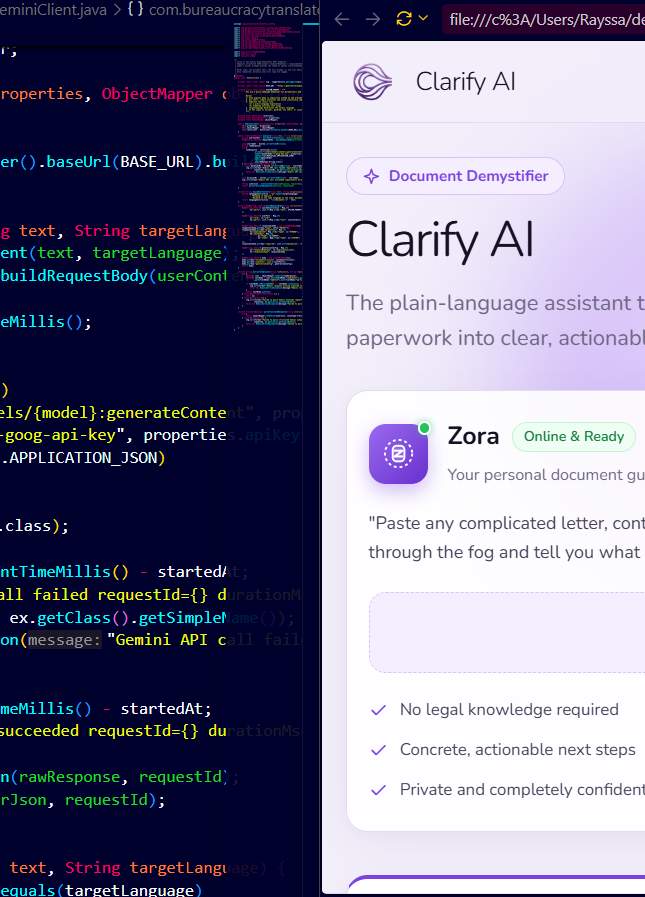
Clarify AI: Making Complex Documents Easier to Understand
Inspiration
The idea behind Clarify AI came from my experience working in real estate, where contracts, official notices, forms, and other documents are part of everyday work.
I noticed that understanding these documents can be difficult because important information is often buried in formal language and unfamiliar terminology. People need to understand not only what a document says, but also what it means, what they may need to do, and which deadlines or consequences deserve attention.
I wanted to explore how artificial intelligence could help bridge this gap and make complex information more accessible.
What It Does
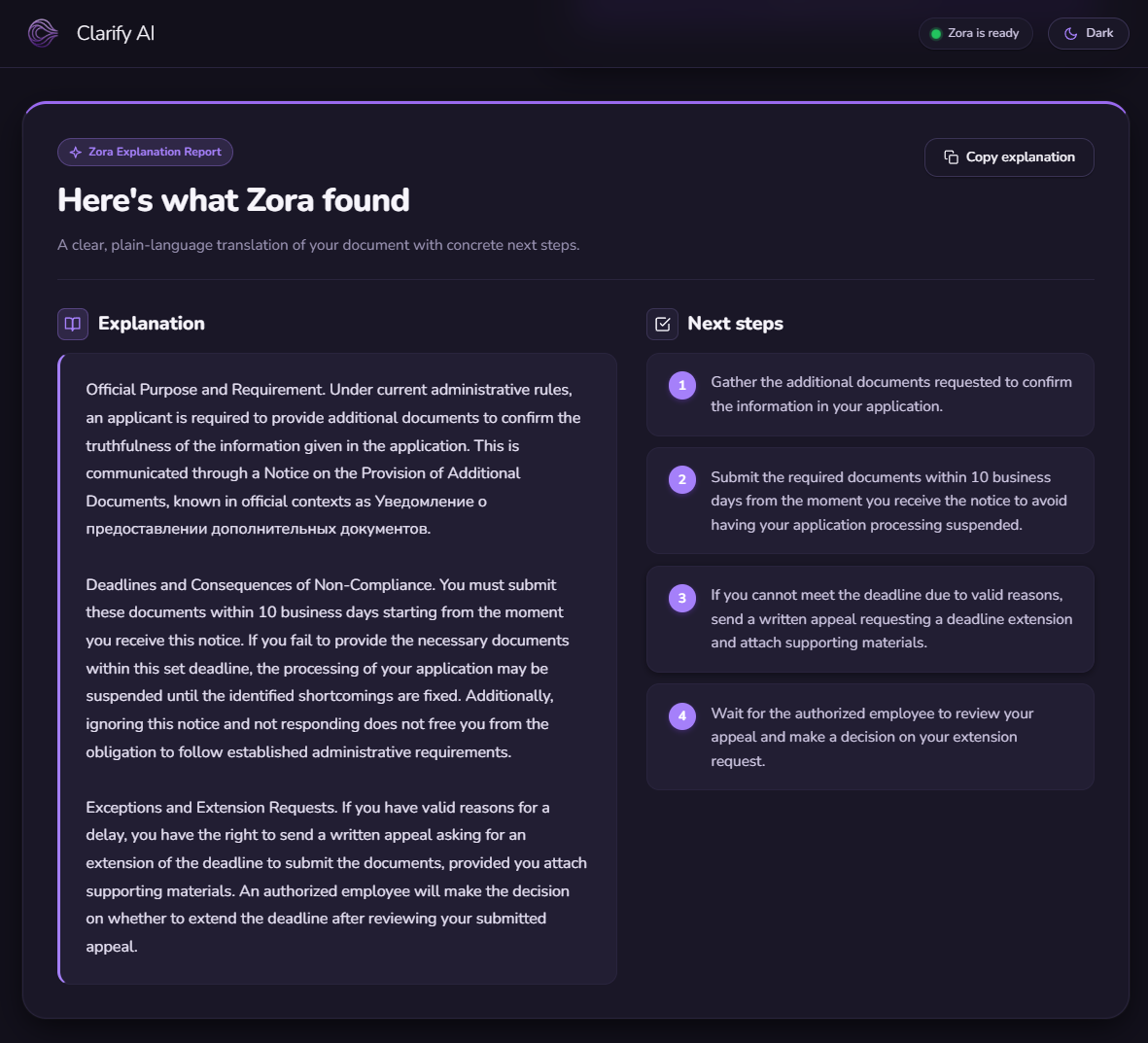
Clarify AI transforms complex bureaucratic and legal document content into clearer explanations and actionable next steps.
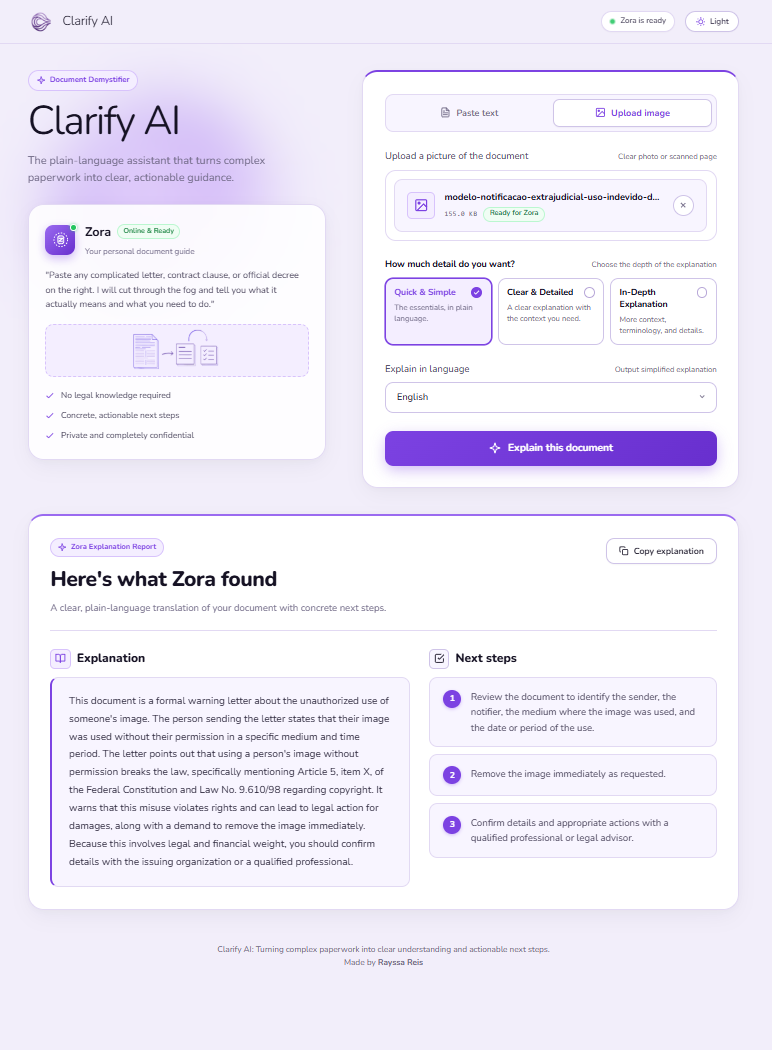
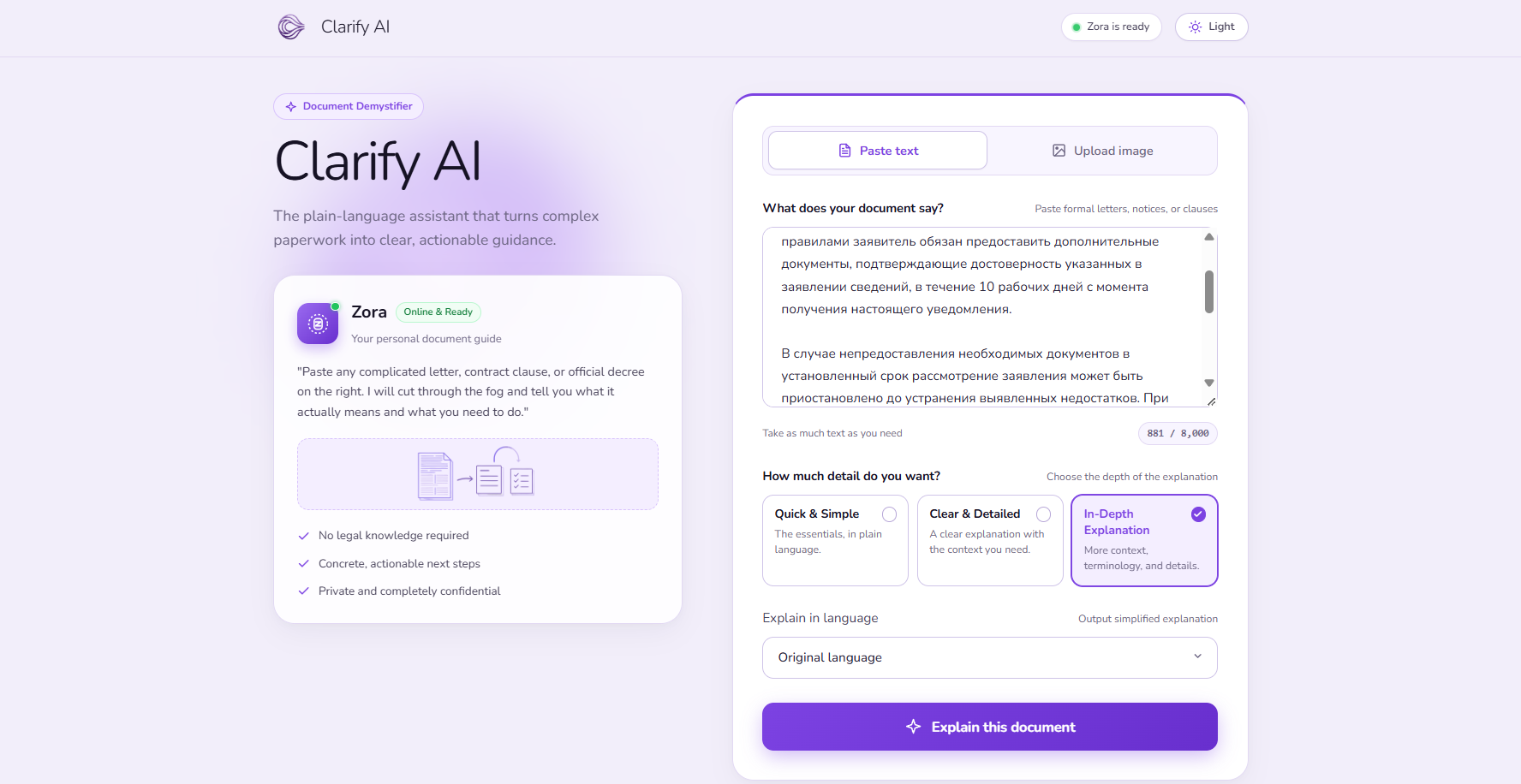
Users can submit text directly or provide an image of a document. The application uses OCR to extract text from images and Google Gemini to generate explanations.
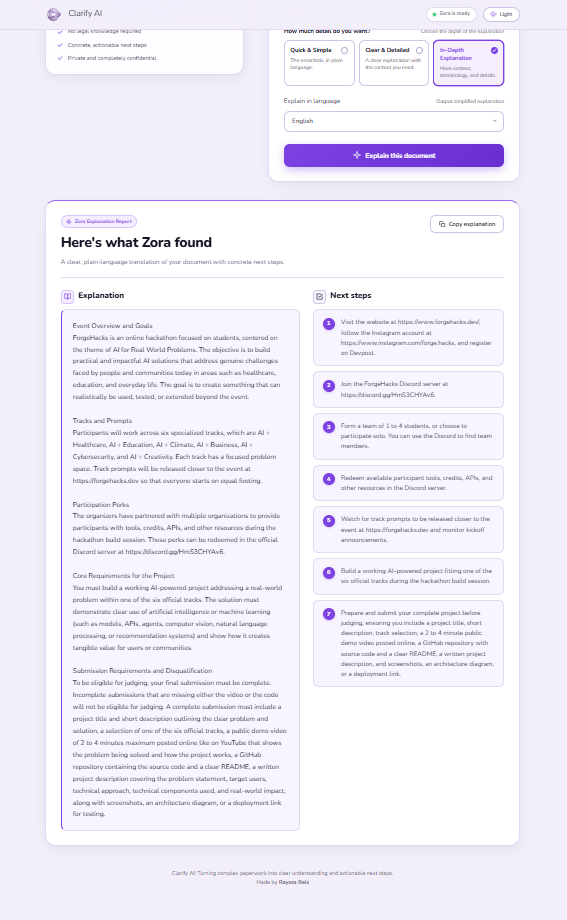
One of its key features is adjustable explanation depth, allowing users to choose how much detail they need:
- Quick & Simple: A concise explanation focused on the main points.
- Clear & Detailed: A balanced explanation with additional context.
- In-Depth: A deeper explanation for users who want to explore the content in greater detail.
Users can also choose to receive the explanation in the document's original language or in English.
The goal is to make important information easier to understand and help users identify possible next steps without having to navigate complex language alone.
How I Built It
I built Clarify AI independently using Java 21, Spring Boot 3, and Gradle for the backend, with HTML, CSS, and JavaScript for the frontend.
The application follows a layered architecture that separates request handling, business logic, and external service integrations.
The main components include:
- Frontend: Provides the interface for submitting documents, choosing explanation preferences, and viewing results.
- REST API: Exposes the
POST /api/translateendpoint. - Controller layer: Handles incoming requests and coordinates the application workflow.
- Service layer: Manages validation, processing, and orchestration.
- OCR integration: Uses OCR.space to extract text from document images.
- AI integration: Uses Google Gemini to generate explanations and actionable next steps.
- DTOs and exception handling: Structure API communication and manage errors.
For text input, the content goes directly to the AI processing stage. For image input, OCR.space first extracts the text, which is then sent to Google Gemini.
The backend returns a structured response containing an explanation and a list of next steps. The selected explanation depth and output language are passed through the API so the processing workflow can reflect the user's preferences.
Challenges I Faced
One of the main challenges was handling different input types through a consistent user experience. Text and images require different processing steps, so I needed to coordinate OCR and AI processing while keeping the backend organized.
Another challenge was designing a clear separation of responsibilities between the controller, service layer, and external integrations. This structure helps keep the application maintainable and makes individual components easier to test.
I also focused on making the results useful beyond a basic summary. Separating the explanation from the suggested next steps helps users identify both the meaning of a document and actions they may need to consider.
What I Learned
Building Clarify AI helped me connect backend engineering concepts with a practical AI application.
I strengthened my understanding of REST API design, layered architecture, external API integration, request validation, and automated testing. I also learned more about coordinating OCR and language models in a document-processing workflow.
Most importantly, this project reinforced the importance of starting with a real problem and designing technology around people's needs. AI is not only about generating text; it can also help make existing information more understandable and accessible.
What's Next
I would like to continue improving Clarify AI by expanding document format support, improving multilingual experiences, enhancing the transparency of generated explanations, and exploring ways to help users identify important information more reliably.
My goal is to keep developing Clarify AI into a practical tool that makes complex documents easier to understand while reminding users to verify important legal requirements and deadlines.
Clarify AI is my attempt to combine software engineering and artificial intelligence to solve a problem I have observed firsthand: making important information easier to understand and act on.

Log in or sign up for Devpost to join the conversation.