-
-
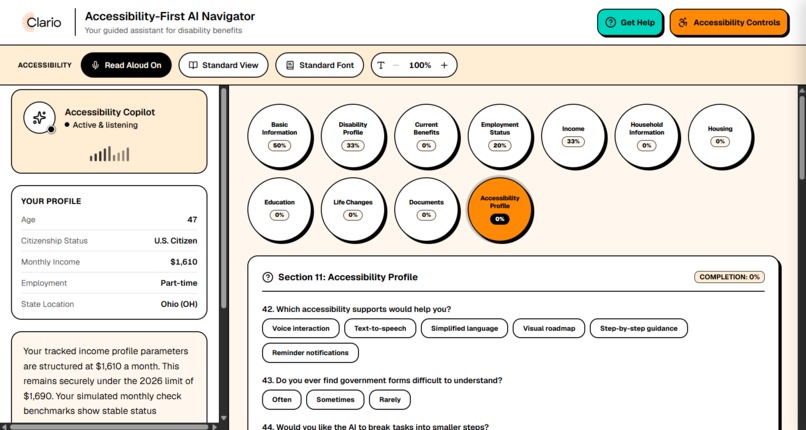
Clario page
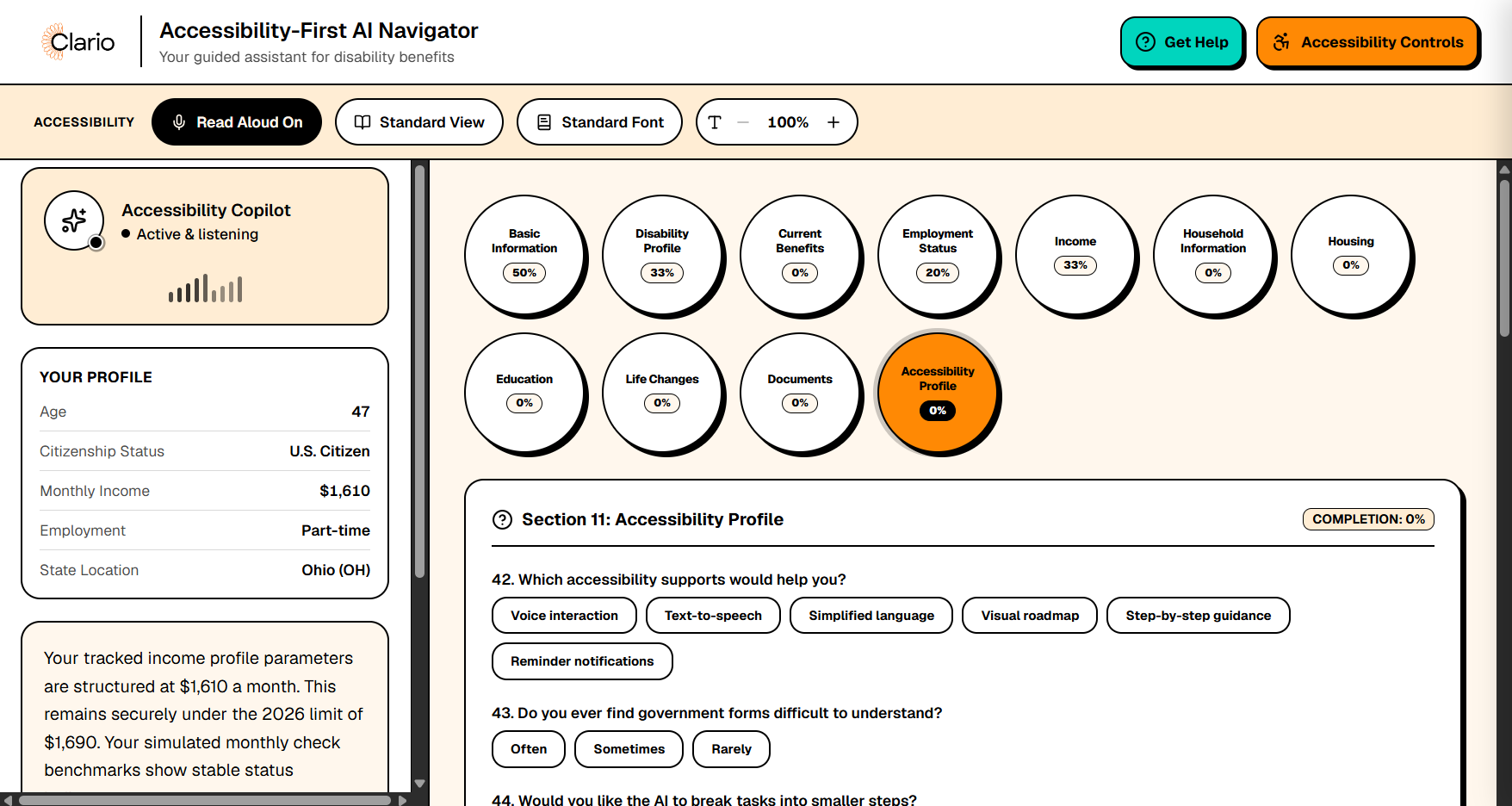
Inspiration
CDC Analysis found that about 1 in 4 U.S. adults report having a disability (most commonly with mobility, cognition, vision, self-care, etc). The US Bureau of Labor Statistics uncovered that a mere 22.8% of US citizens with a disability in 2025 were employed. In fact, of the 7.4M people receiving SSI payments in late 2024, just under 60% had no other source of income. These figures have consistently proven that for many recipients, such benefits are the main source of survival. Moreover, failure to reach these benefits could have life-altering consequences for the disabled, most of whom already experience unmet healthcare needs due to financial constraints
Things don't have to remain this way, though. Many benefits are available for the disabled across platforms in domains such as food, health insurance, housing, utilities, welfare/financial assistance, Social Security, etc. Most people, however, have no idea where to start, what applies to them, and how to effectively navigate through these available resources.
Our goal with Clario, therefore, is to reduce that burden by creating an accessibility-first benefits navigator for the disabled. Catering to each user’s unique needs, this will explain all the person’s viable options in plain language and adapt to different accessibility needs. This allows ultimately, for users to move forward with more confidence and dignity.
What it does
Clario is an accessibility-first AI navigator designed to help people with disabilities understand, apply for, and manage government benefits such as SSI, SSDI, Medicaid, and SNAP. Clario serves as a customised digital caseworker instead of just an eligibility checker. People with a range of accessibility needs can use the platform because users can communicate via text or voice. From user responses, the system creates a structured benefits profile that it then compares to official eligibility requirements. Clario then provides confidence scores, cites pertinent government sources, and explains possible advantages in simple terms. The Document Gap Detector, which finds missing or out-of-date application documents; the Benefits Impact Simulator, which builds a digital twin of a user's benefits situation and forecasts how life changes like employment or relocation may affect support; and the Benefits GPS, which creates a customised roadmap outlining next steps, deadlines, and necessary documentation, are some of the key features. With Clario, users can more confidently and independently navigate intricate benefit systems.
How we built it
For quick deployment, scalability, and smooth frontend-backend integration, we used v0 by Vercel to create Clario as a cloud-native web application. In order to support users with a variety of accessibility needs, the platform was designed with accessibility as a fundamental principle. It includes features like voice interaction, simplified language options, adjustable contrast modes, and reading masks.
The Google Gemini API, which drives conversational interactions, natural language comprehension, and customised explanations, is the foundation of Clario. Users can communicate with the Accessibility Copilot via text or voice, and their answers are converted into a structured benefits profile that includes details about current benefits, household composition, employment status, and type of disability. After that, Gemini analyses this data to provide individualised advice and explain complicated policies in simple terms. In order to provide actionable support instead of just listing programmes, we also created features like the Benefits Impact Simulator, Document Gap Detector, and Benefits GPS.
Challenges we ran into
We also had to carefully distinguish between information that could be automated and decisions that should remain under human oversight. Designing an accessibility-first interface presented another challenge, as different users have different communication and cognitive needs. We wanted Clario to support a wide range of disabilities while avoiding a one-size-fits-all approach. Finally, ensuring responsible AI behavior was critical. Because users may rely heavily on the system when making life decisions, we needed mechanisms to reduce hallucinations, communicate uncertainty, and clearly indicate that Clario provides guidance rather than official determinations.
Accomplishments that we're proud of
We're proud that we transformed a complicated and overwhelming process into an experience that is easier to understand and navigate for people with disabilities. We're proud that accessibility was at the center of our design from the very beginning. By incorporating features such as voice support, simplified language, and adaptive guidance, we created a solution designed to empower users to navigate benefits more independently and confidently.
What we learned
By creating Clario, we discovered that the difficulty of obtaining benefits involves navigating complexity rather than just finding programmes. We found that while many current systems already offer information, very few offer customised advice based on a person's situation and accessibility requirements. Additionally, we discovered how crucial it is to combine AI methods rather than depending only on large language models. Building reliable applications in high-stakes domains requires rule-based systems, retrieval mechanisms, and human oversight. Lastly, the significance of inclusive design was reaffirmed by this project. Accessibility should be a fundamental design principle that benefits all users rather than being seen as an extra feature.
What's next for Clario
We intend to transform Clario into a production-grade decision support system given more time for development. Future iterations will use a hybrid AI architecture that combines sophisticated NLP pipelines, Retrieval-Augmented Generation (RAG), and deterministic rule engines. To guarantee that answers are accurate and current, official policy documents from organisations like the Social Security Administration and CMS would be regularly indexed.
Additional improvements include partnerships with disability advocacy organisations, multilingual support, confidence-based escalation mechanisms that direct complex cases to human experts, and automated document understanding using OCR and NLP. Clario's dependability, explainability, and practical impact would all be greatly enhanced by these enhancements.
Built With
- gemini
- v0

Log in or sign up for Devpost to join the conversation.