-
-
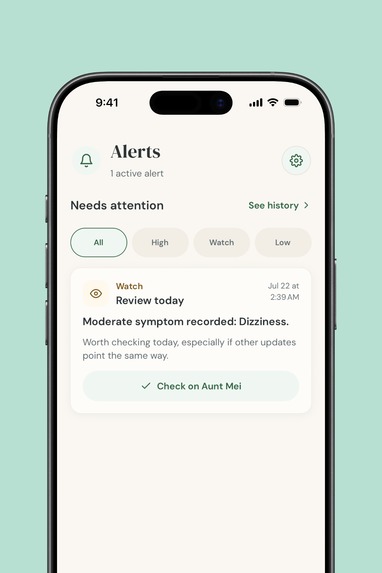
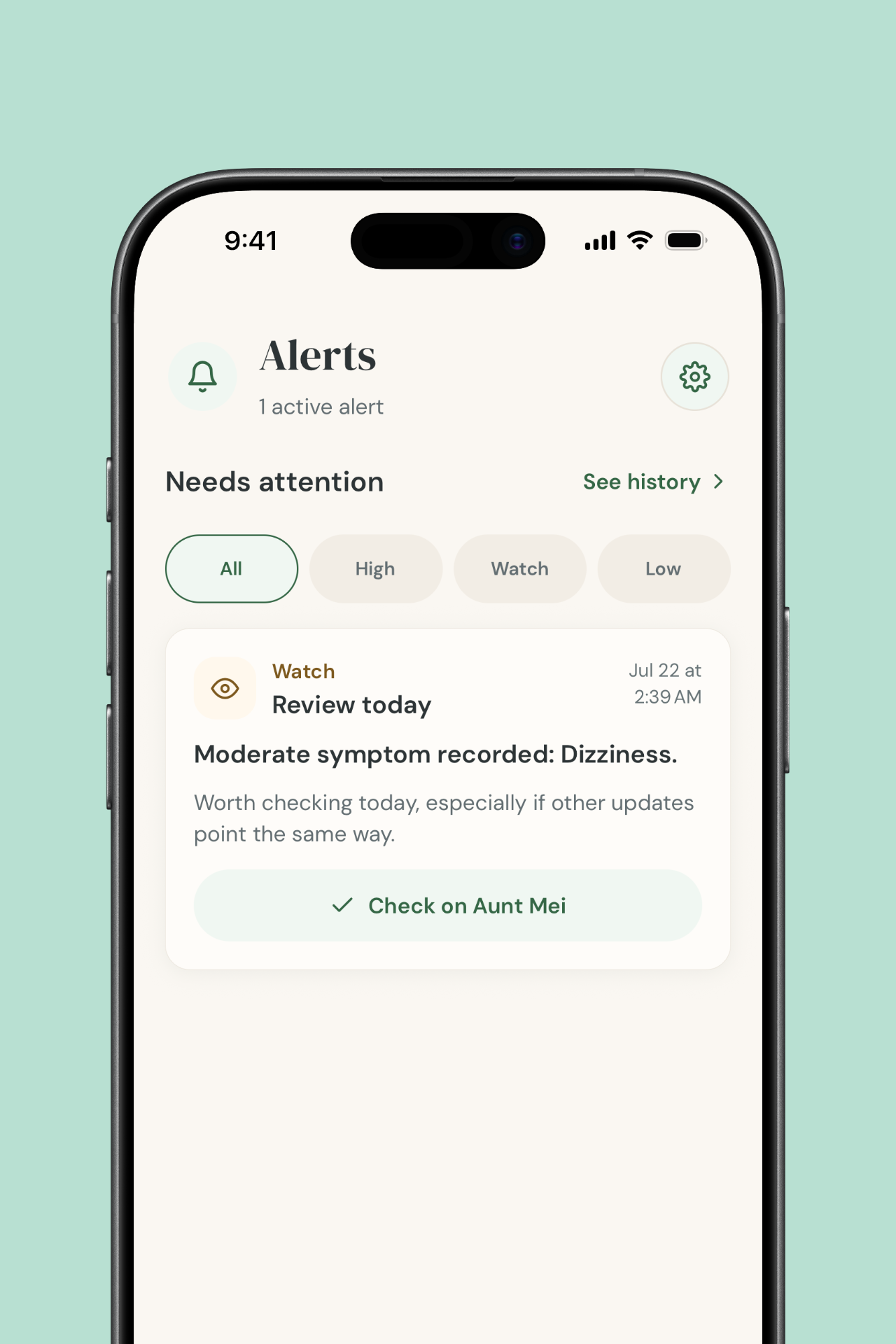
Active Alerts
-
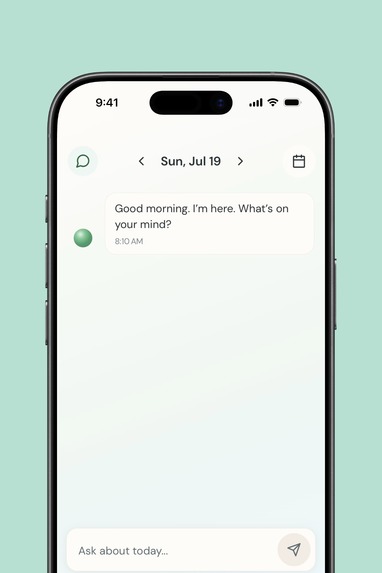
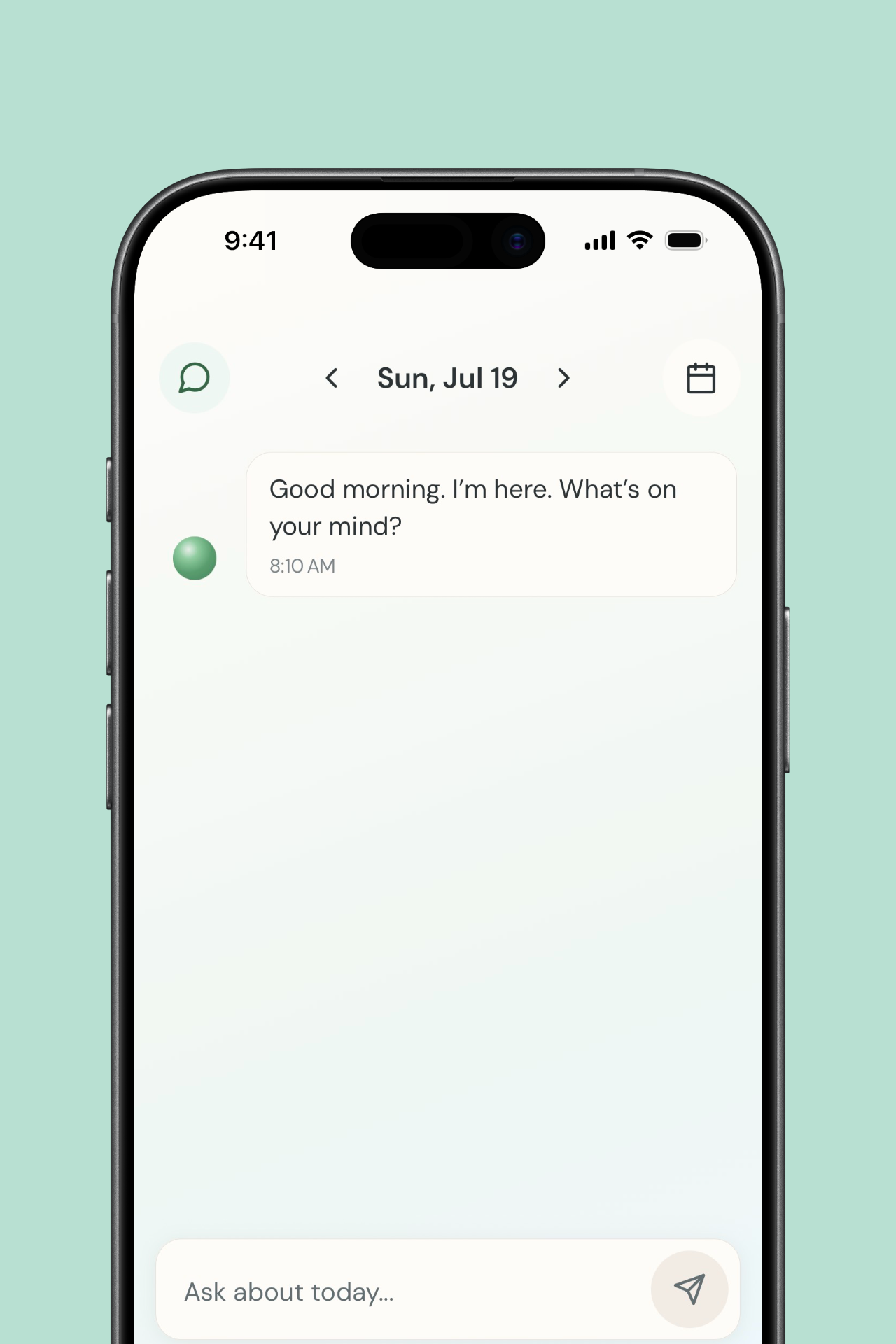
Chat with Claire
-
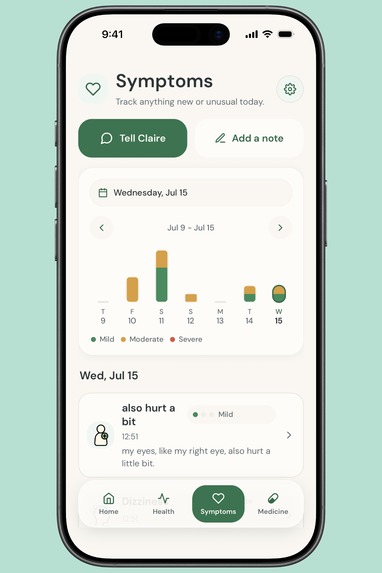
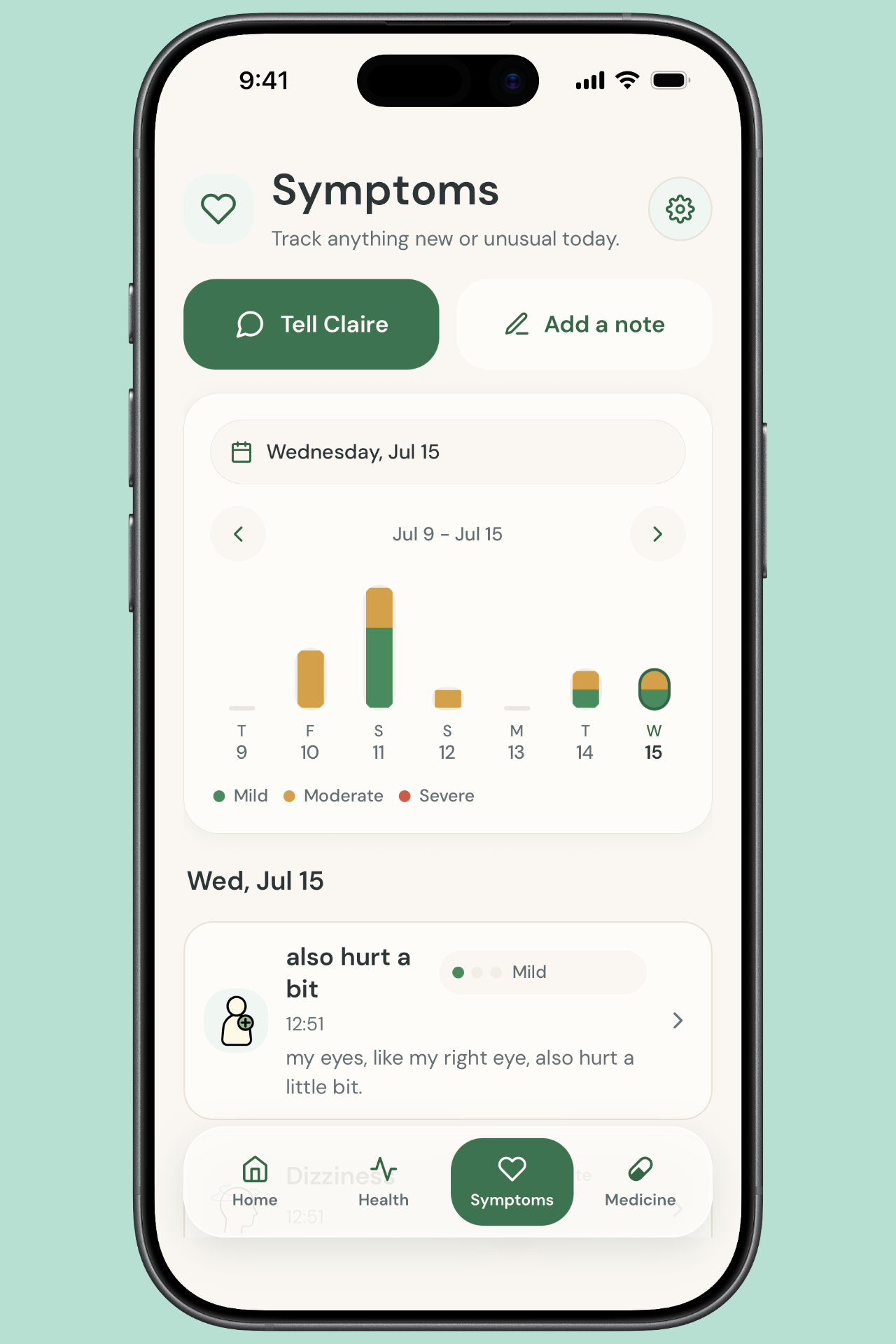
Symptom Logger
-
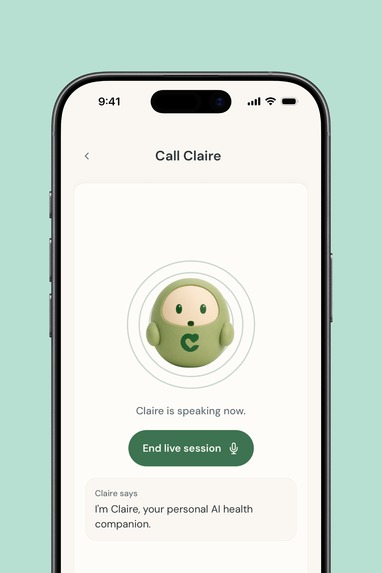
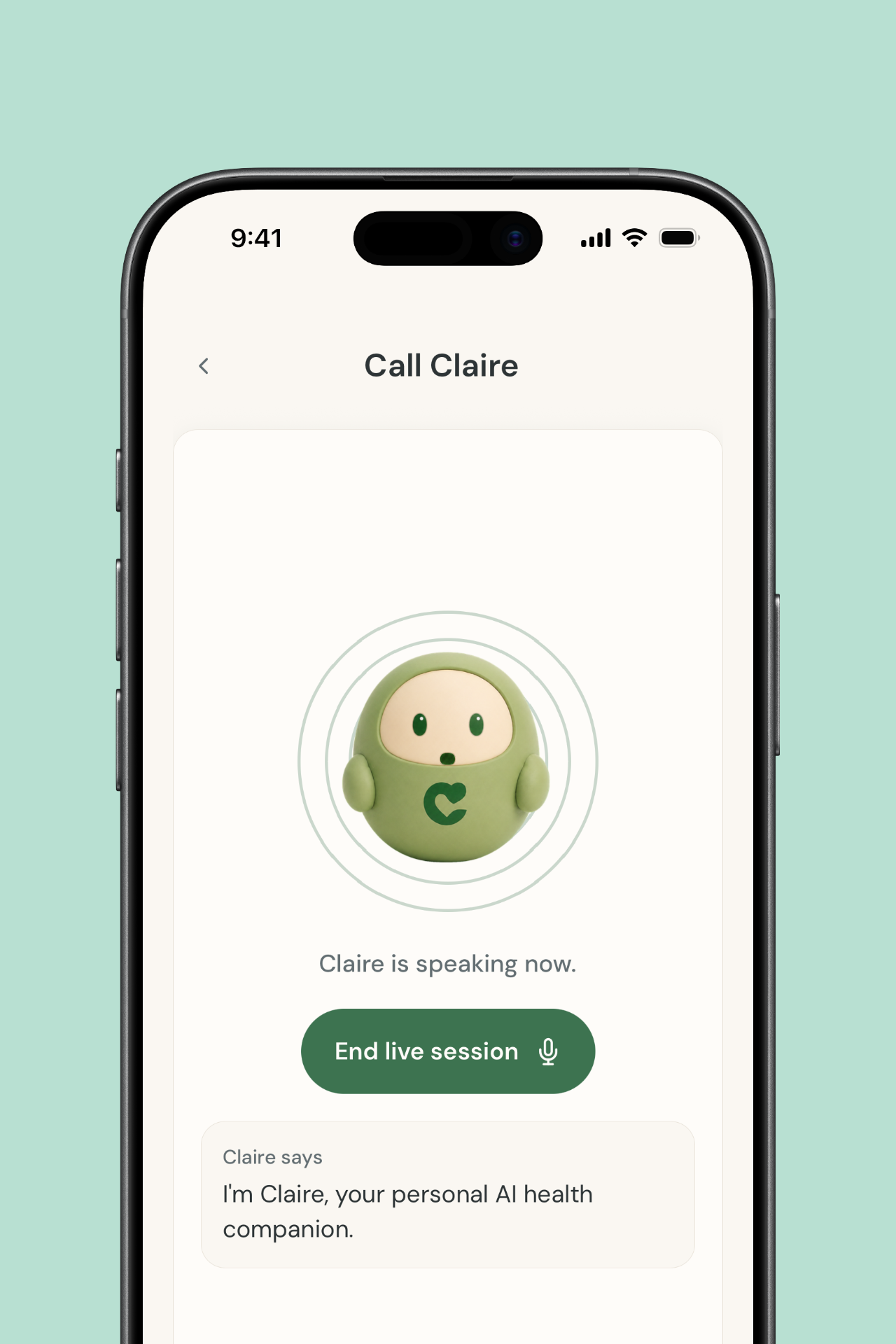
Call Claire
-
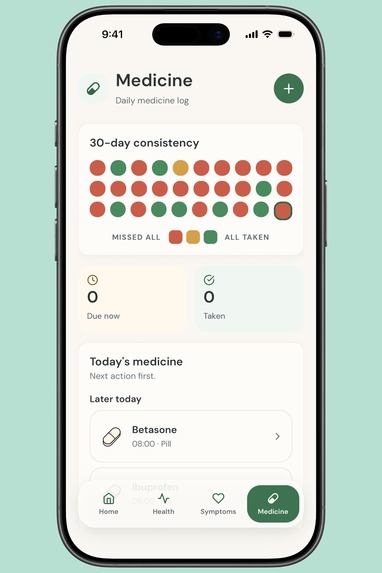
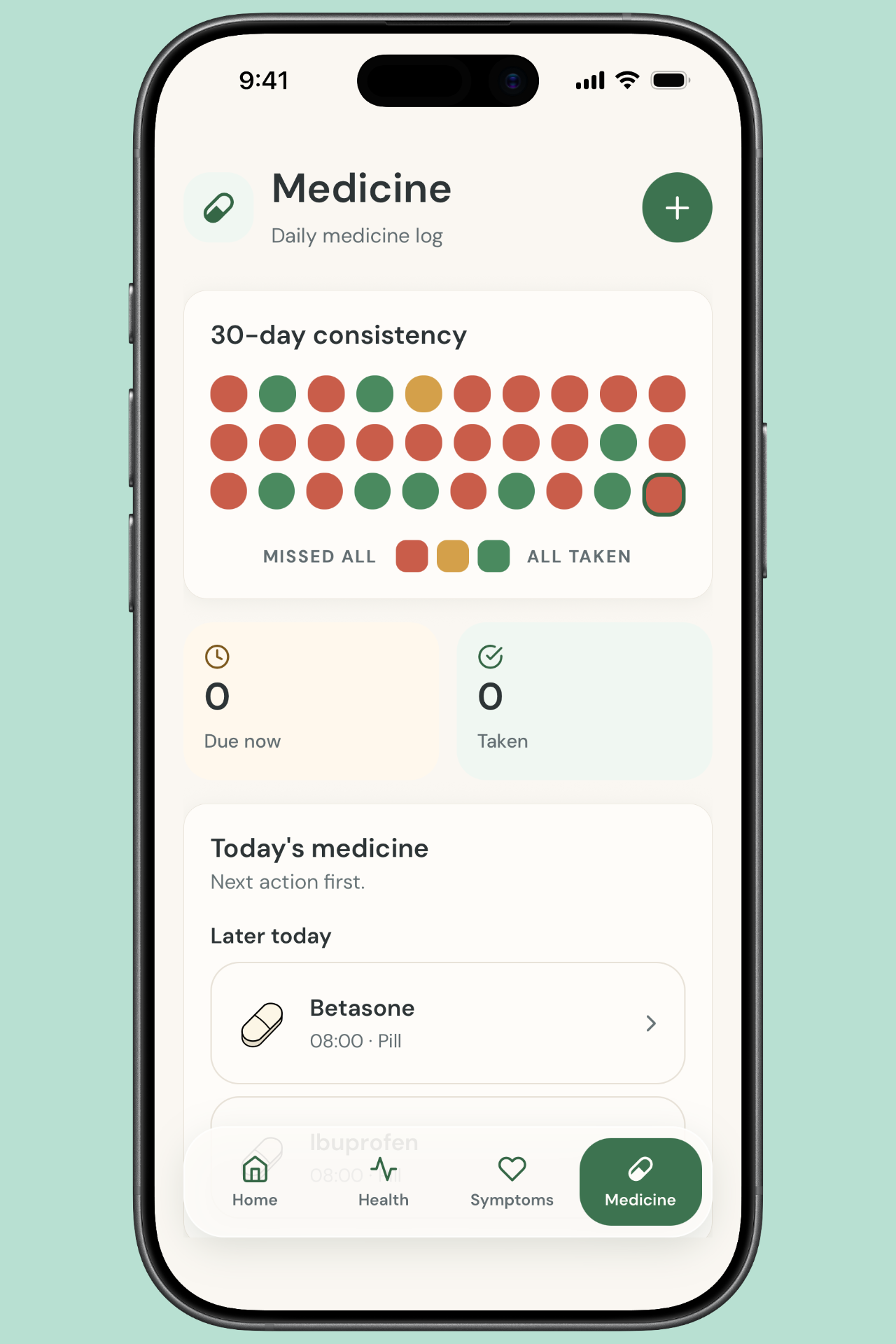
Medication Reminder
-
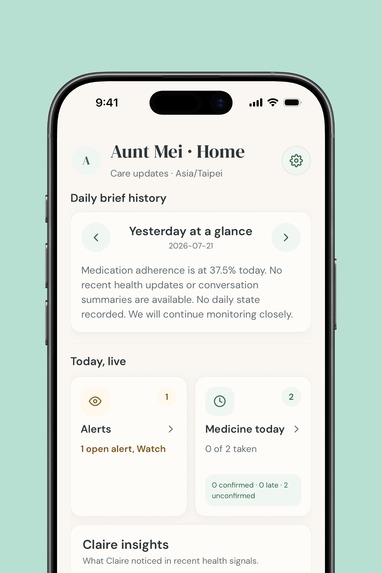
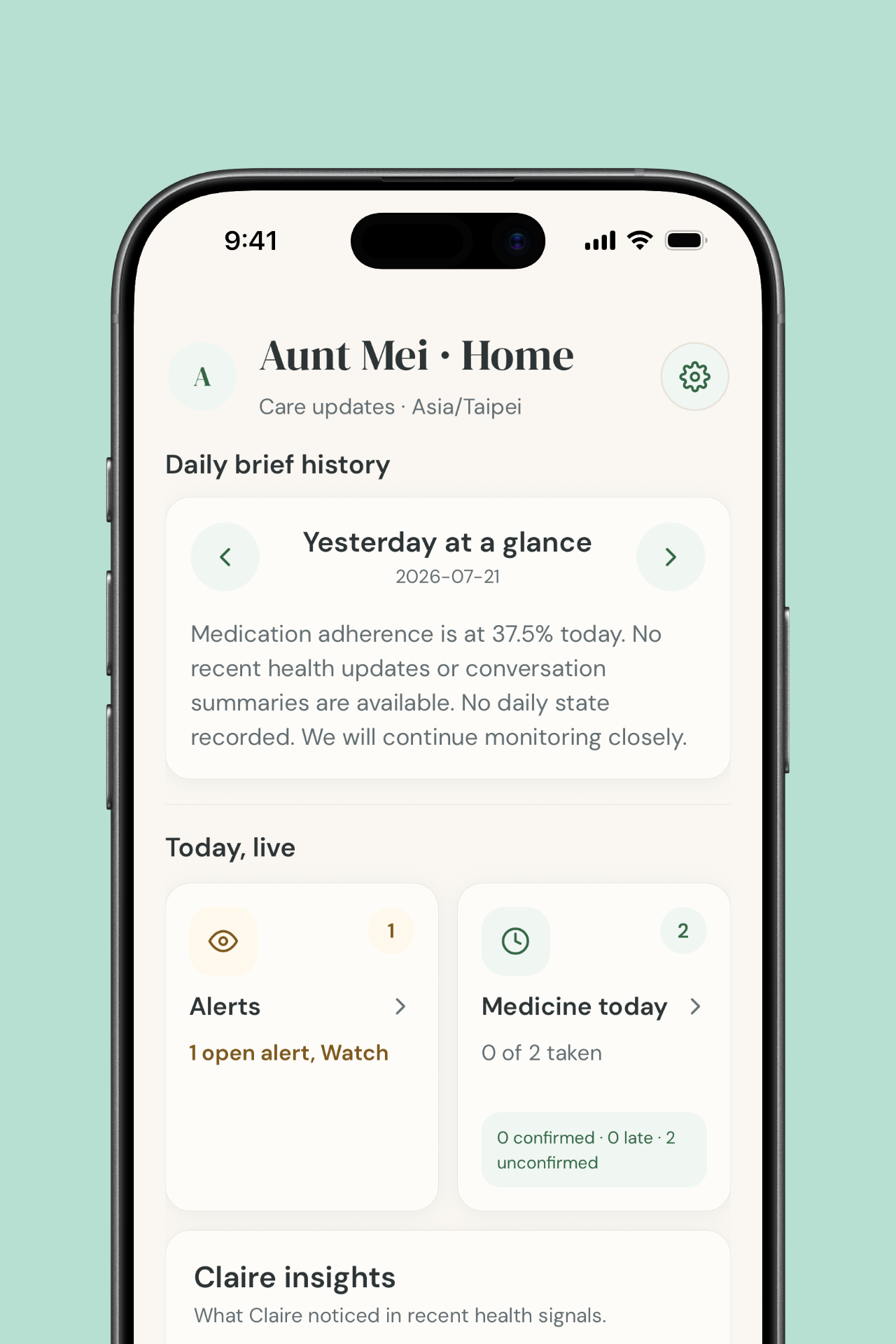
Family/Caregiver Dashboard
-
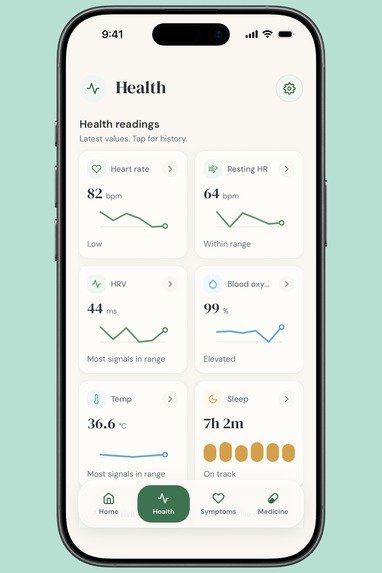
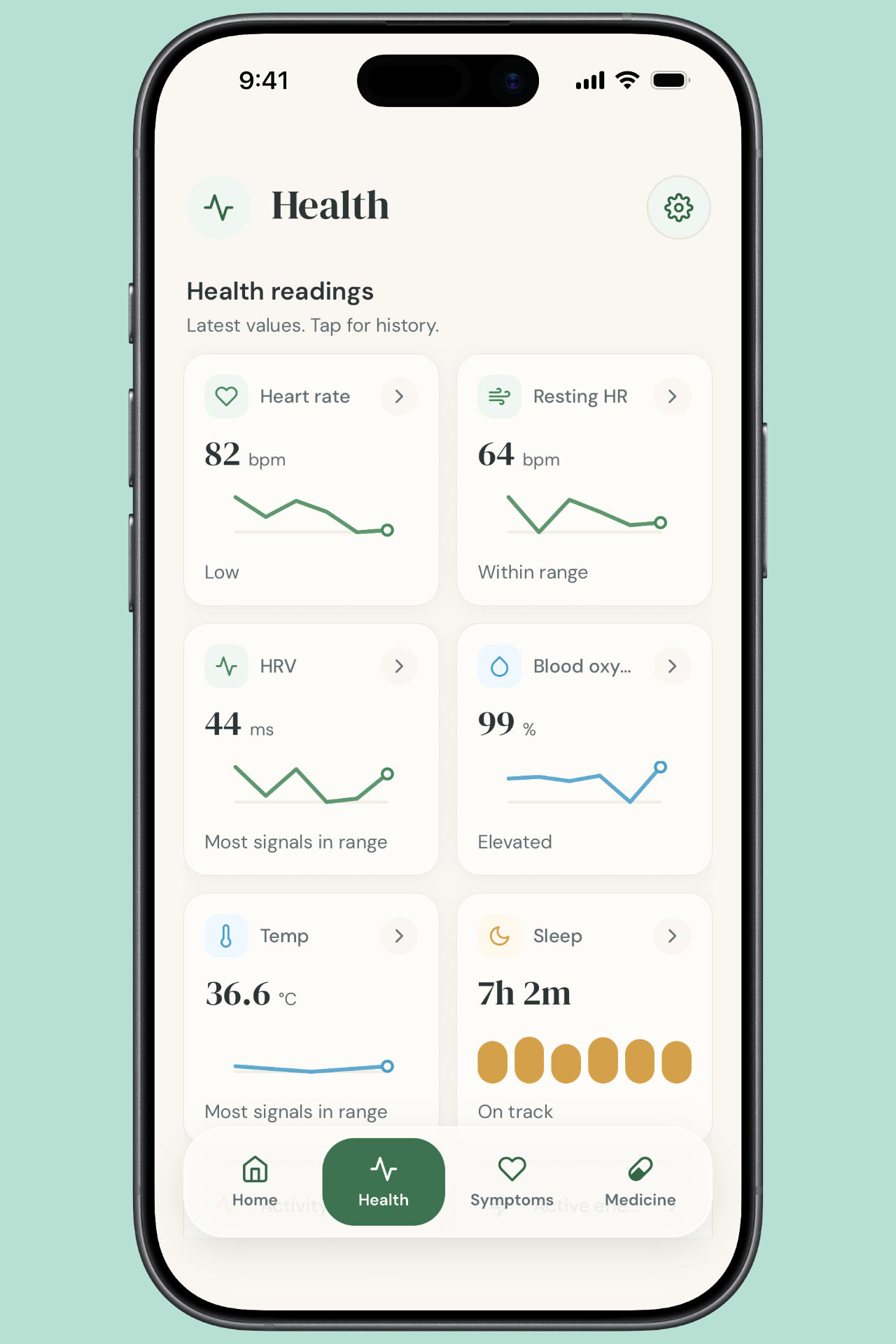
Health Dashboard
-
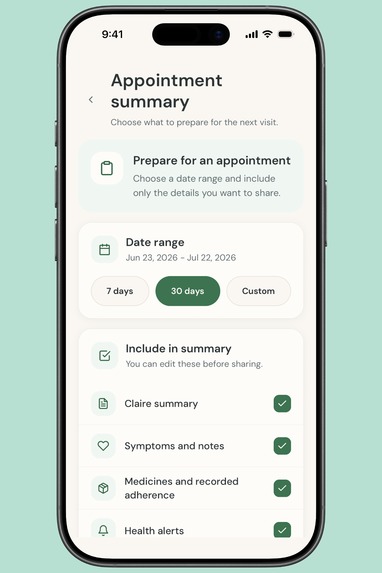
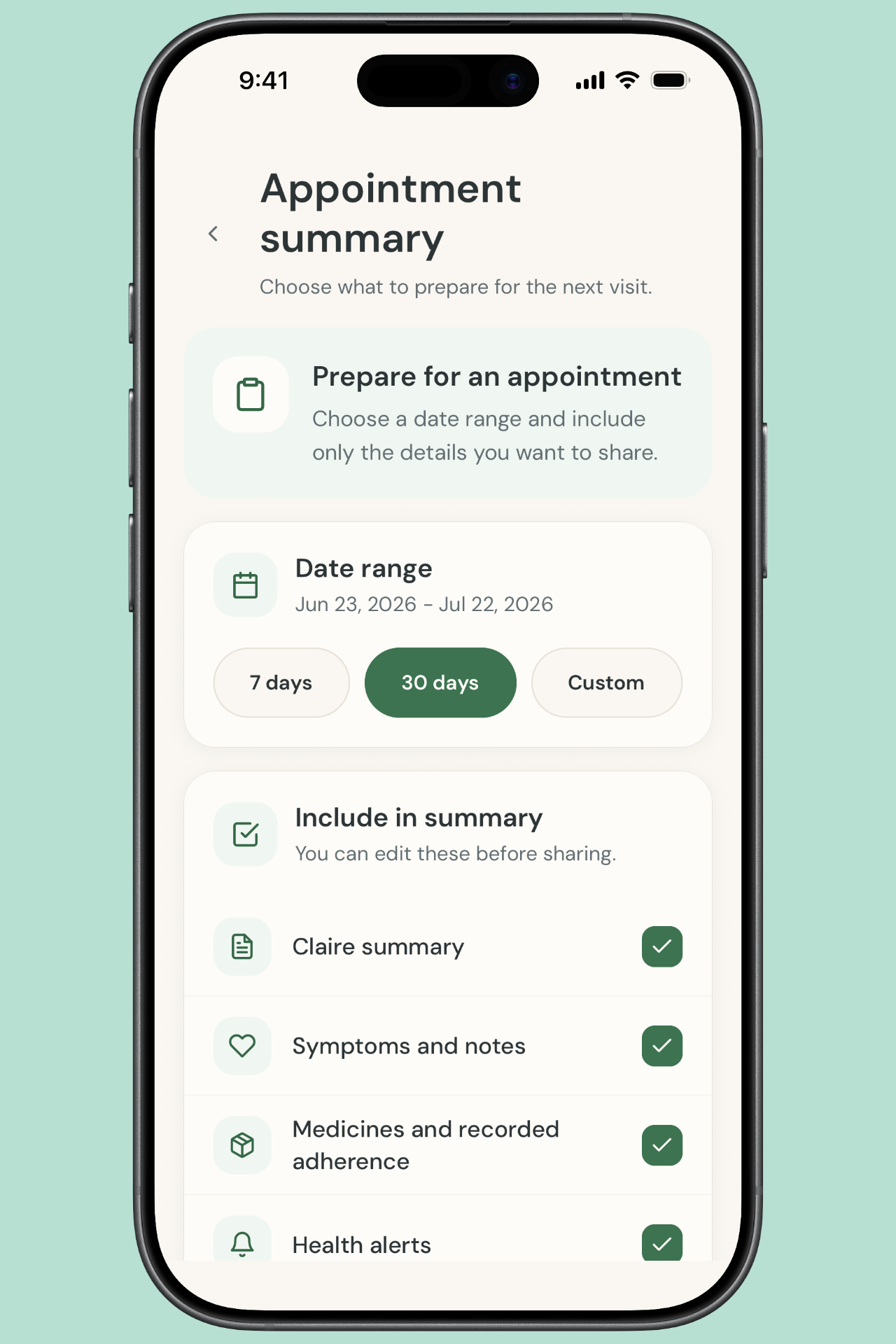
Export Health Report for doctor
Claire: Helping families notice when something changes
Inspiration
Claire began with a feeling I know personally: caring deeply about your family while not being close enough to know whether they are truly okay.
Last year, I was taking the bus to work on a Saturday morning when I saw a message my mother had sent around midnight. My grandmother had passed away following a scooter accident.
The accident happened around 3 PM the previous day while she was crossing a road near our home. People nearby tried to notify my family by knocking on the front door, but my mother did not hear them from the kitchen, and my father was at work. I did not learn what had happened until the following morning.
I know Claire could not have prevented that accident. What stayed with me was the delay, the lack of awareness, and the helplessness of learning too late that something serious had happened.
This year, I also lost my uncle to a heart attack while he was driving. These experiences made me increasingly worried about my parents as they grow older. One question kept returning:
How can I notice when something changes, even when I cannot physically be there?
That question became Claire.
What Claire does
Claire is a voice-first AI care system for families caring for aging parents from a distance.
The most important health changes usually happen quietly: poor sleep, reduced movement, missed medication, dizziness, coughing, fatigue, mood changes, or just not responding the way they usually do. These signals are easy to miss — especially across distance.
Claire has two connected experiences: For the elderly user: Simple voice check-ins, medication reminders, and symptom logging. Everything is accessible just by talking to Claire — no menus to navigate, no app to learn.
For the family: Claire turns daily health signals into plain-language summaries and alerts. Not raw numbers — actual answers to the question families care about: what changed, why might it matter, and what should I do next?
Underneath both views, Claire learns each person's normal patterns from voice conversations, reported symptoms, routines, medication history, and wearable data. Instead of showing a chart and leaving families to interpret it, Claire builds a personal baseline and answers the one question that actually matters: "Is something different today?"
We're starting with family awareness and care coordination. The long-term vision is a personal clinical AI for aging families.
How I built it
Claire is a working mobile product with elderly-facing and family-facing experiences in one Expo and React Native application.
The system includes:
- An Expo mobile application with separate elderly and caregiver experiences
- A Fastify API for authenticated care workflows
- Supabase for authentication, care records, storage, and access control
- A scheduled worker for daily summaries and background care processing
- A voice pipeline built around LiveKit and WebRTC
- Wearable data comes in through HealthKit
- AI reasoning connected to medication, symptom, conversation, and health context
- Multilingual support for the families Claire is intended to serve
- Safety rules and evaluations for health-related conversations
Voice AI was one of the most technically demanding parts. A voice companion cannot behave like a normal text chatbot with a microphone added on top. Latency, interruption handling, turn detection, transcription quality, synthesis, and network stability all affect whether the conversation feels natural.
I explored two major approaches: live speech-to-speech models and the more modular speech-to-text, reasoning, and text-to-speech pipeline. Live models can feel more natural, but the modular approach currently provides more control and predictable behavior for safety-sensitive care interactions. Claire’s architecture allows these components to evolve as live models become more reliable and affordable.
Codex was my main development workspace to build Claire.
I divided the project into focused Codex tasks for mobile UI, backend systems, the AI agent, voice infrastructure, testing, and product design. For each substantial feature, I followed a repeatable process:
- Discuss the problem and validate whether the feature should exist.
- Compare possible architectures and their tradeoffs.
- Turn the selected approach into a written implementation plan.
- Review the plan for missing safety, privacy, or product considerations.
- Use a focused Codex goal to implement and verify the work.
- Run separate review passes with Claude to find defects and unintended complexity.
I maintained implementation plans and bug reports inside the repository so that each agent could work from explicit context rather than relying on an increasingly long conversation.
I also created scheduled Codex review workflows. At night, one task could inspect the current implementation and produce a structured bug report. A separate task would then verify the findings before making focused fixes.
I also used Cursor as my code editor and occasionally used separate review tools to challenge a plan, but Codex remained the primary environment where Claire was designed, implemented, tested, and refined.
Challenges I faced
Learning mobile development from zero
Claire is my first mobile application. I had no previous experience building with Expo, React Native, native health integrations, mobile authentication, or custom development builds.
Codex helped me bridge that gap, but I still needed to understand the decisions being made. I learned how mobile navigation, secure device sessions, permissions, native dependencies, and platform-specific behavior differ from traditional web development.
Building a reliable voice experience
Voice exposed issues that are less noticeable in text interfaces. Even a small delay can make a conversation feel broken. Interruptions, background noise, transcription mistakes, and switching between listening and speaking all require deliberate handling. So I learned how to implement livekit, exploring different voice architecture, etc.
Working responsibly with health information
I do not have a medical background.
I used a lot of ChatGPT deep research, sessions, safety-oriented evaluation cases, synthetic fixtures, and feedback from friends studying medicine to review the system’s behavior. I separated deterministic emergency escalation rules from general AI guidance and designed Claire to support family awareness rather than make diagnoses.
There is still much more clinical review and validation required before Claire should be relied on in real care situations.
Keeping AI development under control
Codex made it possible for me to build far beyond my previous technical experience, but speed also created risk. Agents can introduce unnecessary abstractions, expand the scope, or confidently implement the wrong interpretation.
I learned to improve results by discussing architecture first, writing down decisions, constraining each task, reviewing diffs, and requiring tests before considering work complete. I also need to tweak AGENTS.md a lot.
What I learned
The biggest thing I learned is that voice AI is not simply another interface for an agent. It is a real-time system where latency, turn-taking, audio quality, safety, and emotional tone are part of the product architecture.
I also learned that health-related AI requires a different level of restraint. The goal is not to make the model sound certain. The goal is to make uncertainty understandable, recognize situations that require urgent human attention, and avoid creating false reassurance.
Finally, I learned how much one person can build with a carefully structured AI development process. Codex did not remove the need for product judgment or engineering decisions. It changed where I spent my time. Instead of being blocked by unfamiliar frameworks, I could focus more on understanding the problem, comparing tradeoffs, testing behavior, and refining the experience.
What is next
Claire is starting with family awareness and care coordination: helping families notice changes earlier, follow up sooner, and feel less helpless when they cannot always be present.
The next steps are deeper testing with families and caregivers, professional medical review, improved wearable integration, stronger personal baselines, and more reliable multilingual voice conversations.
My long-term vision is for Claire to become a trusted personal care intelligence layer for aging families. It should understand an individual over time, recognize meaningful changes, and help the right person respond without taking dignity or independence away from the older adult.
Claire cannot make distance disappear. But it can help families feel less blind to what is happening across that distance.
Built With
- codex
- expo.io
- livekit
- node.js
- react-native
- supabase
- typescript

Log in or sign up for Devpost to join the conversation.