-
-

-
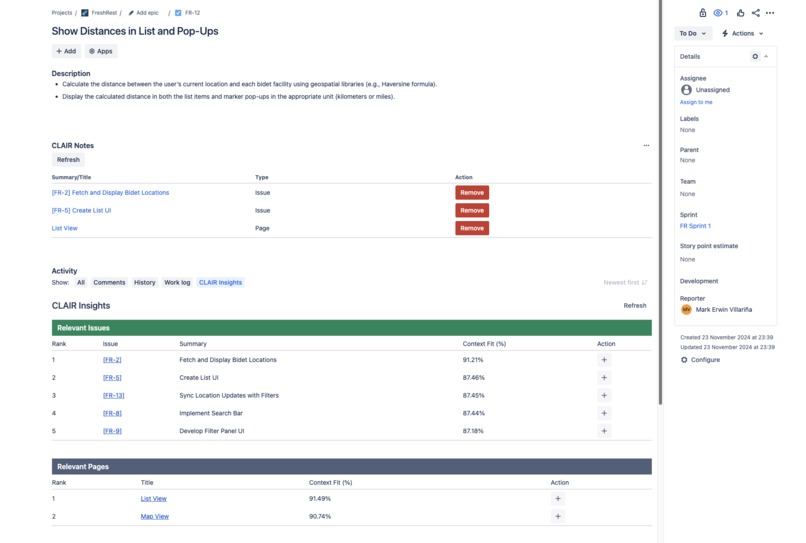
CLAIR
-
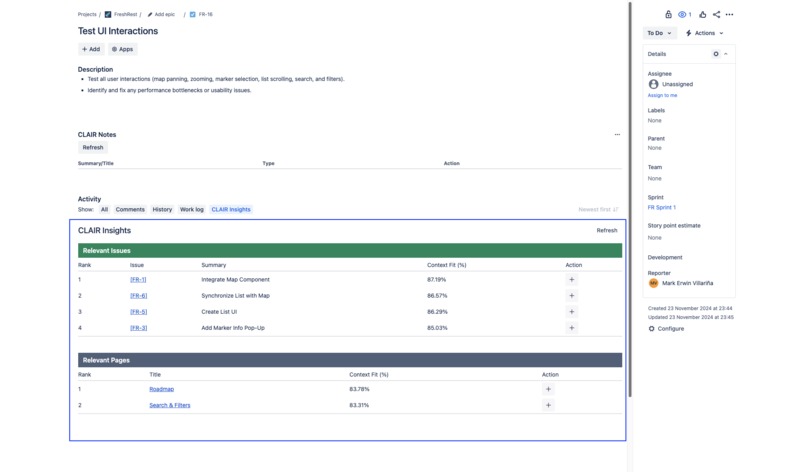
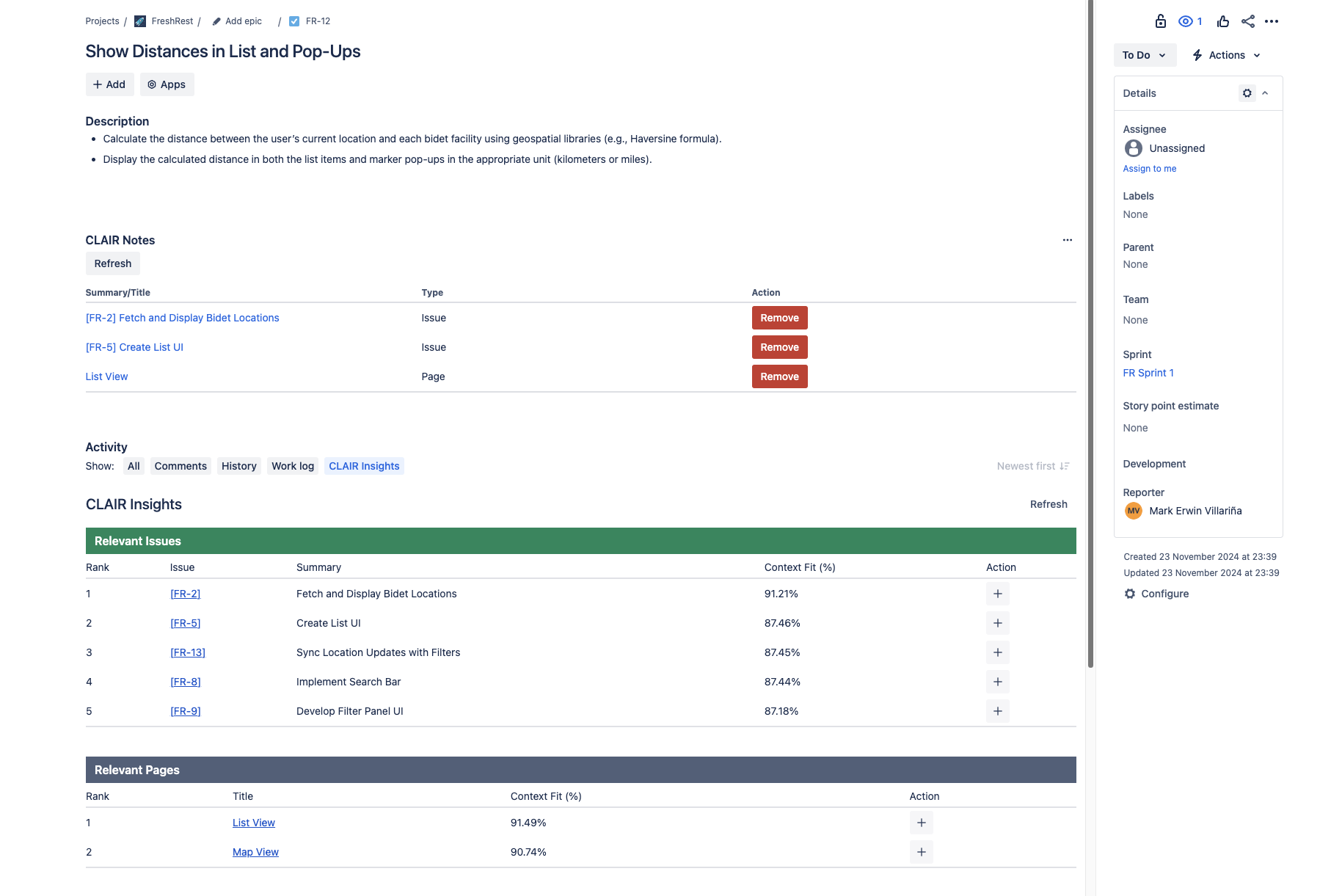
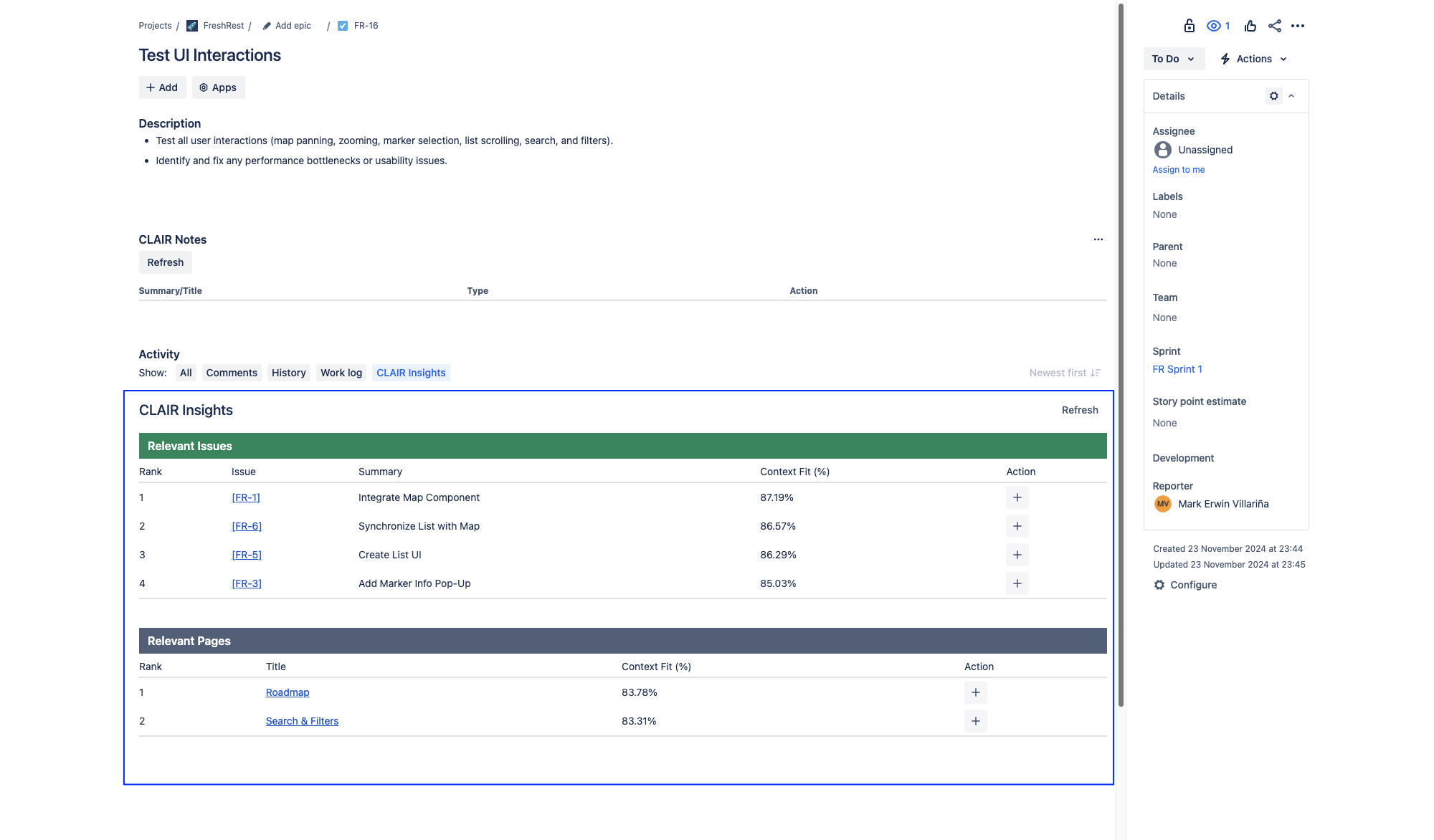
CLAIR Insights
-
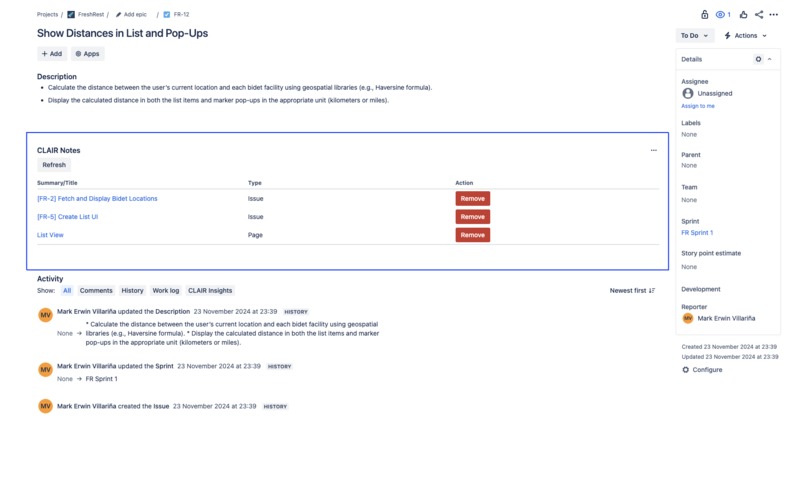
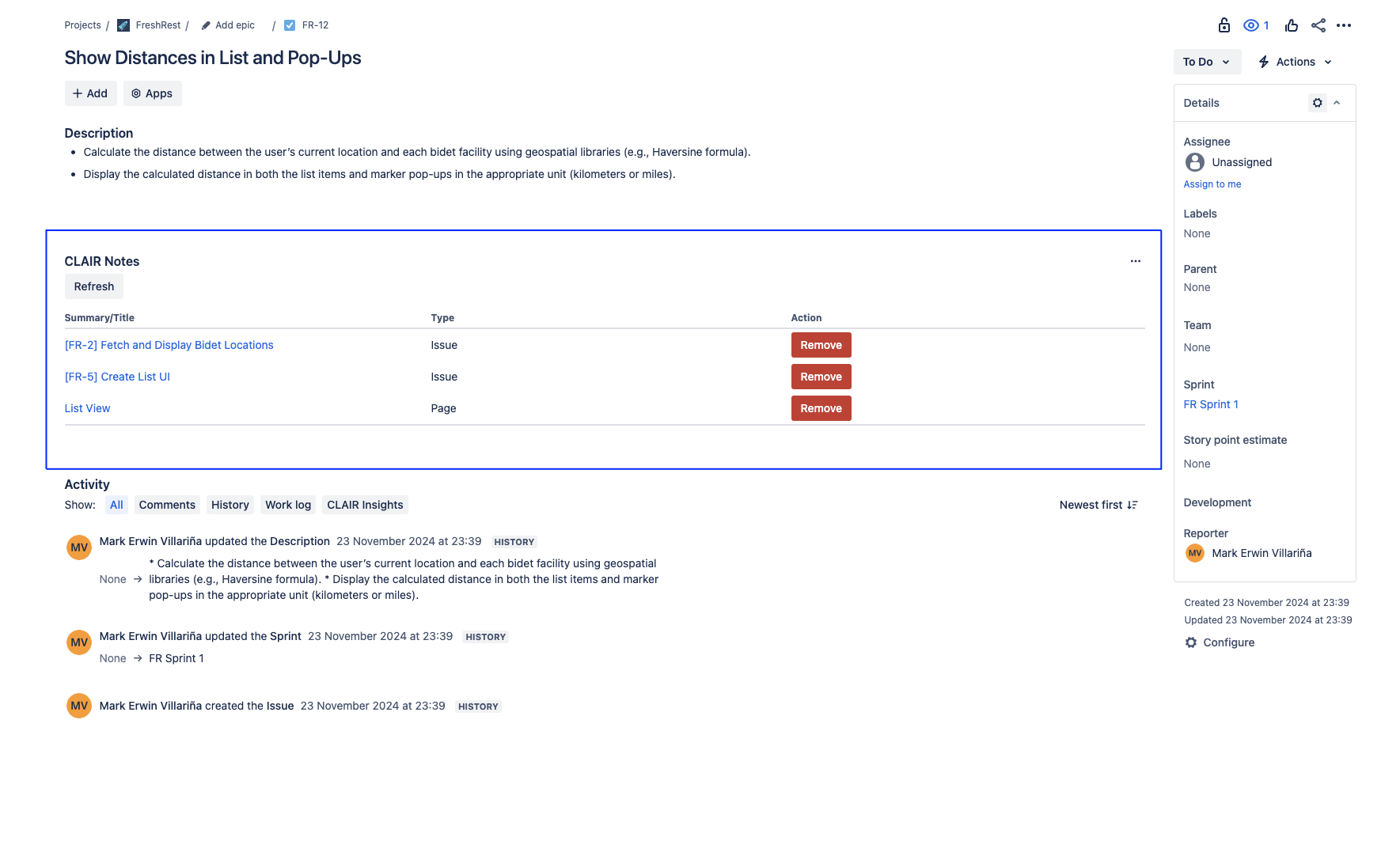
CLAIR Notes
-
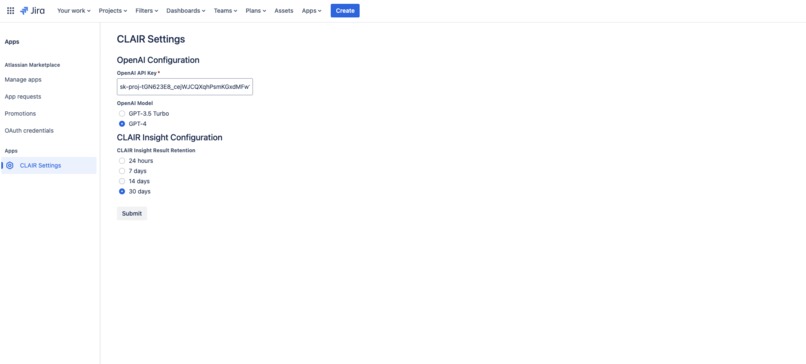
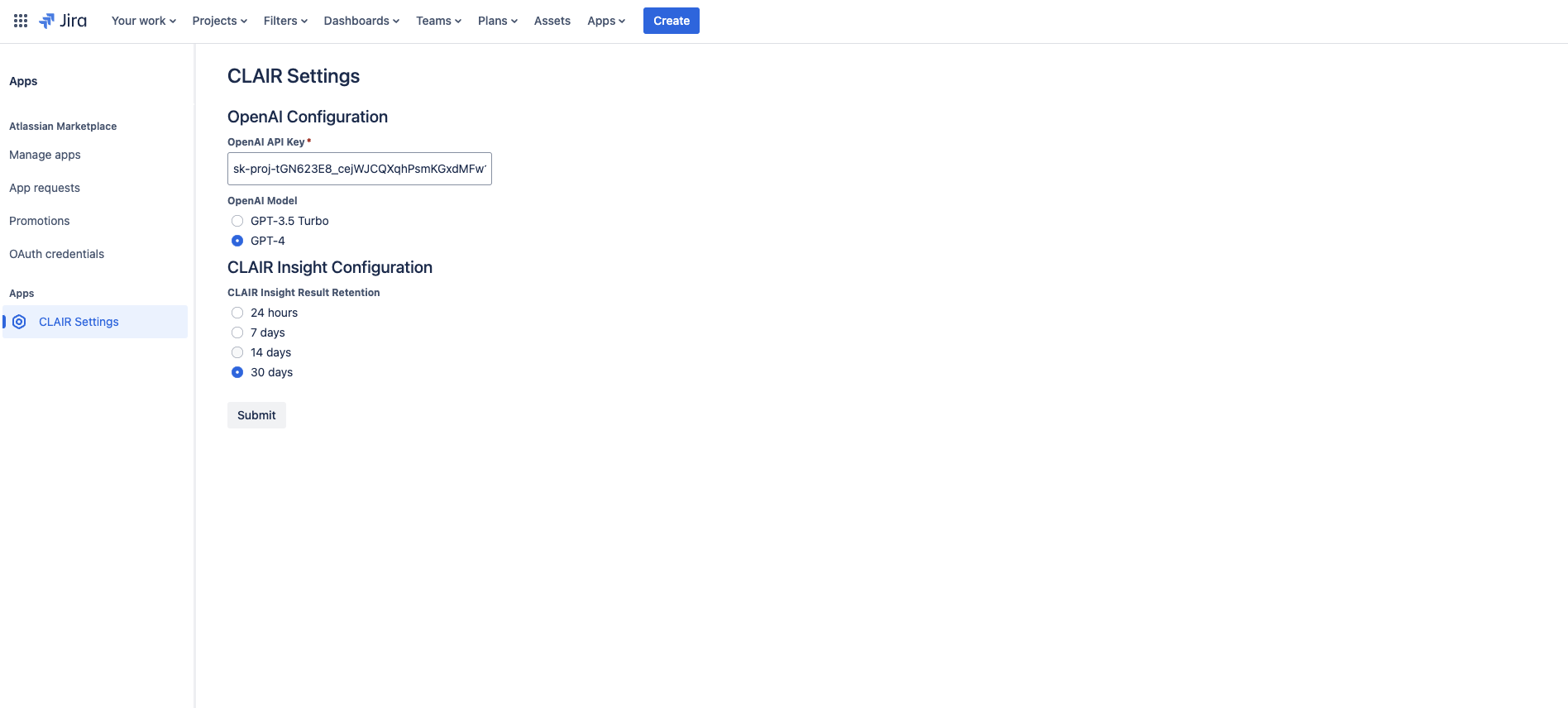
CLAIR Settings

Inspiration
CLAIR was born out of frustration in a bustling product development team. The team struggled to find relevant Jira issues, scattered Confluence pages, and hidden knowledge buried in a sea of tickets and docs. Meetings stretched endlessly, and decision-making stalled. One day, an engineer envisioned a tool that would act like a ‘clairvoyant,’ predicting what information teams needed before they even asked.
This idea sparked the creation of CLAIR – the Contextual Learning Assistant for Issue Resolution. Leveraging AI, CLAIR connects the dots, finds the most relevant insights, and turns chaos into clarity. Now, CLAIR empowers teams to stay focused, solve problems faster, and work smarter, all while reducing the noise and hassle.
What it does
CLAIR is an AI-powered assistant for Jira and Confluence that simplifies workflows by providing context-aware insights. It is divided into three main modules:
1. CLAIR Insights (Issue Activity)
- Analyzes the current Jira issue and retrieves related Jira issues and Confluence pages using AI.
- Factors in semantic similarity and recency to rank the recommendations.
- Offers instant, context-aware results to save time and boost productivity.
2. CLAIR Notes (Issue Panel)
- Allows users to save selected related issues and pages for quick reference.
- Provides a centralized view of previously saved insights to streamline workflows.
- Ensures essential connections are easily accessible when needed.
3. CLAIR Settings (Admin Page)
- Enables administrators to configure OpenAI API keys and select the desired model.
- Allows customization of result retention settings to control how long insights are stored.
- Provides flexibility for organizations to tailor CLAIR to their specific needs.
How CLAIR Helps:
- Reduces time spent searching for information by delivering the right data at the right time.
- Enhances decision-making and problem-solving with AI-powered insights.
- Boosts collaboration by seamlessly connecting relevant issues and knowledge pages.
CLAIR transforms the way teams manage Jira and Confluence, enabling smarter, faster, and more efficient workflows.
How we built it
Building CLAIR involved combining modern technologies with practical solutions for Jira and Confluence users. Here's an overview of the process:
1. Foundation with Atlassian Forge
- Forge provided the backbone for integrating CLAIR into Jira and Confluence.
- We utilized Forge Custom UI for rich user interfaces and Forge APIs for seamless interactions with Jira issues and Confluence pages.
2. AI-Powered Recommendations
- CLAIR leverages OpenAI's GPT models:
- Embeddings for semantic similarity to identify related issues and pages.
- Chat Completions for conversational insights and enhanced user interaction.
- AI ranking incorporates cosine similarity and recency to ensure relevance.
3. Modular Design
- We designed CLAIR with three main modules:
- CLAIR Insights: Displays AI-generated recommendations within the issue activity.
- CLAIR Notes: Allows users to save and revisit related issues and pages.
- CLAIR Settings: Provides admin controls for API keys, models, and retention policies.
4. Efficient Data Handling
- CLAIR uses OpenAI APIs to process text data securely.
- Recommendations and saved data are handled with Forge storage for simplicity and compliance.
5. User-Centric Features
- We prioritized usability, creating intuitive interfaces for:
- Saving related issues and pages with one click.
- Accessing saved content in the CLAIR Notes panel.
- Configuring settings quickly in the admin page.
By combining the power of Atlassian Forge and OpenAI technologies, CLAIR delivers intelligent, contextual insights that streamline workflows and enhance productivity for teams.
Challenges we ran into
Building CLAIR wasn’t without its hurdles. One of the primary challenges we faced was ensuring accurate recommendations. Early versions of the AI struggled to generate consistently relevant results. To address this, we fine-tuned the ranking algorithm by incorporating semantic similarity and recency metrics to improve relevance.
Integrating CLAIR seamlessly with Jira and Confluence also posed difficulties. Accessing Confluence pages from Jira and vice versa through Forge required careful API handling and setting up proper permissions. By leveraging Forge's Cross-Product API capabilities and testing extensively, we ensured smooth integration across both platforms.
Managing API usage and costs was another significant challenge. OpenAI’s APIs are powerful but costly, so we needed to optimize usage while keeping expenses manageable. We implemented intelligent batching for requests and allowed admins to configure the OpenAI model to balance performance and cost.
User experience was also a critical focus. Designing a clean, intuitive interface that fit seamlessly into Jira and Confluence while offering advanced functionality required careful thought. We created modular UI components using Forge Custom UI, ensuring the interface was clear, simple, and responsive.
Additionally, handling long titles and large datasets presented difficulties, cluttering the UI and making it harder for users to find what they needed. We solved this by truncating long titles with hover tooltips and implementing ranking algorithms that surfaced the most critical information.
Ensuring data security and compliance was another challenge. Processing user data through external AI services raised concerns, so we ensured that no sensitive or personal data was sent to external APIs. Instead, we focused on using metadata and relevant content, keeping user information secure.
Finally, balancing real-time performance with AI-powered insights without noticeable delays in the Jira or Confluence UI was tough. To tackle this, we cached frequently accessed results and optimized API calls to minimize latency.
Overcoming these challenges helped us create a robust, intelligent, and user-friendly tool that empowers teams to work smarter and faster with CLAIR.
Accomplishments that we're proud of
We’re incredibly proud of what we’ve achieved with CLAIR. One of our biggest accomplishments is the seamless integration between Jira and Confluence. By leveraging Atlassian Forge, we were able to build a tool that provides real-time, context-aware insights directly within Jira issues and Confluence pages, improving workflow efficiency without disrupting the user experience.
Another major accomplishment is the accuracy of our AI recommendations. Through continuous iteration and fine-tuning, we’ve created a recommendation engine that consistently surfaces the most relevant issues and pages. Our semantic similarity algorithms, combined with recency factors, ensure that teams get actionable insights when they need them most, drastically reducing search time and enhancing productivity.
We’re also proud of the flexibility we’ve built into CLAIR, allowing users to tailor the tool to their needs. The CLAIR Settings module empowers administrators to configure OpenAI API keys, model settings, and result retention policies to best suit their organization’s unique needs, providing full control over the app’s performance and cost.
Additionally, our CLAIR Notes feature has been a game-changer for users who need to save relevant content for later reference. By enabling users to save related issues and pages directly into their personalized notes, we’ve made it easier than ever to keep important insights at hand and accessible for future use.
Lastly, the simplicity of our UI design is something we’re particularly proud of. We managed to strike the perfect balance between powerful functionality and user-friendly design, ensuring that even teams unfamiliar with AI-powered tools can quickly harness CLAIR's full potential.
These accomplishments make us confident that CLAIR is not only a tool for today, but one that will continue to evolve and provide value to teams in the long run.
What we learned
Building CLAIR taught us the importance of balancing AI’s power with simplicity. We learned how to deliver accurate, context-sensitive insights while ensuring a seamless user experience. Flexibility was key—giving users control without complicating workflows. Optimizing performance for real-time recommendations highlighted the value of efficient design, while user feedback proved vital in refining every aspect of CLAIR. Above all, we learned that integrating AI effectively requires constant iteration and a deep understanding of user needs.
What's next for CLAIR - Contextual Learning Assistant for Issue Resolution
Looking ahead, we have some exciting plans for the future of CLAIR to make it even more powerful and user-friendly.
1. Enhanced AI Capabilities
The next step for CLAIR is to further enhance its AI capabilities. We plan to integrate advanced natural language processing (NLP) features, enabling CLAIR to better understand and process more complex queries. Additionally, we aim to experiment with custom AI models tailored specifically to the needs of Jira and Confluence users, providing even more accurate and context-sensitive recommendations.
2. Broader Jira Integration
We’re working on expanding CLAIR’s integration across other parts of the Jira ecosystem, including Jira Service Management and Jira Software. This would allow CLAIR to deliver intelligent insights across various Jira use cases, making it indispensable for all types of Jira users.
3. Collaborative Features
Another exciting feature we plan to introduce is collaboration support. Users will be able to share CLAIR’s insights, saved pages, and related issues with their team members, creating a more collaborative environment. By building sharing and commenting features into CLAIR, we aim to improve team communication and decision-making.
4. Customizable Dashboards
To enhance user experience, we plan to add customizable dashboards where users can set up their own insights, notes, and settings in one convenient place. This will allow for greater personalization, enabling teams to organize CLAIR according to their specific needs and preferences.
5. Multi-Language Support
To make CLAIR more accessible to a global audience, we will be adding multi-language support. This will allow non-English-speaking users to interact with CLAIR in their native language, broadening its usability.
6. Performance Improvements
We’re continually optimizing CLAIR’s performance, focusing on faster loading times and better resource management, ensuring that it runs smoothly even with large datasets or heavy usage. Improved caching and background processing are on the way to make CLAIR even more responsive.
7. Expanded Documentation and Training
To help users get the most out of CLAIR, we plan to release expanded documentation and training resources. These resources will offer deeper insights into how to use CLAIR’s features, as well as tips and best practices to maximize its potential.
Built With
- forge
- openai


Log in or sign up for Devpost to join the conversation.