
Inspiration
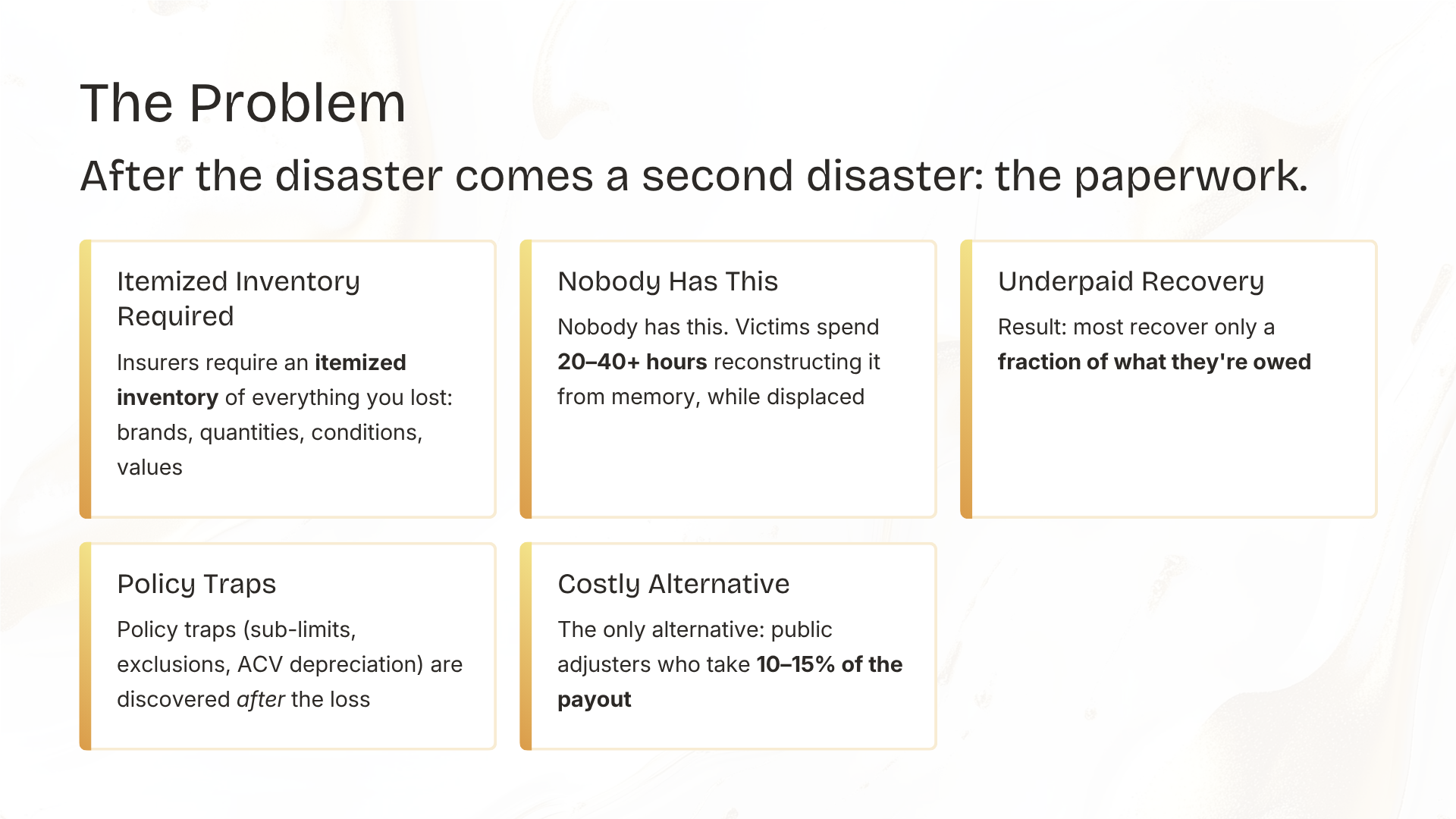
The idea came from a story that stuck with us: after a house fire, an insurer asked a family to list everything they owned — brands, quantities, purchase dates, values — before paying a cent. They were living in a hotel, their receipts had burned with the house, and they had six weeks to remember the contents of every drawer.
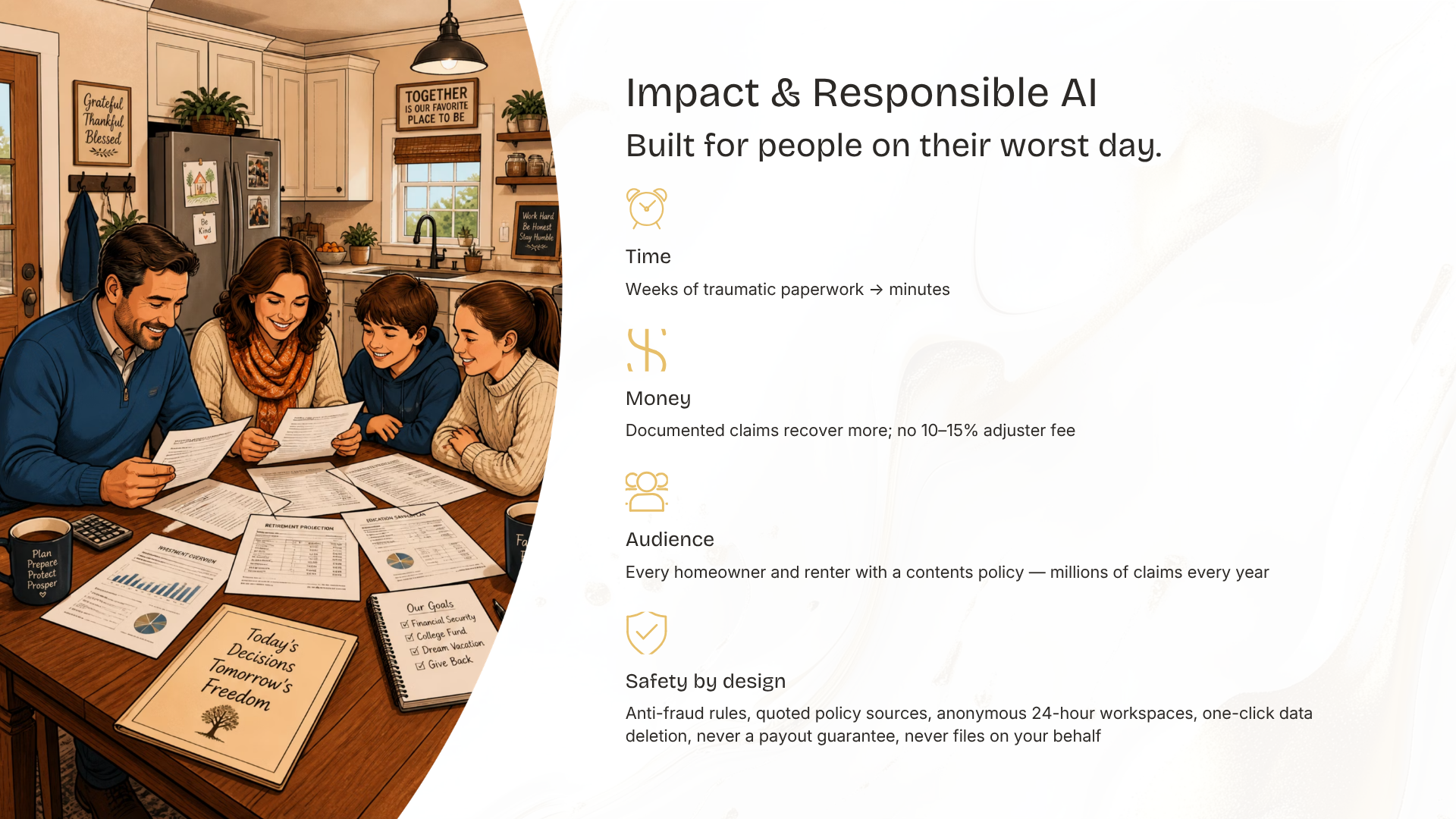
This is not an edge case. It's how contents claims work everywhere. Most disaster victims recover only a fraction of what they're owed because they can't document what they lost, and the only professional alternative — a public adjuster — takes 10–15% of the payout. The cruel part is that almost everyone already has the evidence they need: an old walkthrough video, moving day photos, even the real-estate listing of their own home. Nobody had built the tool that turns that evidence into a claim.
What it does
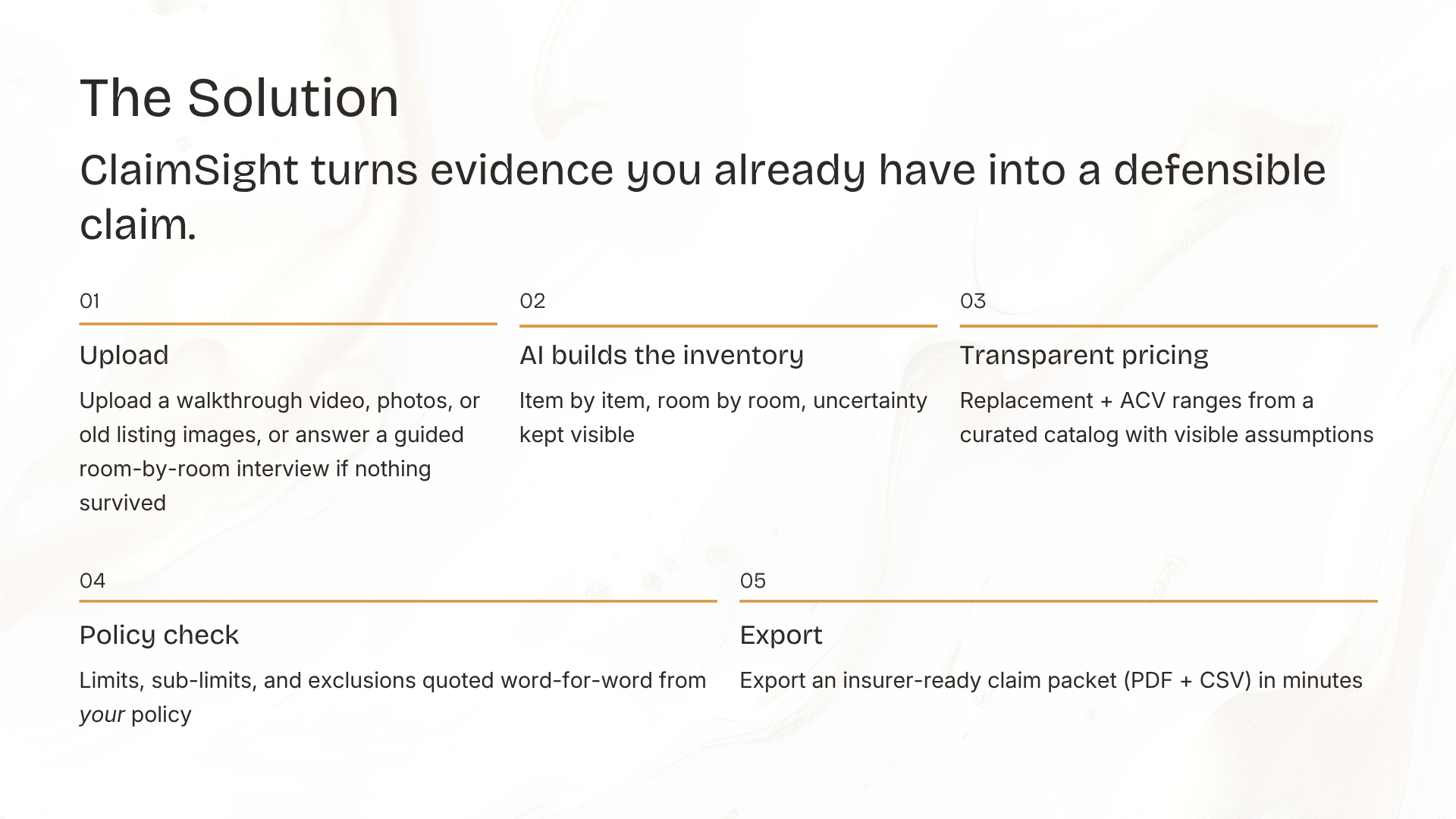
ClaimSight turns home evidence into a reviewable, policy-aware contents claim:
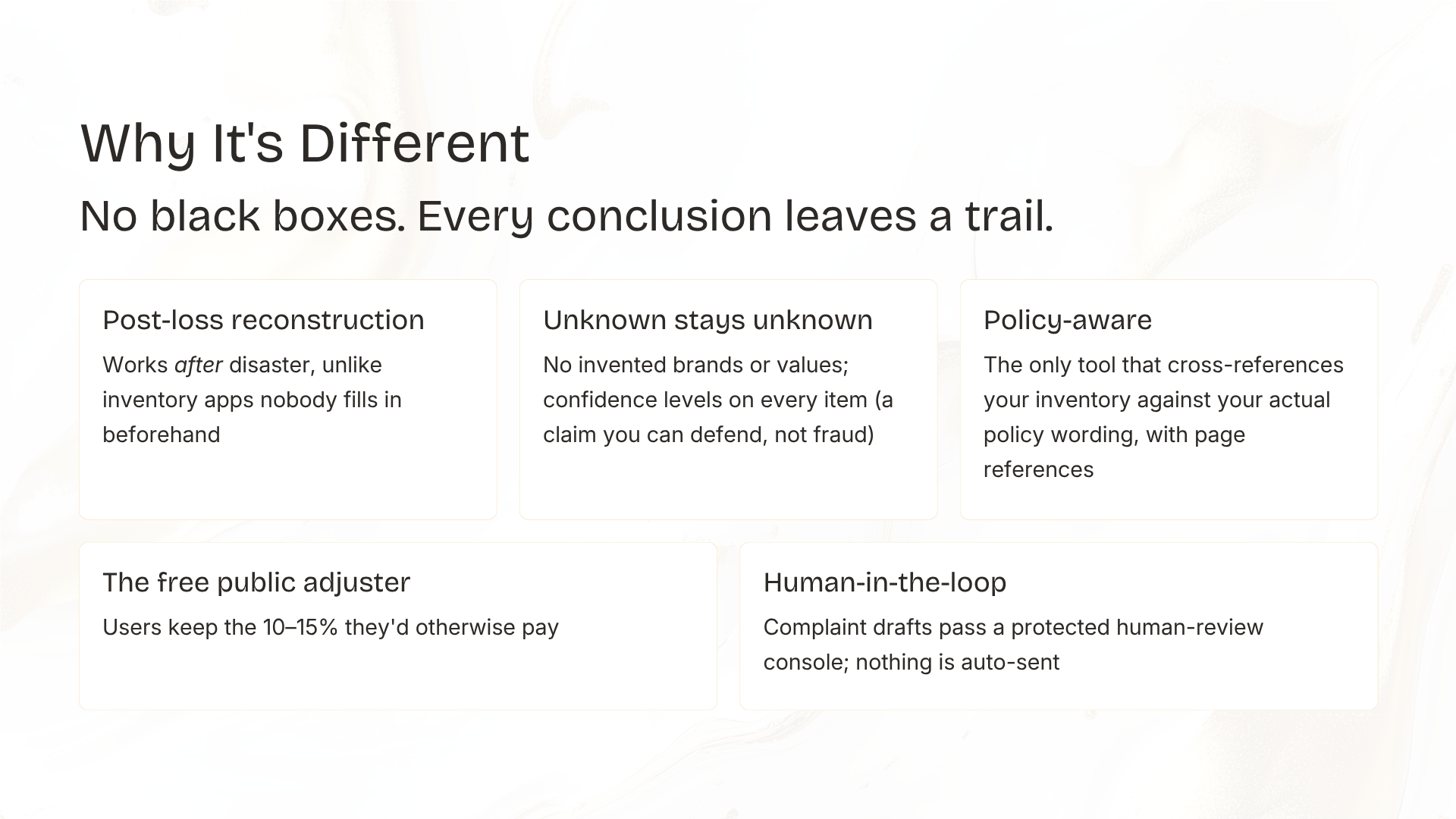
- Upload what you have. A walkthrough video or photos. Vision AI identifies possessions room by room, keeping a frame reference for every item. If no evidence survived the disaster, a conversational intake interviews you room by room and builds the inventory from memory instead.
- Nothing is invented. Unknown brands, models, and quantities stay explicitly unknown, flagged for your review with confidence levels. We think this honesty is the difference between a defensible claim and a rejected one.
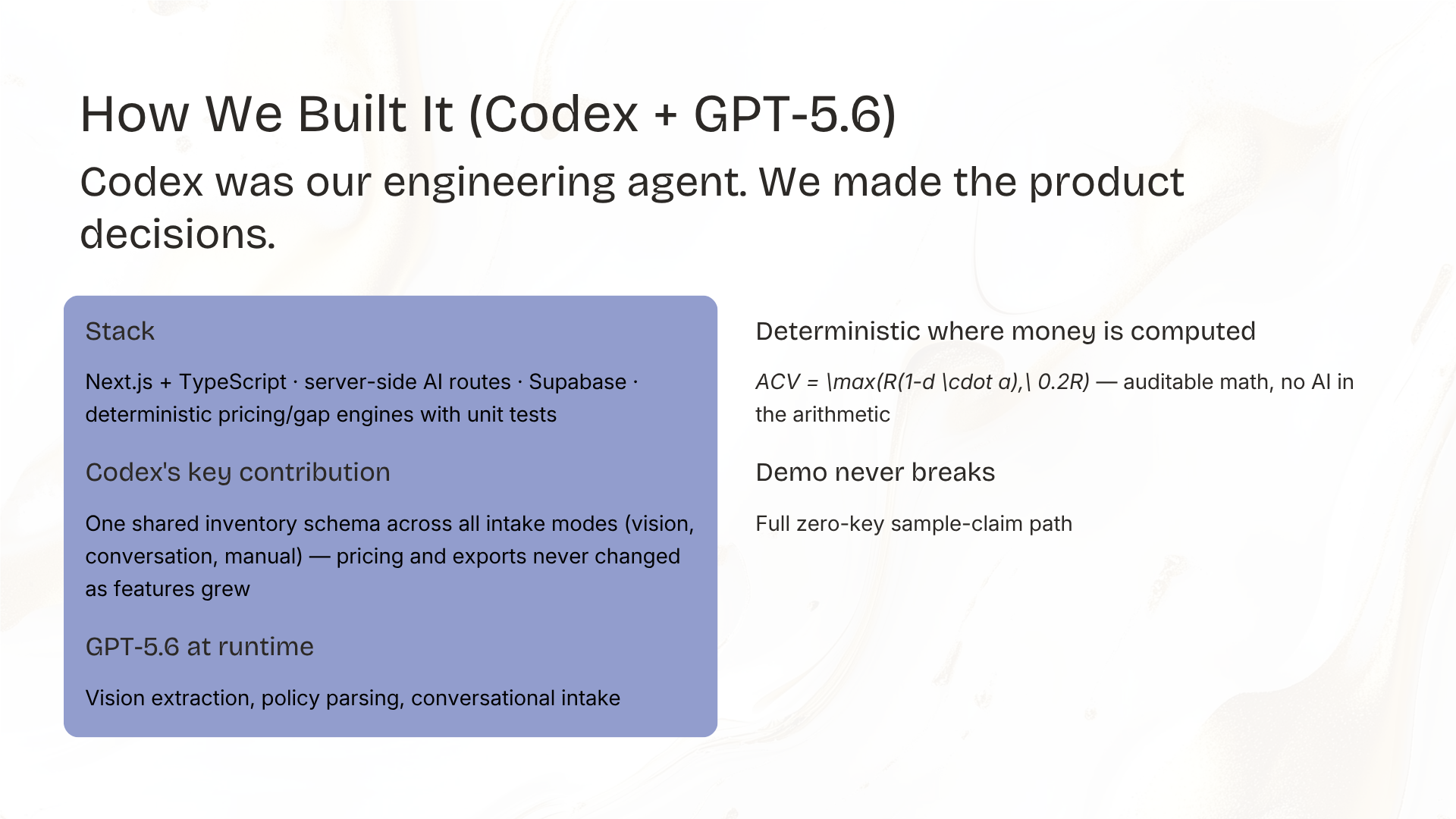
- Transparent pricing. A curated catalog produces replacement-cost and actual-cash-value ranges with visible assumptions. ACV is computed deterministically:
$$ACV = \max\big(R \cdot (1 - d \cdot a),\; 0.2R\big)$$
where $R$ is replacement cost, $d$ the category depreciation rate, and $a$ the assumed age from condition. No AI in the arithmetic — every number is auditable.
- Reads your actual policy. Limits, sub-limits, exclusions, deductibles, and ACV-vs-RCV terms are extracted from the policy PDF, each paired with the exact quoted wording and page reference. The coverage-gap report then shows where your belongings exceed sub-limits before the insurer tells you.
- Walks with you after export. A guided claim journey, a receipt register, a bilingual (English/Spanish) correspondence assistant that drafts replies to insurer letters, and — if the insurer stalls — complaint drafts that pass through a protected human-review console before the user sends anything.
- Privacy by architecture. Anonymous temporary workspaces, 24-hour expiry, one-click deletion. No accounts required.
How we built it
We built ClaimSight with Codex as our primary engineering agent throughout the week — not as an autocomplete, but as the developer we directed.
- Stack: Next.js (App Router, TypeScript), server-side AI routes (keys never touch the browser), Supabase for anonymous-job persistence, Gemini 2.5 Flash for vision extraction, policy parsing, and conversational intake.
- The single-schema decision: early on, Codex proposed that every intake method — vision, conversation, manual edits — converge on one inventory schema. This one decision meant pricing, gap analysis, and exports never changed as we added intake modes. It saved us days.
- Deterministic core, AI at the edges: Codex implemented the pricing engine, gap comparisons, and CSV/PDF exporters as pure, unit-tested TypeScript. AI handles extraction and language; math stays auditable.
- Demo resilience: everything AI-dependent has a working offline path — the synthetic 16-item sample claim runs the entire experience with zero API keys configured, so judges can test the full flow instantly.
- Human-review console: a protected
/adminqueue where complaint drafts are reviewed by a person. We deliberately built it without regulator dispatch or email sending — AI drafts, humans decide.
Challenges we ran into
- Hallucination is a legal problem here, not a UX problem. An invented brand on an insurance claim is potential fraud. We rewrote our vision prompts and schemas until "unknown" became a first-class value, and added confidence levels the user must review. Teaching a generative model to confidently say "I don't know" was harder than teaching it to answer.
- Policy PDFs are hostile documents. Sub-limits hide in dense legal prose with inconsistent structure. Requiring the parser to return a direct quote with a page reference for every claim it makes — or return nothing — was the fix. If it can't cite it, we don't show it.
- Deduplication across video frames. A sofa filmed from three angles is one sofa, not three. Merging items by room, category, and fuzzy-name similarity without collapsing genuinely distinct items took real iteration.
- Scope discipline. Every feature we wanted (insurer portals, regulator dispatch, live retail pricing) threatened the polish of the core. We cut ruthlessly and documented boundaries honestly instead of simulating completeness.
Accomplishments that we're proud of
- A complete vertical slice that runs end-to-end: evidence in, priced and policy-checked claim packet out — including the no-evidence conversational path, which makes the tool work for people who lost everything, phone included.
- Every conclusion leaves a trail: every item has evidence, every price has assumptions, every policy finding has a quote and page number.
- A responsible-AI posture that's structural, not a disclaimer: anti-fraud prompt rules, human review before any complaint leaves the system, anonymous workspaces with real deletion.
- Shipping all of this in one week, with Codex doing the heavy lifting while we made the product decisions.
What we learned
- Agentic coding changes what one small team can attempt. Directing Codex well — clear specs, explicit rules, honest constraints — mattered more than writing code ourselves. Our PROMPT.md became our most important artifact.
- Trust is the product. In a domain where users are traumatized and money is at stake, features matter less than defensibility. "Uncertainty stays visible" started as an ethics decision and became our strongest differentiator.
- Deterministic beats generative wherever money is computed. Users (and judges) can audit a formula; they can't audit a vibe.
What's next for ClaimSight
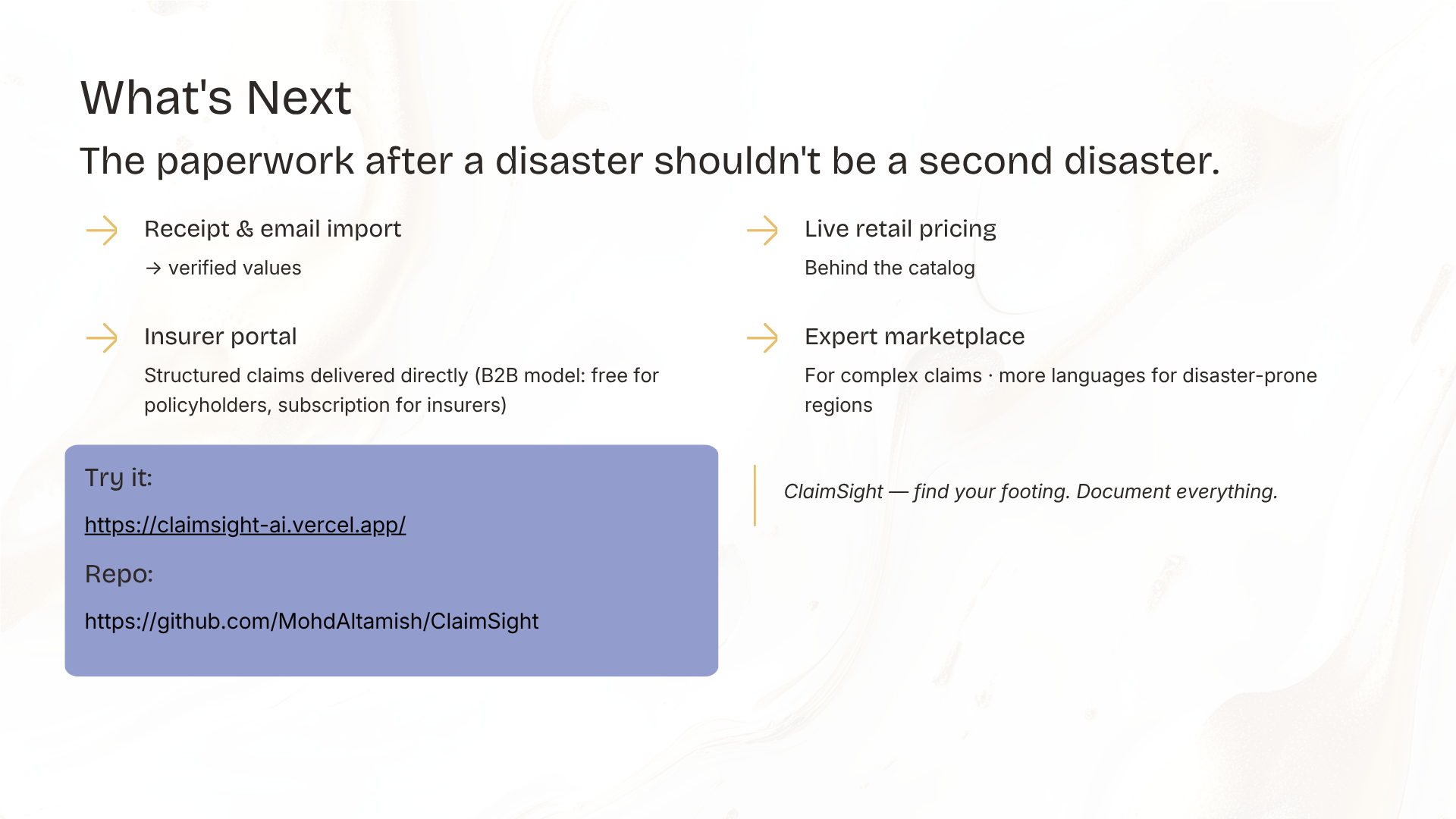
- Receipt and email import to upgrade estimates into verified values
- Live retail pricing behind the curated catalog
- Insurer portal — registered insurers receive structured, pre-verified claims directly (our B2B path: free for policyholders, subscription for insurers who want faster processing)
- Expert marketplace connecting complex claims to licensed public adjusters
- More languages, prioritized by disaster-prone regions
Disasters aren't going away. The paperwork that follows them shouldn't be a second disaster.
Built With
- ai-agents
- codex
- computer-vision
- disaster-response
- gpt-5.6
- insurance
- insurtech
- natural-language-processing
- next.js
- node.js
- openai
- pdf-generation
- pdf-parsing
- postgresql
- react
- supabase
- tailwindcss
- typescript
- vercel
- web-speech-api

Log in or sign up for Devpost to join the conversation.