Inspiration
What it does
How we built it
Challenges we ran into
Accomplishments that we're proud of
What we learned
What's next for ClaimReady
Inspiration
When something is stolen, flooded or broken, the insurer asks for proof of ownership, proof of value and proof of damage, usually within days. That proof normally exists. It is spread across years of phone photo backups, PDF invoices, scanned receipts, the policy document nobody has reread, and camera recordings. Gathering it happens at the worst possible moment, under stress and against a deadline, and items, documents and deadlines get missed.
A UGREEN AI NAS is the one device in a home where all of these sources already meet: photo backups, documents, camera recordings, and on-device AI that can read them. ClaimReady is built on that fact.
What it does
ClaimReady is a Uliya Skill with two modes:
- Claim mode, after a burglary, theft, package theft, water or fire damage, accidental damage or loss: one conversation builds the claim pack for one incident.
- Inventory mode, before anything happens: builds a register of insured items and their proof, so a future claim starts complete.
What the user gets:
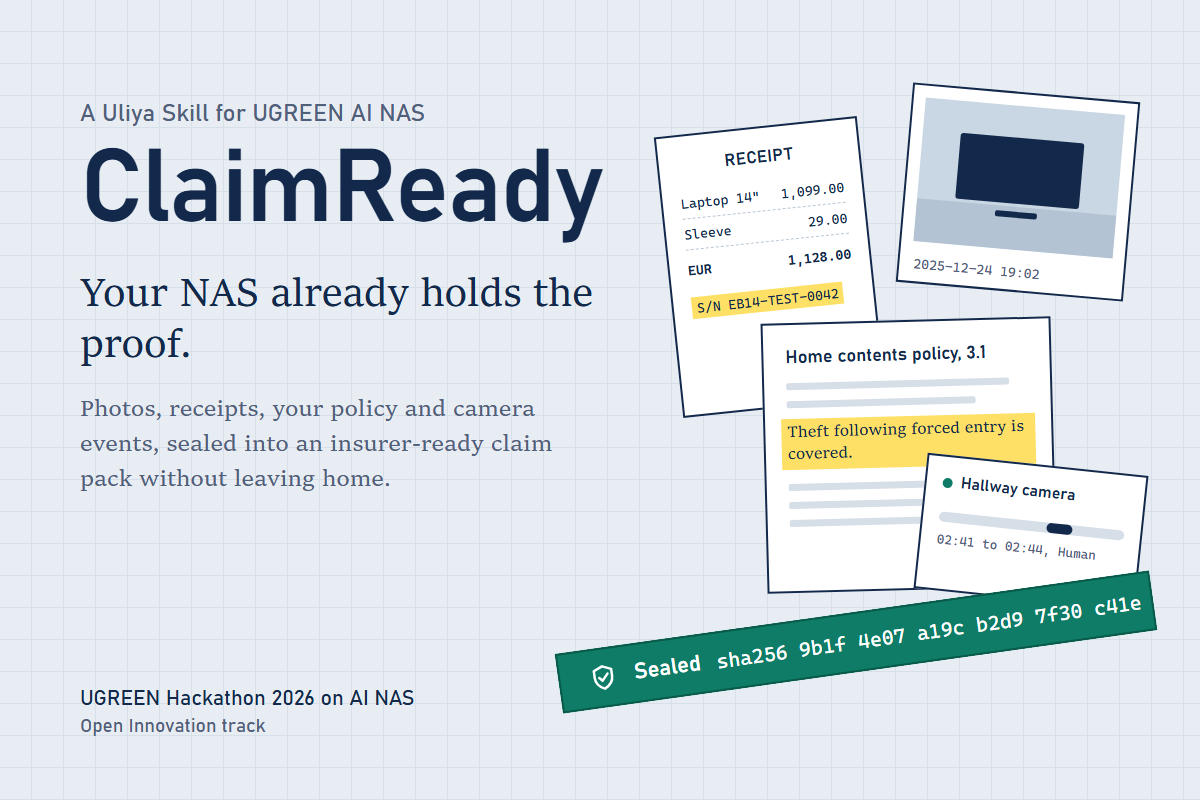
- An evidence matrix. For every item it shows proof of ownership (receipt, invoice, warranty, or a photo taken before the incident), proof of value (the printed price, never an estimate) and proof of damage or loss (photos taken after, and camera events for theft). Each entry links to its source file and gets a rating: strong, partial or missing.
- A coverage check of the user's own policy. Covered event, exclusions, deductible, item limits, the notification deadline (with the date calculated) and the required documents. Each answer is quoted with page and section, or marked "not stated in the policy".
- A missing-evidence checklist with alternatives. For example: no receipt, so ask for a bank statement line or retailer order history; a ring with no proof, so get a valuation; and export a camera clip before it expires.
- A sealed claim folder, written only after approval. It holds copies of the selected evidence, an append-only SHA-256 manifest for chain of custody, tags on the originals, a claim letter draft and the checklist.
The same claim can be run again as new proof turns up. Unchanged files are not copied twice, the manifest gains a new section, and new revisions are saved next to the old ones, because the insurer may already hold them.
Privacy is part of the design:
- Discovery is read-only and runs with the user's own permissions.
- Nothing leaves the NAS.
- Photos that show people are left out by default.
- For theft, camera events are reported as what happened and when, with no face, plate or identity lookups. Identifying a suspect is a police task, and face data is especially sensitive.
How we built it
- We started from the user's result and checked every step against the official capability catalog (2.0.0) in the UGREEN Skill Developer Package. That covered Action names, parameters, effects, approval values and each CLI's single owning expert.
- The Skill is pure Markdown: a
SKILL.mdwith 12 steps and 16 delegation templates, plus eight linked reference files. The parent only delegates. Five experts do the work:file-agent: discovery, SHA-256 fingerprints, copies, manifest, tags.knowledge-agent: voice-memo transcription, evidence search, saving text.document-agent: policy Q&A, receipt extraction, reconciliation, letter draft.photo-agent: object and text search, EXIF, vision check, OCR.security-monitor-agent: cameras, event timeline, event evidence.
- Every delegation handles
completed,failed,cancelled,waiting_userandwaiting_approval. Every slot in an instruction must be filled from the user or from a real upstream result, or the step stops. Empty results are reported as empty, never filled in. - We ran the official static checker until it reported
static-passwith 0 errors and 0 warnings. A separate review pass checked every claim against the catalog and tightened the design.
Challenges we ran into
- No NAS in Round 1. The whole design had to come from the catalog. Where the catalog lists permissions, prerequisites or error codes as unknown, ClaimReady treats the expert's own result as the only proof of success, and the open points are marked for validation on the Finalist NAS.
- Catalog limits shaped the design:
- Cameras report only their current status, so a missing event is never read as "nothing happened".
- The event timeline has no paging, so a full page is flagged as possibly truncated.
- File names for saved text are only hints, so the real output path is always used.
- Copy destinations are folders, so name clashes go into a
run-Nsubfolder instead of being renamed.
- Checker strictness. It requires exact headings, an exact capability-evidence format, and single-quoted instructions, so ClaimReady escapes quotes inside slot values.
- Fitting ten answers into 500 words.
Accomplishments that we're proud of
- A zero-invention rule that holds throughout. Every value in the matrix and the letter names its source file, and amounts stay exactly as printed, in their own currency.
- A sealing process that survives interruption. Fingerprints come first, then copies with verification, then the manifest and tags. A run that stops halfway is detected on the next run, and its copies are recovered rather than duplicated.
- Complete documentation: install, setup, removal, a test plan covering every delegation state, and a worked example with synthetic data.
What we learned
- An orchestration Skill is a contract. It has to say who does what, what passes downstream, and what happens in each state.
- The most valuable sentences in a Skill are often the refusals: do not estimate, do not identify, do not overwrite.
What's next
- Finalist testing day: validate every Action's real output on the iDX6011 Pro with synthetic data, adjust the instructions, and record the demo.
- Later:
- A PDF export of the pack, and scheduled inventory reminders, if the platform adds those capabilities.
- An optional claim album in UGREEN Photos, left out for now on purpose for privacy.
- Wider multilingual policy support.
AI assistance and third-party components
ClaimReady was developed with the help of an AI coding assistant, Claude Code by Anthropic. It was used to analyse the UGREEN capability catalog and checker rules, draft the Skill files (SKILL.md and references), the proposal and this submission text, and run the official static checker. The entrant directed the project and is responsible for the submission. The Skill itself bundles no third-party components and calls no external AI service; at runtime it delegates only to the registered NAS experts.
Development tools used: UGREEN Skill Developer Package (uliya-skill-kit 0.7.3, capability catalog 2.0.0, static checker), Claude Code (Anthropic), Node.js 22 (MIT), Python 3.13 (PSF License) and Microsoft Edge headless (to render the PDF and cover).
Built With
- ai-agents
- claude-code
- document-ai
- markdown
- ocr
- sha-256
- speech-to-text
- ugos
- ugreen-ai-nas
- uliya-skill-kit
- vision-language-model

Log in or sign up for Devpost to join the conversation.