Inspiration
Insurance claims are one of the most important and stressful moments between an insurer and a policyholder. When someone reports property damage, the claims team has to move quickly, but they also have to be accurate, fair, and audit-ready.
A single claim can include photos, policy documents, claim notes, weather context, repair estimates, and human judgment. Today, much of that review process is still manual and fragmented.
That inspired me to build ClaimPilot: an agentic AI claims-review assistant that helps insurance teams turn messy claim evidence into a structured, auditable decision packet.
The goal is not to replace claims officers or adjusters. The goal is to help them work faster, review evidence more consistently, and keep humans in control of sensitive decisions.
What it does
ClaimPilot guides a claims officer through a full claim-review workflow.
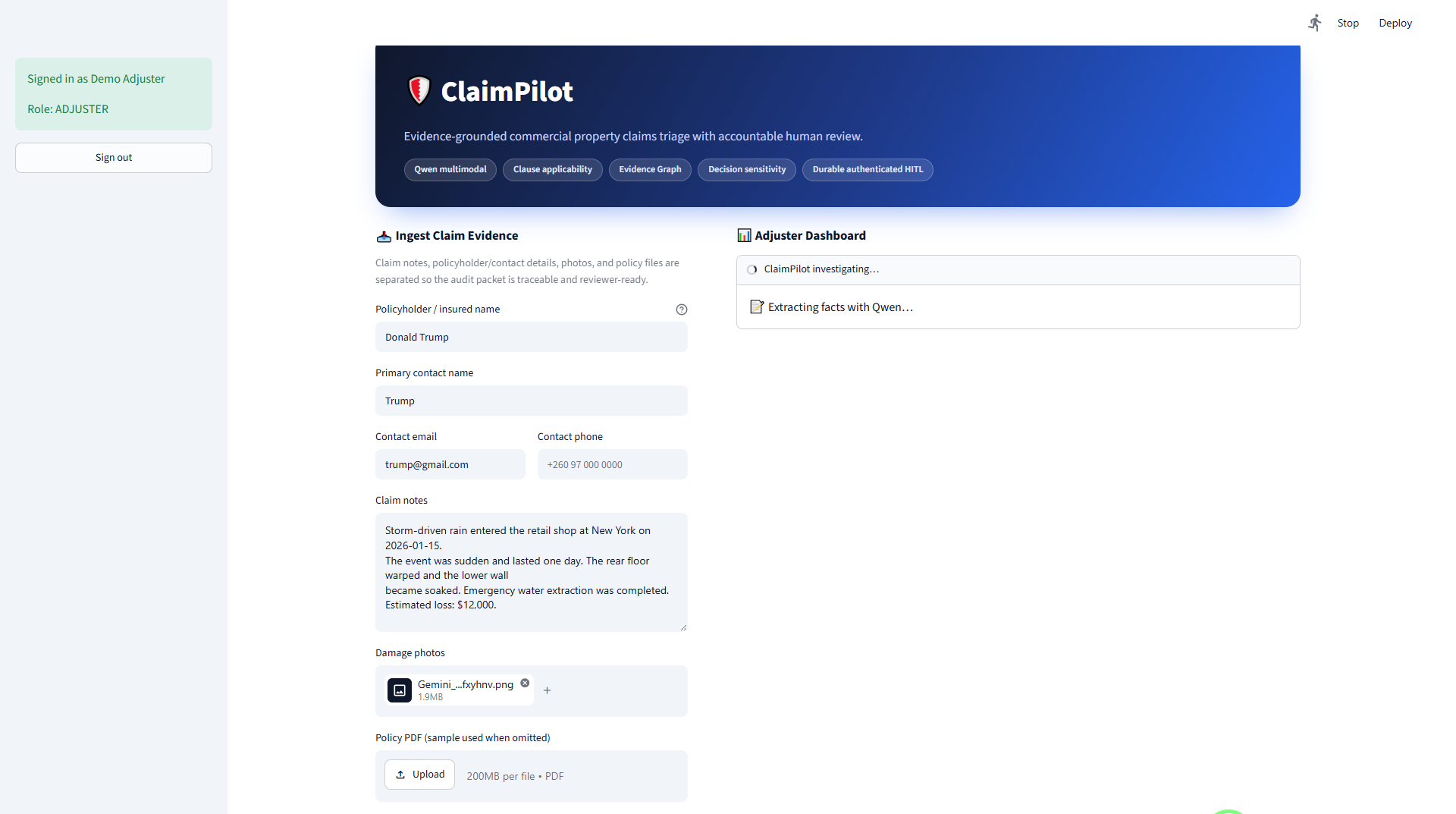
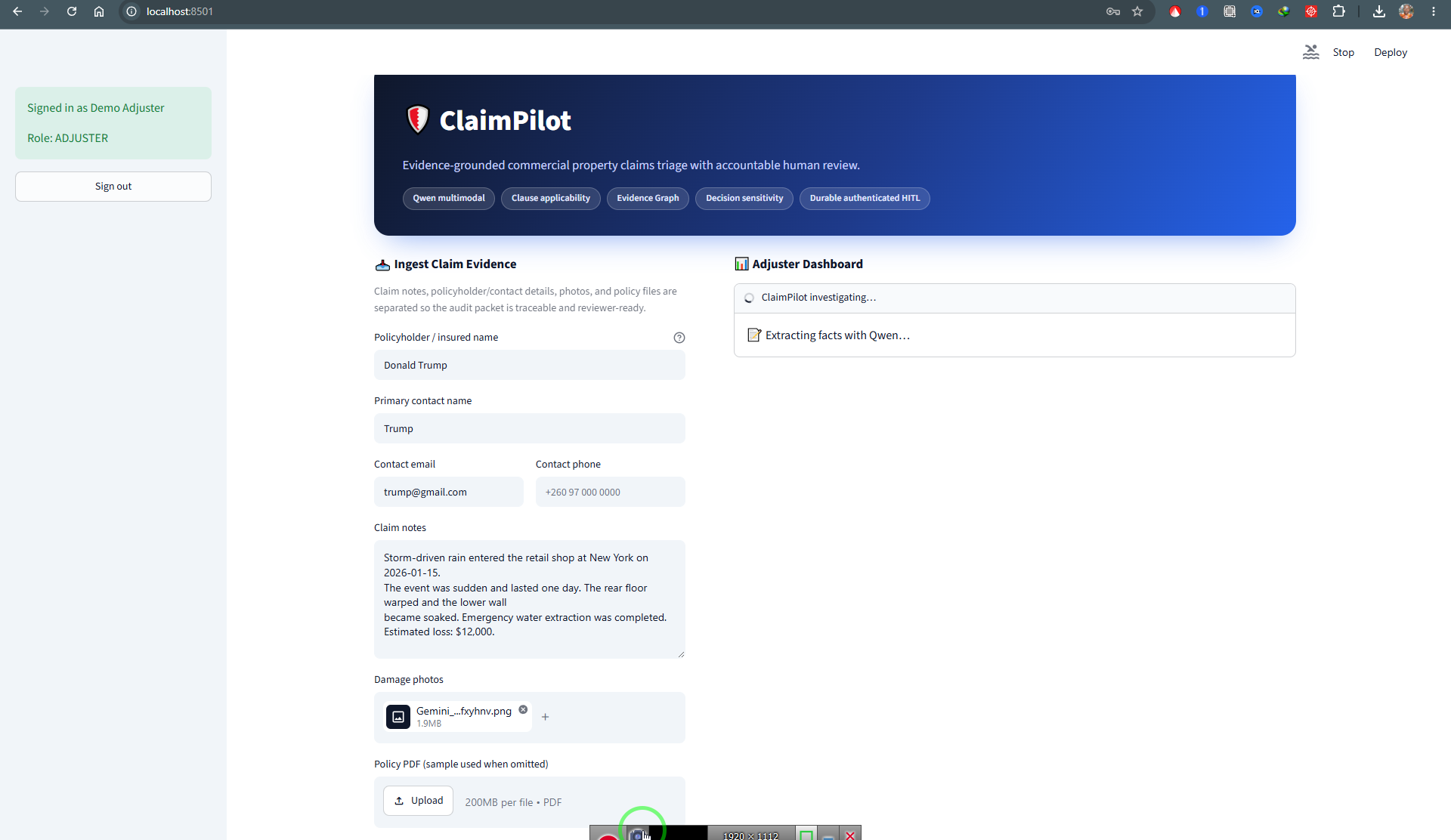
The user enters the policyholder or insured name, contact details, claim location, loss date, and claim notes. They can upload damage photos and an insurance policy document. ClaimPilot then analyzes the evidence and produces a structured claim review.
The system can:
- Analyze uploaded damage photos using a vision-capable Qwen model
- Extract important facts from claim notes
- Review policy language for relevant coverage, exclusions, limits, and deductibles
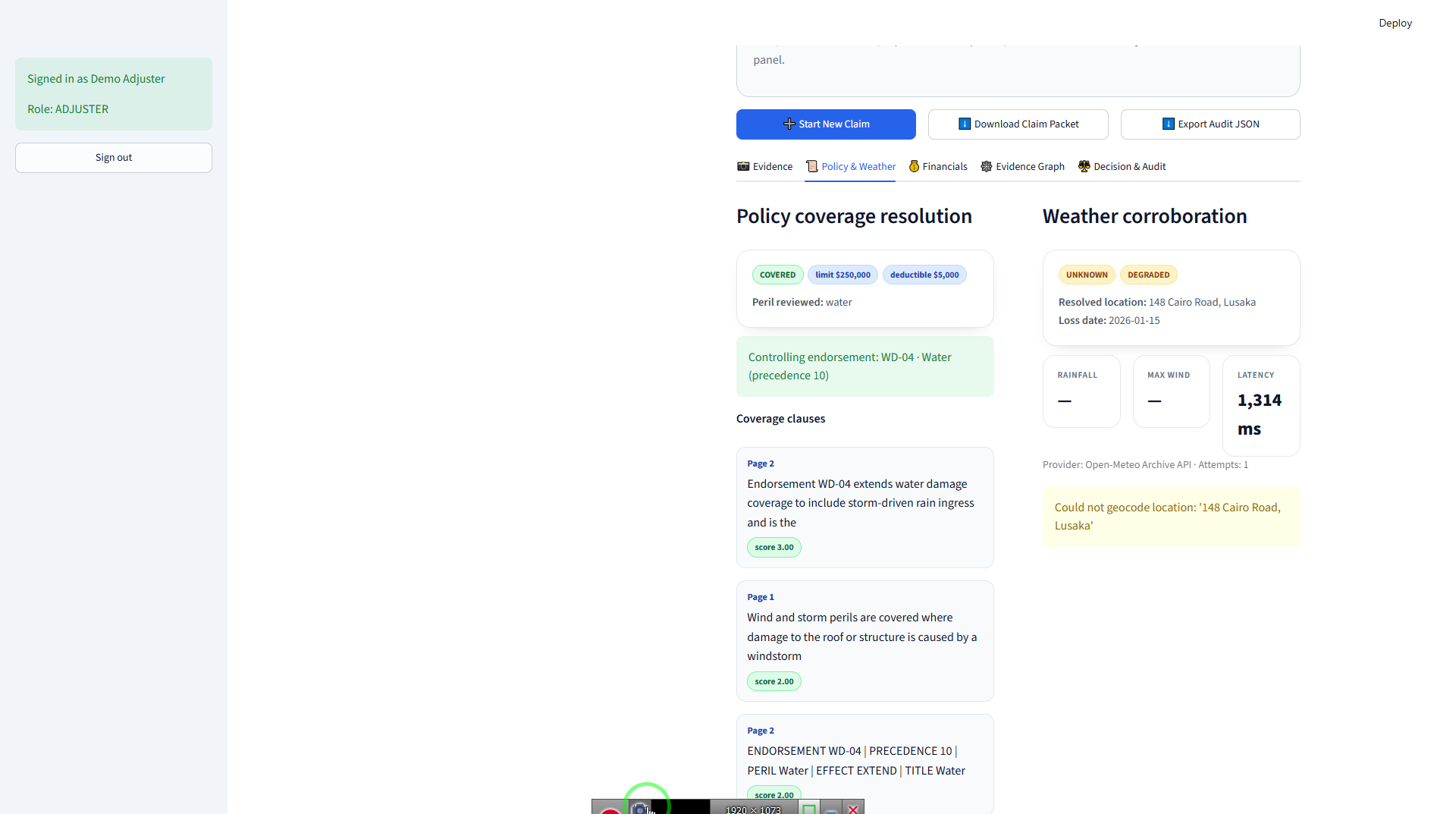
- Check weather context around the reported loss date and location
- Propose likely repair line items using structured model output and a deterministic demo pricebook
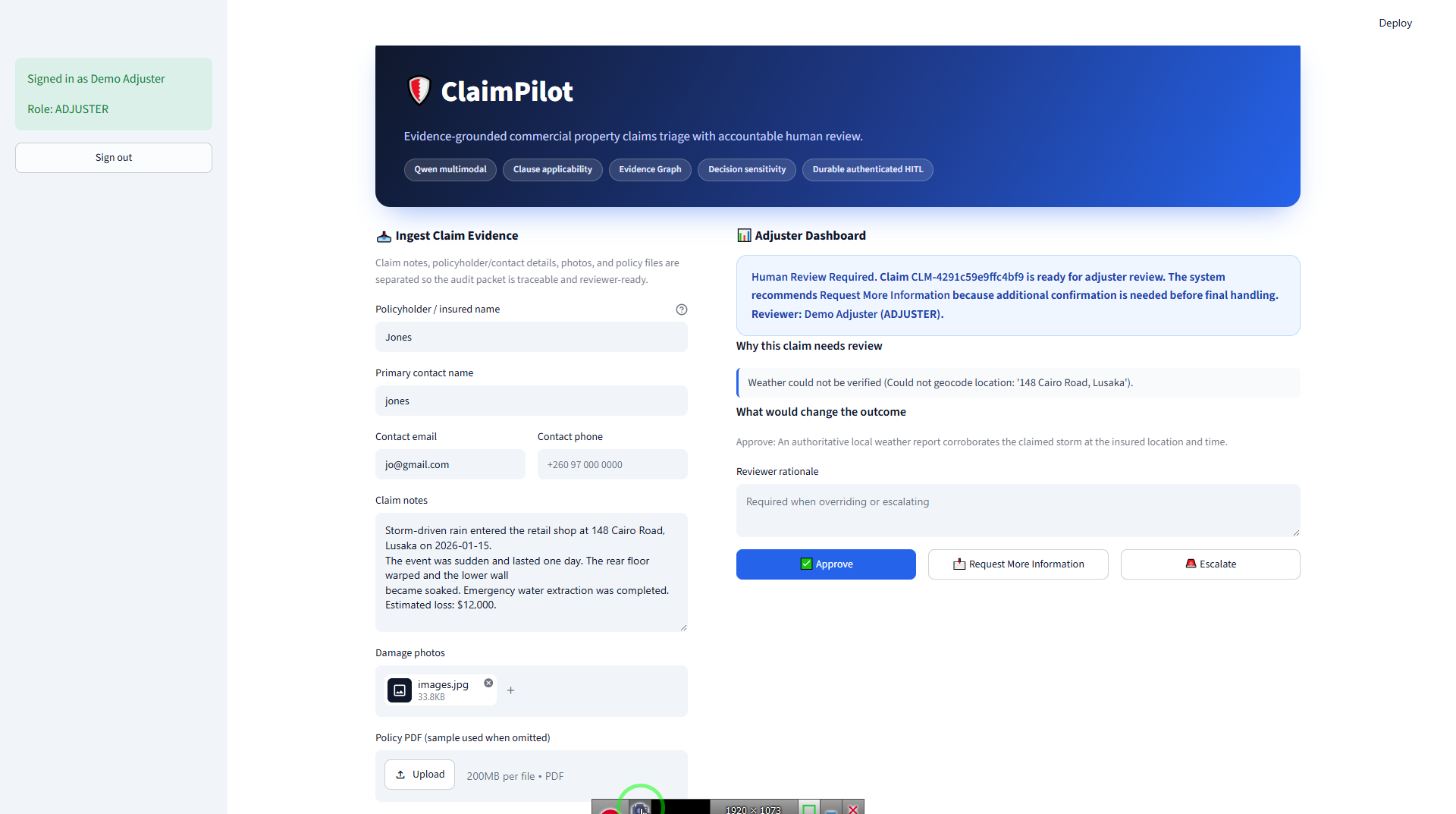
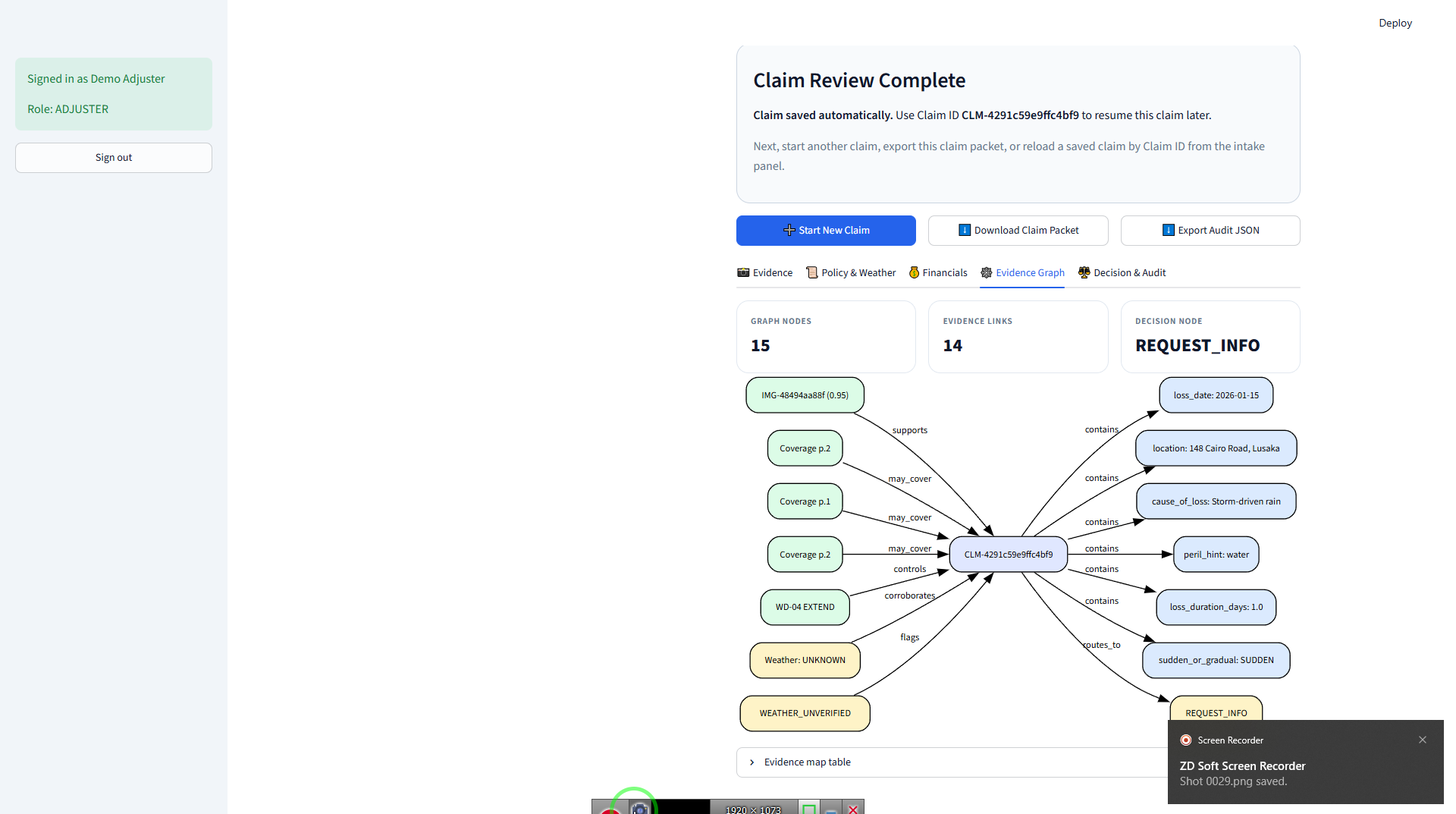
- Generate a routing recommendation such as Approve, Deny, Escalate, or Request More Information
- Pause for human adjuster review when judgment or uncertainty is involved
- Save the claim automatically and generate downloadable claim and audit packets
ClaimPilot is designed as a co-pilot for claims teams. It prepares the file, explains the recommendation, and preserves a reviewable decision trail.
How we built it
ClaimPilot was built as a Python and Streamlit application with an agentic workflow behind the interface.
The system combines several components:
- Streamlit UI for claim intake, evidence review, human review, and post-review actions
- Qwen text and vision-capable models for claim summarization, image analysis, policy reasoning, and structured extraction
- Policy document parsing to surface relevant clauses and coverage signals
- Weather corroboration to compare reported events with external weather context
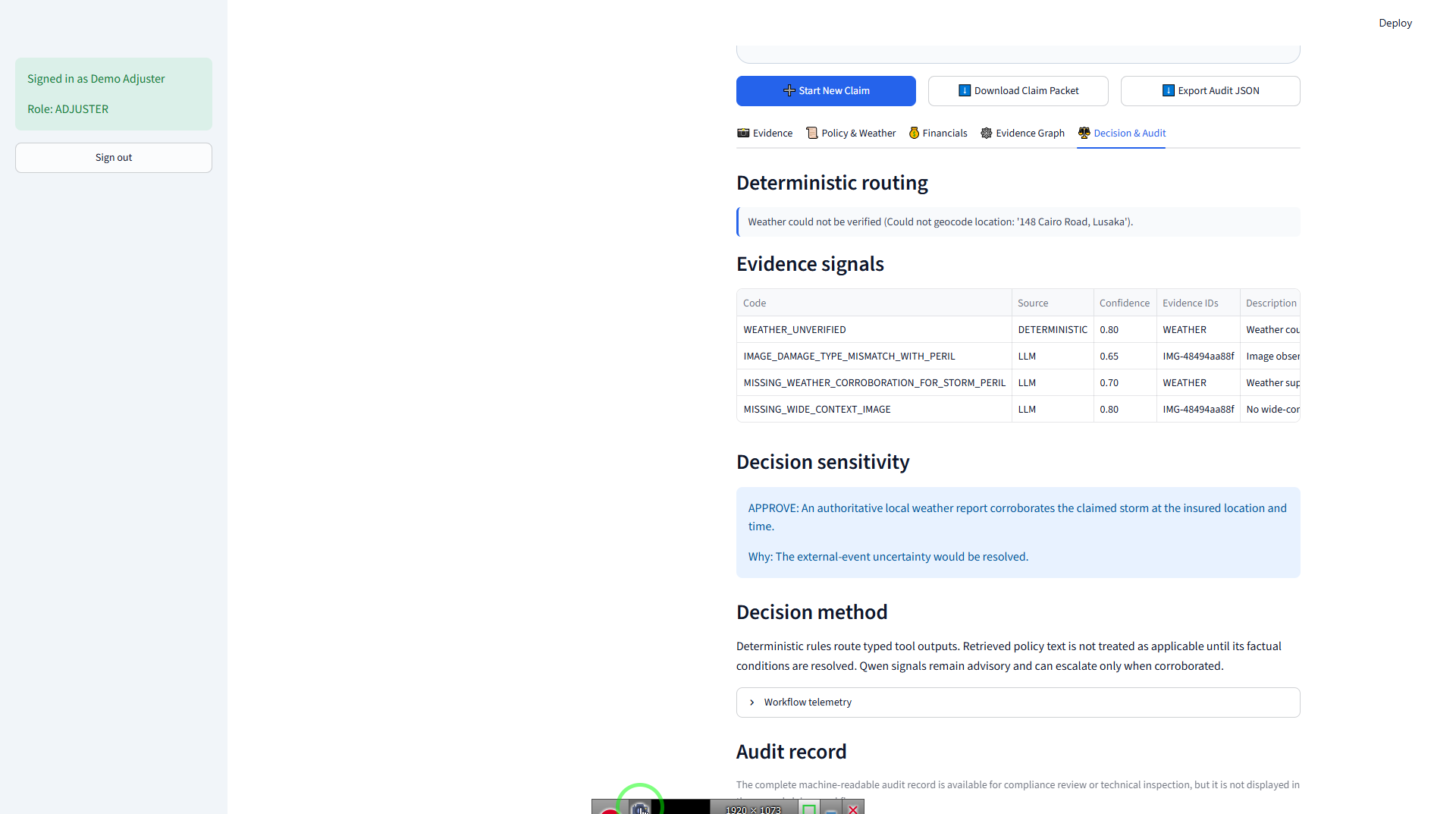
- Deterministic routing rules to keep recommendations consistent and auditable
- Human-in-the-loop checkpoints so adjusters can confirm or change the system recommendation
- Local claim storage so claims can be resumed by Claim ID
- Downloadable claim packets and audit records for compliance and review
The workflow follows this principle:
$$ AI\ Evidence\ Review + Deterministic\ Safeguards + Human\ Oversight = Safer\ Claims\ Automation $$
Instead of returning only a chatbot response, ClaimPilot creates a structured decision packet that a claims professional can inspect, challenge, and finalize.
Challenges we ran into
One challenge was making the app feel like a real claims workspace instead of a technical prototype. Early versions exposed too much raw JSON and developer-style output. I redesigned the UI around claim summaries, evidence cards, routing rationale, human review, and downloadable packets.
Another challenge was handling model failures gracefully. Image analysis can timeout, and structured model output can fail if prompts are not precise. I added safer fallback behavior so ClaimPilot can continue running and route uncertainty to human review instead of breaking the workflow.
A third challenge was model selection. Because ClaimPilot depends on photo analysis, the image-review model must support image input. I updated the project defaults and documentation so judges use a vision-capable Qwen model for damage-photo analysis.
Another challenge was balancing automation with responsibility. Insurance decisions can have serious consequences, so ClaimPilot is intentionally designed to support human adjusters rather than automatically finalize every claim.
Accomplishments that we're proud of
I am proud that ClaimPilot is more than a simple chatbot. It demonstrates a real agentic workflow for a serious business problem.
The project includes multimodal evidence analysis, policy review, weather context, repair estimate generation, routing logic, human review, claim resume, and exportable audit records.
I am also proud of the human-in-the-loop design. ClaimPilot does not hide uncertainty. If evidence is incomplete, conflicting, or risky, the system can recommend Request More Information or Escalate and require adjuster review.
The final UI also feels much closer to a real claims tool. Judges can submit a claim, review the recommendation, complete the human review step, start a new claim, resume a saved claim, and download the claim packet.
What we learned
This project taught me that useful AI agents need more than strong prompts. They need workflow design, clear failure handling, structured outputs, and user trust.
I learned how important it is to separate:
- What the model observed
- What the system verified
- What remains uncertain
- What requires human judgment
I also learned that auditability is critical in insurance. A claims team needs to know not only what the AI recommended, but why it recommended it, what evidence it used, and who made the final decision.
Building ClaimPilot also showed me how powerful multimodal AI can be when combined with deterministic business rules and a clear user workflow.
What's next for ClaimPilot
Next, ClaimPilot could be expanded into a more complete claims operations platform.
Future improvements could include:
- Integration with real insurer claim-management systems
- Connection to production policy administration systems
- Live insurer-approved repair pricebooks
- Contractor/vendor estimate integrations
- Fraud and prior-claim history checks
- Role-based access for adjusters, supervisors, and SIU teams
- A claim queue with assignment, status tracking, and manager review
- More advanced OCR for scanned invoices, receipts, and handwritten estimates
- PDF claim packet generation for formal claim files
- Deeper analytics for claim cycle time, escalation reasons, and evidence quality
The long-term vision is for ClaimPilot to become an AI claims co-pilot that helps insurance teams process claims faster, explain decisions more clearly, and maintain human oversight throughout the entire workflow.
Built With
- agentic
- ai
- alibaba
- api
- cloud
- computer
- human-in-the-loop
- langgraph
- multimodal
- openai-compatible
- pydantic
- pypdf
- python
- qwen
- qwen3.7-plus
- qwencloud
- streamlit
- vision


Log in or sign up for Devpost to join the conversation.