Inspiration
Whistleblower attorneys deal with one of the most frustrating problems in law — they receive piles of documents that could expose real government fraud, but it takes weeks just to figure out if the case is worth pursuing. Most attorneys spend 80 to 100 hours reading through paperwork, building spreadsheets, mapping timelines, and calculating damages by hand — before they even file a single complaint. Smaller firms simply can't afford that time, so valid fraud cases get dropped. We wanted to fix that. We asked ourselves: what if an attorney could upload documents and get a full case analysis in minutes instead of weeks?
What it does
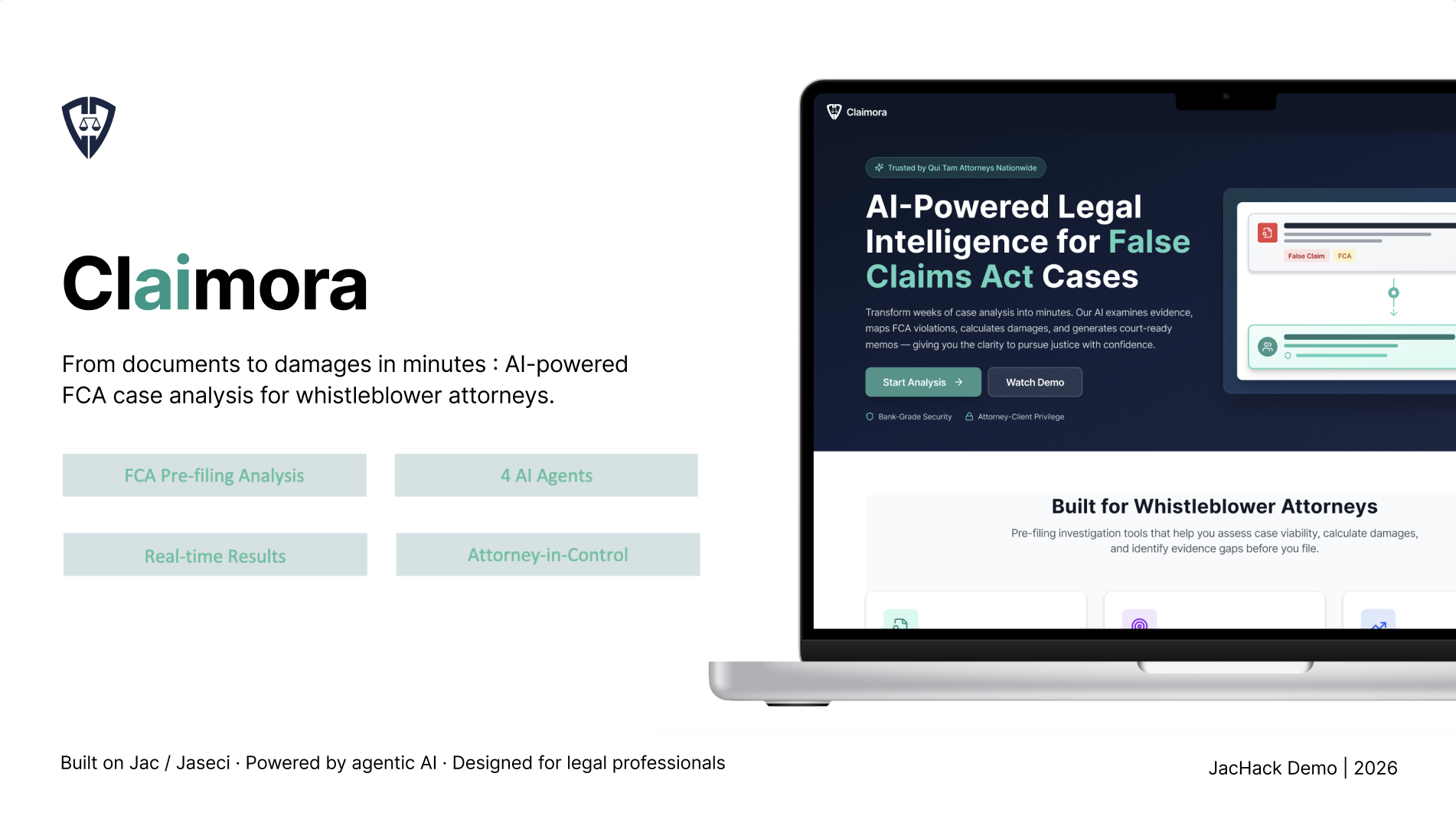
Claimora.AI is an AI-powered tool that helps whistleblower attorneys analyze False Claims Act (FCA) cases dramatically faster. An attorney uploads their case documents — contracts, invoices, emails, billing records — and four AI agents get to work automatically: The first agent reads every document and pulls out all the key people, companies, dates, and dollar amounts The second agent builds a timeline of events and flags any statute of limitations risks The third agent maps out potential FCA violations and generates a heatmap showing where the fraud is concentrated The fourth agent calculates how much money could be recovered using federal penalty guidelines At the end, the attorney gets a complete case memo they can read, edit, and use — all within a few minutes of uploading.
How we built it
We built Claimora.AI using three layers working together. For the frontend, we designed the interface in Figma Make and exported it as a working React app. It has seven screens that walk the attorney through the whole process — from uploading documents to viewing the final memo. For the backend, we used Jac and Jaseci, a programming language specifically designed for building AI agents. We created four specialized agents as Jac "walkers" — small programs that move through a shared knowledge graph of the case, each one building on what the previous one found. This is what makes our approach different from just chaining together AI calls. For the AI layer, we used Jac's built-in LLM integration called byLLM, which lets us get structured, typed outputs from language models rather than raw text. A Python helper layer handles document parsing and file processing. FastAPI connects the frontend to the backend so everything talks together.
Challenges we ran into
Getting the four AI agents to truly share information was harder than expected. In most AI pipelines, each step only sees its own input and output. We needed Agent 4 to actually know what Agent 1 discovered — not just receive a summarized version of it. Jac's graph model solved this architecturally, but it took time to design the node and edge structure correctly. We also struggled with making legal document analysis reliable. Legal documents use very specific language and formatting that general-purpose AI tools often misread. Getting the FCA violation mapper to correctly distinguish between a billing error and actual fraud required careful prompt design and output validation. Connecting the frontend to the backend in a way that shows live progress — so attorneys can watch each agent complete its work in real time — was also a significant engineering challenge.
Accomplishments that we're proud of
We're proud that we built a genuinely functional end-to-end pipeline — not just a demo with fake data. The four agents actually run, they actually share context, and they actually produce structured legal analysis from real documents. We're also proud of the architecture choice. Using Jac walkers on a shared graph is a fundamentally better way to model this problem than stringing together API calls. It means the damage estimate is grounded in the same entities and timeline that were extracted at the start — the whole analysis stays coherent. The before-and-after impact is also something we're proud of: what takes an attorney 80 to 100 hours now takes 1 to 2 hours. That's a 98% reduction in pre-filing investigation time.
What we learned
We learned that the hardest part of building agentic AI systems isn't the AI — it's the data flow. Making sure each agent has the right context, passes the right information forward, and fails gracefully when a document is unclear took more engineering than any individual AI call. We also learned a lot about the False Claims Act itself. Understanding the legal nuances — what makes a claim "material," how the first-to-file rule works, what the DOJ looks for when deciding whether to intervene — made us realize how much domain knowledge matters when building AI tools for specialized professional fields. Generic AI tools miss this completely. Finally, we learned that Jac's graph-native approach is genuinely powerful for problems that are naturally relational. A legal case is not a flat document — it is a web of people, events, contracts, and money. Modeling it as a graph and letting agents walk through it is a much more natural fit than treating everything as text.
What's next for Claimora.AI
We have five clear next steps: First, we want to complete the full backend-to-frontend integration so the live demo runs entirely on real data end to end. Second, we want to find three to five whistleblower attorney firms willing to test it on real cases during a closed beta. Real feedback from real attorneys will shape everything. Third, we want to fine-tune our violation detection on the DOJ's public FCA settlement database — thousands of real cases that would dramatically improve how accurately we identify fraud patterns. Fourth, we want to add a DOJ intervention score — a prediction of how likely the government is to take over a case before the attorney even files, based on the strength of the evidence package. Fifth, we plan to open source the Jac pipeline on GitHub and deploy the frontend publicly so any attorney can try it. The long-term vision is to become the standard pre-filing analysis tool for the entire whistleblower legal industry — making it possible for any attorney, at any firm size, to pursue cases that would otherwise never see a courtroom.

Log in or sign up for Devpost to join the conversation.