
Inspiration
Filing insurance claims is confusing and time-consuming. Small omissions lead to delays or denials. We wanted a guided, privacy-respecting way to help people tell a complete, policy-aware story and walk away with a professional, insurer-ready claim in minutes.
What it does
ClaimMax is a web app that drafts optimized insurance claims using AI.
- Collects incident details (photos + short description) and insurer metadata (provider, policy #, claim type).
- Generates a structured claim with sections: Incident Description, Damage Summary, Claim Justification, Requested Reimbursement, and Supporting Docs.
- Provides an editable preview with AI Notes and a Claim Strength score to highlight gaps and suggest improvements.
- Exports a clean, insurer-formatted PDF and can email a copy to the user.
- MVP focuses on auto claims (GEICO template) with a modular path to add more insurers.
How we built it
- Frontend: React SPA with image upload, inline editor, progress UX.
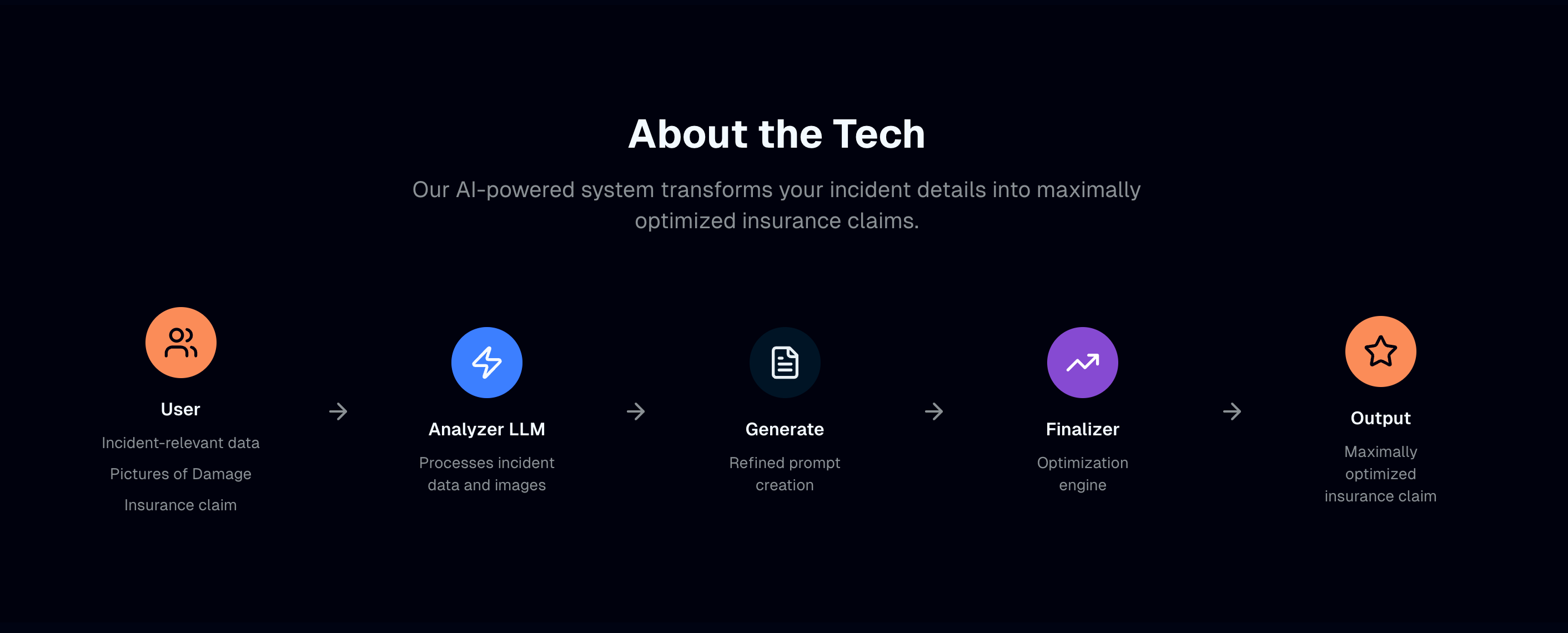
- Backend: Python + FastAPI orchestrating an AI pipeline (extract/validate → draft → critique/score).
- Platform: Supabase for Postgres, Auth (incl. Google), and Storage (images/PDFs) with Row-Level Security and signed URLs.
- AI: OpenAI (hosted) with insurer-aware prompt templates and a two-stage flow to reduce misses.
- Docs: Server-side PDF renderer with insurer-specific layout mapping (GEICO v1).
- Data model (MVP):
users,claims,uploads,insurer_templates(mapping JSON for portability).
Challenges we ran into
- Turning free-text + photos into reliable, structured fields the PDF can depend on.
- Designing edits that keep user changes aligned with AI structure.
- Making Claim Strength meaningful (heuristics + LLM critique) rather than cosmetic.
- Template architecture so adding new insurers is configuration, not a rewrite.
- Handling privacy/security cleanly (RLS, signed URLs) without slowing iteration.
Accomplishments that we're proud of
- A smooth, end-to-end flow from uploads goes to a AI draft that is edited and made into an insurer-ready PDF.
- Modular insurer template system (GEICO first) for quick expansion.
- Helpful AI Notes that coach users to add missing context.
- Solid privacy posture with Supabase RLS and short-lived, signed asset access.
What we learned
- Short, example-driven prompts reduce user friction; people refine after they see a first draft.
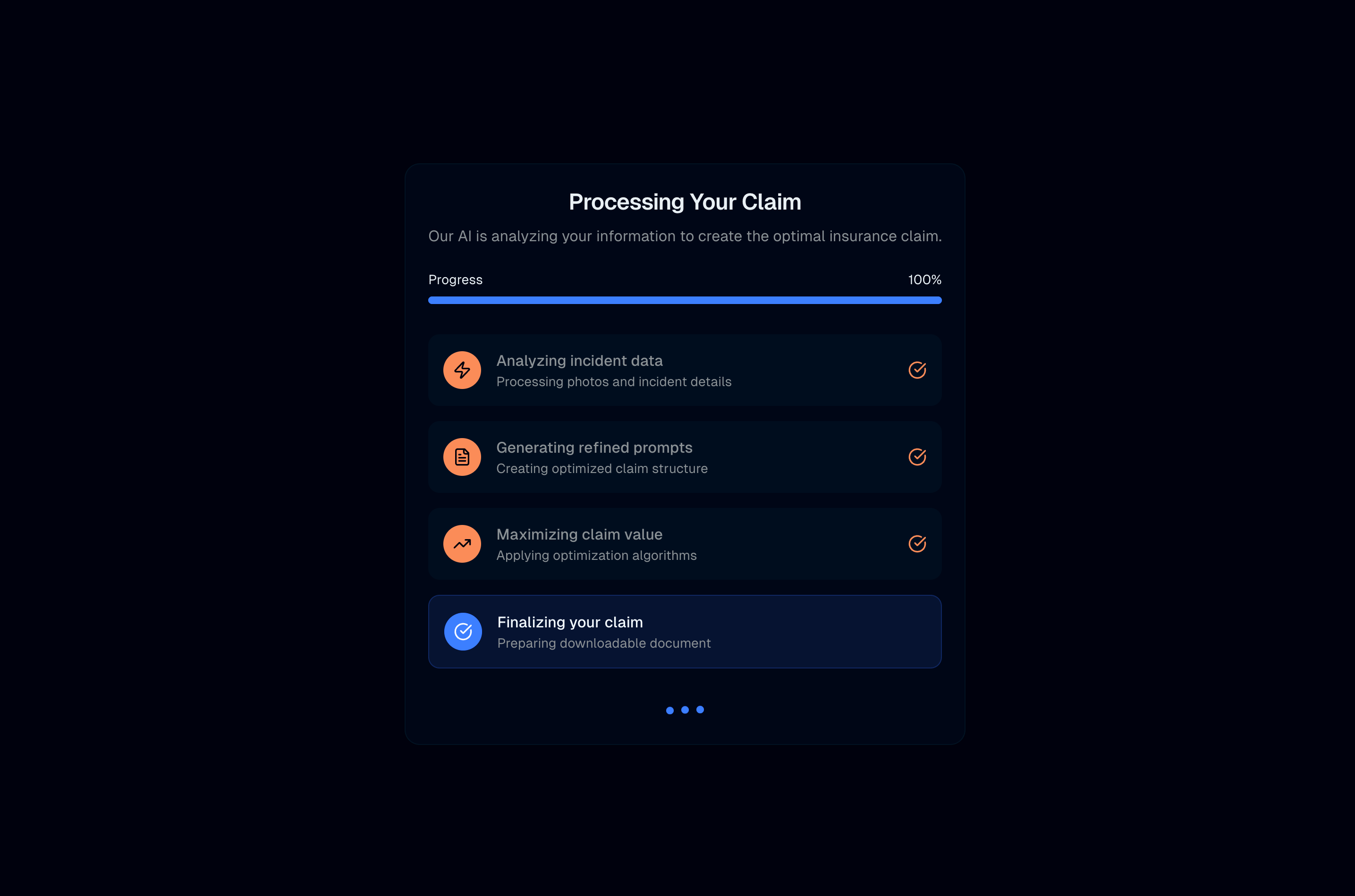
- Clear progress states (“Validating…”, “Optimizing…”) keep users engaged.
- Investing early in schema + RLS speeds development and builds trust.
- Two-stage prompting (validate then generate) improves accuracy and consistency.
What's next for ClaimMax
- Add more insurer templates (Progressive, State Farm, etc.) and policy-aware language packs.
- Direct claim submission to insurer portals/APIs.
- OCR on policy PDFs to auto-extract coverage terms and limits.
- Vision features to auto-tag damage areas from photos.
- Versioning & audit trail for edits; richer analytics behind Claim Strength; guided reimbursement estimator.
Built With
- anthropic
- gemini
- llm
- nextjs
- openai


Log in or sign up for Devpost to join the conversation.