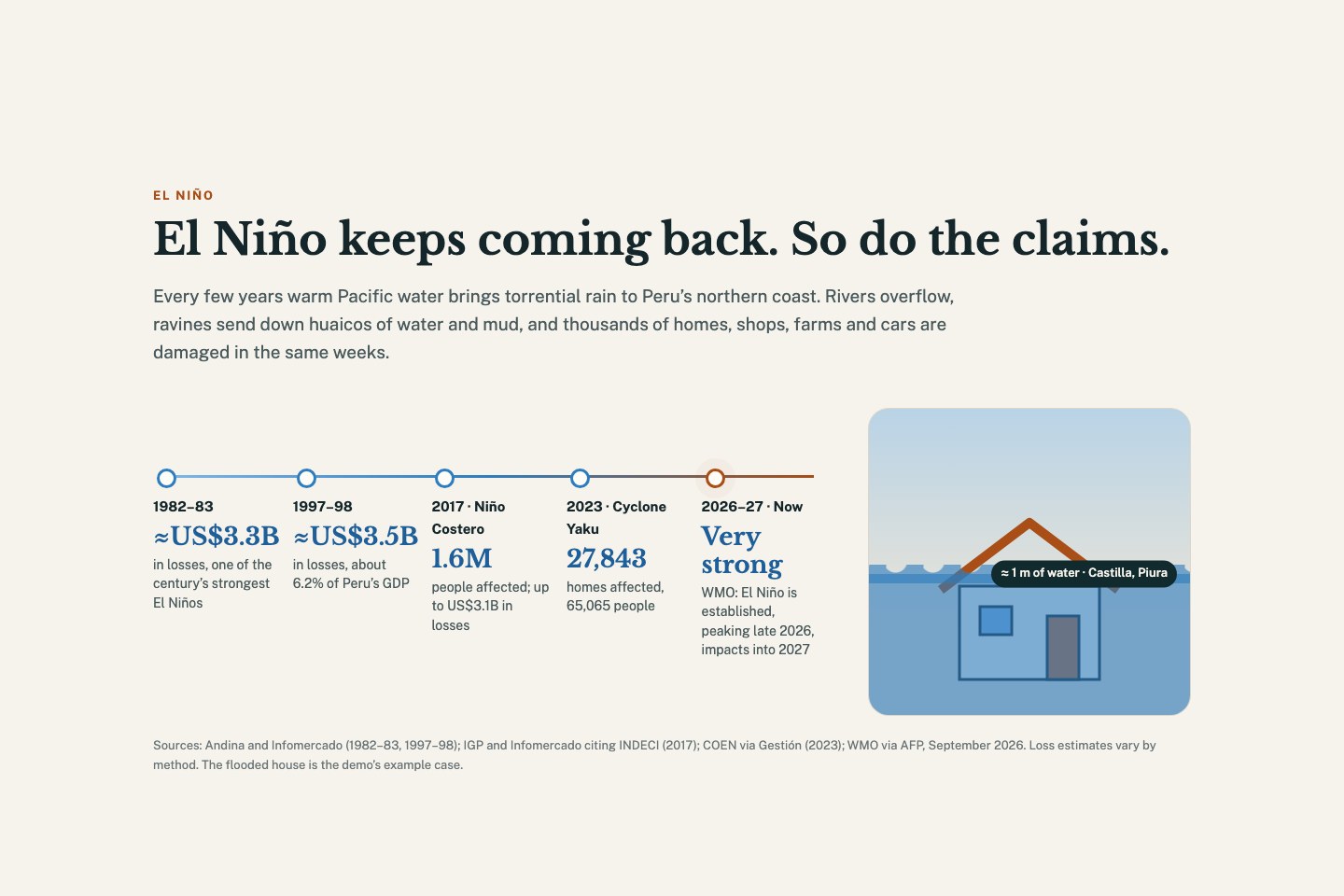
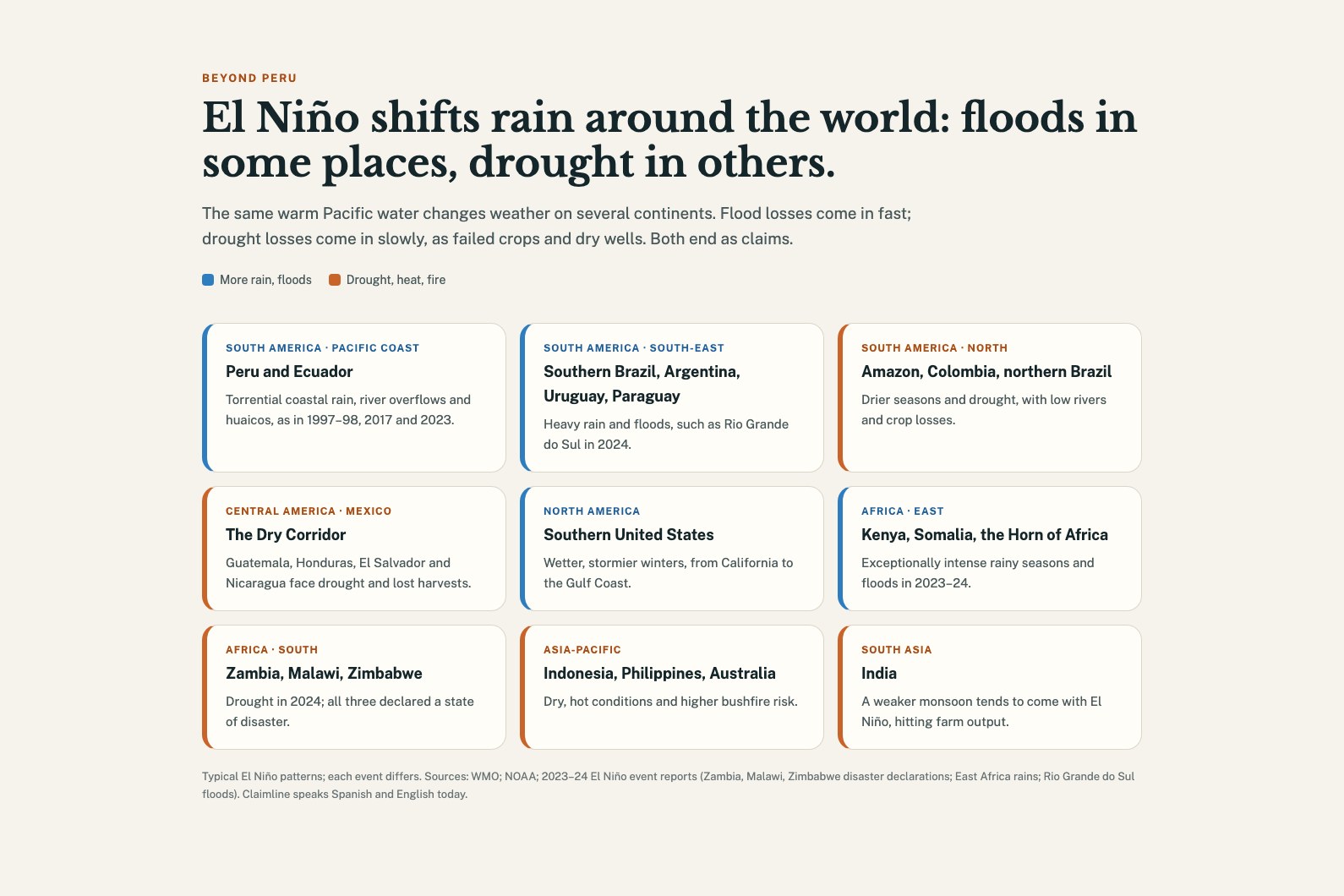
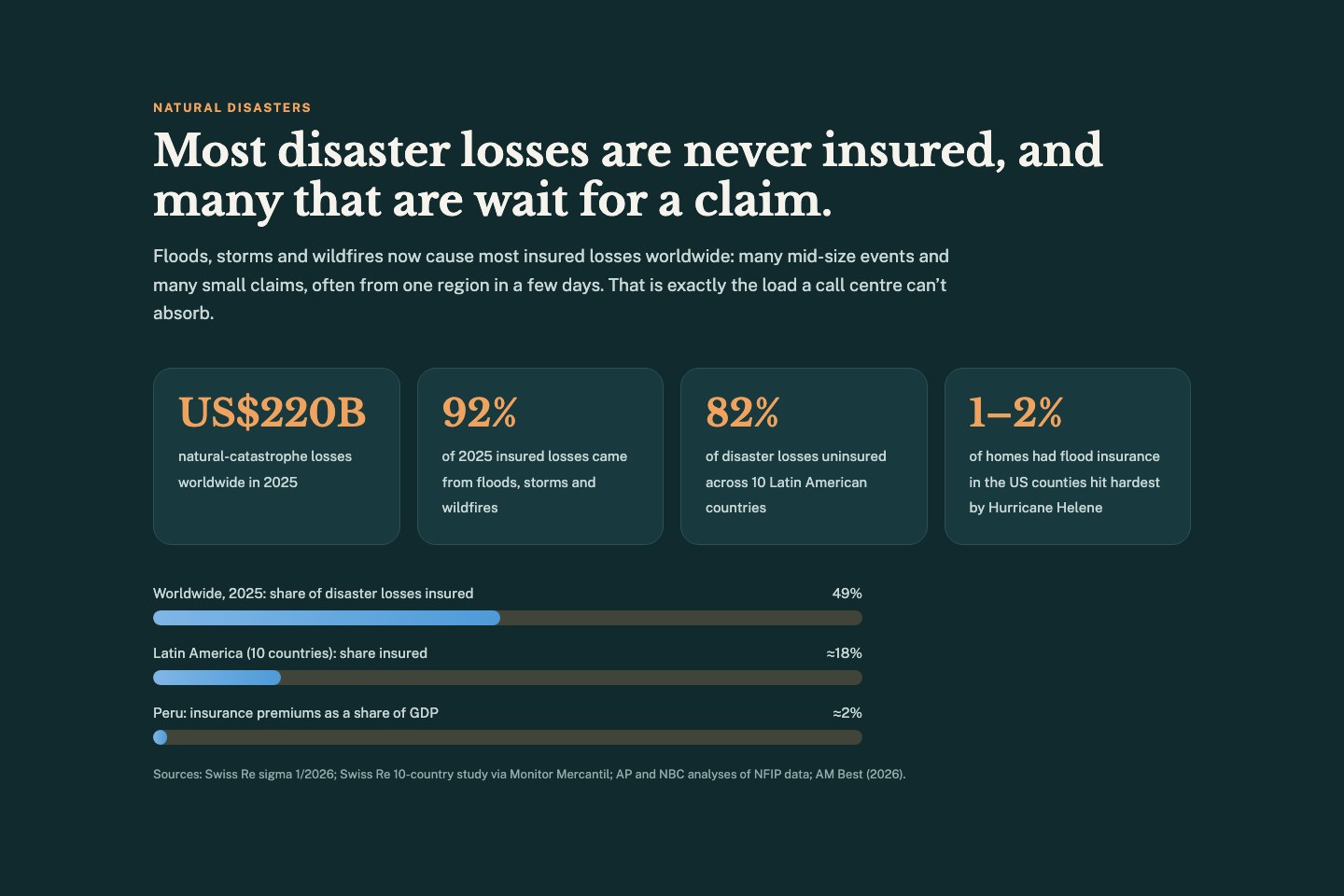
We're from Peru. Every few years, El Niño turns our northern coast into a disaster zone: in 2017 the Niño Costero affected 1.6 million people and caused up to US$3.1 billion in losses; in 2023 Cyclone Yaku damaged 27,843 homes. And in September 2026 the WMO announced that a very strong El Niño is forming right now. When the water comes in, people don't fill in insurance forms. They have no power, no office to visit and no paperwork left. What they do have is WhatsApp. Meanwhile, insurers face thousands of incomplete reports at once, and when two people are involved, like two drivers crashing on a floodedroad, the stories never match. Peru's insurance penetration is only about 2% of GDP, and across Latin America 82% of disaster losses go uninsured. A claim is the moment people decide whether insurance is worth it: in Accenture's survey, 83% of dissatisfied claimants switched or planned to switch insurer. Wewanted that moment to be easy, fast and fair.
What it does
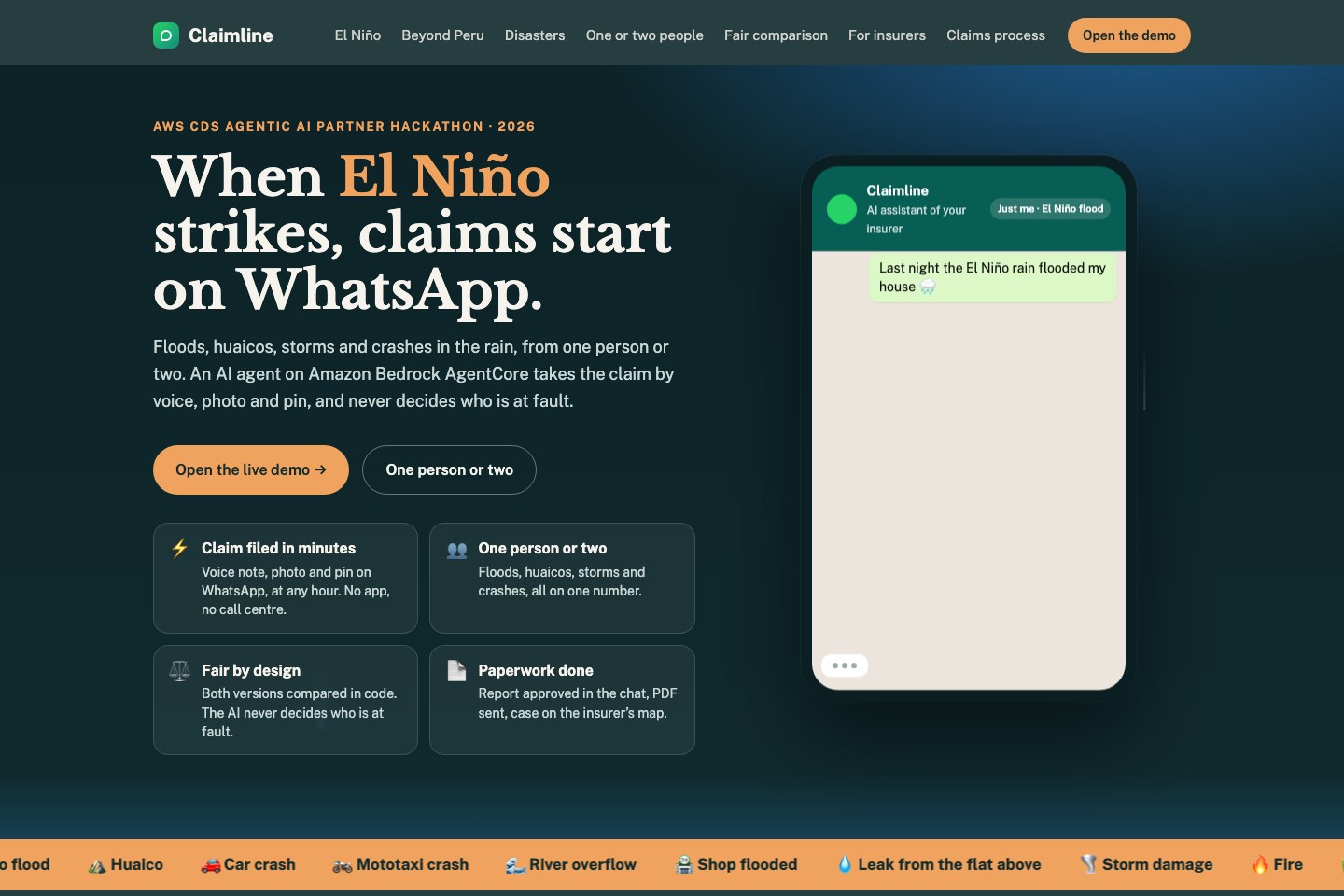
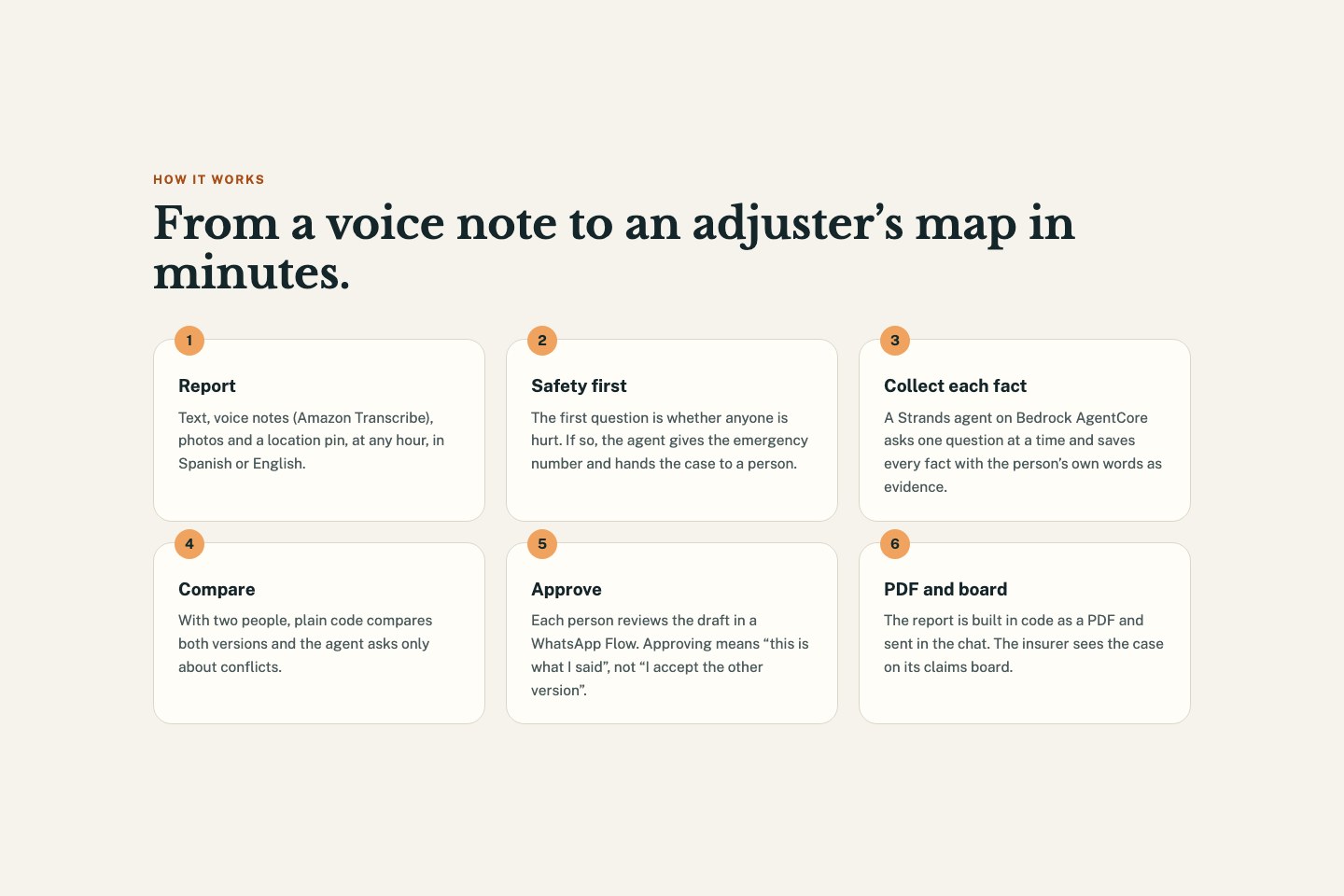
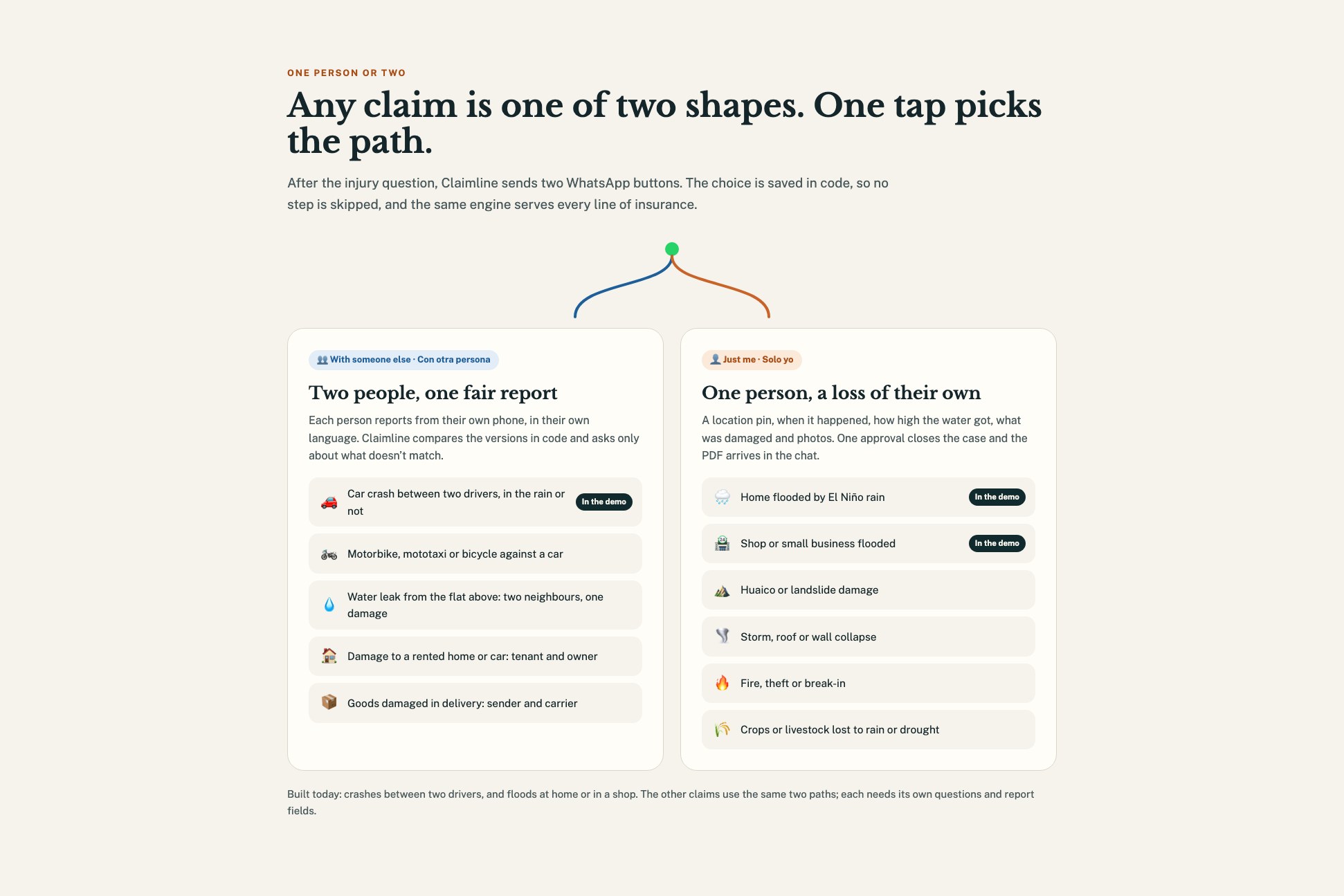
Claimline turns a WhatsApp message into a complete, fair, approved insurance claim. One WhatsApp number serves every loss. After a safety check ("is anyone hurt?"), the person taps one of two buttons:
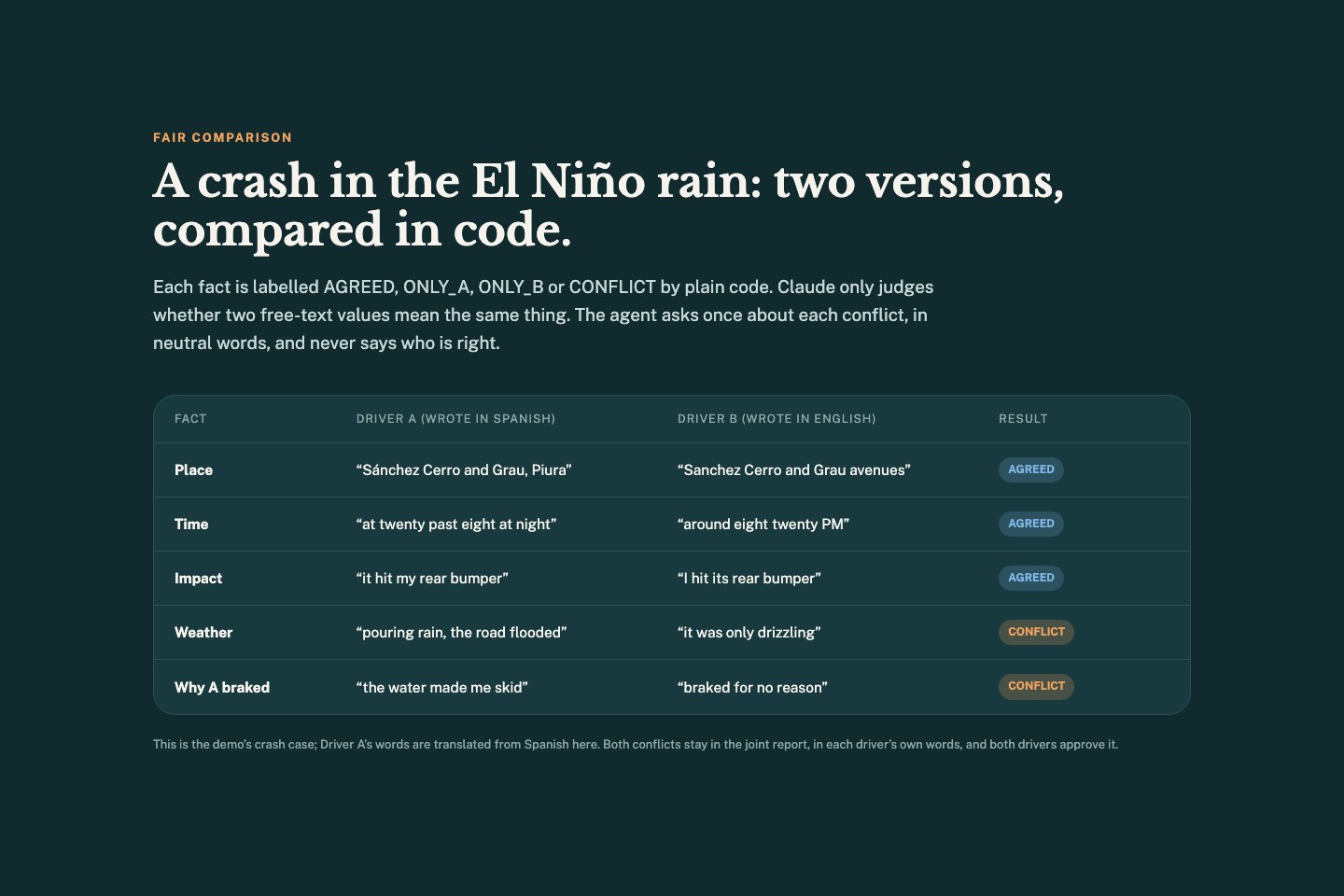
- 👤 Just me (Solo yo): a loss of one's own, such as a home or shop flooded by El Niño rain. The agent asks for a location pin, when it happened, how high the water got and what was damaged, then sends the report to approve.- 👥 With someone else (Con otra persona): a car crash between two drivers. Each person reports from their own phone, in their own language. Claimline compares both versions in plain code, asks only about what doesn't match, and never says who is at fault. Then:- 🎙️ People report by text, voice notes, photos and location pins, at any hour.
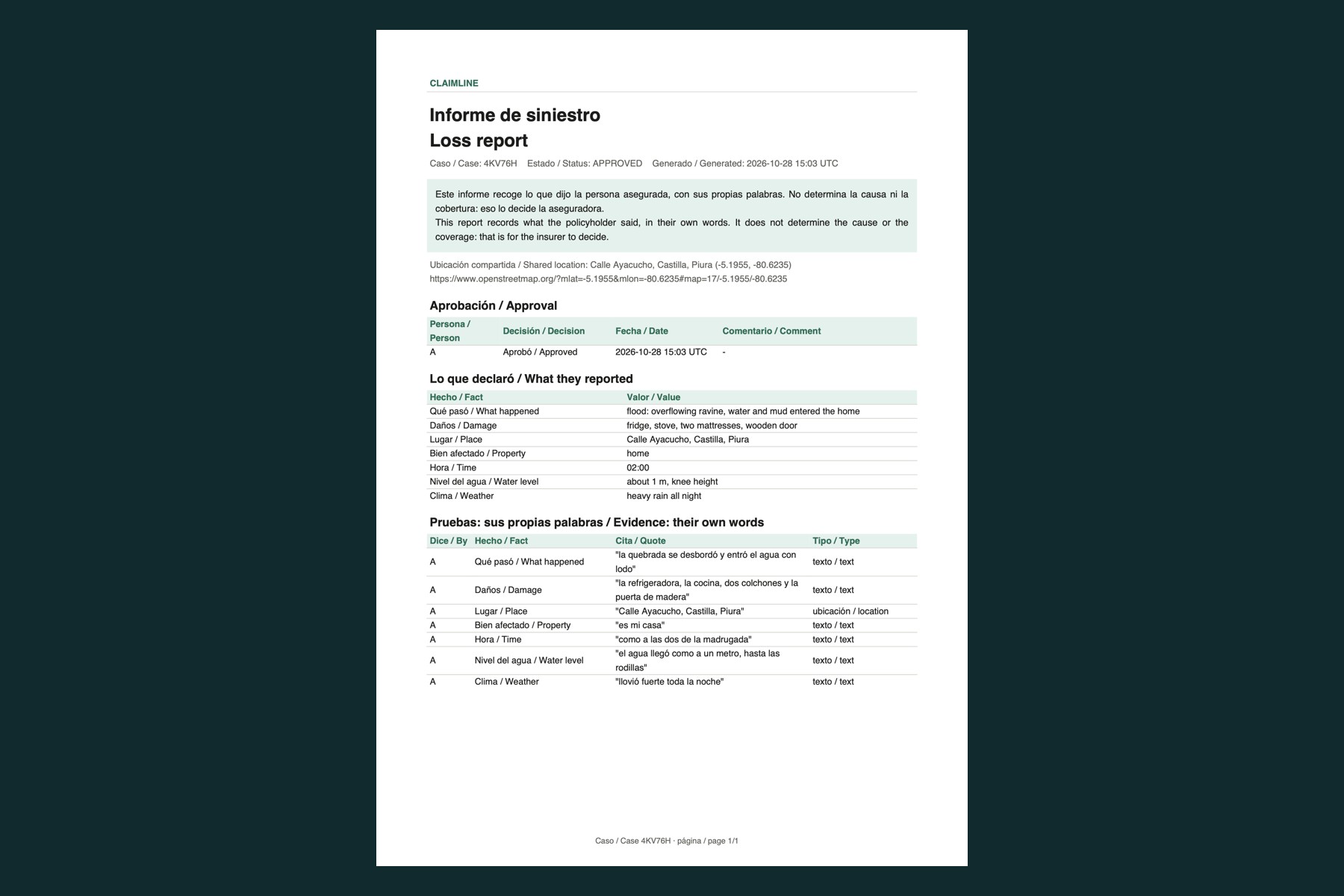
- 🧾 Every fact is saved with the person's own words as evidence.- ✅ Each person approves the report in a WhatsApp Flow, and receives a PDF in the same chat.
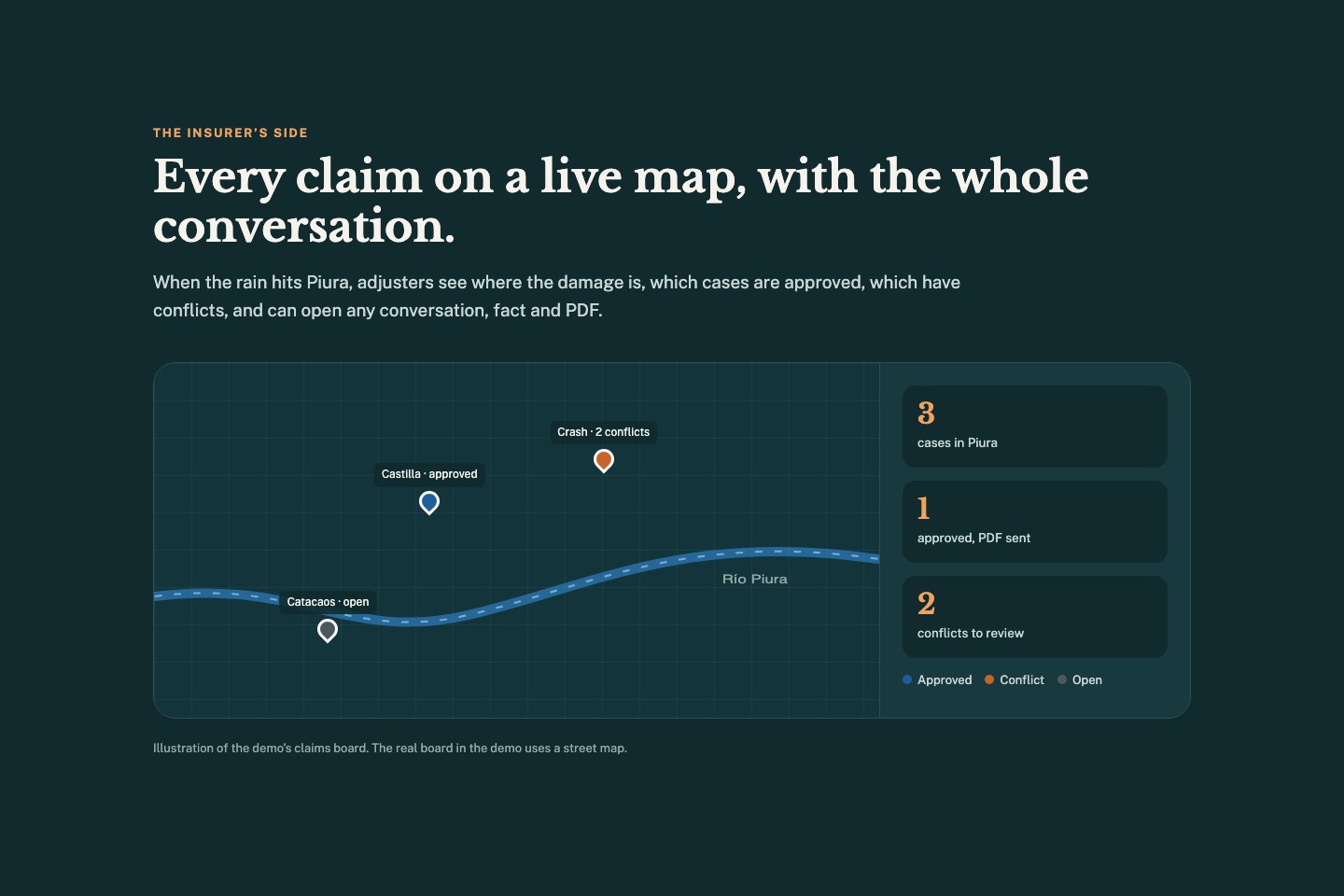
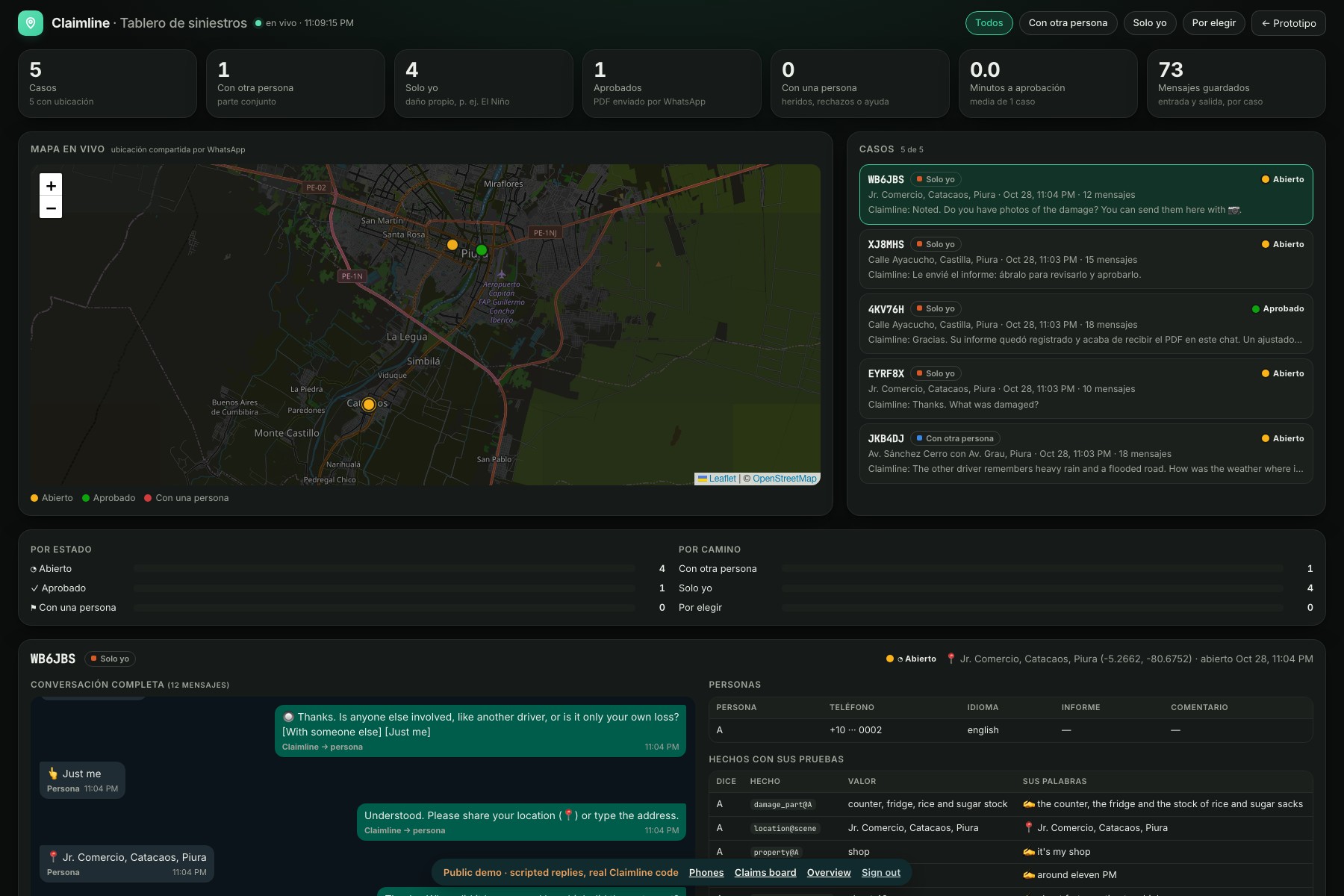
- 🗺️ The insurer gets a claims board: every case on a live map, the full conversation, the facts, the comparison and the PDF. ## How we built it
Claimline is fully serverless on AWS and deploys with one AWS CDK command into the insurer's own account.
- AWS End User Messaging Social is the only channel: inbound webhooks (text, audio, images, location, button taps, Flow answers) arrive through Amazon SNS, and every outbound message (text, reply buttons, the approval Flow, the PDF document) goes through
SendWhatsAppMessageandPostWhatsAppMessageMedia. - A router Lambda dedupes events, copies media to Amazon S3 and transcribes voice notes with Amazon Transcribe.
- The agent is built with Strands Agents on Amazon Bedrock AgentCore Runtime and Memory, powered by Claude on Amazon Bedrock.
- Cases, people, facts with evidence and every message of every case live in Amazon DynamoDB.
- The comparison is deliberately not done by the LLM: each fact is labelled AGREED, ONLY_A, ONLY_B or CONFLICT in plain Python, with rules for speeds, times and "both say their light was green". Claude only judges whether two free-text phrases mean the same thing.
- The report PDF is built in code, never written by the model.
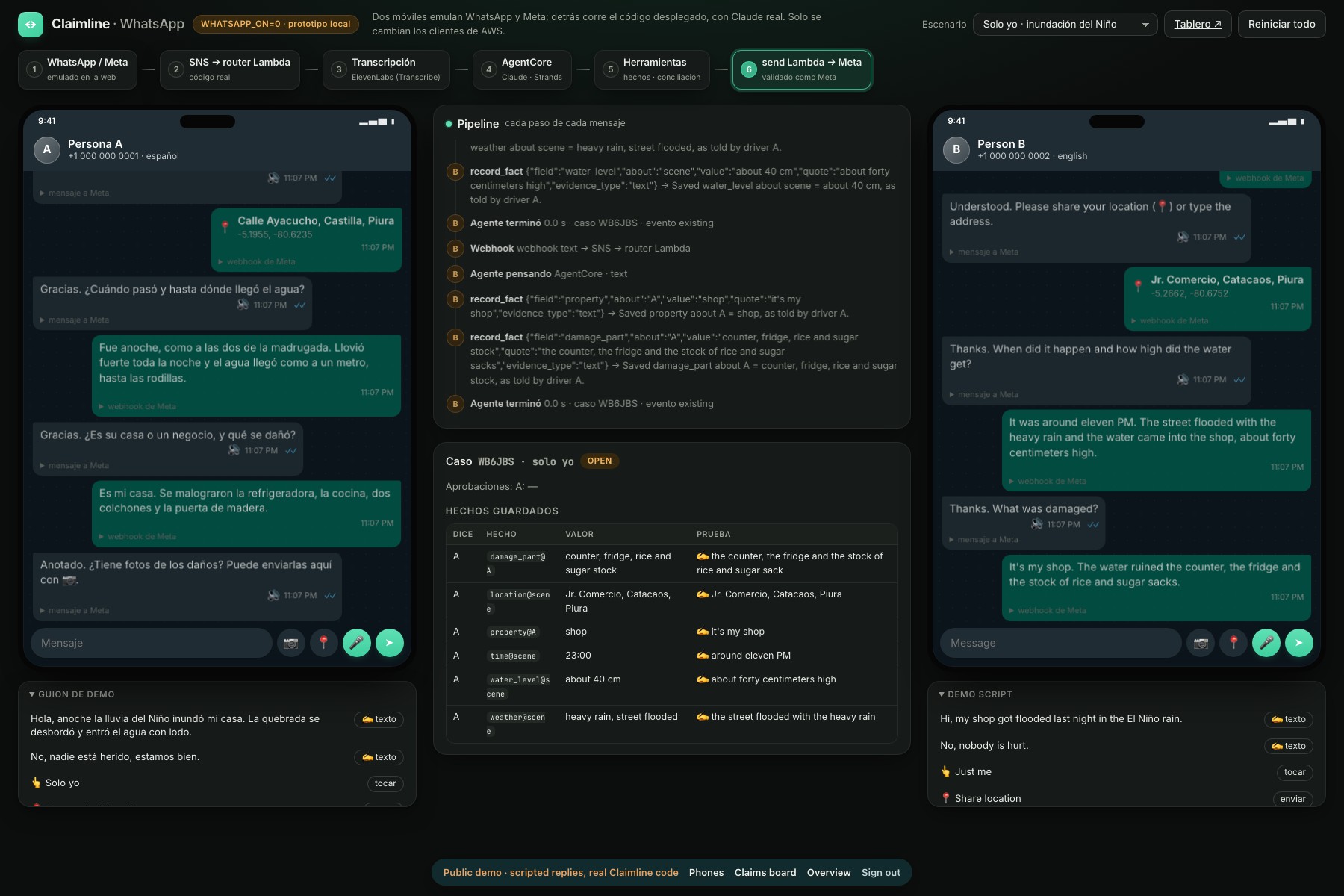
- To test without phones, we built a local WhatsApp prototype: two phones in the browser, an emulated Meta that validates every message against WhatsApp's real limits, and the exact same Lambda and agent code behind it.
The design comes from research: witnesses who talk to each other pick up details they never saw (Gabbert et al.), and a single loaded word changes what people remember (Loftus & Palmer). So each person reports alone, questions stay neutral, and code, not the AI, compares the facts.
Challenges we ran into
- Keeping the AI neutral. An LLM naturally wants to conclude who was right. We moved every judgment into code and gave the model only conversation and meaning-matching.
- Two people, two phones, one case. Joining the second driver with a code, messaging each person in their own language, and asking about each conflict exactly once took careful state handling.
- WhatsApp's real constraints. Reply buttons have 20-character titles, Flows have strict schemas, and publishing a Flow can't be undone, so we built one static Flow that serves every language.
- Voice is messy. Speech recognition mishears plates and street names, so the agent asks for plates in writing and confirms numbers.
- Testing without real phones. Meta access is slow to get, so we emulated Meta's validation locally to catch rejected messages before they happen.
Accomplishments that we're proud of
- The joint crash report runs end to end on real WhatsApp through AWS, and both drivers received the approved PDF on their phones.
- An AI agent that never assigns fault, by design, not by prompt alone.
- Two paths and one number that cover floods, huaicos and crashes, from one person or two.
- A claims board that shows a disaster as insurers need to see it: on a map, with the evidence one click away.
- A public demo anyone can open in the browser, running the real code.
What we learned
- LLMs are great at conversation and terrible referees. Let the model listen, and let code decide.
- In a disaster, the best channel is the one people already have. WhatsApp beats any app.
- Research on eyewitness memory translates directly into product rules.
- Serverless matters for disasters: zero cost on quiet days, full scale on the day the river overflows.
What's next for Claimline
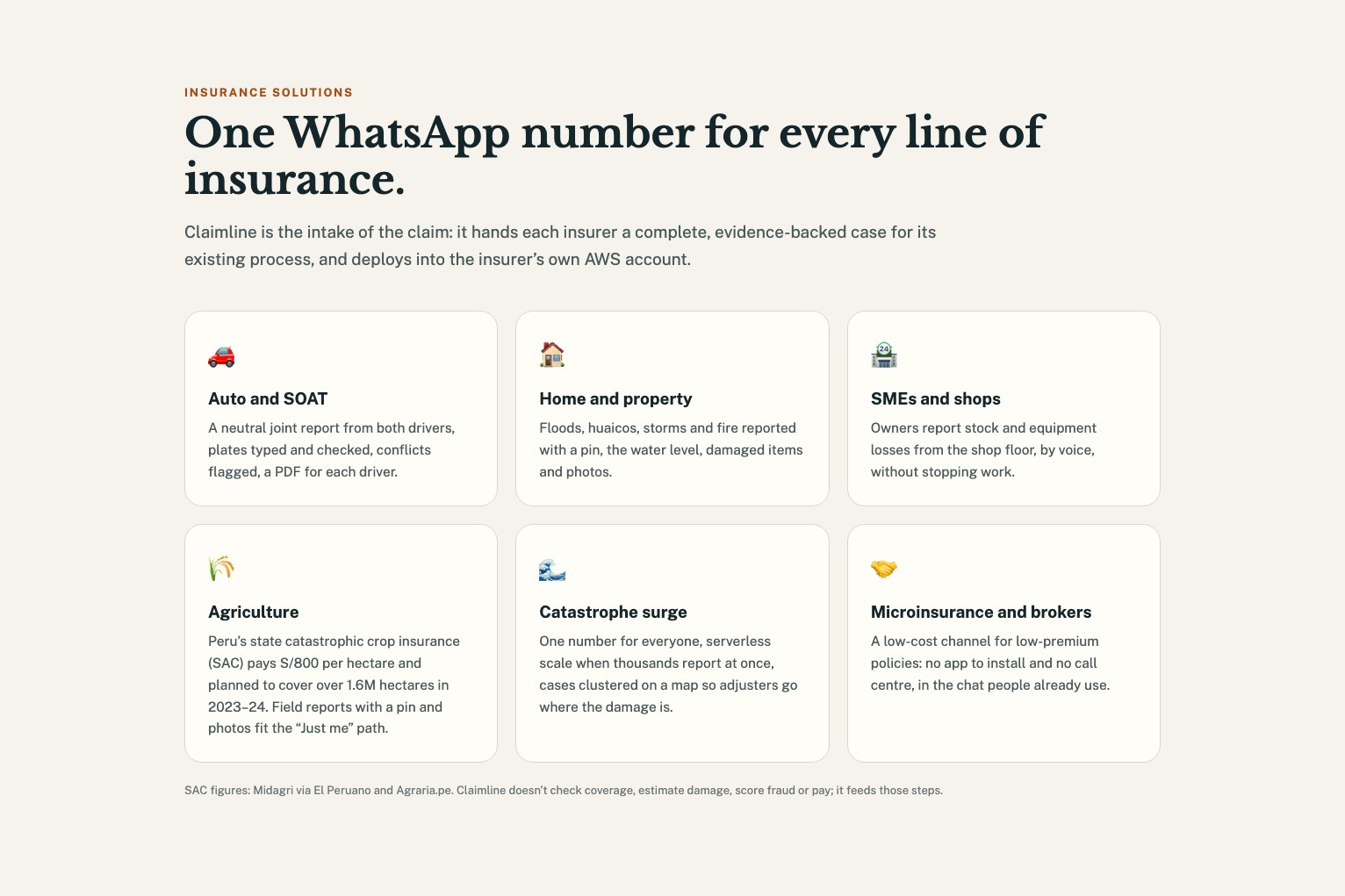
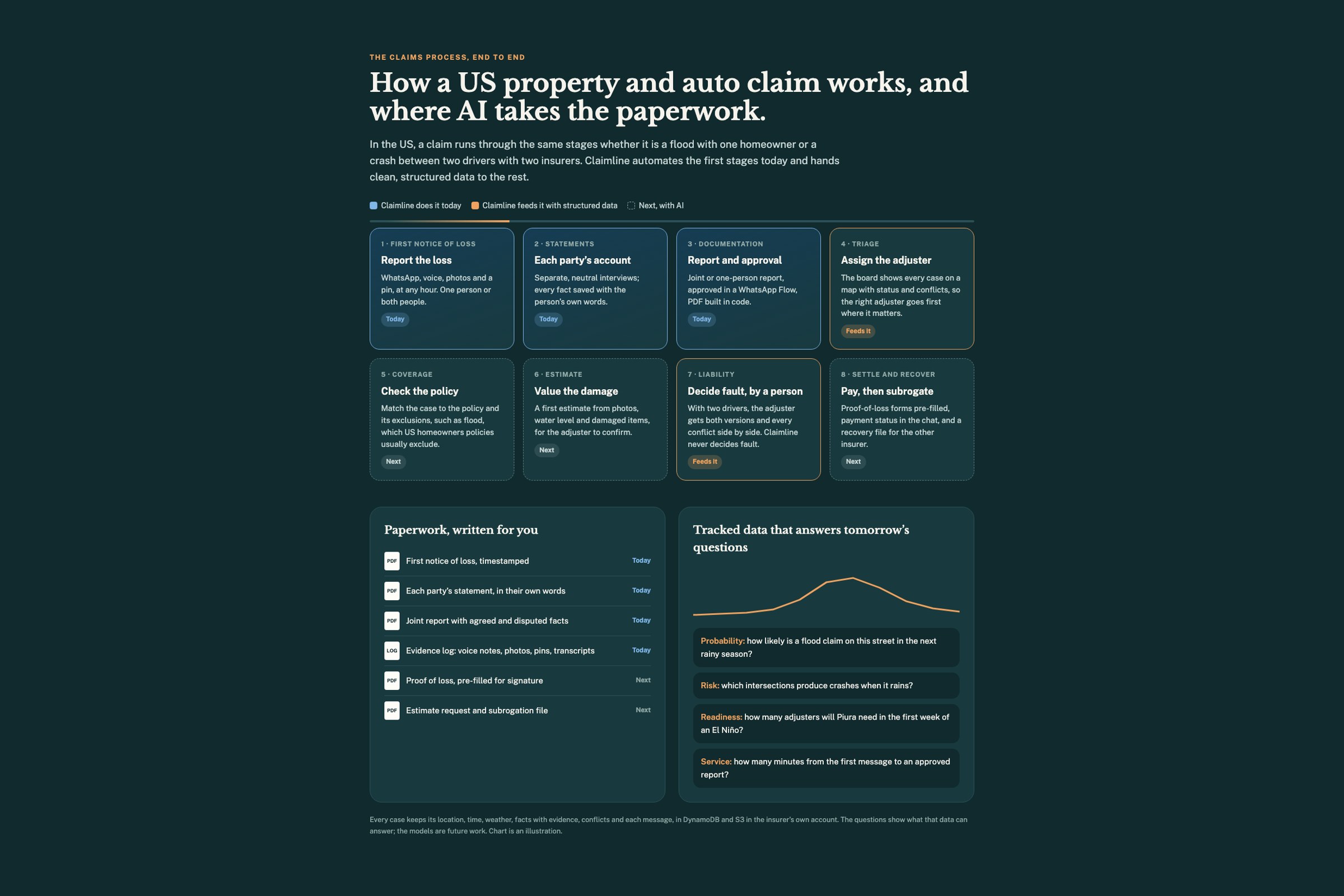
- 🏢 More insurers, one platform: each insurer gets its own WhatsApp number, questions and AWS account, for auto, home, SMEs, agriculture, microinsurance and brokers, with approved cases exported to their core claims system.
- ⚖️ Compliance on autopilot: a full audit trail per case (already built), deadline alerts for regulators' rules such as Peru's SBS and US prompt-payment laws, and consent and data retention handled in the chat.
- 🤖 Automated service: claim status updates in WhatsApp, requests for only the missing documents, and AI help with coverage checks, damage estimates and proof-of-loss forms, with a person always deciding.
- 📊 Data that prevents the next loss: which streets flood, which intersections crash in the rain, how many adjusters Piura needs in week one.
- 🚀 Road ahead: run both paths on AWS with Claude, a five-person field test, then a pilot with a Peruvian insurer before the 2026–27 El Niño peaks, from Lima to Houston.
Password for demo - Password: claimline-e87946
Built With
- amazon-bedrock
- amazon-bedrock-agentcore
- amazon-cloudwatch
- amazon-dynamodb
- amazon-sns
- amazon-sqs
- amazon-transcribe
- amazon-web-services
- aws-cdk
- aws-end-user-messaging-social
- aws-lambda
- boto3
- caddy
- claude
- css3
- fpdf2
- html5
- javascript
- leaflet.js
- python
- strands-agents
- whatsapp-flows

Log in or sign up for Devpost to join the conversation.