-
-
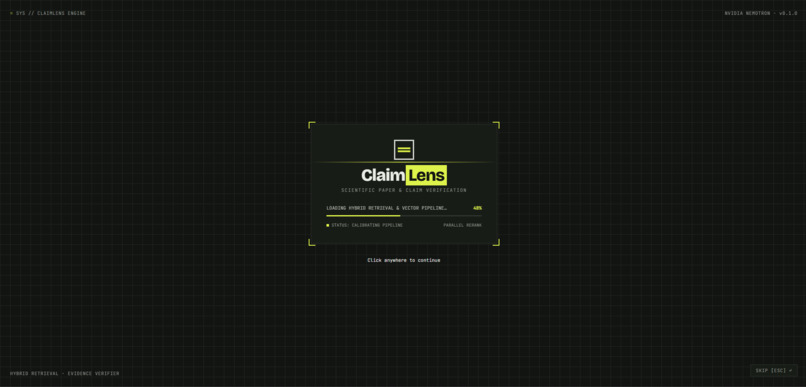
ClaimLens Loading Page
-
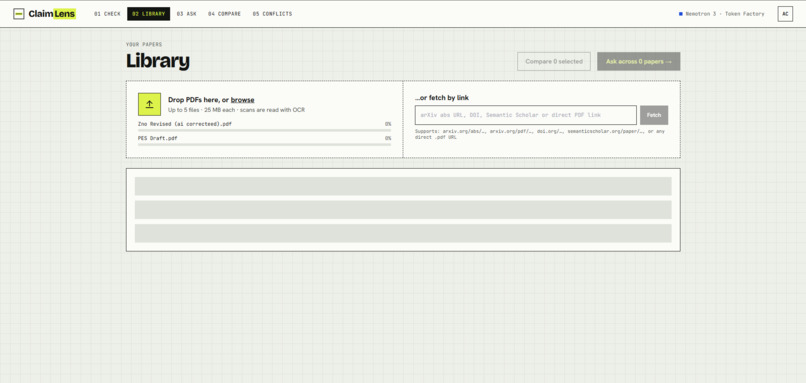
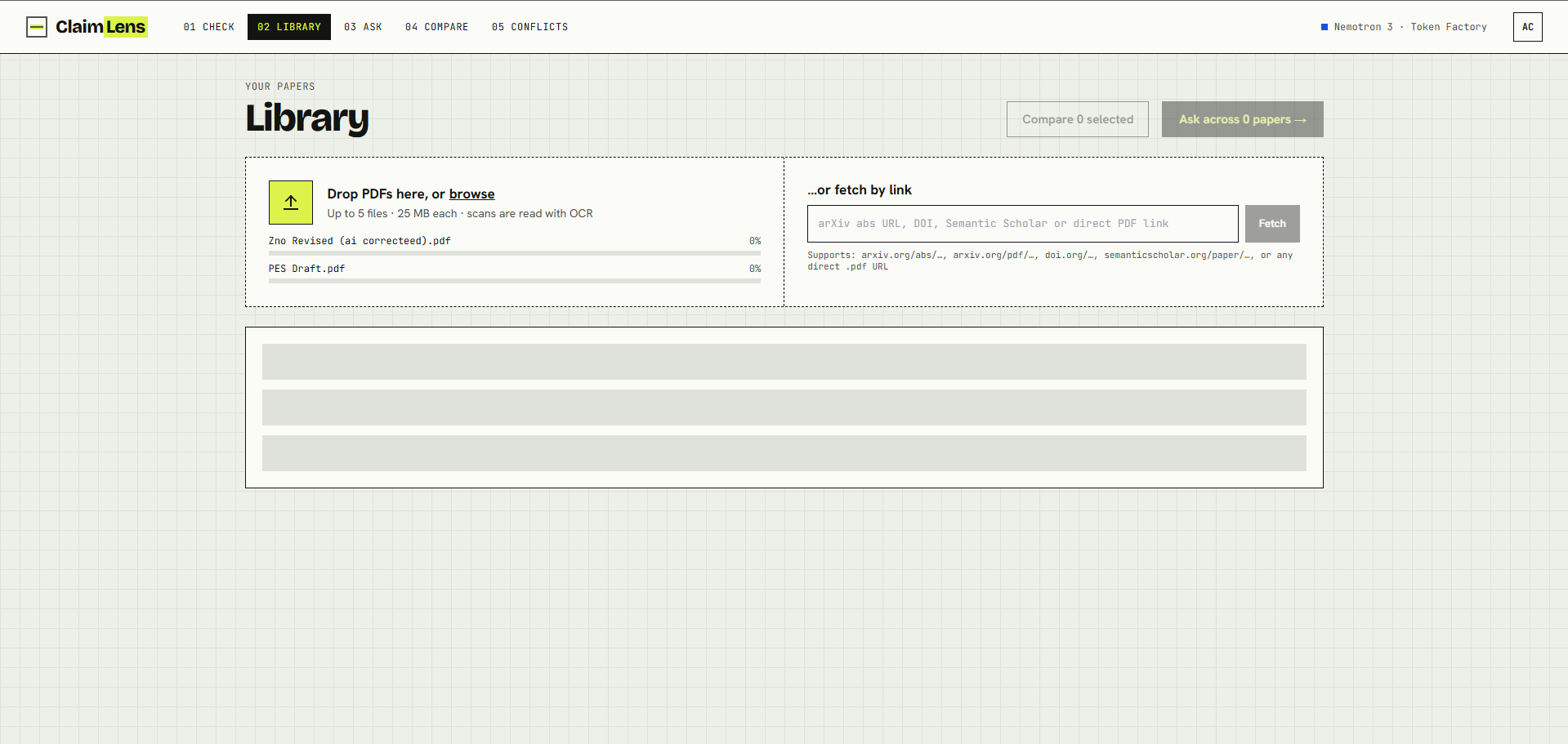
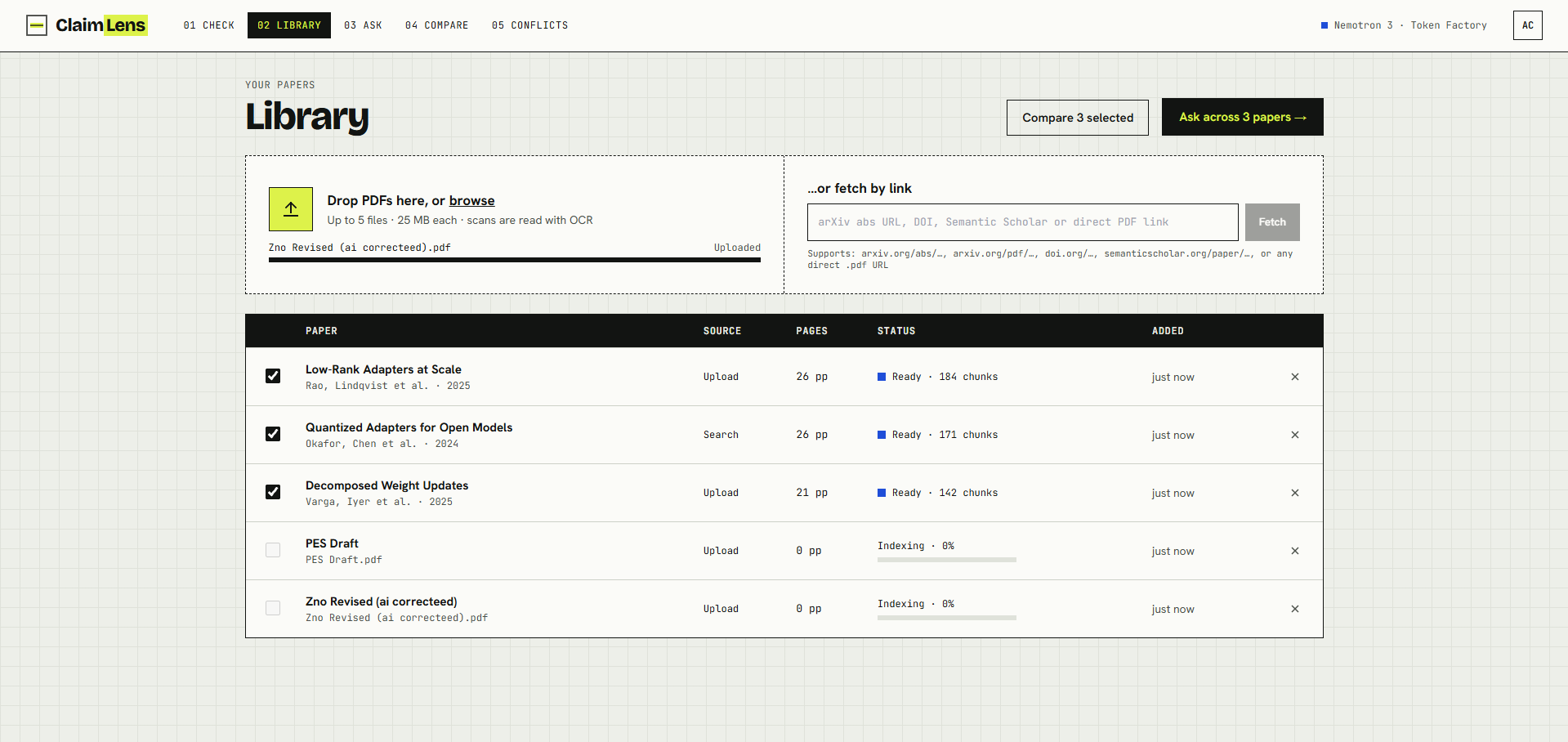
This is ClaimLens’s Library page. It lets you upload PDFs or fetch a paper by arXiv, DOI, Semantic Scholar, or direct PDF link.
-
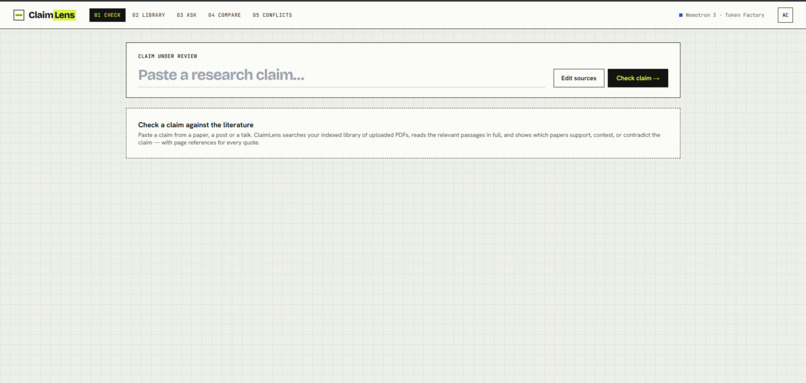
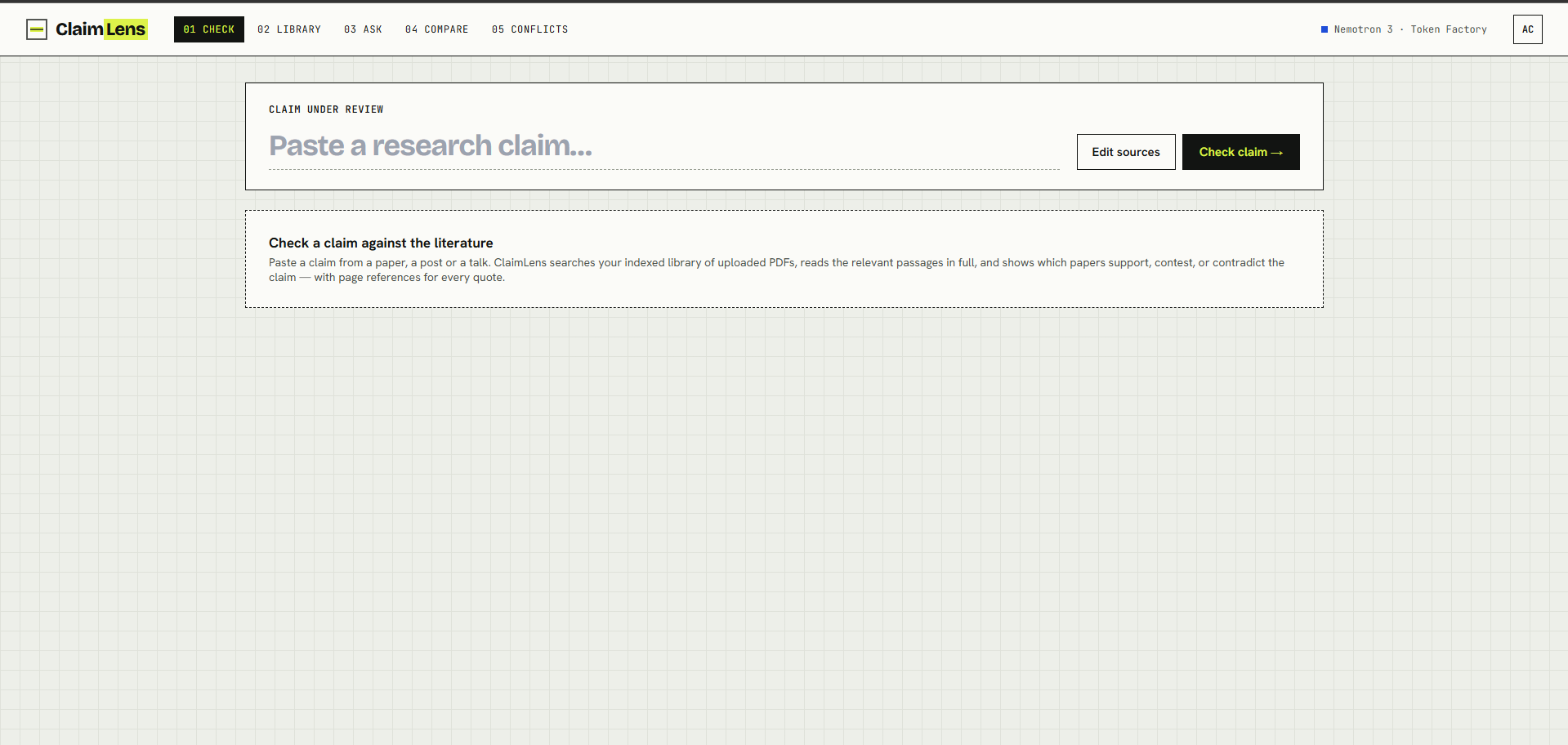
This is the Check workspace in ClaimLens. Paste a research claim into the box, choose sources with Edit sources.
-
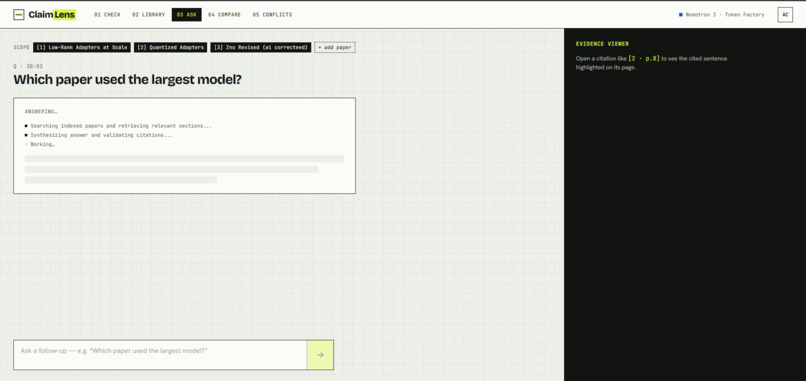
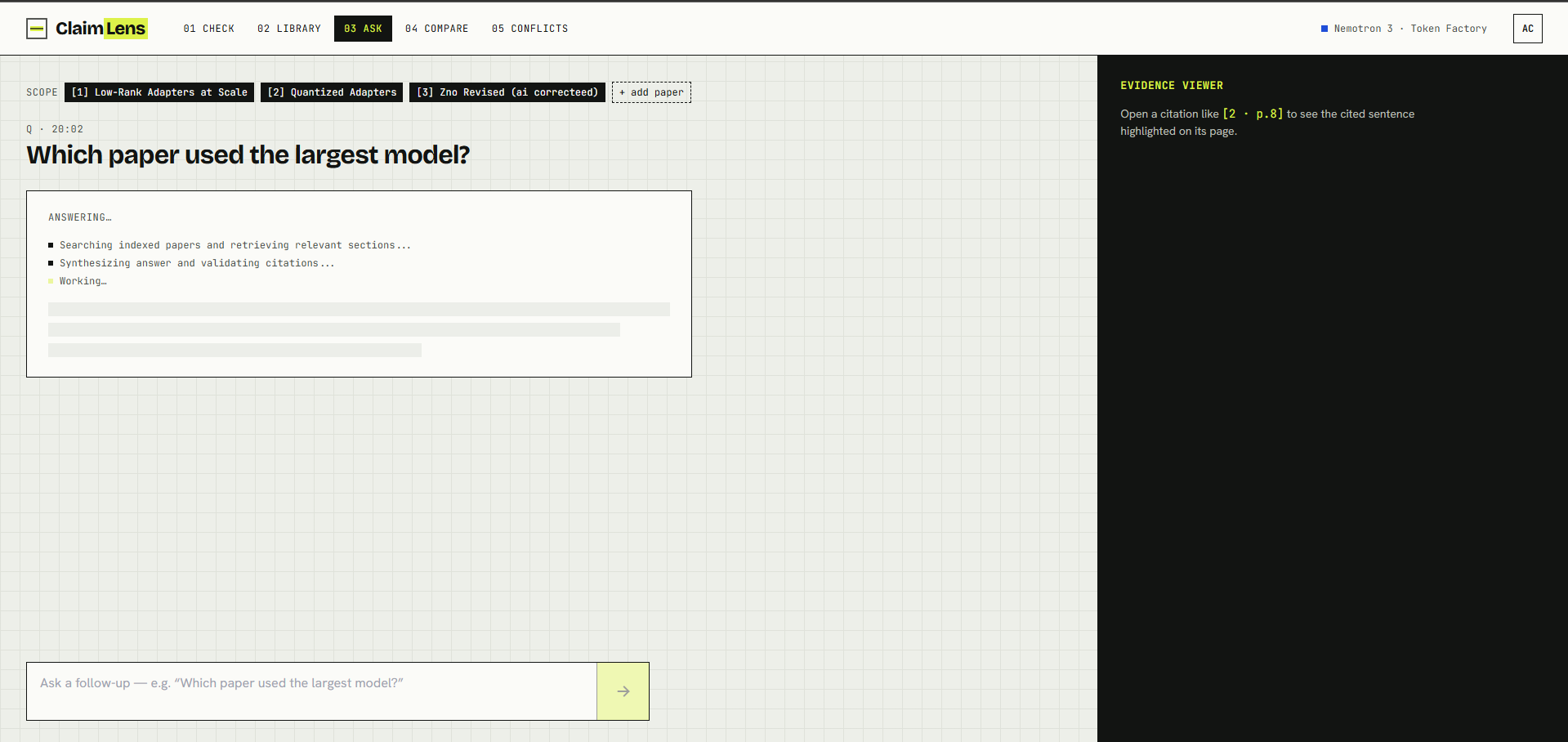
This is ClaimLens’s Ask page. It’s answering “Which paper used the largest model?” across three selected papers.
-
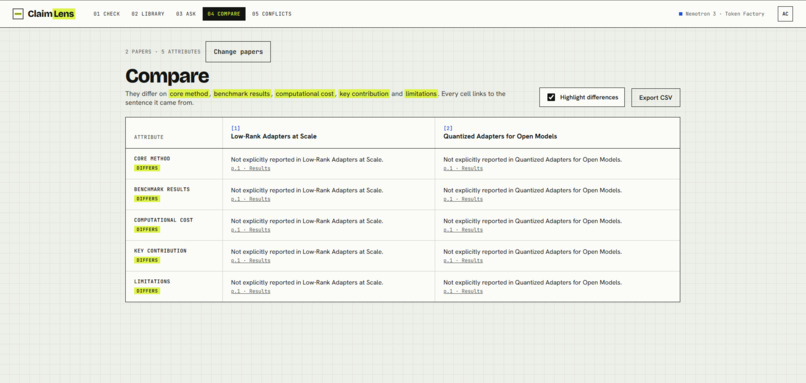
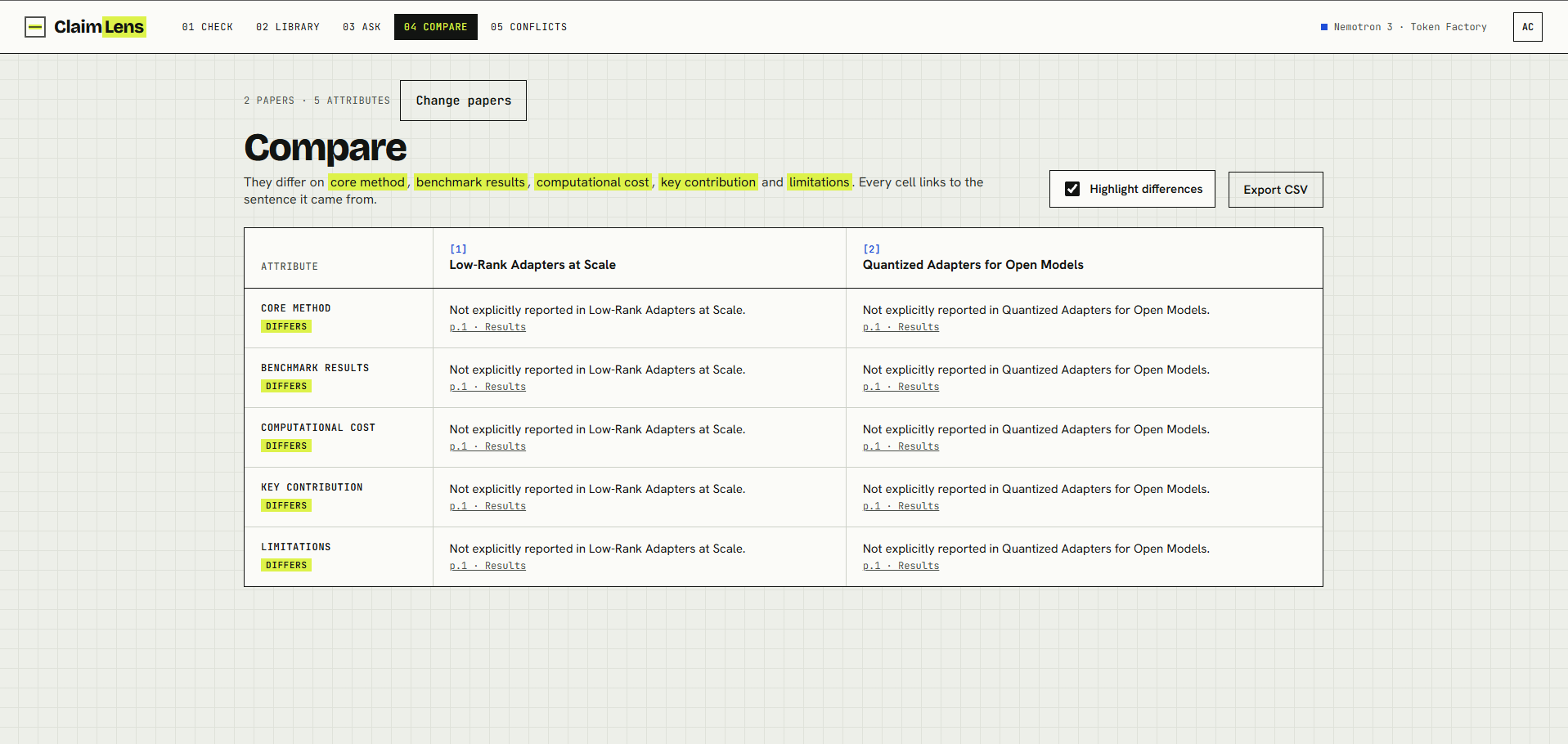
This is ClaimLens’s Compare page.
-
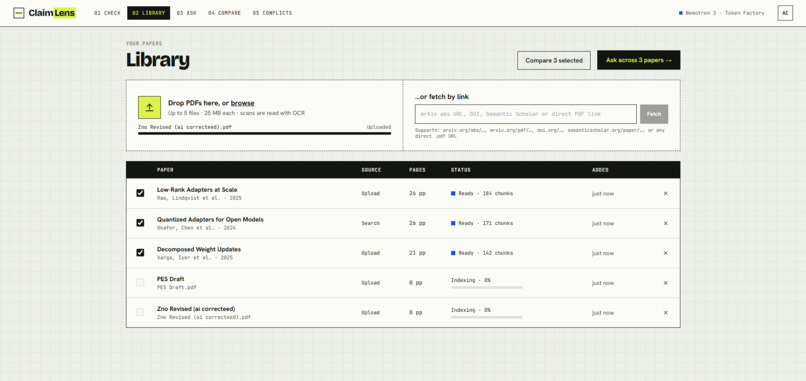
If you mean the fourth paper in the list, it’s PES Draft. It’s still indexing at 0%.
-
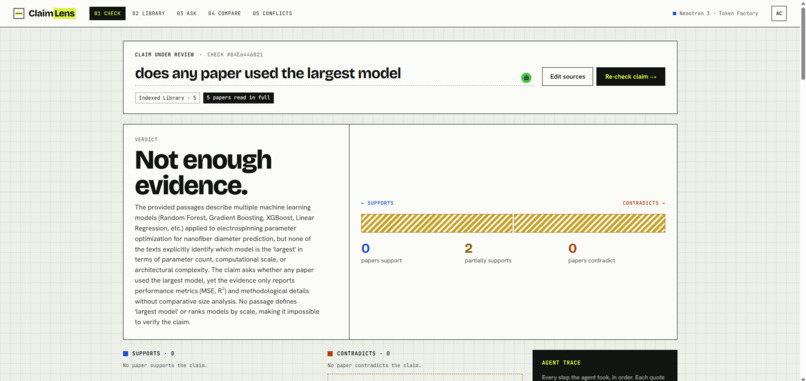
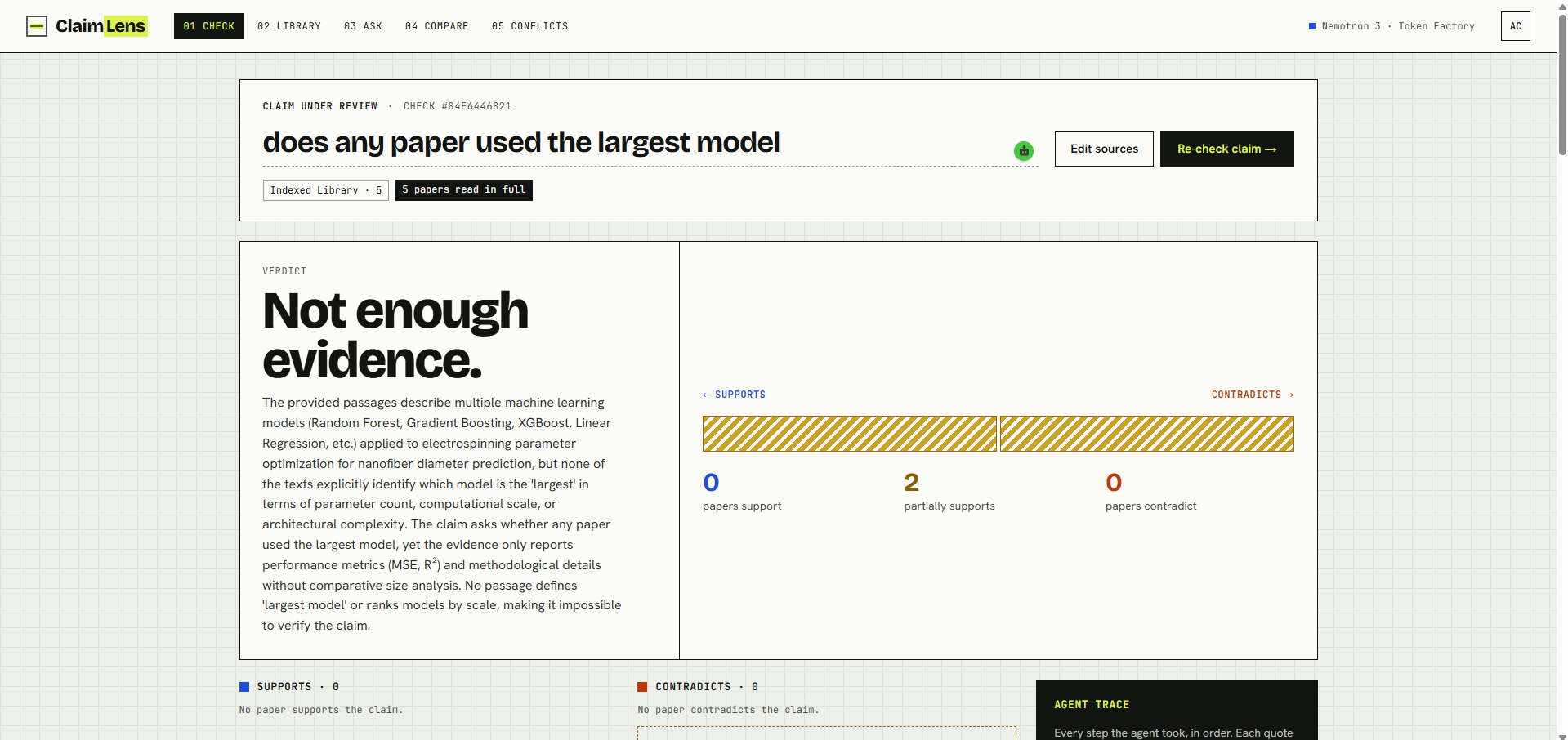
This is a claim-check result in ClaimLens. It reviewed five papers and returned “Not enough evidence” for the claim.
-
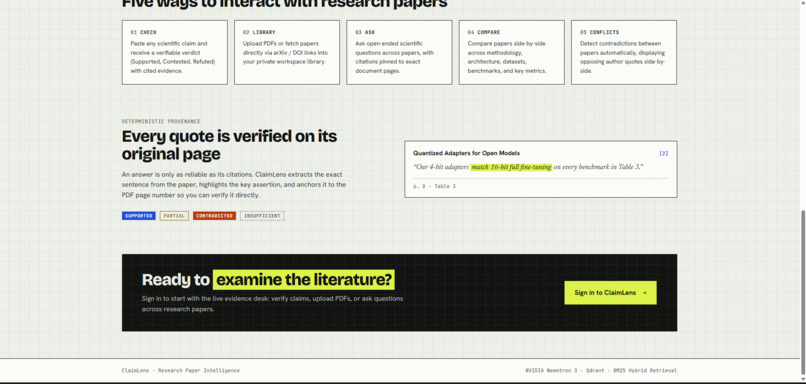
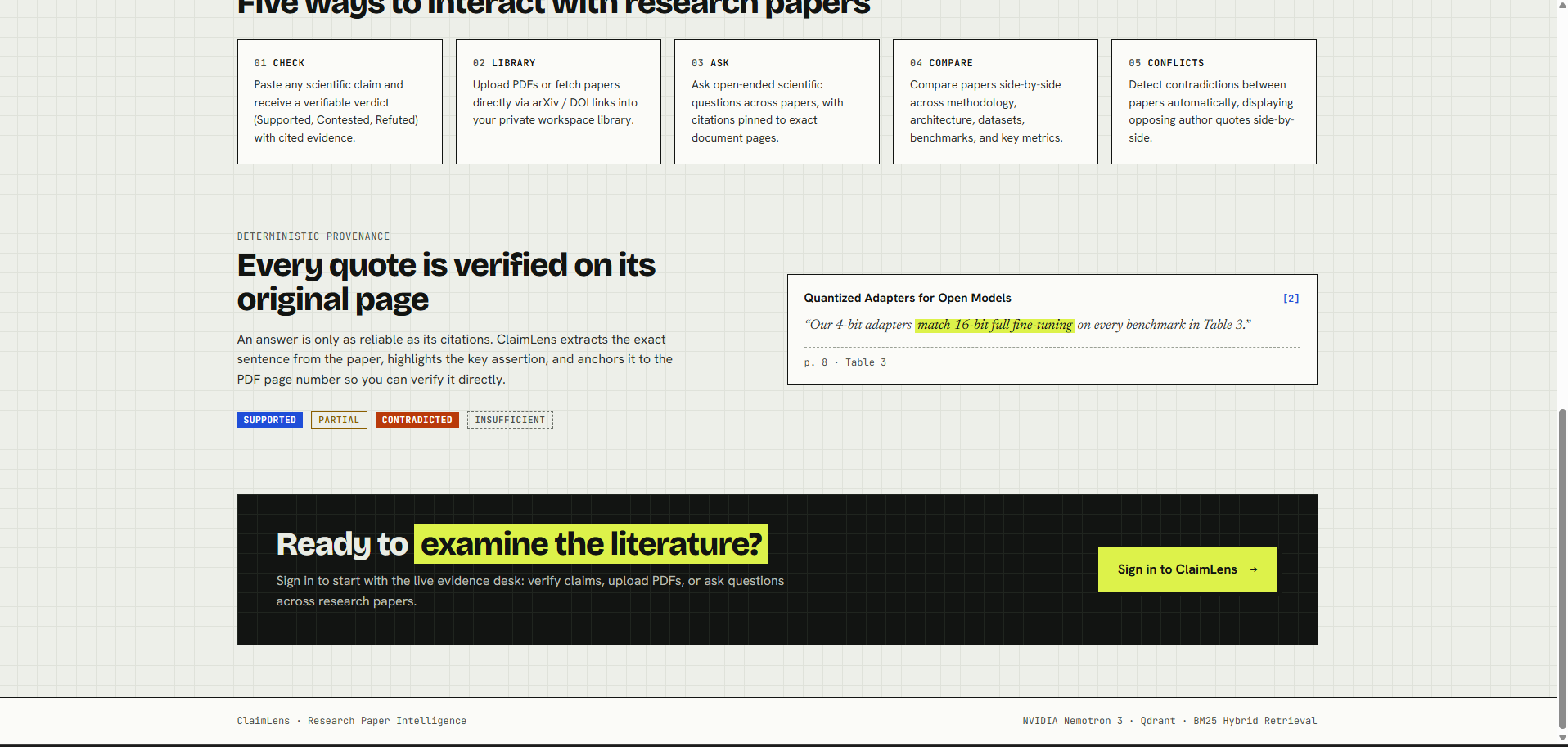
ClaimLens landing page bottom
-
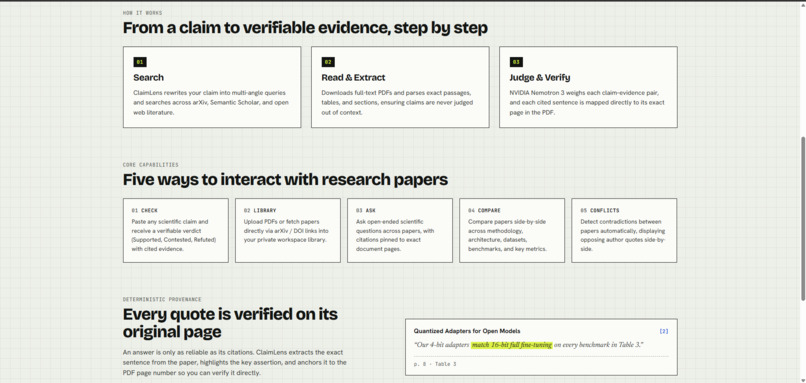
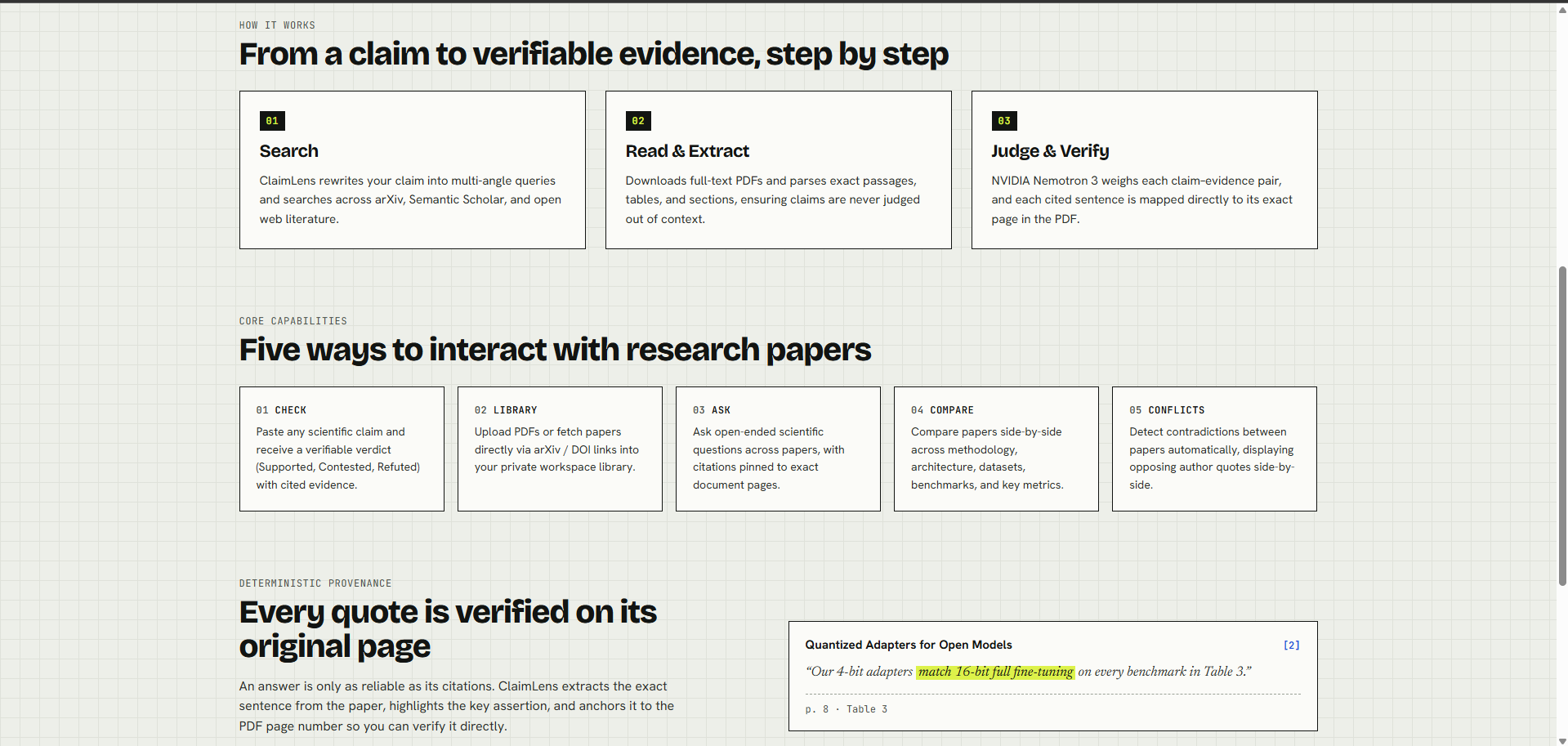
Short tutorial on how clainlens works
-
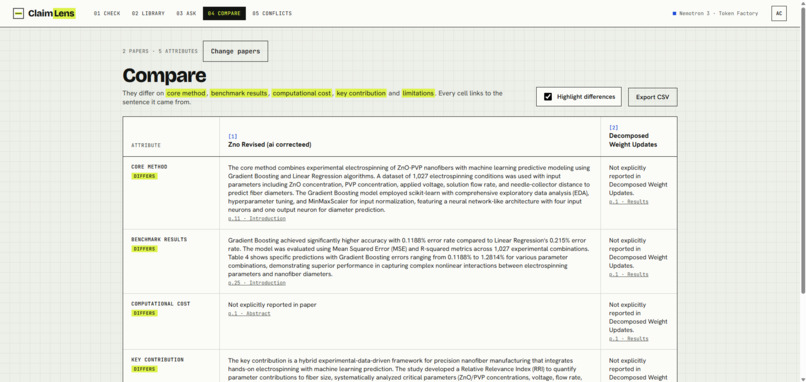
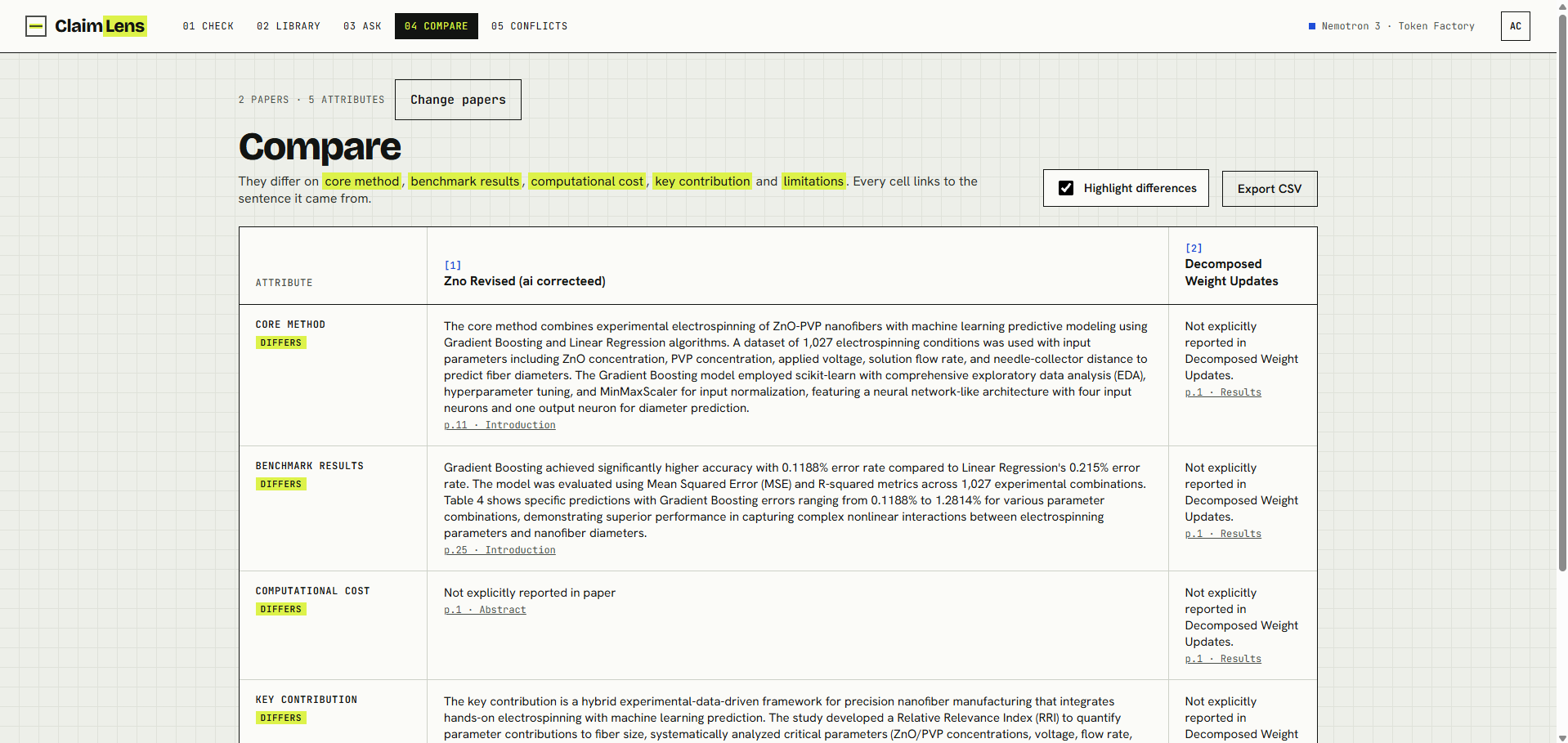
This is the Compare page again, now showing a detailed comparison between *Zno Revised (ai corrected)* and *Decomposed Weight Updates*.
-
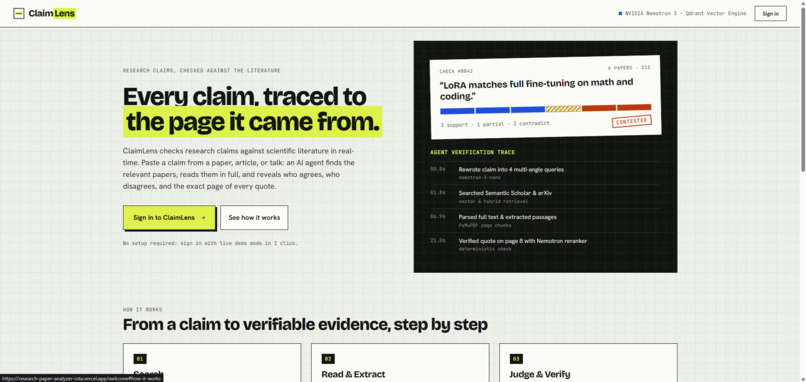
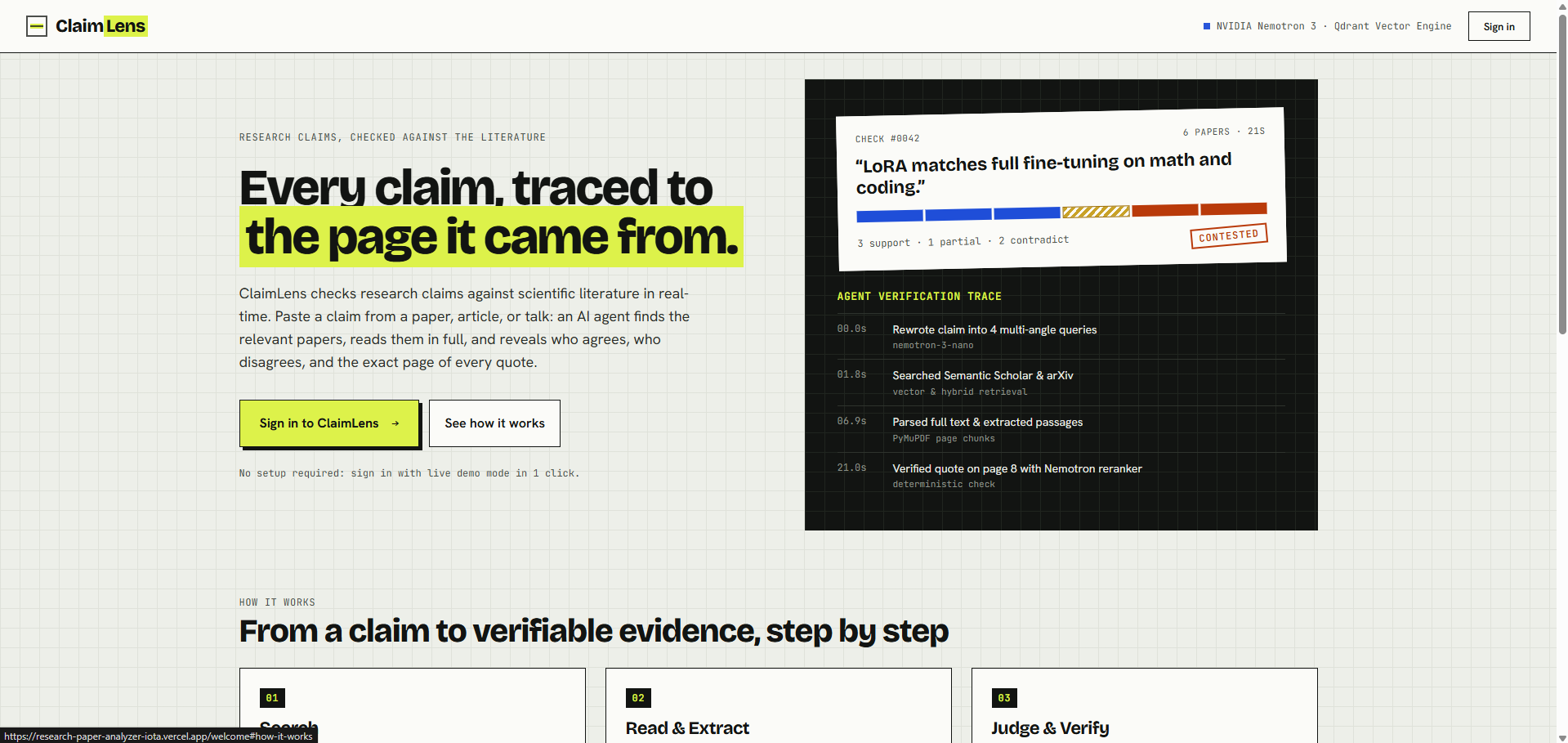
ClaimLens landing page
-
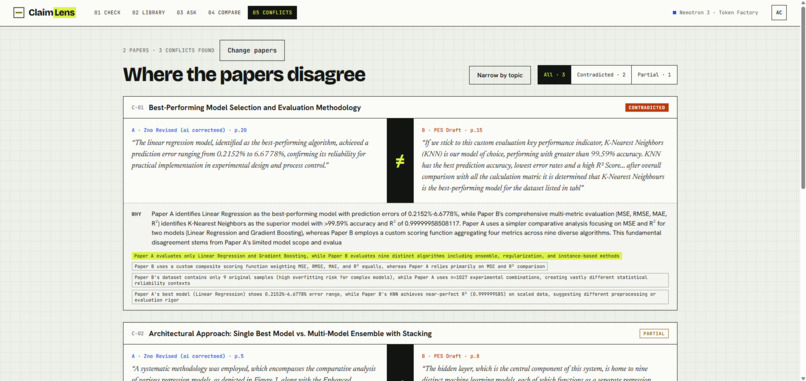
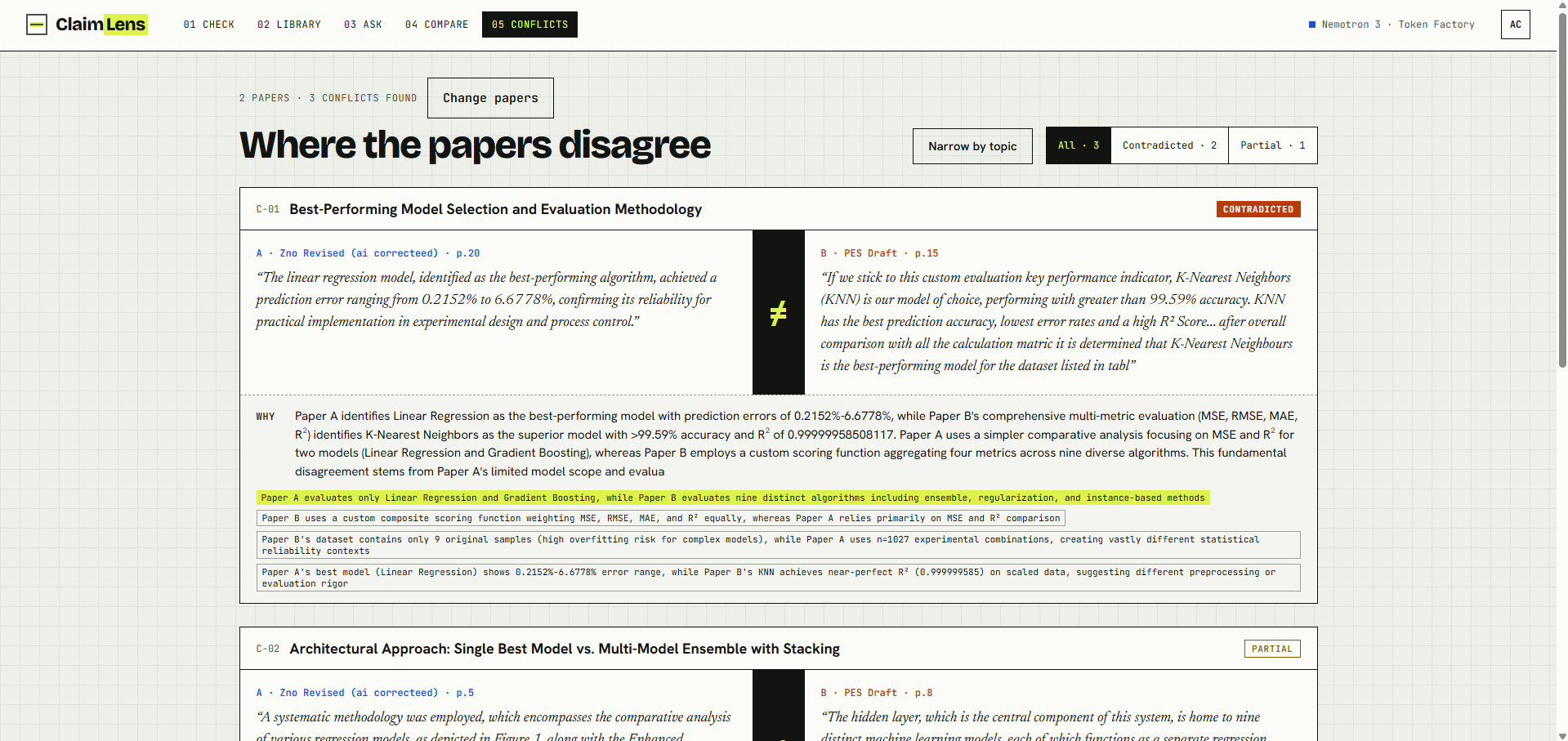
This is ClaimLens’s Conflicts page. It compares passages from two papers and groups potential disagreements by topic.
-
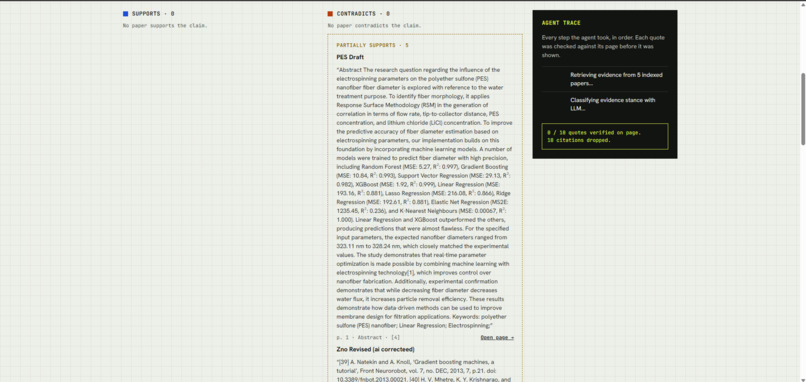
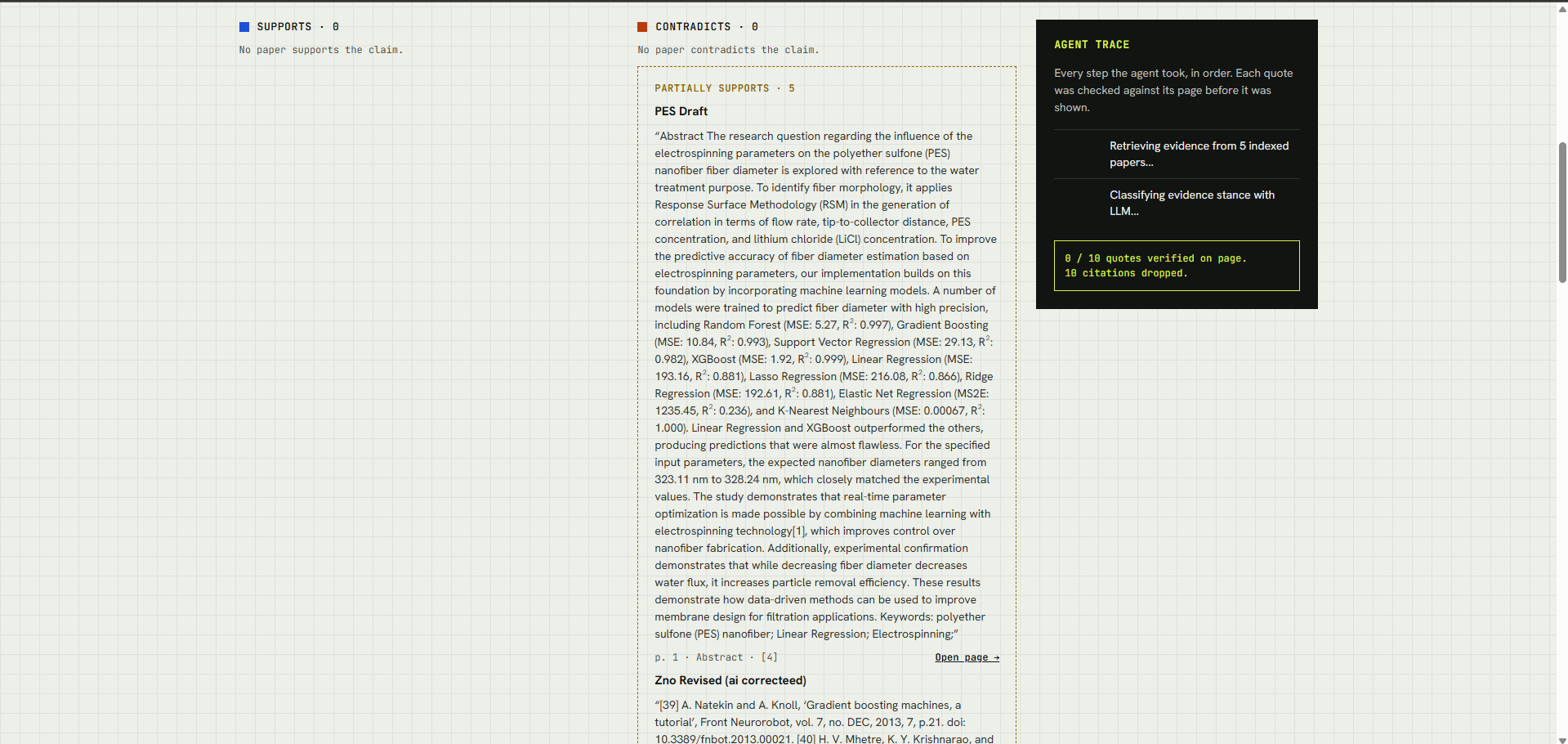
This is the evidence and agent-trace section of the claim-check result.
-
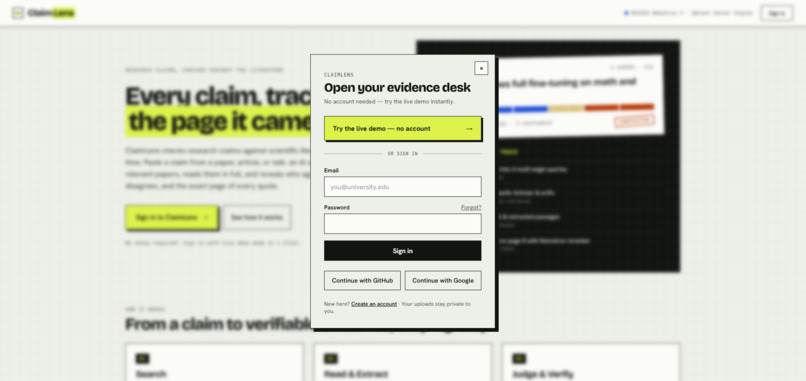
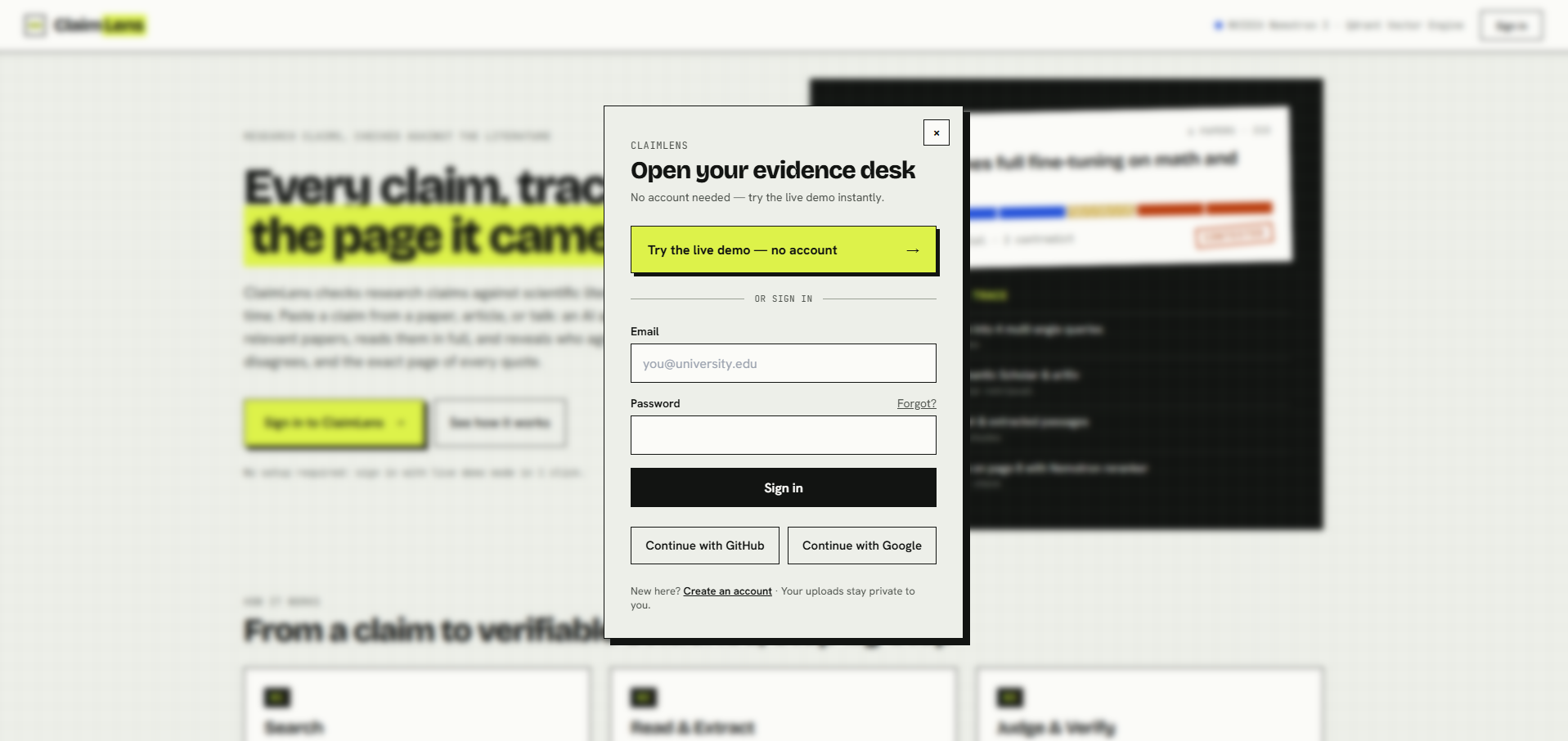
ClaimLens sign-in dialog
Inspiration
Research papers are full of valuable ideas, but finding a specific result, checking its supporting evidence, and comparing it with other studies can take hours. We wanted to make that process easier with a tool that lets readers ask direct questions while keeping the original papers and evidence close at hand.
That idea became ClaimLens: an AI-assisted research workspace designed to help people explore papers without losing sight of where the information comes from.
What it does
ClaimLens lets users upload research PDFs or fetch papers using supported arXiv, DOI, and Semantic Scholar links. Once papers are in the library, users can:
- Ask questions across one or more papers and review answers with linked passages and page references.
- Compare study details, such as methods, benchmarks, metrics, and reported results.
- Explore statements that may conflict across selected papers.
- Check a claim against additional research found through Semantic Scholar and arXiv, with optional Tavily search.
The application checks generated quotations against stored paper text so readers can trace evidence back to its source. Its output is intended to support research review, not replace checking the original papers.
How we built it
We built ClaimLens as a full-stack application. The frontend uses React, TypeScript, and Vite, while the backend is built with Python and FastAPI.
When a paper is added, the document pipeline extracts its text, divides it into page-aware chunks, and prepares it for search. The query pipeline combines keyword search with semantic retrieval, ranks relevant passages, and provides evidence for the selected workflow. SQLite stores application data, documents, vectors, jobs, and the full-text search index.
For semantic embeddings, ClaimLens can use NVIDIA API Catalog. For AI-generated answers and analysis, it can use NVIDIA Nemotron through Nebius Token Factory. Local fallback providers make it possible to explore the main workflow without configuring hosted model credentials. We also added optional Firebase Authentication for user accounts.
Challenges we ran into
A key challenge was connecting document processing, retrieval, AI providers, and the user interface while keeping answers tied to the correct paper and page. A relevant passage is only useful if readers can find it again and understand its context, so we built evidence references into the response workflow and added checks for quoted text.
We also had to handle differences between local fallback behavior and hosted model services, configure embedding models with compatible vector dimensions, and keep external API credentials out of the source code. Supporting both an account-free demo and optional authenticated accounts added another layer to the application design.
Accomplishments that we're proud of
We’re proud to have brought several research workflows together in one working application: paper upload and discovery, evidence-linked question answering, paper comparison, conflict exploration, and claim checking.
We’re especially pleased that answers can link back to passages in the source PDFs, and that the core app can run with local fallbacks when hosted model credentials are unavailable. ClaimLens also has a full-stack architecture, a Docker Compose setup, API documentation, and an optional Firebase sign-in path.
What we learned
Building ClaimLens taught us how much work goes into making AI answers useful and inspectable. Retrieval quality, chunking, page references, model configuration, and citation checks all affect whether a response helps someone understand a paper.
We also gained experience building and connecting a React frontend, FastAPI backend, document-processing pipeline, search and retrieval components, SQLite storage, and external model APIs. The project reinforced the importance of clear fallbacks and transparent links to source material when using AI for research tasks.
What's next for ClaimLens — Advance Research Paper Analyzer
We’d like to continue improving ClaimLens as an advanced research paper analyzer. Possible next steps include refining retrieval and ranking, expanding support for paper formats and sources, improving the comparison and claim-checking workflows, and making the evidence viewer more useful for close reading.
We also want to keep improving the setup and deployment experience so researchers can more easily configure their preferred model providers and use ClaimLens with their own collections of papers.
Built With
- arxiv-api
- docker
- fastapi
- firebase-authentication
- nebius-token-factory
- nvidia-api-catalog
- nvidia-nemotron
- pymupdf
- python
- react
- semantic-scholar-api
- sqlite
- tavili
- typescript
- vite
