-
-
UIPATHDEMO
Inspiration
Insurance claims are a perfect real-world example of why enterprises need governed agentic automation.
Claims are not simple one-step tasks. They involve messy documents, policy rules, customer communications, fraud signals, missing information, system failures, and human judgment. A basic chatbot cannot safely approve or deny claims. A traditional RPA bot cannot reason through exceptions. A fully autonomous AI system creates risk.
ClaimGuard AI was inspired by the idea that the future of enterprise AI is not “agents replacing people,” but agents coordinating work under human accountability.
UiPath Maestro Case gives us the right control plane: agents can move the case forward, but humans stay responsible for sensitive decisions.
What It Does
ClaimGuard AI processes an insurance claim from intake to audit summary using multiple coordinated agents.
The system can:
Receive a new claim submission.
Extract claim details from structured claim data and attachments.
Identify missing documents or incomplete information.
Verify policy coverage and policy status.
Detect fraud-risk signals and suspicious inconsistencies.
Route exceptions to a human adjuster.
Generate customer follow-up messages.
Create an audit-ready final case summary.
Show how UiPath Maestro Case coordinates agents, automation, APIs, and humans across a long-running workflow.
The solution demonstrates these key enterprise capabilities:
Multi-agent orchestration Human-in-the-loop review Exception handling Retry/fallback logic Auditability Governance Structured outputs Case-based workflow progression
How We Built It
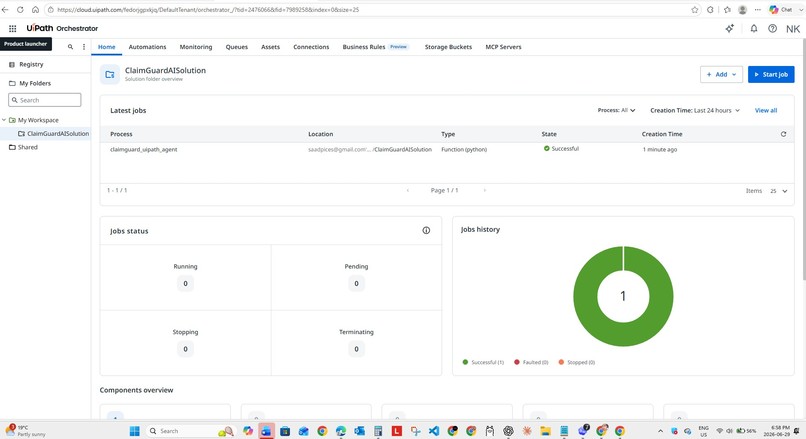
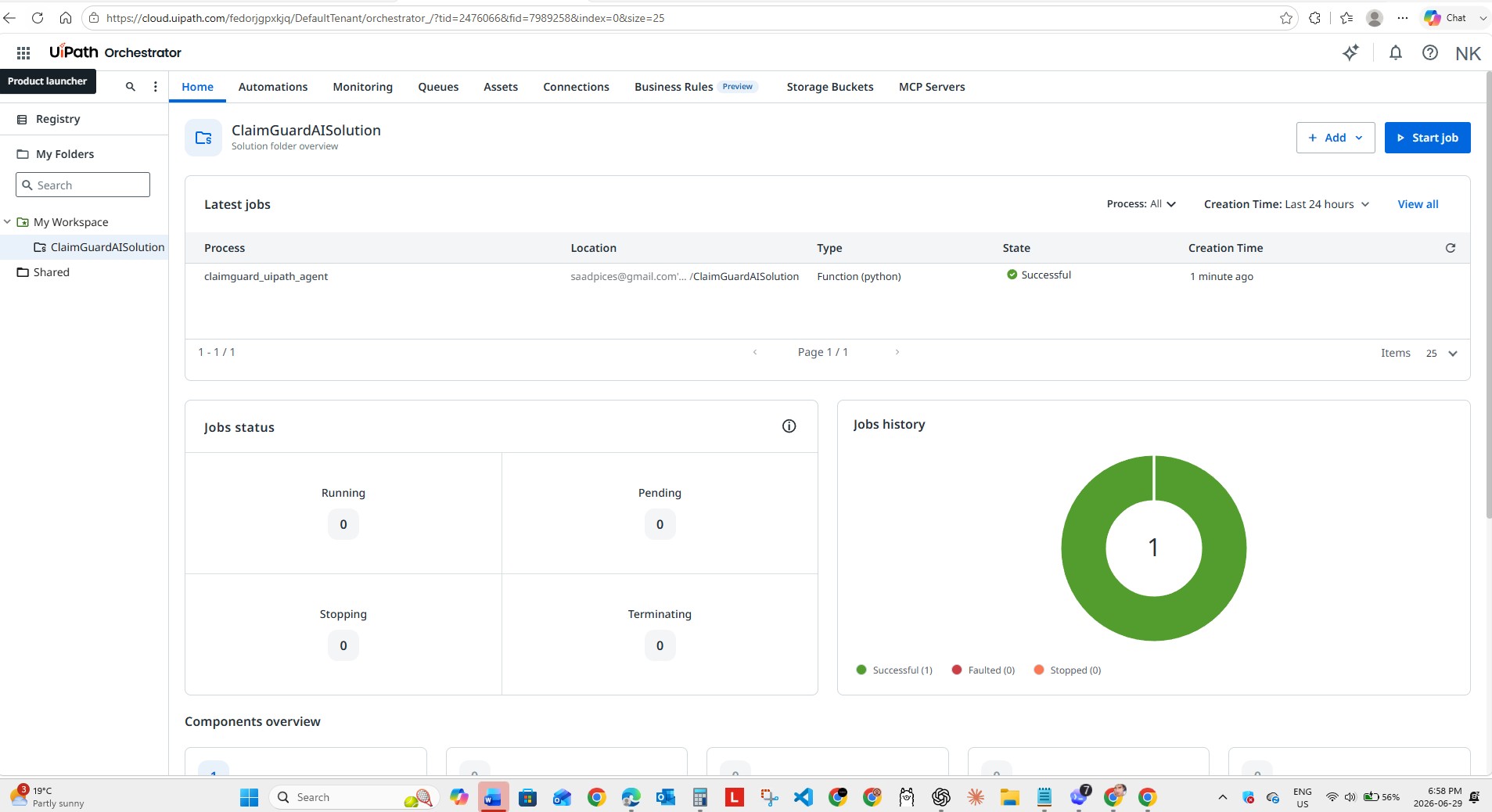
We built ClaimGuard AI around UiPath Automation Cloud and designed the workflow for UiPath Maestro Case.
The core architecture includes:
UiPath Maestro Case Used as the orchestration and governance layer for the claim lifecycle. Maestro coordinates stages, decisions, human tasks, and exception paths.
UiPath Agent Builder Used to create autonomous agents such as the Claim Intake Agent, Policy Verification Agent, and Customer Communication Agent.
UiPath Document Understanding Designed for extracting information from insurance documents such as claim forms, invoices, receipts, repair estimates, photos, and incident reports.
UiPath API Workflows Used for policy lookup, CRM lookup, customer status updates, and mock external system integrations.
Coded Agents / UiPath for Coding Agents Used for the Fraud Signal Agent and Audit Compliance Agent logic. These coded agents support deterministic scoring, structured JSON output, and enterprise-friendly audit notes.
Cursor + UiPath CLI Used to generate and organize project files, schemas, coded agent logic, and documentation. This supports the bonus-points category for coding agents through UiPath for Coding Agents.
Agent Architecture
- Claim Intake Agent
Receives a new claim, extracts key details, checks completeness, identifies missing documents, and recommends the next workflow step.
Output: intake status, missing documents, claim summary, recommended next step.
- Policy Verification Agent
Checks whether the policy is active, whether the claim type is covered, whether the incident date falls within the coverage period, and whether the claim exceeds coverage limits.
Output: coverage status, policy exception flags, human-review requirement.
- Fraud Signal Agent
Analyzes risk indicators such as high claim value, missing documents, repeated claims, duplicate invoices, suspicious timing, and inconsistencies.
Output: low/medium/high fraud risk score, risk indicators, recommended next step.
- Human Adjuster Review
A human reviews high-value, incomplete, ambiguous, or risky claims. The human can approve, reject, request more documents, or escalate.
Output: human decision, reason, final action.
- Audit Compliance Agent
Creates a final audit summary showing the timeline, agent decisions, exceptions, human approvals, and final recommendation.
Output: audit-ready case report.
Workflow A new insurance claim is submitted. UiPath Maestro Case creates a new claim case. Claim Intake Agent validates the claim. Policy Verification Agent checks coverage. Fraud Signal Agent reviews risk. Maestro routes exceptions to a human adjuster. Human adjuster approves, rejects, or requests more information. Customer Communication Agent drafts the customer response. Audit Compliance Agent generates the final case summary. Failure and Exception Handling
ClaimGuard AI was designed to show real-world complexity, not only the happy path.
Missing documents The case pauses and the system drafts a customer follow-up request.
Low document confidence The case is routed to a human validator.
Policy ambiguity The case is escalated to a human adjuster.
High-value claim Human approval is required.
Fraud-risk signals The case is routed to a human fraud investigator.
API failure The workflow retries the API call and can fall back to RPA/manual review.
Uncertain agent output The workflow escalates instead of guessing.
Human-in-the-Loop Design
ClaimGuard AI keeps humans accountable at critical decision points.
Human review is required when:
Documents are missing.
Extraction confidence is low.
Claim amount is high.
Policy coverage is unclear.
Fraud risk is medium or high.
A final denial or sensitive customer message is needed.
A human overrides an agent recommendation.
Every human decision is logged into the audit trail.
Business Impact
ClaimGuard AI can help insurance teams:
Reduce manual intake work.
Shorten claim cycle time.
Improve consistency of claim triage.
Prioritize high-risk claims faster.
Reduce missed documentation.
Improve audit readiness.
Keep humans focused on complex decisions.
Increase trust in AI-assisted operations.
The main value is not just automation. It is governed agentic operations.
Challenges We Ran Into
One challenge was designing an agentic workflow that is powerful but still safe for enterprise use. Insurance claims involve sensitive decisions, so we avoided fully autonomous approvals or denials.
Another challenge was deciding where agents should act independently and where humans must stay in control. We solved this by defining clear escalation rules for missing documents, high claim values, fraud risk, low confidence, and policy ambiguity.
We also designed the system so it can work with both low-code UiPath agents and coded agents, while keeping UiPath Maestro as the main orchestration and governance layer.
Accomplishments That We’re Proud Of
We created a complete multi-agent claims workflow that is easy to understand and realistic for enterprise adoption.
We designed specialized agents instead of one generic assistant.
We built clear exception paths for real-world claim complexity.
We included human-in-the-loop decision points.
We created audit-friendly structured outputs.
We used coded-agent logic for fraud scoring and audit generation.
We aligned the project tightly with UiPath AgentHack’s focus on production-style agentic automation.
What We Learned
We learned that agentic automation is most valuable when agents are not isolated. The real power comes from orchestrating agents, APIs, robots, documents, and humans together.
We also learned that enterprise AI needs governance from the beginning. For high-impact workflows like insurance claims, the system must be explainable, auditable, and designed for escalation.
UiPath Maestro Case is a strong fit for this kind of dynamic workflow because cases do not always follow a predictable straight-line process.
What’s Next
Next, ClaimGuard AI could be expanded with:
Real insurer CRM integrations.
More advanced Document Understanding models.
Vendor verification.
Payment processing integration.
Appeals workflow.
Customer portal.
Fraud investigation dashboard.
Claim reserve estimation.
Multi-language customer communication.
Analytics dashboard for cycle time, exception rate, and human override rate.
Built With
UiPath Automation Cloud UiPath Maestro Case UiPath Agent Builder UiPath Document Understanding UiPath API Workflows UiPath RPA UiPath Apps UiPath for Coding Agents UiPath CLI Cursor Python JSON Schema Mock insurance claim data Mock policy database
Testing Instructions for Judges Open the UiPath Automation Cloud project. Start a new ClaimGuard AI case using the sample claim input. Run the Claim Intake Agent. Confirm that claim details are extracted and missing documents are identified. Run the Policy Verification Agent. Confirm that policy status, coverage period, deductible, and limits are checked. Run the Fraud Signal Agent. Confirm that the claim receives a low, medium, or high risk score. Trigger the missing-document or high-risk scenario. Confirm that Maestro routes the case to human review. Complete the human adjuster decision. Run the Audit Compliance Agent. Review the final audit summary showing agent outputs, exception path, human decision, and final case status.
Sample scenarios included:
Complete claim Missing-document claim High-risk claim Policy exception claim

Log in or sign up for Devpost to join the conversation.