Inspiration
Insurance claims often require people to piece together information from policies, bills, medical reports, receipts, photos, and claimant statements. A single inconsistency or missing document can delay the entire process.
I wanted to build something beyond a chatbot that simply summarizes documents.
ClaimGuard AI was inspired by the idea of giving claims teams an AI investigator that can connect evidence across multiple sources, understand the policy context, identify inconsistencies, and explain what should happen next.
The goal is simple: make claims investigation faster, more consistent, and easier to understand.
What it does
ClaimGuard AI is an AI-powered insurance claim investigation platform.
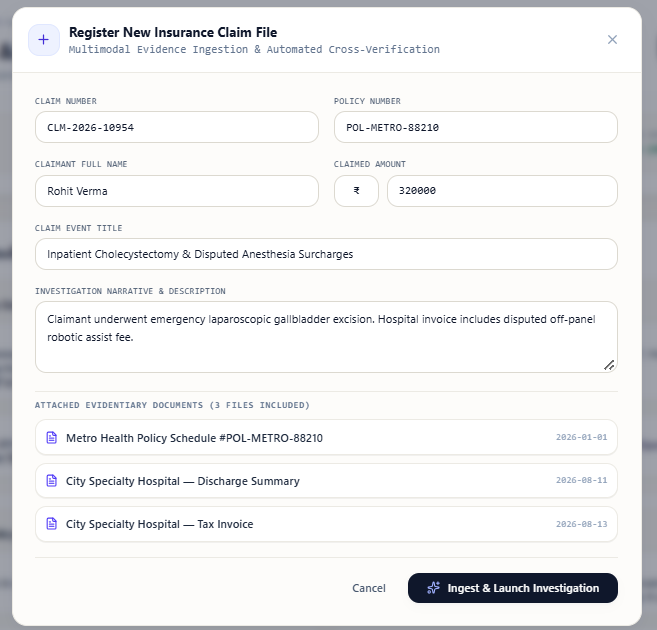
A user can provide a claim along with relevant documents and evidence such as:
- Insurance policy documents
- Hospital bills and invoices
- Medical reports
- Prescriptions
- Photos and receipts
- Claimant statements
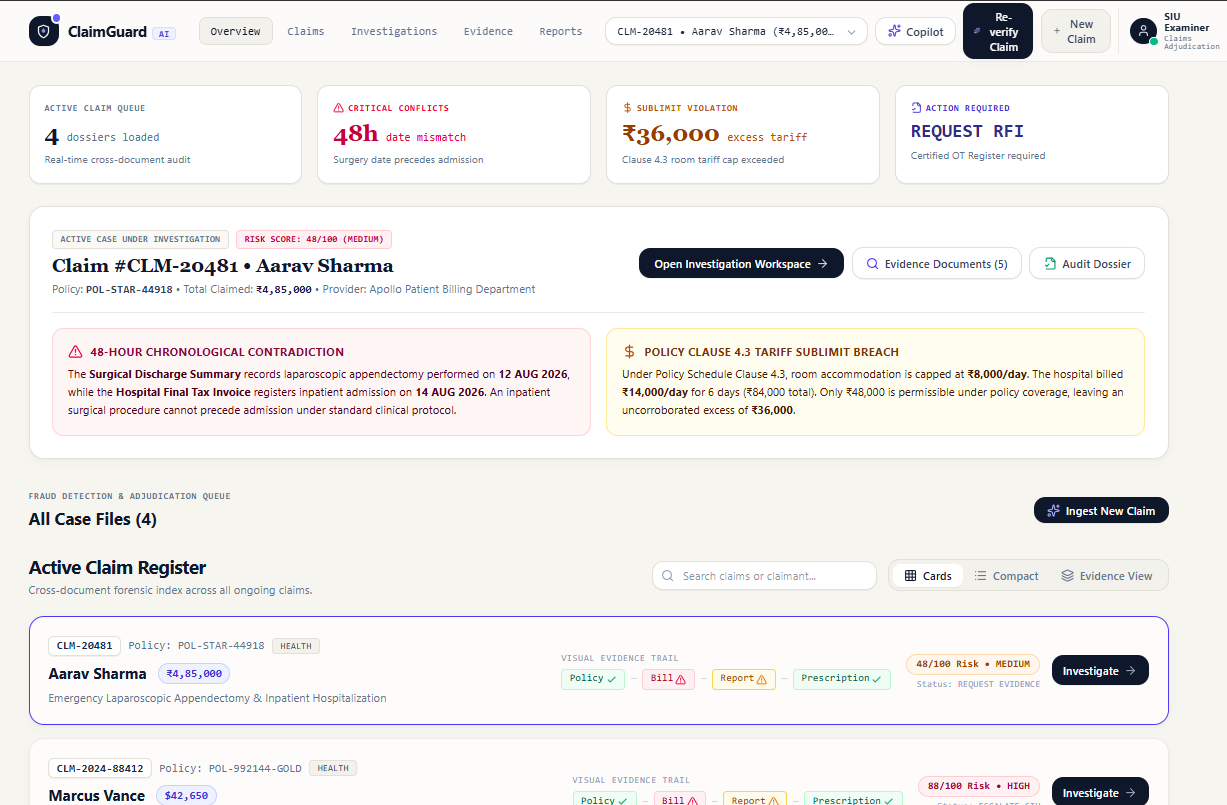
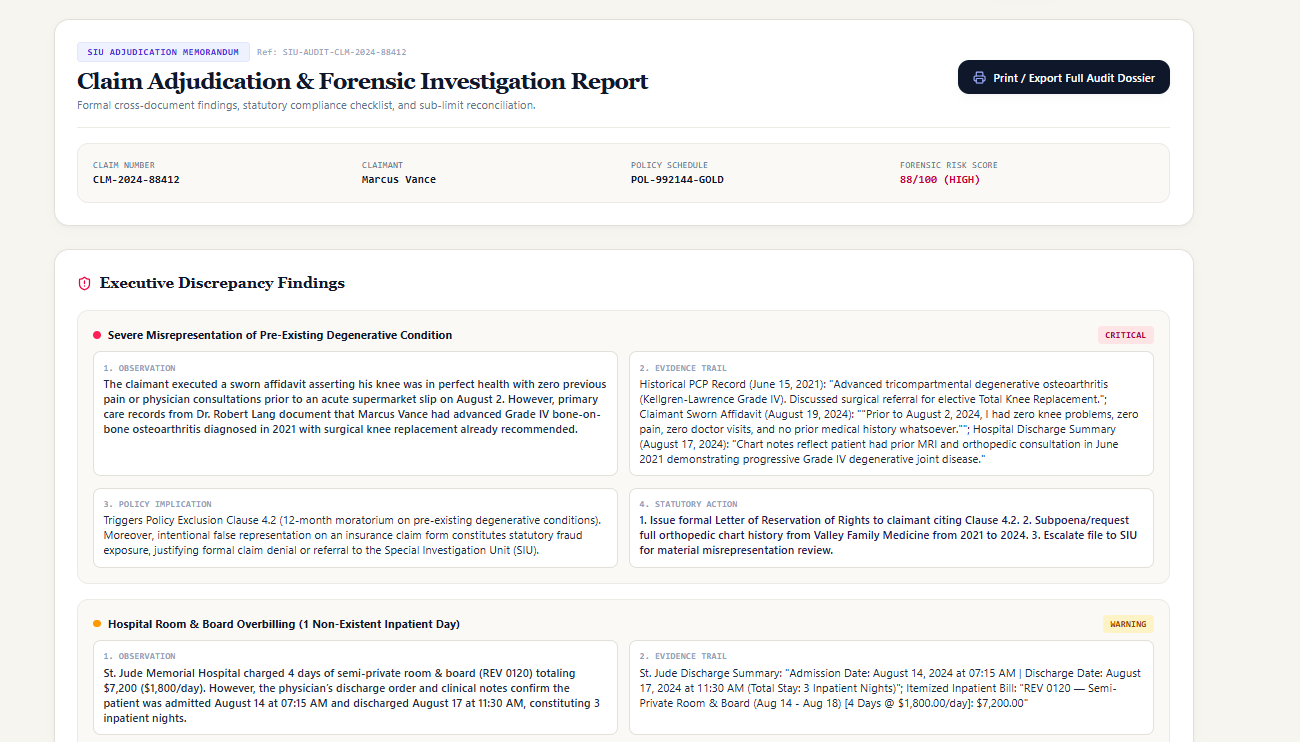
ClaimGuard analyzes the information and produces an investigation report containing:
- Coverage assessment — whether the claim appears to match the policy
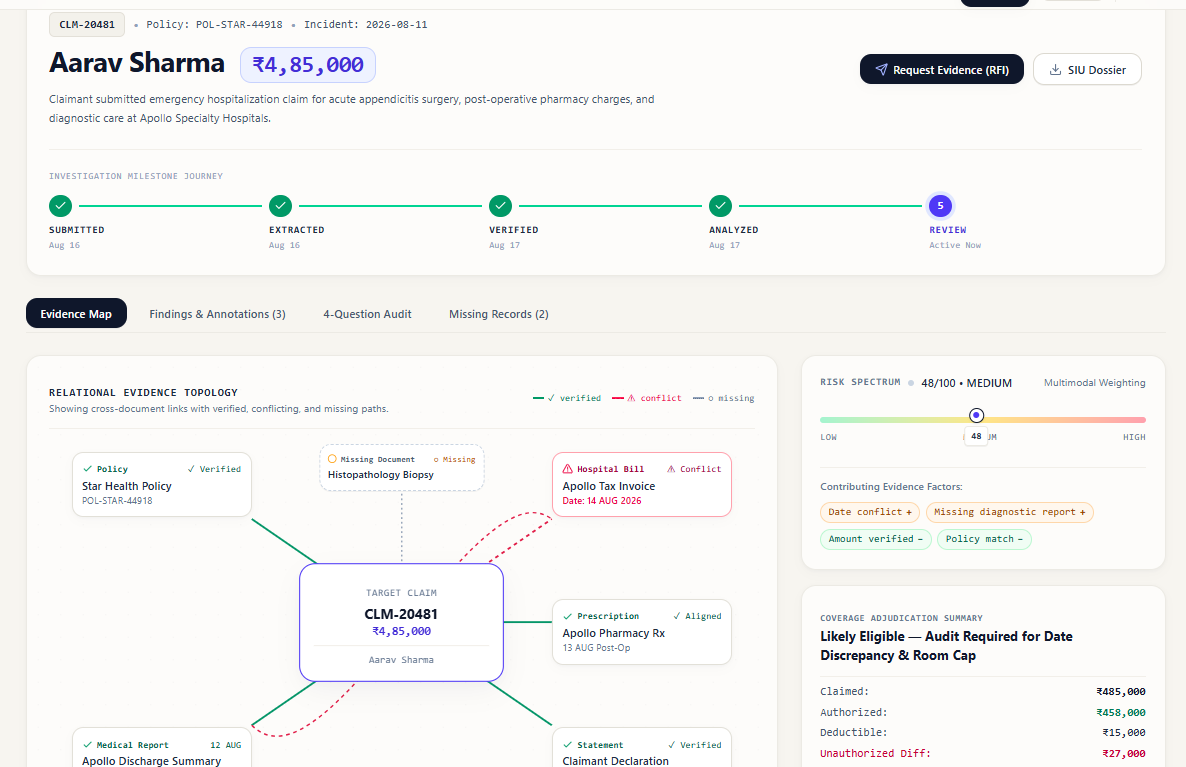
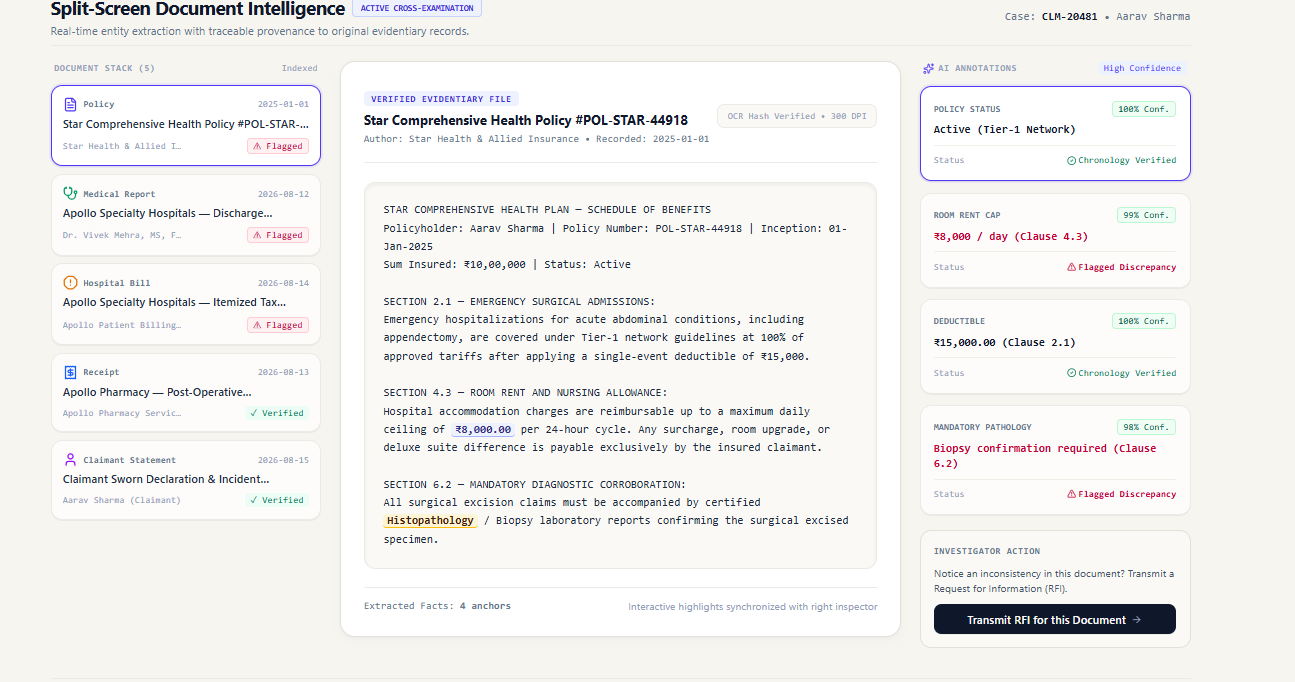
- Evidence analysis — connections between documents and claim details
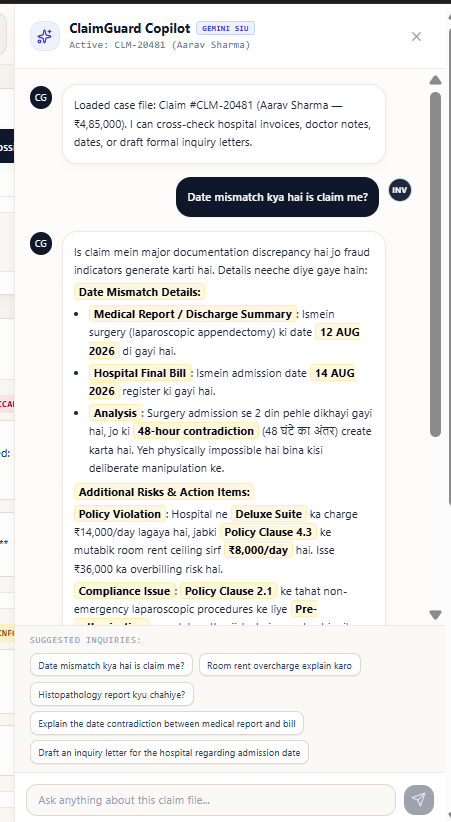
- Inconsistency detection — conflicting dates, amounts, or information
- Missing evidence — documents or information that may still be required
- Risk indicators — areas that deserve additional review
- Recommended action — what the investigator should verify or request next
Instead of only returning an AI-generated answer, ClaimGuard makes the evidence behind the conclusion visible.
How I built it
I designed ClaimGuard as a multi-stage AI investigation workflow rather than a single prompt.
The core pipeline is:
Claim & Evidence → Information Extraction → Cross-Document Analysis → Policy Matching → Inconsistency Detection → Evidence Graph → Investigation Report
The AI layer is responsible for understanding unstructured information across documents and connecting related facts.
The investigation layer then compares those extracted facts against the policy and other claim evidence to identify:
- conflicting information
- missing evidence
- potential coverage issues
- suspicious inconsistencies
- relationships between pieces of evidence
The frontend presents these results through a dashboard designed around the investigator's workflow, including claim status, risk indicators, evidence relationships, key findings, and recommended actions.
I intentionally focused on explainability: an investigator should be able to understand why ClaimGuard flagged something instead of receiving an unexplained score.
Challenges I ran into
The biggest challenge was making the system reason across multiple pieces of evidence instead of treating every document independently.
A policy might describe one set of conditions while a bill, medical report, and claimant statement contain different dates, amounts, or descriptions. Connecting those pieces reliably is much harder than simply extracting text from them.
Another challenge was deciding where AI should be used and where structured logic should take over. I wanted AI to handle the messy, unstructured parts of investigation while keeping the final findings transparent and traceable.
I also had to think carefully about the user experience. Claims investigation can already be overwhelming, so I wanted the interface to surface the most important findings without hiding the underlying evidence.
Accomplishments that I'm proud of
I'm proud that ClaimGuard is designed as a complete investigation workflow rather than an AI document summarizer.
Some of the parts I'm most proud of are:
- Turning multiple claim documents into one connected investigation
- Making inconsistencies visible instead of burying them in generated text
- Connecting findings back to supporting evidence
- Combining policy context with claim evidence
- Designing the product around an actual investigator workflow
- Building an interface where the result can be understood at a glance
Most importantly, I built ClaimGuard around a simple product principle:
AI should help investigators make better decisions, not make the investigation less transparent.
What I learned
I learned that adding more AI does not automatically make a product better.
For a workflow like insurance claims, the important part is knowing where AI provides leverage and where deterministic, structured reasoning is more appropriate.
I also learned that multimodal information becomes much more useful when it is connected rather than simply extracted. A bill by itself is useful; a bill connected to a policy clause, medical report, claimant statement, and timeline is much more powerful.
Finally, I learned that explainability is not just a technical feature. It is a product requirement when AI is being used to support decisions that can affect real people.
What's next for ClaimGuard AI
I see ClaimGuard evolving from a claim investigation assistant into a complete AI claims intelligence platform.
My roadmap includes:
1. Real-time claim collaboration Allow investigators, insurers, and reviewers to work together on the same investigation.
2. Stronger multimodal analysis Improve handling of scanned documents, handwritten information, images, receipts, and other real-world evidence.
3. Historical pattern intelligence Compare new claims against historical investigation patterns to identify recurring anomalies and emerging fraud signals.
4. Human-in-the-loop decisions Allow investigators to approve, reject, override, or request additional evidence while preserving a complete audit trail.
5. Enterprise integrations Connect ClaimGuard with existing insurance claim-management and document systems.
My long-term vision is to make claims investigation faster without making it less human, and more intelligent without making it less explainable.
Built With
- artificial-intelligence
- computer-vision
- document-ai
- fastapi
- generative-ai
- github
- google-gemini
- multimodal-ai
- natural-language-processing
- python
- react
- rest-api
- tailwind-css
- typescript
- vercel


Log in or sign up for Devpost to join the conversation.