-
-
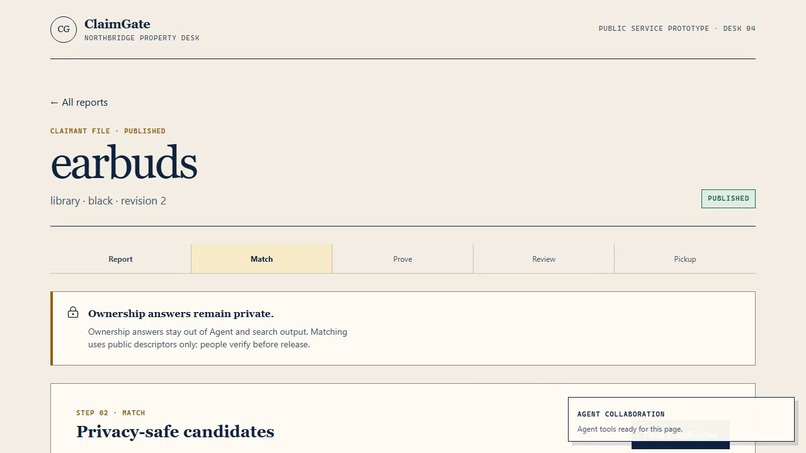
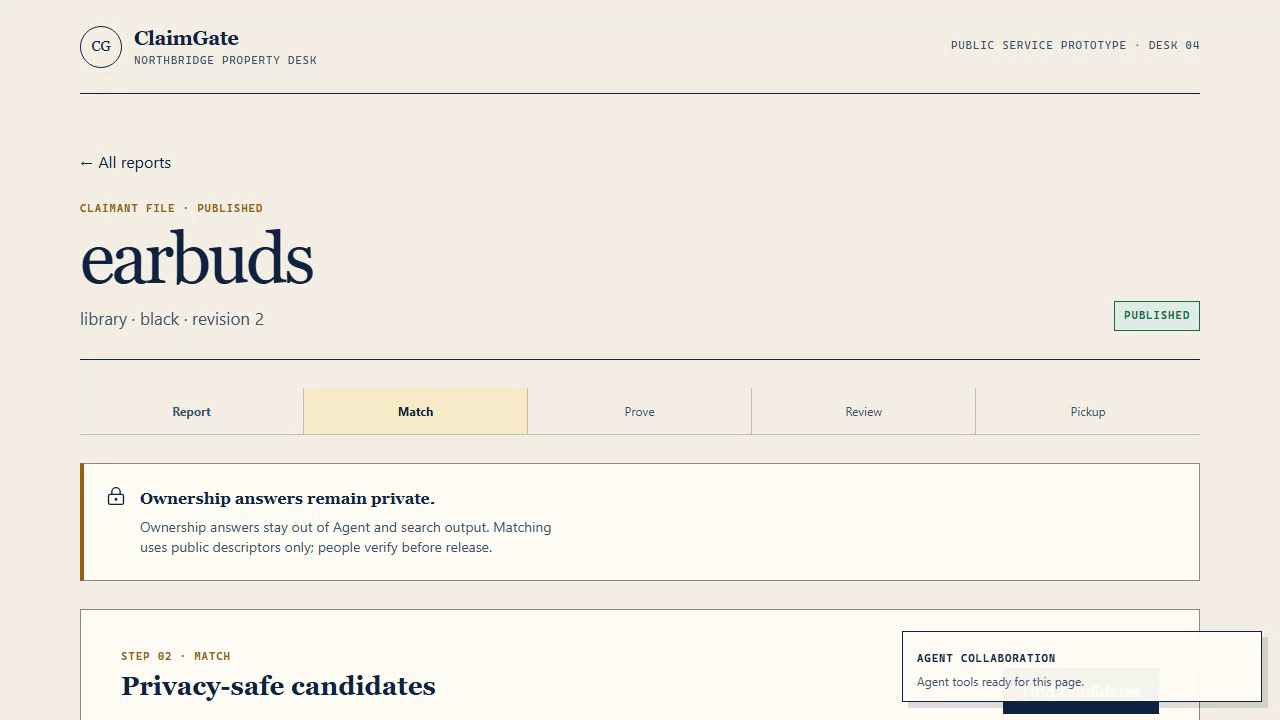
WebMCP exposes privacy-safe candidate matching while private proof stays manual.
-
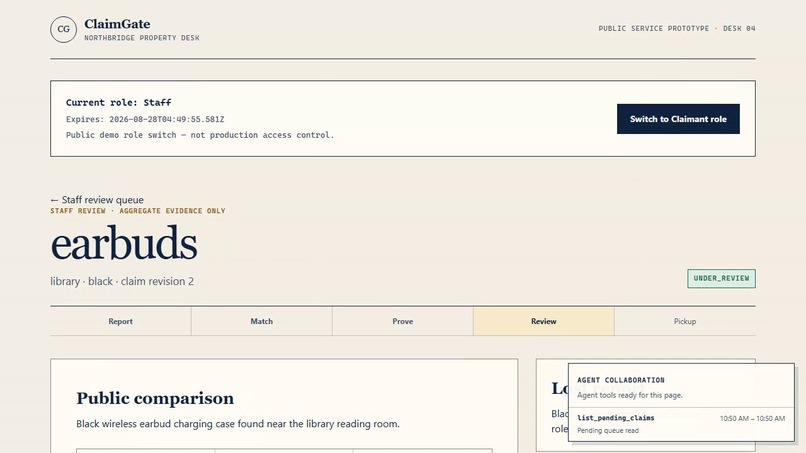
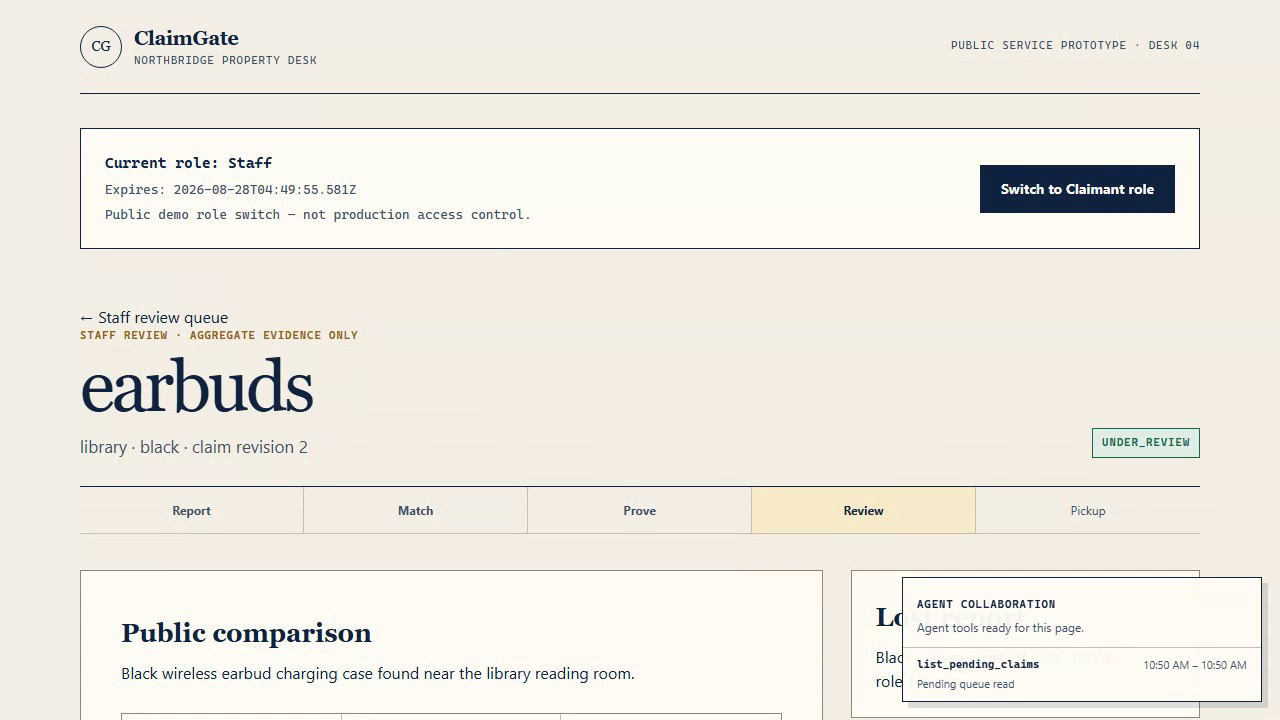
Staff reviews aggregate eligibility and a redacted timeline, never evidence values.
-
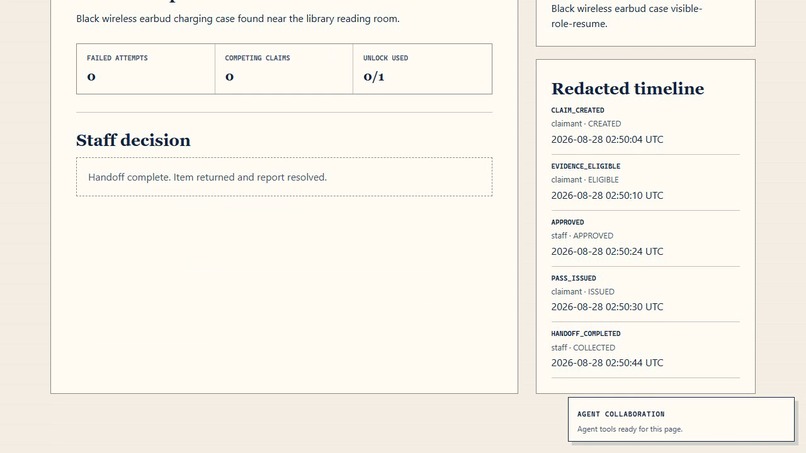
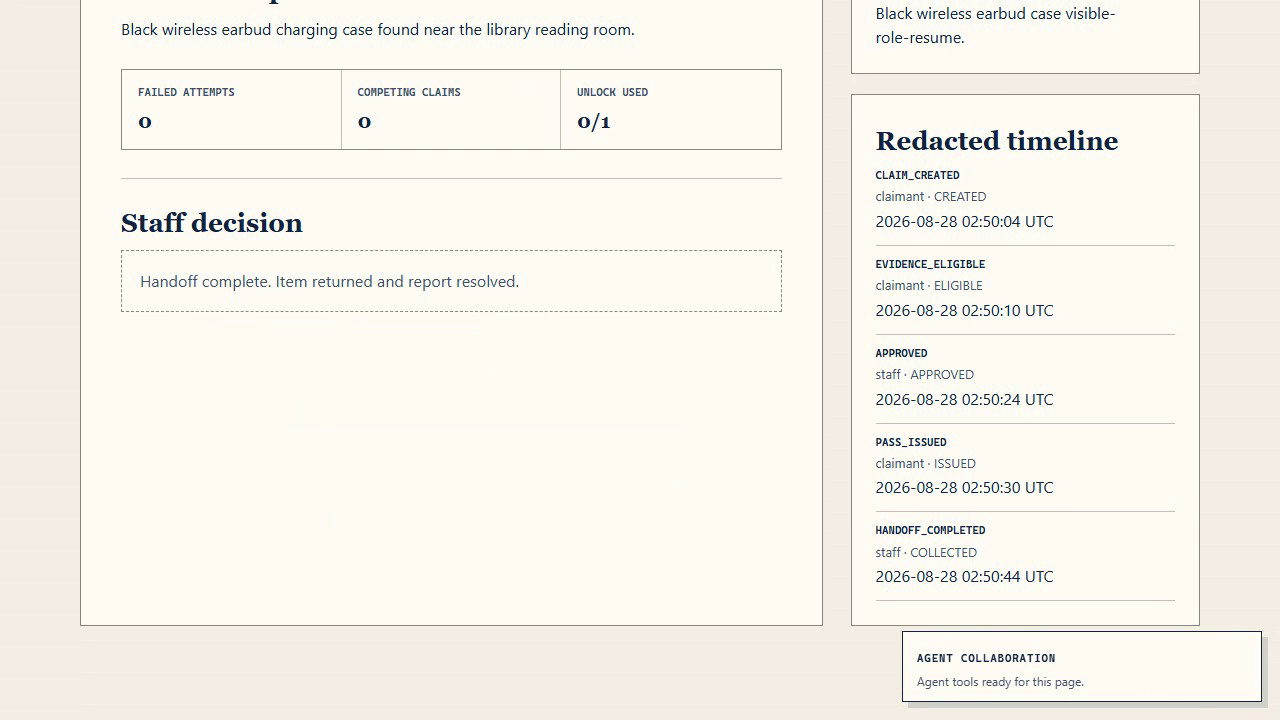
Atomic handoff completes the claim, returns the item, and resolves the report.
-
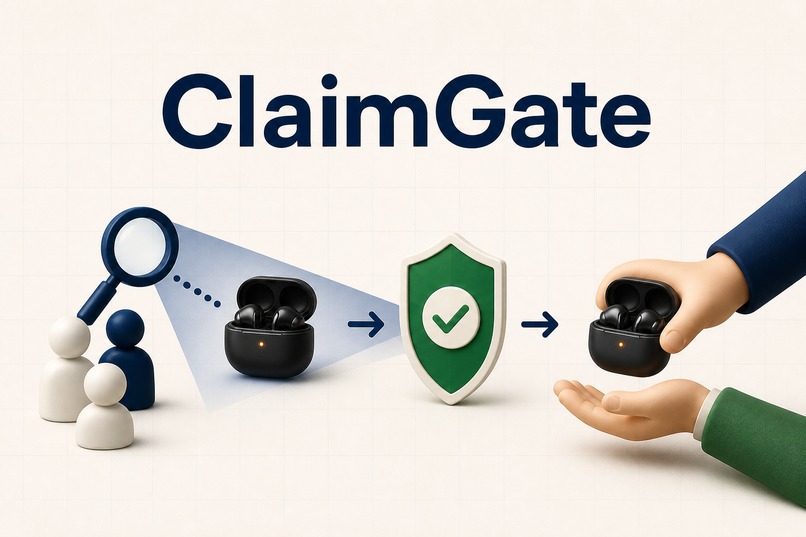
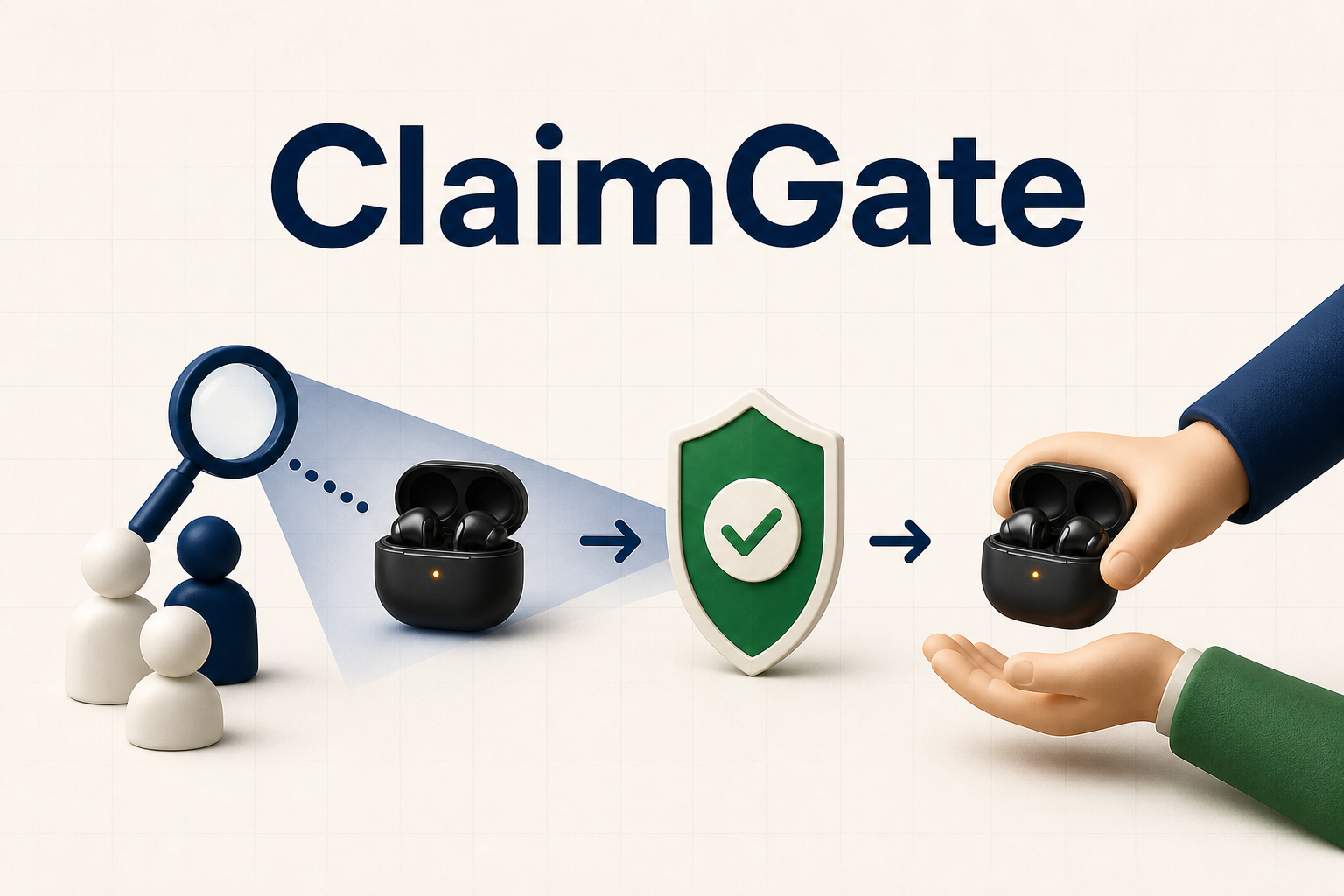
ClaimGate — privacy-first lost-property claims with human release decisions.
Problem
Lost-property desks need enough public detail to find a likely item without publishing the details that prove ownership. Giving every field to an Agent would turn private proof into searchable material.
ClaimGate separates public matching from private proof. The Agent handles structured preparation and safe reads. People publish, submit evidence, decide the claim, issue the pickup credential, and complete the release.
Why WebMCP
This workflow changes as the claim moves from draft to match, review, pickup, and collection. WebMCP lets the page expose the few actions that are valid now, with typed inputs and bounded results. The Agent does not have to infer controls from page layout, and sensitive actions can stay absent from the tool set.
Better experience
A Claimant can describe a loss once, let the Agent structure the public fields, and receive explainable candidates without copying data between screens. Staff gets a short queue and a redacted summary. Each person sees the next action in the same claim instead of reconstructing context after every role change.
Before and after
Before ClaimGate, the demo journey is a sequence of manual forms and page searches, with a risk of mixing public clues and ownership proof. With ClaimGate, the Agent prepares, searches, and summarizes through explicit tools while the UI reserves publication, proof, judgment, credential transfer, and handoff for visible human controls.
What it does
A Claimant starts a fresh two-hour instance with fictional Northbridge Campus inventory. The Agent can create or update a lost-report draft, list reports, find up to three candidates, and stage one candidate. Results contain broad fields, confidence bands, and public reasons, not internal inventory IDs.
The Claimant publishes and submits masked evidence manually. Two correct slots
are sufficient even if a third submitted slot is wrong. The browser receives
only aggregate eligibility, insufficiency, or the third-attempt LOCKED state.
Staff reads a bounded queue and redacted review summary, then decides manually.
After approval, the Agent can read pickup instructions. The Claimant manually generates and copies a ten-minute, one-time credential, then Staff pastes it into the handoff form. One transaction marks the claim collected, item returned, and report resolved. The normal web flow also works without WebMCP.
How implemented
ClaimGate is one Next.js 16 application with separate report, matching, evidence, claim, authorization, audit, and WebMCP modules. SQLite scopes every record to a demo instance. Signed HttpOnly sessions and server routes enforce role, ownership, state, version, CSRF, origin, idempotency, and rate limits.
The browser uses native document.modelContext.registerTool(). A page and state
registry selects nine tools, and an AbortController removes the previous
generation on navigation or state change. Tool visibility assists selection;
the server remains authoritative.
The tools are create_lost_report_draft, update_lost_report_draft,
list_my_reports, find_candidate_matches, stage_claim_candidate,
get_claim_status, get_pickup_instructions, list_pending_claims, and
get_claim_review_summary. Publishing, evidence, decisions, pass issue or
reissue, role switching, and handoff have no WebMCP tool.
Matching uses fixed category, time, area, color, and tag rules. Runtime evidence comparison uses salted HMAC digests and a fixed three-slot shape. The public repository contains the readable fictional seed answers so judges can run the demo; the privacy boundary covers runtime clients, pages, APIs, WebMCP, logs, and stored raw evidence, not repository readers.
Only a successful issue or reissue response returns the full pickup credential. The current Claimant page keeps it in memory and can reveal, mask, or copy it. Navigation or refresh clears it and cannot recover it. The server stores only a digest, and reissue invalidates the previous generation.
Challenges we ran into
- State-aware tool lifecycle: Chrome 151 can briefly change membership while registrations are replaced. A serialized generation manager and server state checks make stale calls fail safely.
- Runtime privacy evidence: We separated public DTOs from private transports, signed opaque candidate handles, bounded outputs, and scanned tool results, HTML, logs, storage, history, and public build assets.
- Visible cross-role continuity: Claimant and Staff must resume the same authorized claim without hidden navigation. Contextual role switching and a 14-scenario visible Playwright suite cover that path.
Accomplishments that we're proud of
- The complete report, match, proof, review, pickup, and handoff flow works in the normal UI and the WebMCP-assisted path.
- Nine tools appear only in valid page and state scopes; human-only actions stay absent.
- A clean production build completed three independent native Chrome 151 runs.
Each used fresh SQLite state, exercised all nine tools, completed the manual
transitions, and ended with Home tools
[]. - All 14 visible Playwright E2E scenarios passed after commit
04c618dadded contextual cross-role claim navigation. - The release path isolates its runtime, data, processes, ingress, and Nginx resources from unrelated services.
These are implementation and test results, not claims of awards, adoption, users, or judging outcome.
What we learned
Tool discovery improves planning but is not authorization. Runtime privacy needs separate data paths, not hidden UI fields. Human control is clearest when a sensitive transition has no tool at all. Stateful WebMCP also needs navigation, stale-version, delayed-completion, and teardown tests, not only a happy path.
What's next
A production pilot would need institutional identity, enrolled Staff, accessibility and abuse review, retention policy, backup and recovery, and a database architecture for multiple application instances. Configurable matching and evidence policies should preserve the same public-match, private-proof, and human-release boundaries.

Log in or sign up for Devpost to join the conversation.