-
-
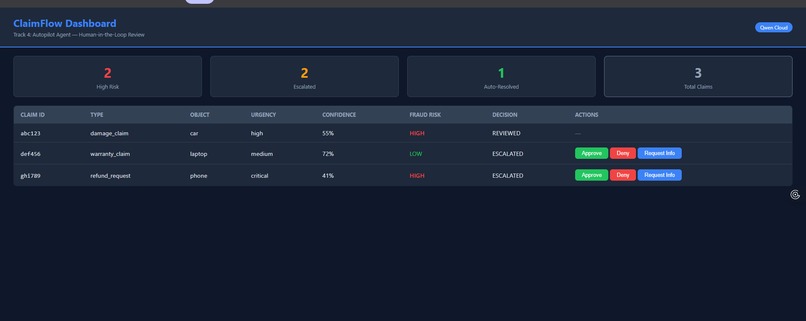
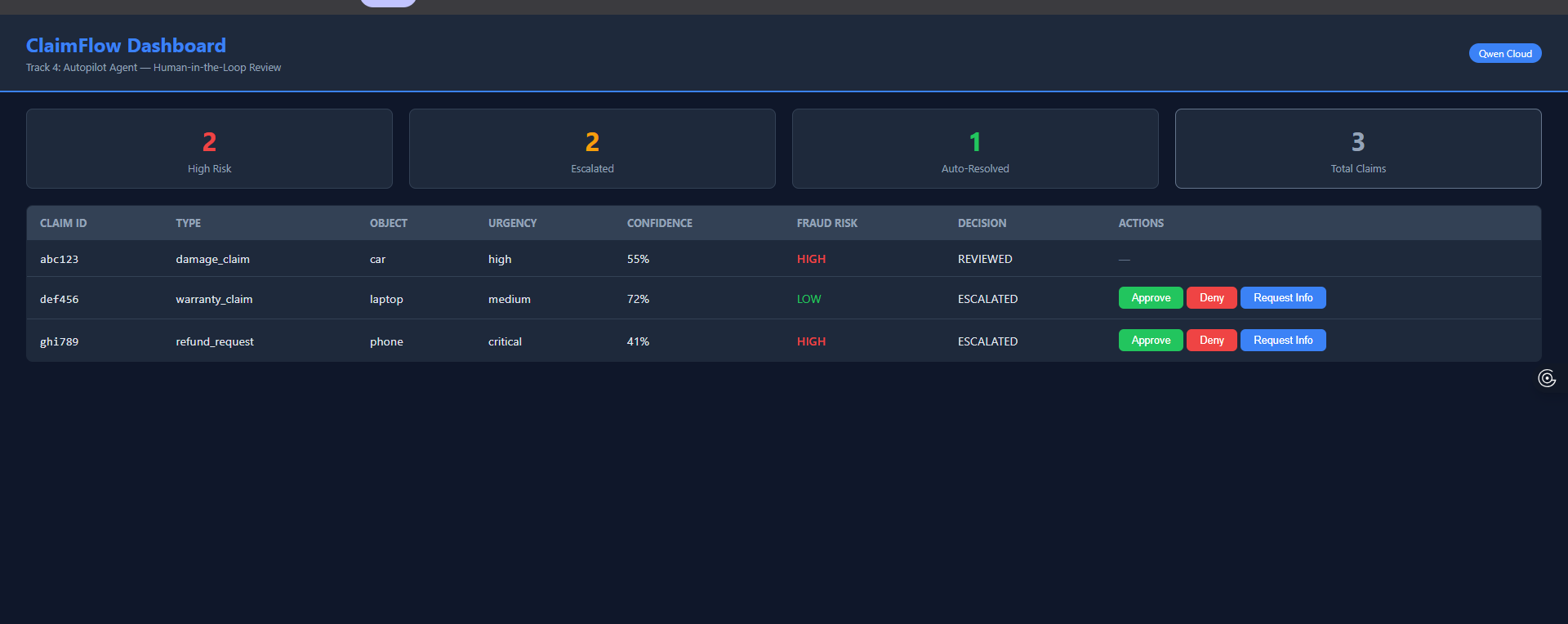
dashboard at localhost:8080
What It Does
ClaimFlow automates the entire claims processing workflow. A customer submits a claim via WhatsApp, web form, or API with text and photos as evidence. The agent processes it through six stages:
- Intake — Normalizes messages from any channel, detects language
- Classify — Qwen 3.7 Max identifies claim type, object, urgency, sentiment
- Verify — Qwen Vision Max inspects image evidence against the claim
- Fraud Detection — Four Rs framework (Recognize → Reject → Reveal → Route)
- Decide — Auto-approve, request info, or escalate to human
- Respond — Auto-reply in user's language or create human case
How I Built It
Built with Python 3.10+, Flask, and the Anthropic-compatible Qwen Cloud API. Two Qwen models power the pipeline: qwen3.7-max for text classification and qwen-vl-max for image evidence verification. The human-in-the-loop dashboard runs on Flask with server-side templates.
Challenges
Getting the 6-stage pipeline to handle edge cases gracefully. Building the Four Rs fraud framework to combine vision-based evidence checking with user history patterns. Making the agent fail-safe — when uncertain, it escalates rather than making a wrong decision.
What I Learned
AI agents work best when they know their limits. The autopilot handles 80% of claims, but the human dashboard for the remaining 20% is what makes it production-ready. Multi-language support is a small detail that makes a big difference for real-world deployment.


Log in or sign up for Devpost to join the conversation.