Inspiration
Independent therapists do not go into practice because they love insurance administration. But when a claim is denied, they are often left decoding payer codes, checking credentialing assumptions, reading EOBs, and guessing whether the next step is an appeal, corrected claim, payer call, or client bill.
The inspiration for ClaimCompass came from that moment of confusion: a provider has already done the clinical work, but revenue gets stuck because the denial workflow is hard to interpret. I wanted to build an agent that does more than explain a code. It should read the document, retrieve payer-specific guidance, decide the correct next action, show its reasoning, and help prevent the same denial from happening again.
What it does
ClaimCompass is a denial-resolution agent for independent therapists and small behavioral-health practices.
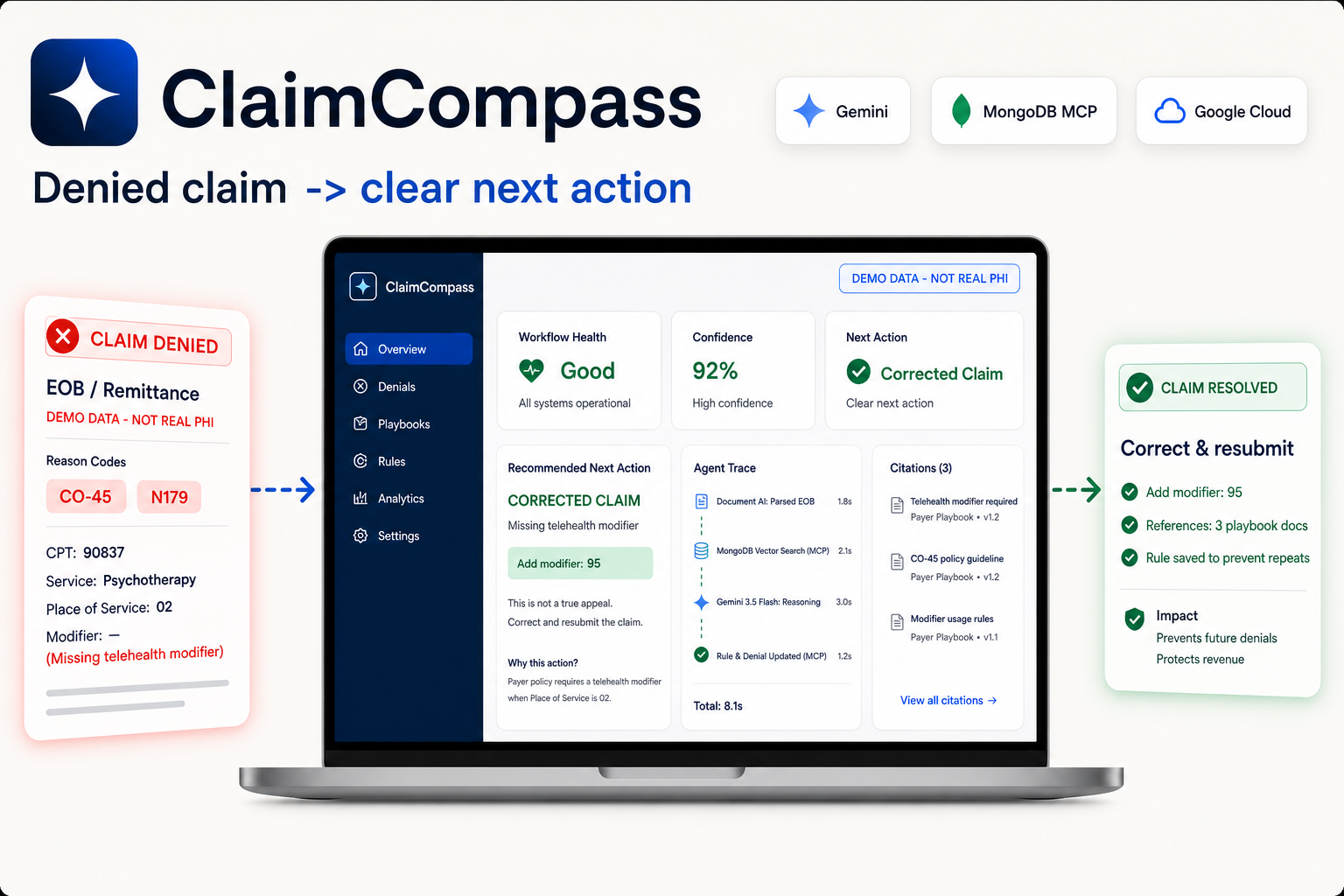
For the hackathon demo, it processes a fully synthetic EOB for a therapy claim:
CPT 90837, denial codes CO-45 and N179, and a missing telehealth modifier.
The app lets a user inspect the sample PDF, run the agent workflow, and review a
traceable result.
ClaimCompass:
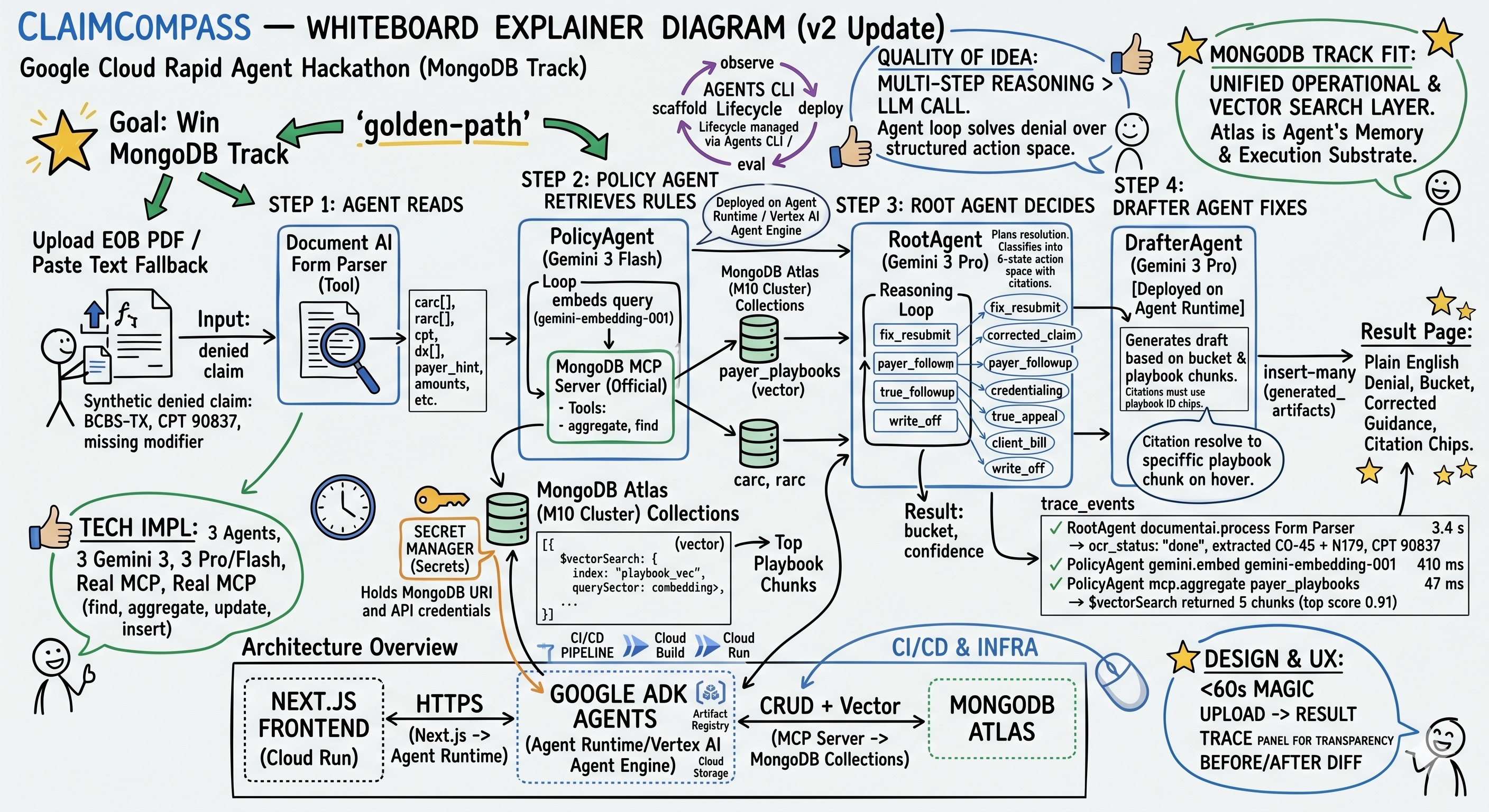
- extracts claim context from a synthetic PDF workflow;
- creates a live Gemini embedding query;
- retrieves relevant payer playbook guidance from MongoDB Atlas Vector Search through the official MongoDB MCP Server;
- classifies the denial into the right action bucket;
- shows corrected-claim guidance with citations;
- writes the updated denial state and reusable billing rule back to MongoDB;
- displays an agent trace and MongoDB before/after proof for judges.
The key outcome is simple: it turns a denied claim into a clear next action: correct and resubmit, with human review.
How I built it
I built ClaimCompass as a code-first Google Cloud agent demo with a Next.js frontend, Google Cloud AI services, and MongoDB Atlas as the operational and retrieval layer.
The AI path uses Gemini for reasoning/generation and Gemini embeddings for semantic retrieval. The document workflow uses Google Document AI for the synthetic EOB path. The app is built with Google Cloud Agent Builder / ADK terminology and is hosted for the demo on Cloud Run.
MongoDB Atlas is central to the agent loop. I store denials, payer playbooks,
generated artifacts, trace events, demo runs, and billing rules in Atlas. The
agent retrieves playbook chunks with Atlas Vector Search using $vectorSearch
through the official MongoDB MCP Server, then writes updates back through MCP so
the demo proves both retrieval and persistence.
The website and demo flow were shaped with MagicPath for rapid product/design direction. Codex helped implement the project system-by-system: Next.js UI, agent scaffolding, MongoDB MCP integration, Gemini model wiring, evals, docs, Cloud Run deployment, and final verification. I stayed human in the loop for product judgment, healthcare safety, cost controls, architecture decisions, and final scope.
Challenges I ran into
The biggest challenge was keeping the demo ambitious while staying honest, safe, and shippable.
Healthcare data is sensitive, so I made the entire demo synthetic and visibly
marked DEMO DATA - NOT REAL PHI. I also avoided real payer logos, real EOBs,
and unsupported policy claims.
Another challenge was aligning the hackathon requirements with the right stack. The brief asked for Gemini and Google Cloud Agent Builder, while the build also needed custom MCP calls, MongoDB Vector Search, trace persistence, and a product-specific workflow. I chose a code-first ADK-style approach, hosted the demo on Cloud Run, and documented the Agent Builder / Agent Runtime distinction clearly.
I also had to make the hosted demo reliable for judges. The final flow keeps the scenario narrow, but makes the proof strong: live Gemini embedding, live MongoDB MCP vector retrieval, MCP write-back, visible citations, and a before/after database diff.
Accomplishments that I'm proud of
I am proud that ClaimCompass is not just a chatbot wrapper. It demonstrates a real agentic workflow: document intake, retrieval, classification, guidance, traceability, and write-back.
The MongoDB integration is also a strong proof point. Atlas is not used as a
passive database; it acts as the agent's working memory, vector retrieval layer,
trace store, and rule store. The demo shows MongoDB MCP calls, $vectorSearch,
and write-back in the product UI.
I am also proud of the safety posture. The project is healthcare-adjacent, so I treated privacy, synthetic data, disclaimers, and human review as product requirements rather than afterthoughts.
Finally, I am proud of the build process itself. I used a tracked system plan, daily checkpoints, evals, Cloud Run deployment, and human-in-the-loop Codex development to move from blueprint to hosted demo under hackathon time pressure.
What I learned
I learned that the strongest agent demos are not about making an AI answer sound smart. They are about proving the workflow: what tools were called, what data was retrieved, what changed in the system, and where the human should review the result.
I also learned how important it is to keep the first version narrow. A full revenue-cycle copilot could cover credentialing, eligibility, claim submission, appeals, and cash-flow risk. For the hackathon, the right move was to choose one high-value denial path and make it traceable end to end.
On the technical side, I learned how Gemini, Document AI, Google Cloud deployment, MongoDB Atlas Vector Search, and the MongoDB MCP Server can fit together as one agent loop rather than separate demos.
What's next for ClaimCompass: Denial Resolution Agent for Therapists
Next, ClaimCompass should expand from one golden-path denial into a broader denial-resolution workspace for therapists.
The near-term roadmap is:
- support more denial families, including prior authorization, credentialing, eligibility, place-of-service, and coordination-of-benefits issues;
- add more payer and CPT-specific playbooks with stronger citation management;
- support real user-uploaded documents only after production-grade privacy, security, consent, and retention controls are in place;
- add role-based review workflows for billers and practice owners;
- learn from saved billing rules to prevent repeat denials before submission;
- turn the command center into a therapist revenue copilot that covers before, during, and after the denial.
The long-term vision is to help small practices protect revenue without forcing clinicians to become insurance operations experts.
Design and Build Process
- Website/design direction: MagicPath was used to accelerate exploration of the landing page and demo presentation, keeping the product focused on a clear denial-to-action story for therapists.
- Development partner: Codex was used as the coding agent across the repo to implement the Next.js UI, ADK scaffold, MongoDB MCP integration, Gemini embedding/generation paths, evals, docs, and Cloud Run deployment workflow.
- Human in the loop: I reviewed architecture choices, approved cost-sensitive cloud actions, kept the healthcare safety constraints tight, verified outputs, and decided what belonged in the final hackathon scope.

Log in or sign up for Devpost to join the conversation.