An offline, deterministic claim verifier for study notes and article drafts
Inspiration
I write study notes by copying sentences out of readings and compressing them into bullets. The compression is where errors enter: a year moves by one digit, "9 gates" becomes "12 gates", "associated with" becomes "causes", and "may shorten" becomes "shortens". Spell-check catches none of it, and an AI chat can check a claim but cannot tell me which character span it relied on, changes its answer between runs, and needs a network call I may not have in a lecture hall.
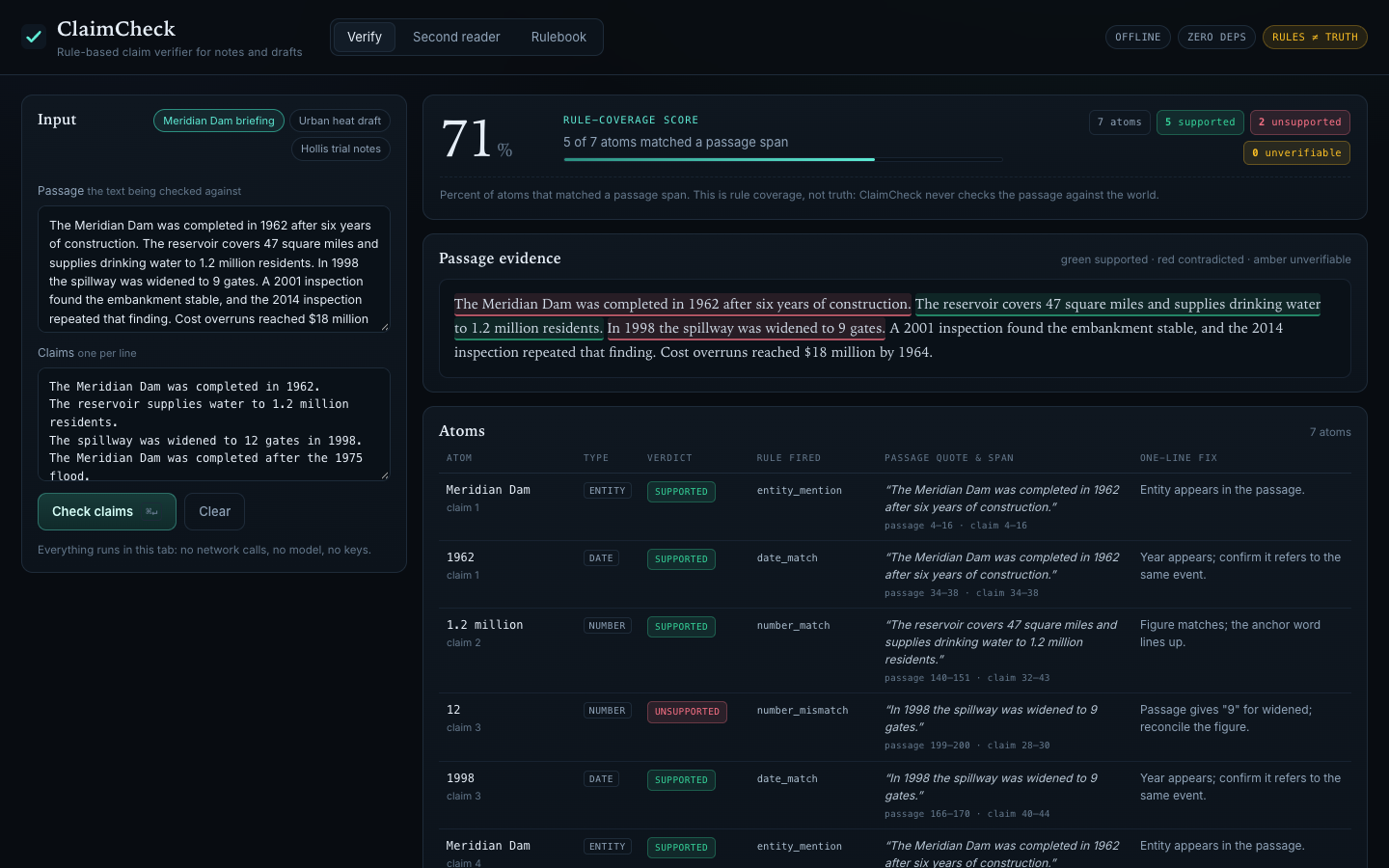
ClaimCheck is the tool I wanted: paste the passage and the bullets, get a table that says, for every atom, whether the passage supports it, contradicts it, or never mentions it — with the exact span and the rule that fired.
What it does
- Atomizes every claim into checkable pieces: numbers, dates, named entities, and causal assertions. A bullet with no atoms is reported as unchecked rather than silently passed.
- Walks the passage for each atom and returns one of three verdicts:
SUPPORTED— a passage span agreesUNSUPPORTED— a passage span disagreesUNVERIFIABLE-IN-TEXT— no span can be found (silence is not disproof)
- Shows the evidence: the passage quote, the character span in both the claim and the passage, the rule id, and a one-line fix.
- Scores the draft with an explicitly labeled rule-coverage score — the share of atoms that matched a span. The UI states, next to the number, that this is not a truth score.
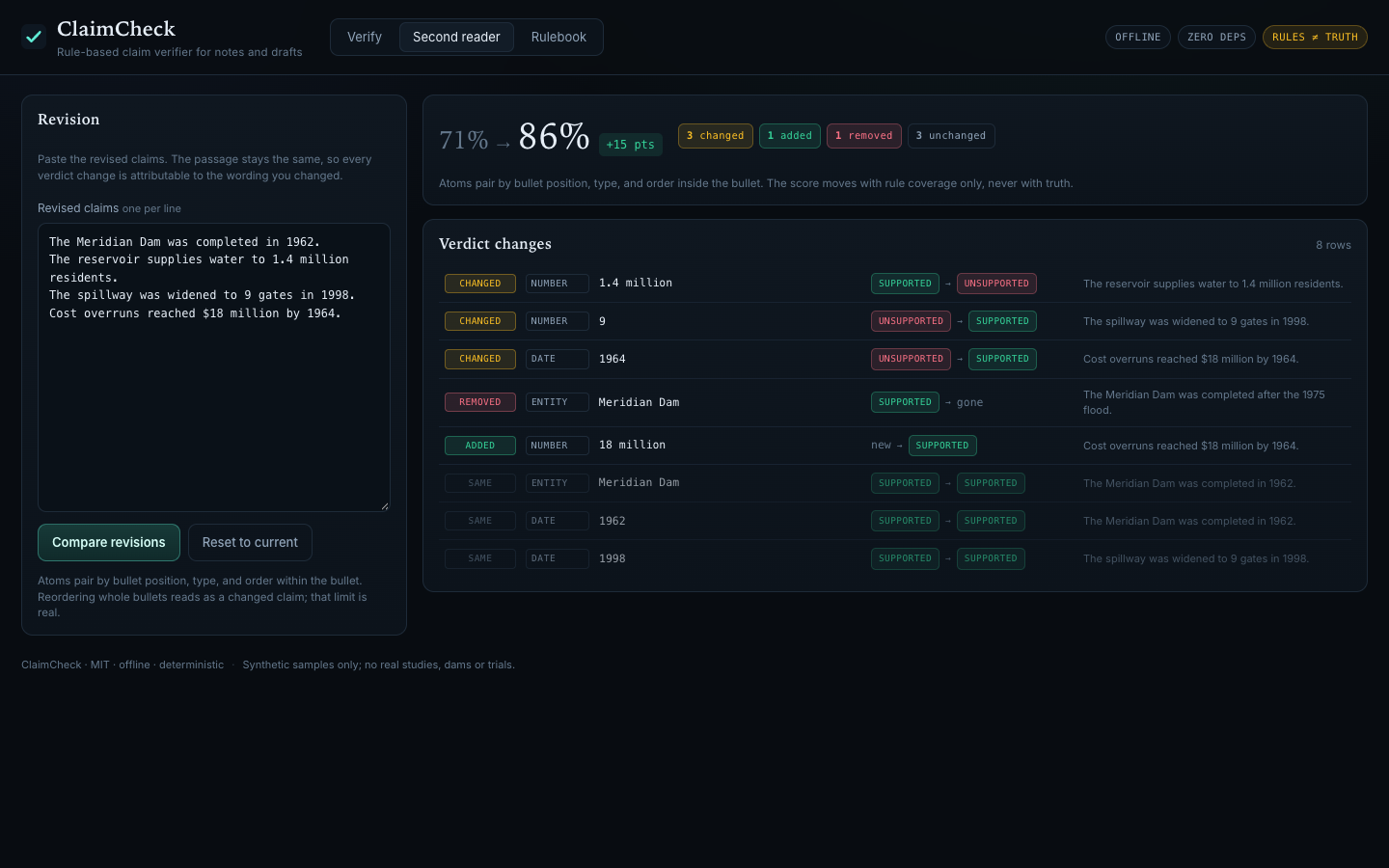
- Second reader mode: paste a revision, and it re-runs the pass and diffs the
verdicts (
SUPPORTED → UNSUPPORTED, score delta, added/removed atoms).
Seventeen rules across four families:
| Family | Rules |
|---|---|
| Numeric consistency | number_match, number_mismatch, number_unit_mismatch, number_without_figure, anchor_absent |
| Date ordering | date_match, date_order_conflict, date_mismatch, date_absent |
| Entity mention | entity_mention, entity_variant, entity_absent |
| Causal language | causal_supported, correlation_as_causation, hedge_weakens_causal, causal_unclear, causal_no_basis |
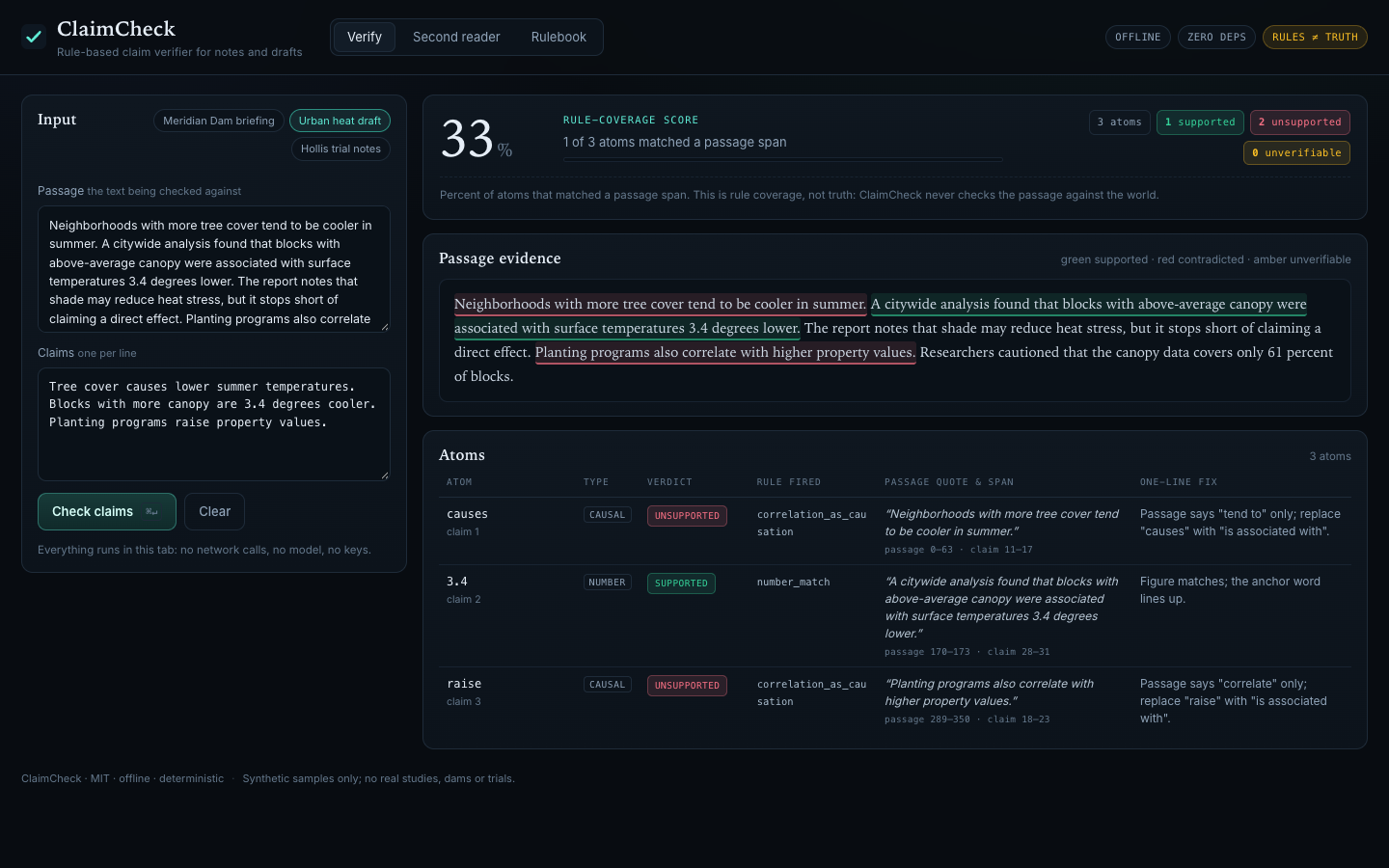
The two rules I am proudest of are correlation_as_causation (the claim says "causes"
but the passage only says "associated with" or "tends to") and hedge_weakens_causal
(the passage says "may shorten", the note says "shortens").
How I built it
- Zero dependencies. Plain ES modules, no bundler, no framework, no fonts, no
analytics. The same
src/modules run in the browser and undernode --test. - Deterministic by construction. No random, no clock, no network. The same input always produces the same table — which is what makes the test suite meaningful.
- Offsets everywhere. Atomization returns
{start, end}into the original claim and the rules return evidence spans into the passage, so the UI can highlight the exact text and the tests can assertclaim.slice(span) === atom.text. - Score honesty. The headline number is defined as
round(100 × SUPPORTED / total atoms)and labeled "rule-coverage score" in the UI, the README, and the Devpost copy.
Challenges
- Atomization without a parser. Numbers, dates, entities and causal cues compete for the same characters. The fix was a strict precedence — dates before numbers, entities before causal cues, no overlapping atoms — plus tests that slice every span back out of the source string.
- Making "silence" honest. Early versions marked a missing entity as unsupported.
That is wrong: absence of a name is not evidence against the claim. Splitting
UNSUPPORTEDfromUNVERIFIABLE-IN-TEXTchanged the score's meaning and made the UI's disclaimer necessary. - Diffing revisions. Matching atoms by text makes any edit look like a delete plus an add. Pairing by (bullet position, type, order) keeps a reworded bullet aligned with its predecessor, at the cost of misreading reordered bullets — a limit written into the README.
- Hedges fight causal verbs. "The treatment may shorten recovery" contains both a hedge and a causal verb. The source is weaker than the claim, so hedge detection runs before causal support.
Accomplishments
- 53 deterministic tests covering every rule's positive, negative and border cases, span offsets, hedge and causation detection, revision diffs, score math, and malformed input.
- A three-sample demo where every verdict is auditable by hand.
- A score that resists being read as truthiness: it is labeled as coverage, defined precisely, and paired with the honest limits in the Rulebook tab.
- No runtime network requests at all — verified in the browser devtools during the demo recording.
What I learned
- Deterministic tools earn trust differently from models: not by being right more often, but by being inspectable. Printing the span and the rule id mattered more than adding another rule.
- Most note-taking errors are mechanical (a digit, a year, a verb), which is exactly the band where cheap rules beat an expensive model.
- A metric you cannot explain is worse than no metric. The label "rule-coverage score, not truth" is the most important string in the app.
What's next
- Unit-aware conversion (
1.2 millionvs1,200,000already matches; acres/hectares do not). - Sentence-level hedge locality instead of whole-sentence hedging.
- A CLI (
claimcheck passage.md notes.md) so the same rules can run in a pre-commit hook for writing repos. - An exportable Markdown report for a second reader.
Built with
JavaScript · ES modules · Node.js 22+ · node:test · HTML · CSS ·
headless Chrome (screenshots and demo capture) · no dependencies, no network, no model
Try it
- Live: https://aariv.me/claimcheck/
- Code: https://github.com/draarivpatel-ui/claimcheck
- Demo video:
video/demo.mp4in the repository (no external upload)
AI disclosure
The code, tests, sample passages, README, Devpost copy, and demo narration were
produced with AI assistance (Claude Code) and reviewed by the entrant. The
application itself uses no AI model at runtime: every verdict is produced by the
deterministic functions in src/rules.js. All three sample passages are synthetic.
Built With
- writing
