Inspiration
Financial payout systems need more than a successful API response. A payout can be delayed, remain unclaimed, encounter provider-side discrepancies, or become difficult to investigate. When money is involved, teams need reliable evidence, clear accountability, and safeguards against unauthorized actions.
We built ClaimBridge to address this problem: a financial operations platform that combines AI-assisted investigations with deterministic financial policies and human-controlled payout authorization.
Our central principle is simple:
AI proposes. Deterministic policy decides. Humans authorize. Payment providers execute.
What it does
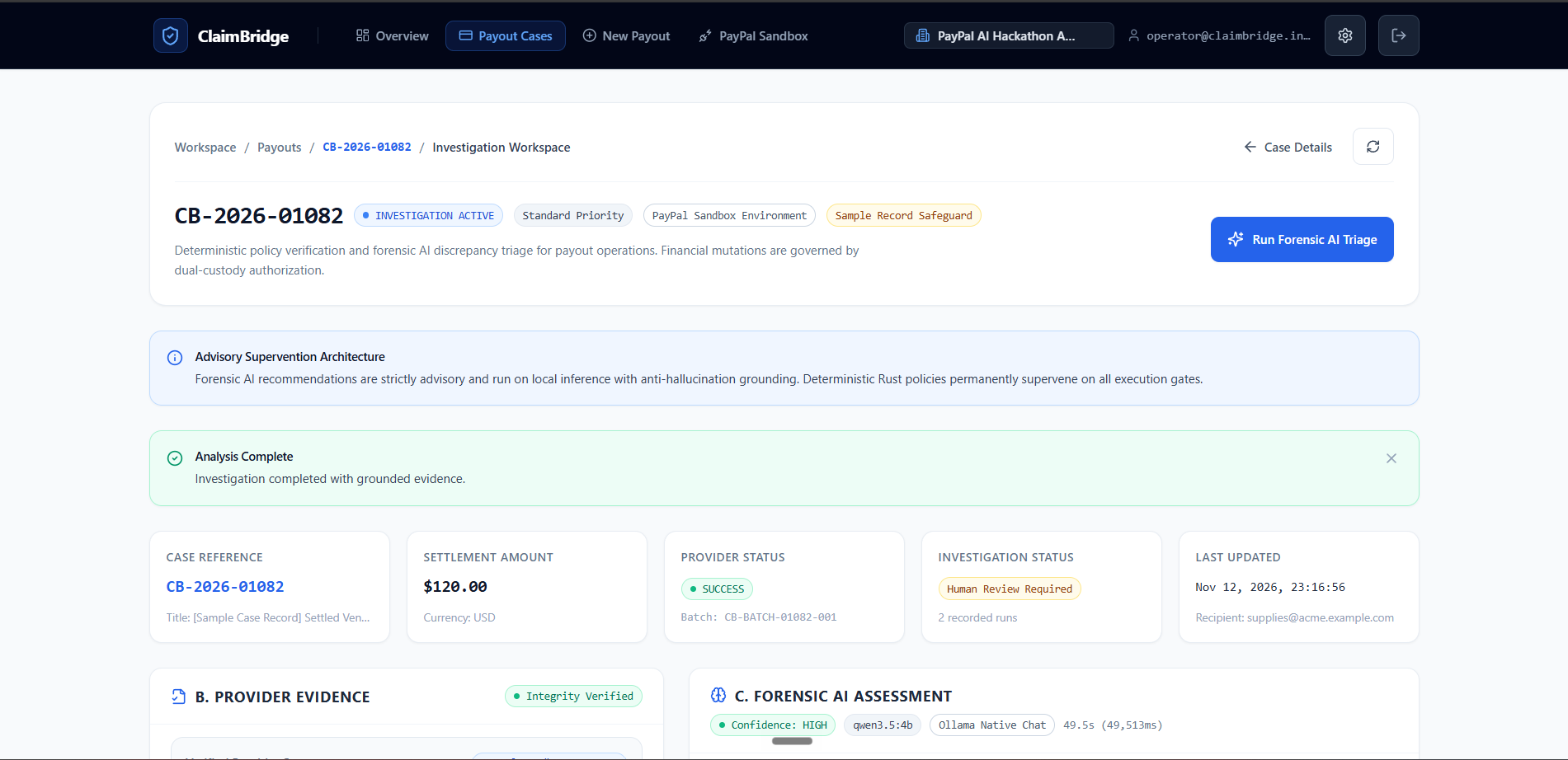
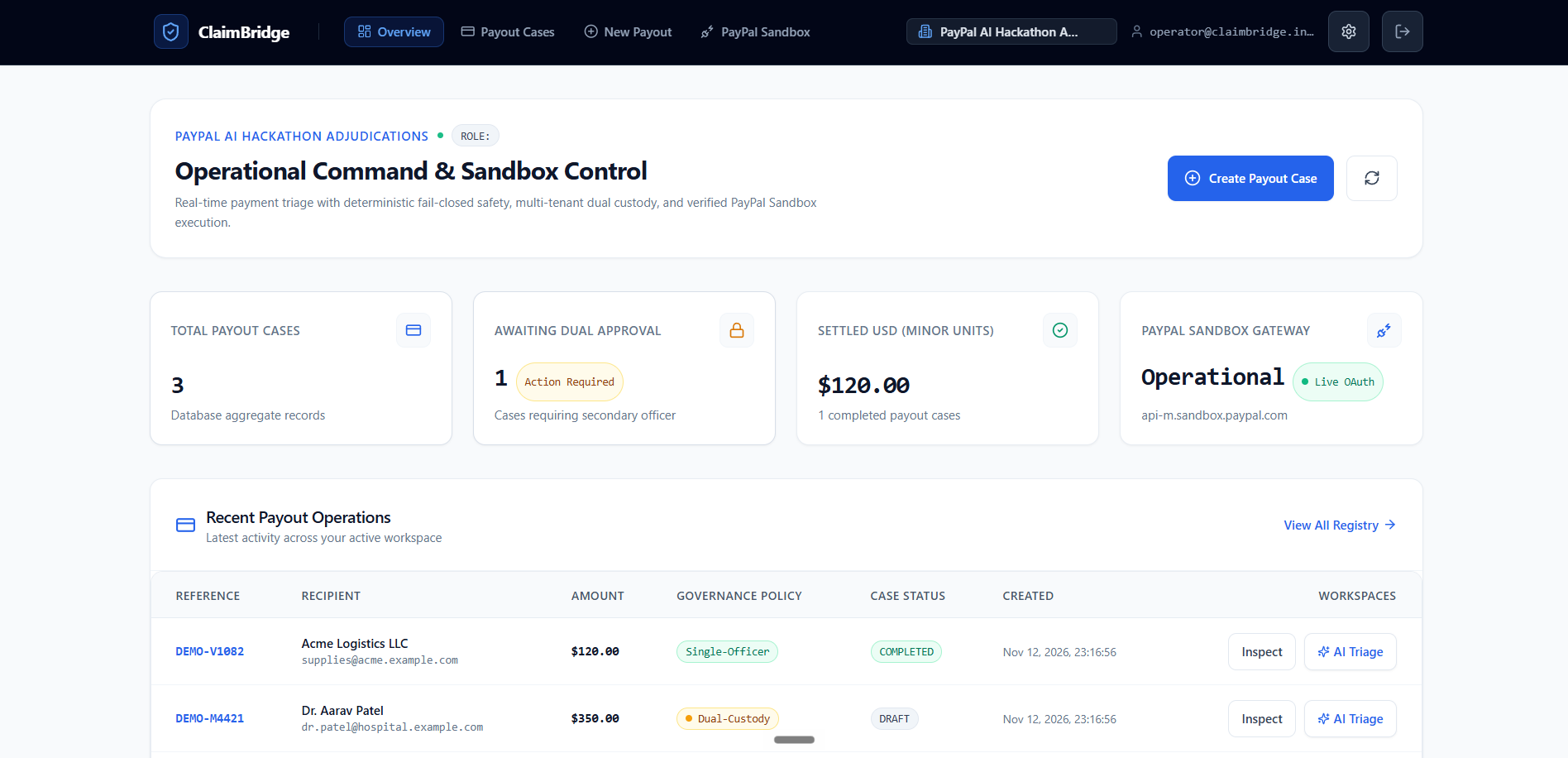
ClaimBridge provides a unified workspace for managing payout cases, investigating transaction discrepancies, reviewing provider evidence, and controlling settlement workflows.
Its key capabilities include:
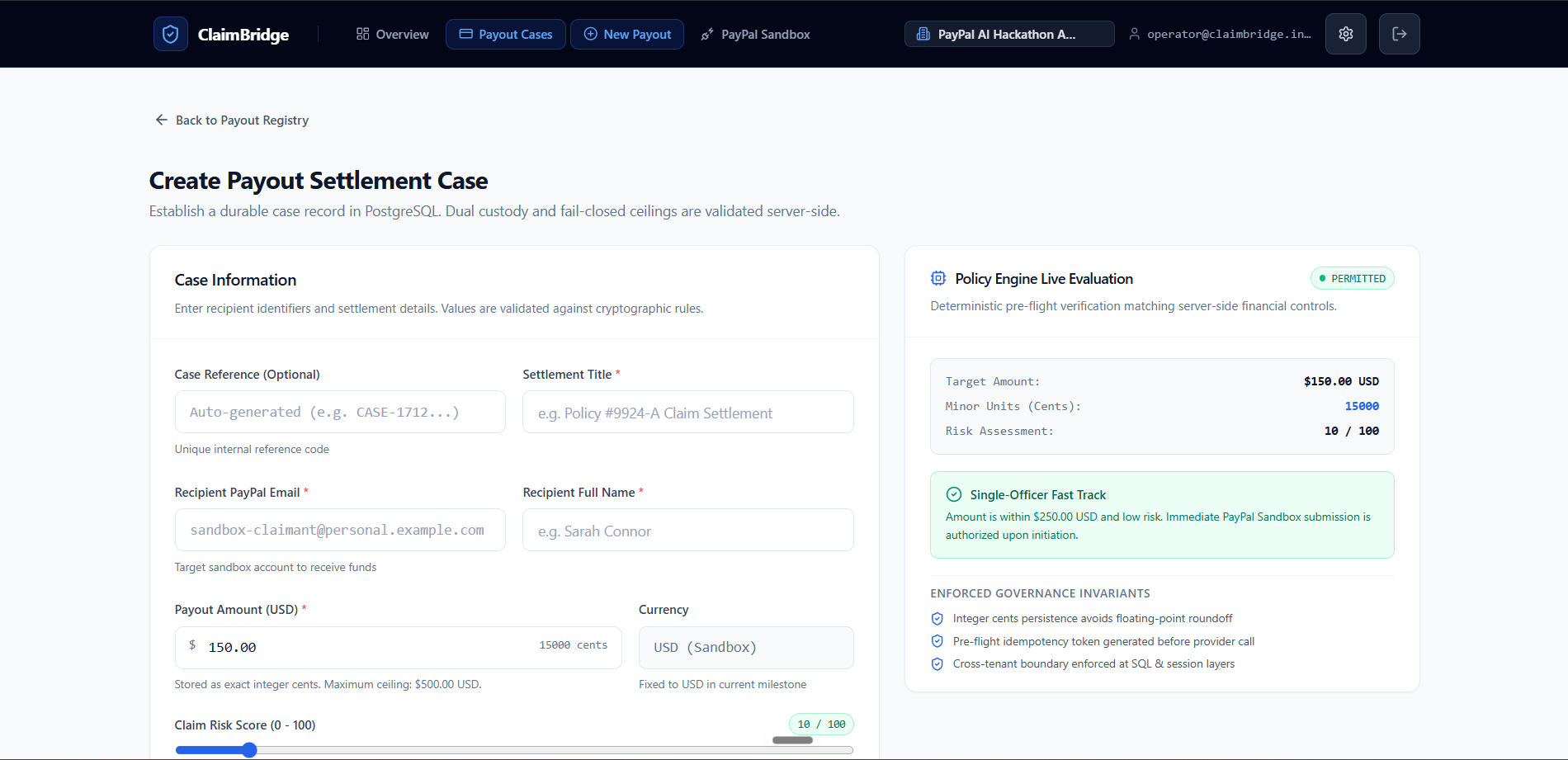
- Payout management: Create and manage durable payout cases with recipient details, settlement amounts, and transaction references.
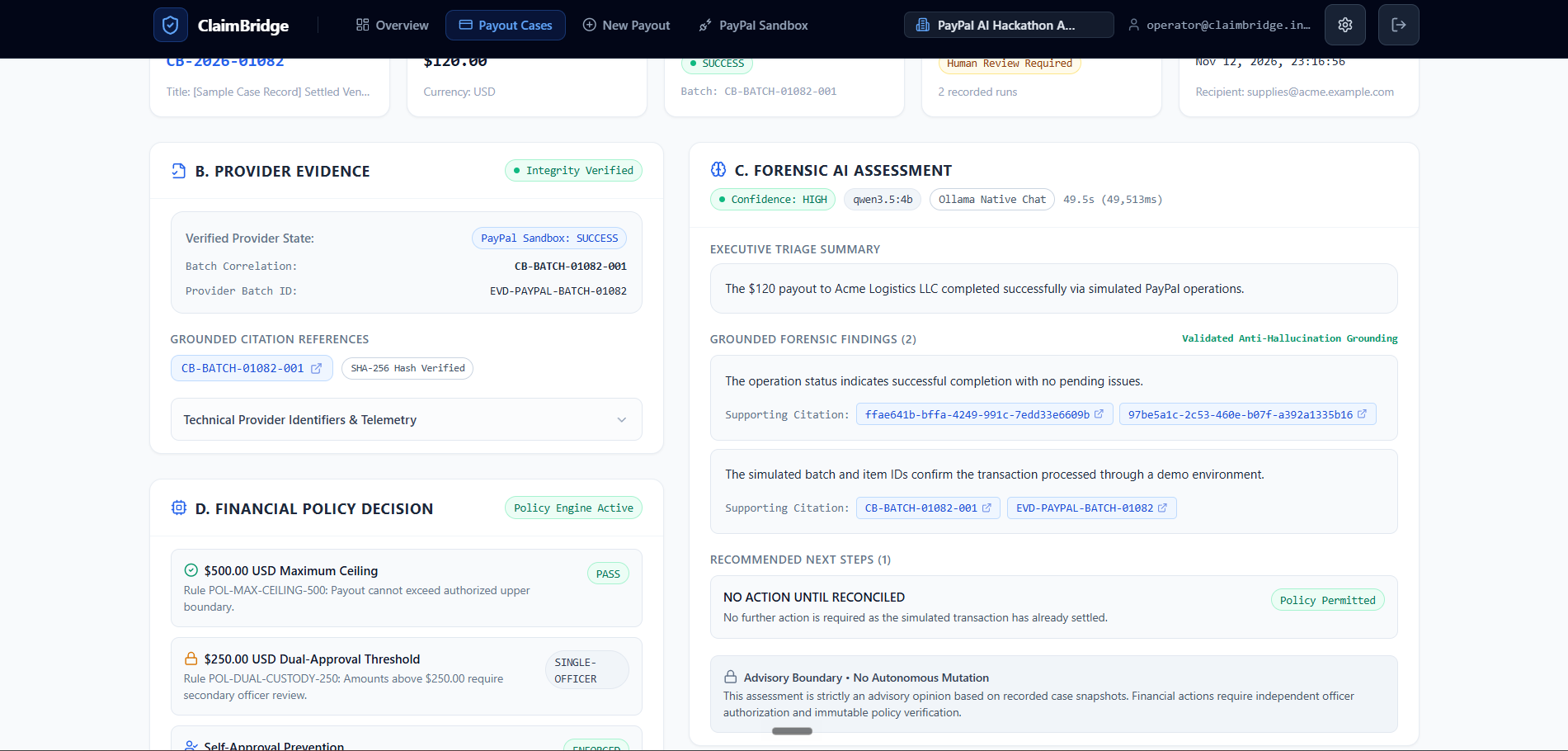
- AI-powered investigations: Use locally hosted Qwen 3.5 4B through Ollama to analyze recorded payout evidence and generate structured forensic findings.
- Evidence-grounded recommendations: AI findings must reference valid evidence identifiers. Unsupported recommendations are rejected rather than treated as facts.
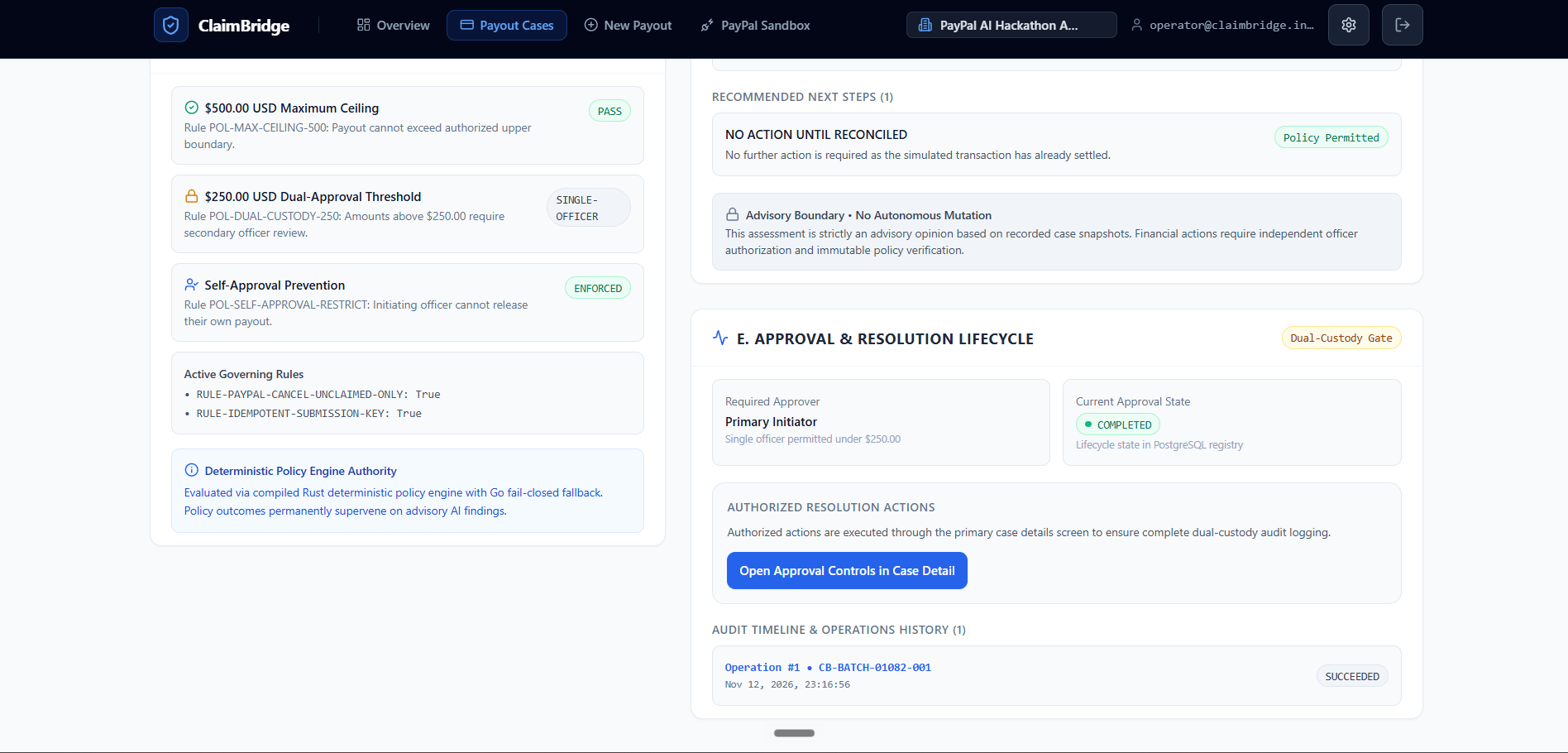
- Deterministic financial policies: Enforce payout ceilings, dual-approval thresholds, self-approval prevention, and other financial governance rules.
- Human-controlled authorization: AI cannot independently approve or execute financial mutations.
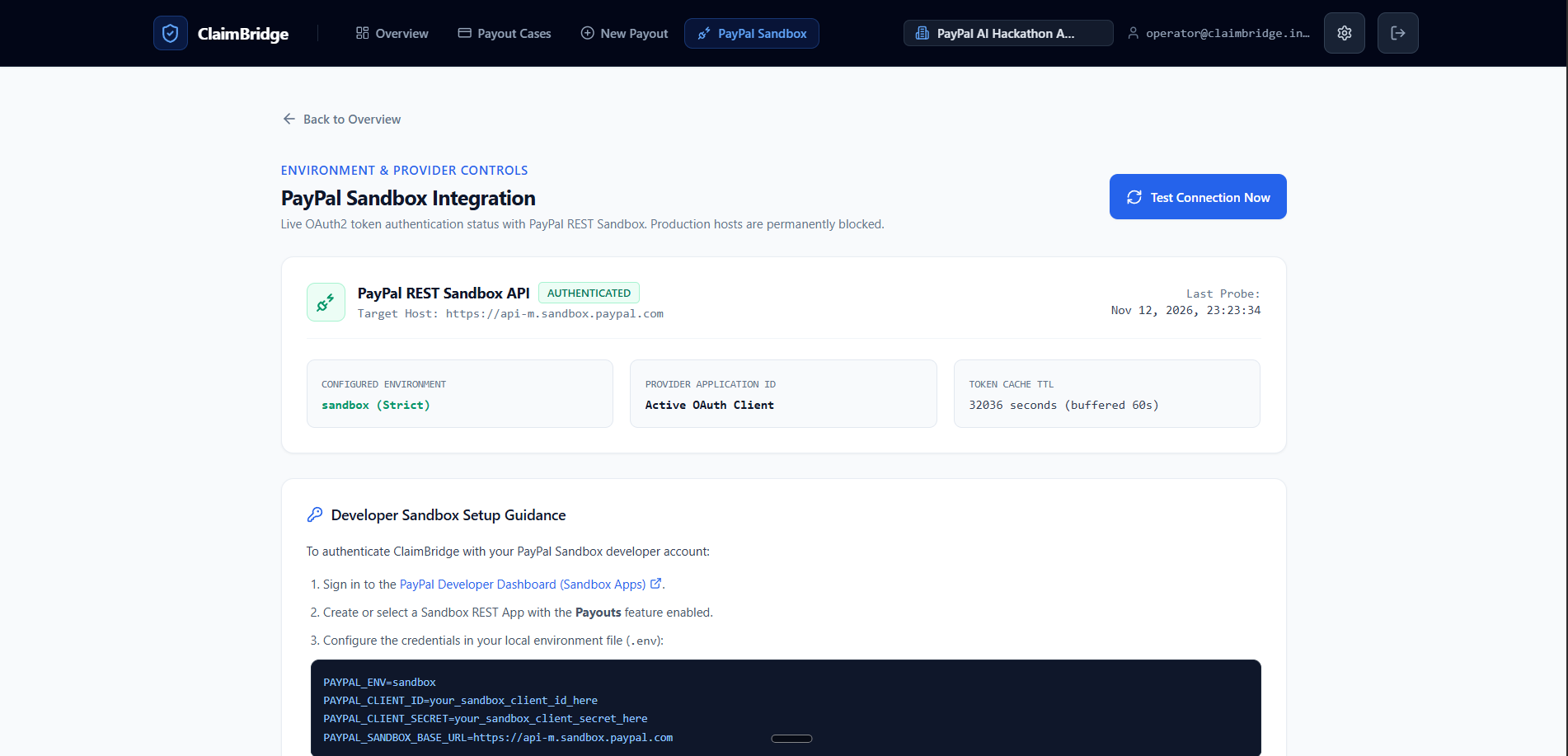
- PayPal Sandbox integration: Authenticate against the PayPal REST Sandbox API and support sandbox payout workflows.
- Auditability: Persist payout operations, investigation reports, and approval lifecycle records in PostgreSQL.
How we built it
We designed ClaimBridge as a multi-layered system rather than allowing an AI model to directly control payment operations.
The frontend is built with Next.js, React, TypeScript, and Tailwind CSS. It provides operational dashboards, payout case management, forensic investigation reports, and approval workflows.
The backend is implemented in Go and handles API orchestration, authentication, tenant isolation, database operations, and provider integration.
A separate Rust-based deterministic policy engine evaluates financial rules. The Go implementation provides a fail-closed fallback where the compiled Rust engine is unavailable.
For AI inference, we integrated Ollama with Qwen 3.5 4B. The model analyzes structured transaction snapshots and produces evidence-grounded investigation results. AI output remains advisory and cannot override deterministic policy decisions.
PostgreSQL provides durable storage for payout cases, operations, investigations, and approval records. Docker Compose brings the application services together for local execution.
Challenges we faced
One of our biggest challenges was making local AI inference reliable on CPU-based hardware. Inference latency, model availability, request timeouts, and inconsistent provider responses required careful handling.
We improved model configuration, reduced unnecessary output generation, hardened evidence-grounding instructions, introduced explicit timeout classification, and extended request timeouts across the API and frontend proxy.
Another major challenge was designing financial safety boundaries. We needed to ensure that an AI-generated recommendation could never become an unauthorized financial action. This required deterministic policy checks, dual-custody controls, idempotency, tenant isolation, and durable audit records.
Integrating PayPal Sandbox also required handling provider authentication, environment restrictions, and sandbox-specific payout limitations.
What we learned
Building ClaimBridge taught us that adding AI to financial software is not simply about generating intelligent responses. It is about designing systems where intelligence operates within strict, verifiable boundaries.
We learned to separate probabilistic AI reasoning from deterministic execution, build evidence-first workflows, handle unreliable external services, and test security invariants across the entire application.
ClaimBridge is our attempt to make financial operations more explainable, auditable, and safe — without giving an AI model control over people's money.
Built With
- ai
- docker
- fastapi
- github
- go
- llm
- next.js
- ollama
- paypal-rest-api
- postgresql
- python
- qwen-3.5
- react
- rest-api
- rust
- tailwind-css
- typescript

