
Inspiration
Supplier recovery claims often look complete long before they are actually safe to release.
The governing contract may sit in one document, the quality event in another, the supplier 8D somewhere else, while inspection results, freight invoices, labor records and approvals are spread across different systems.
That creates two bad outcomes.
A company can send a supplier a recovery claim that contains duplicated, unsupported or poorly evidenced costs — damaging credibility and supplier trust.
Or reviewers become so cautious that legitimate, recoverable costs are delayed or never claimed.
I built Claim Ready to create a safer middle ground:
release only what the evidence supports, and only after the right people have approved it.
What Claim Ready does
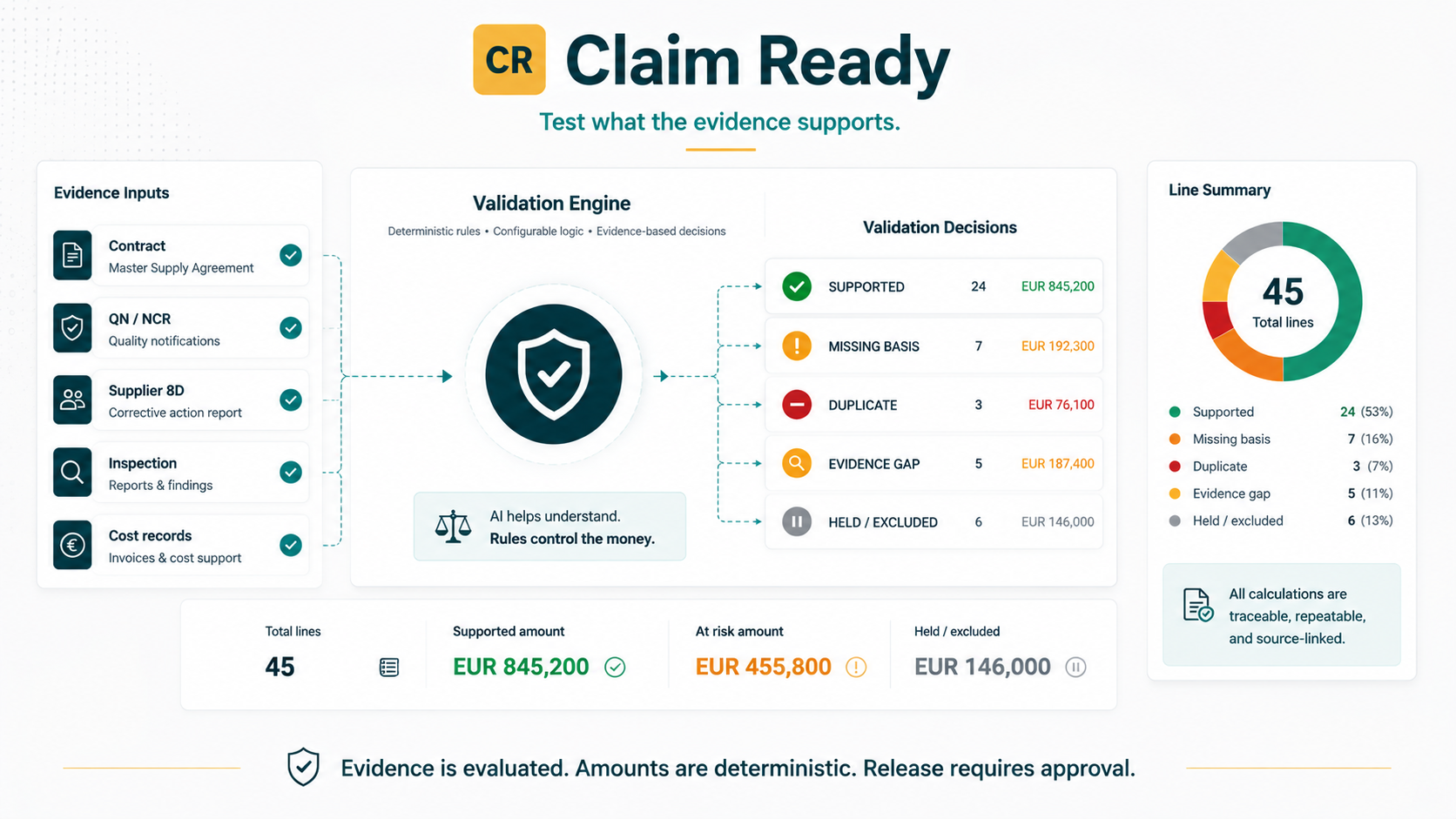
Claim Ready is a pre-flight evidence firewall for supplier-quality recovery claims.
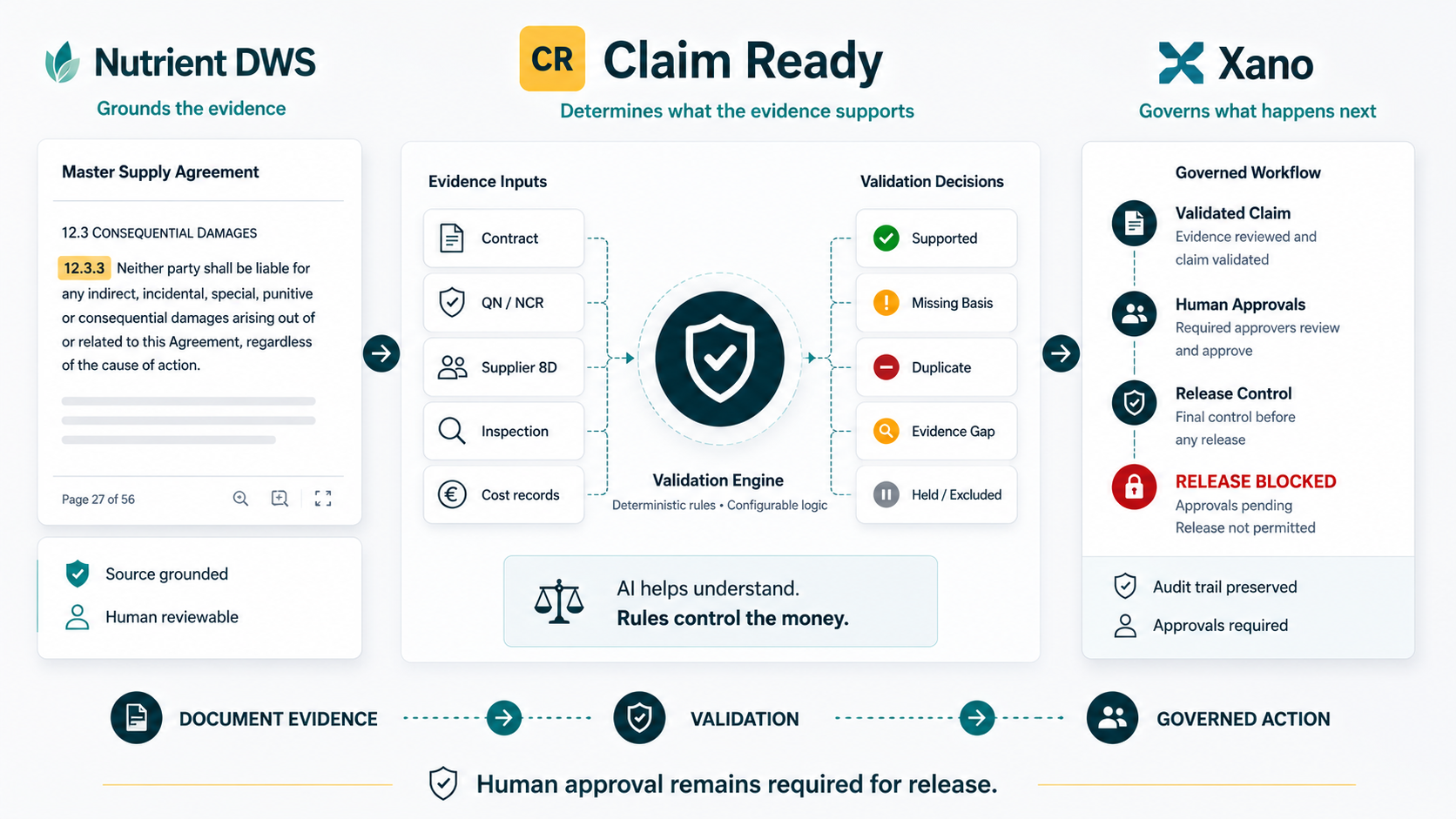
Before a claim is released to a supplier or finance, Claim Ready compares every claim line against:
- governing contractual evidence
- quality and non-conformance records
- supplier 8D evidence
- inspection and laboratory evidence
- cost-support records
- deterministic calculations
- duplicates and contradictions
- required human approvals
The system does not determine legal liability.
AI helps extract, organize, connect and explain information.
Deterministic rules control amounts, totals, duplicates, dates and release conditions.
Humans retain approval, Legal and release authority.
The demo case
The main synthetic demonstration starts with a supplier-quality incident representing:
EUR 1.45 million gross exposure
Claim Ready determines that:
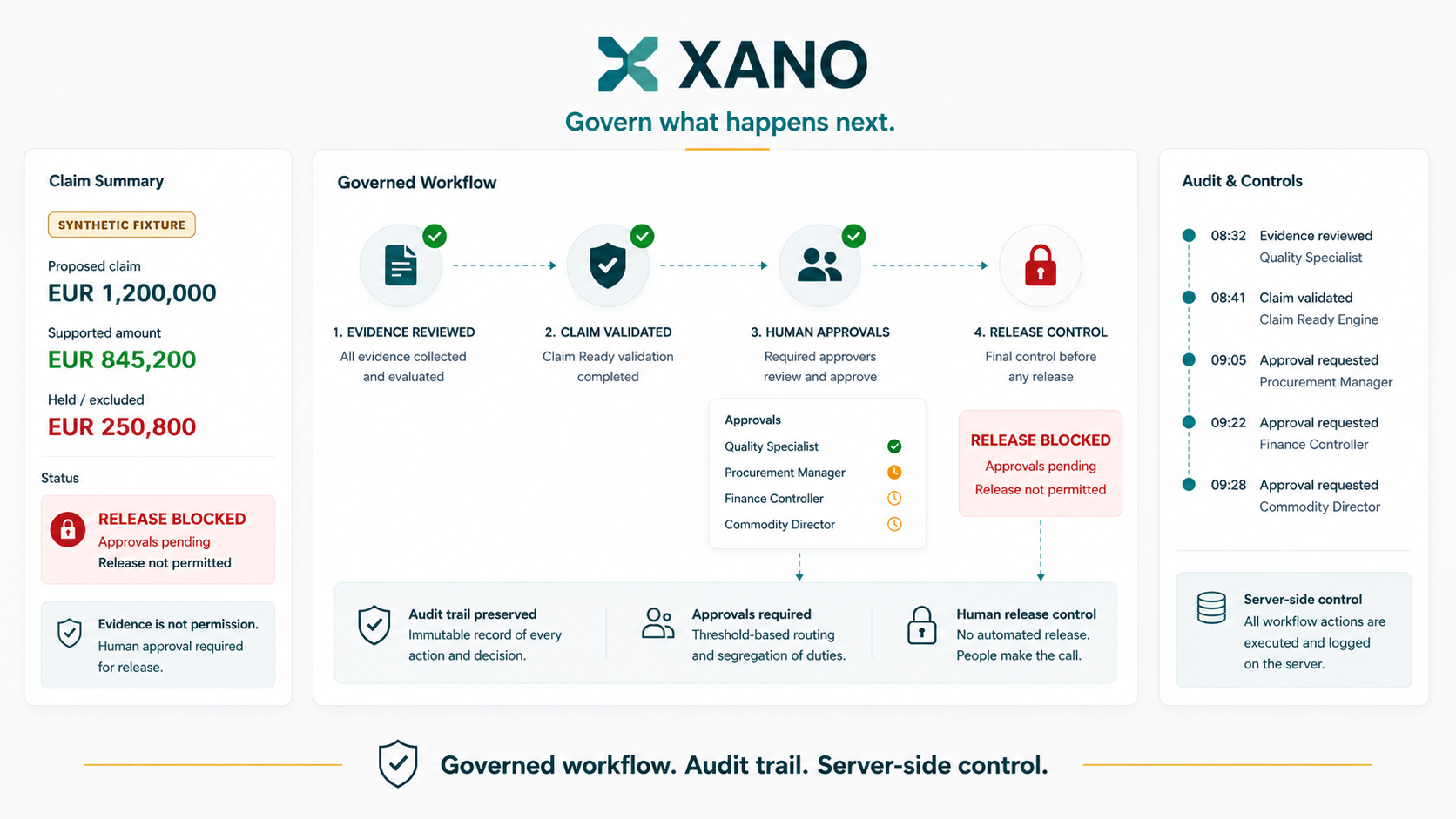
EUR 1.20 million belongs in the proposed recovery claim
while:
EUR 250,000 remains held or excluded
because the available evidence does not support releasing it.
The result remains:
RELEASE BLOCKED
until the required human controls are satisfied.
How Nutrient DWS helps
The first challenge is trusting the source documents.
A contractual clause should not become true simply because an AI system says it found it.
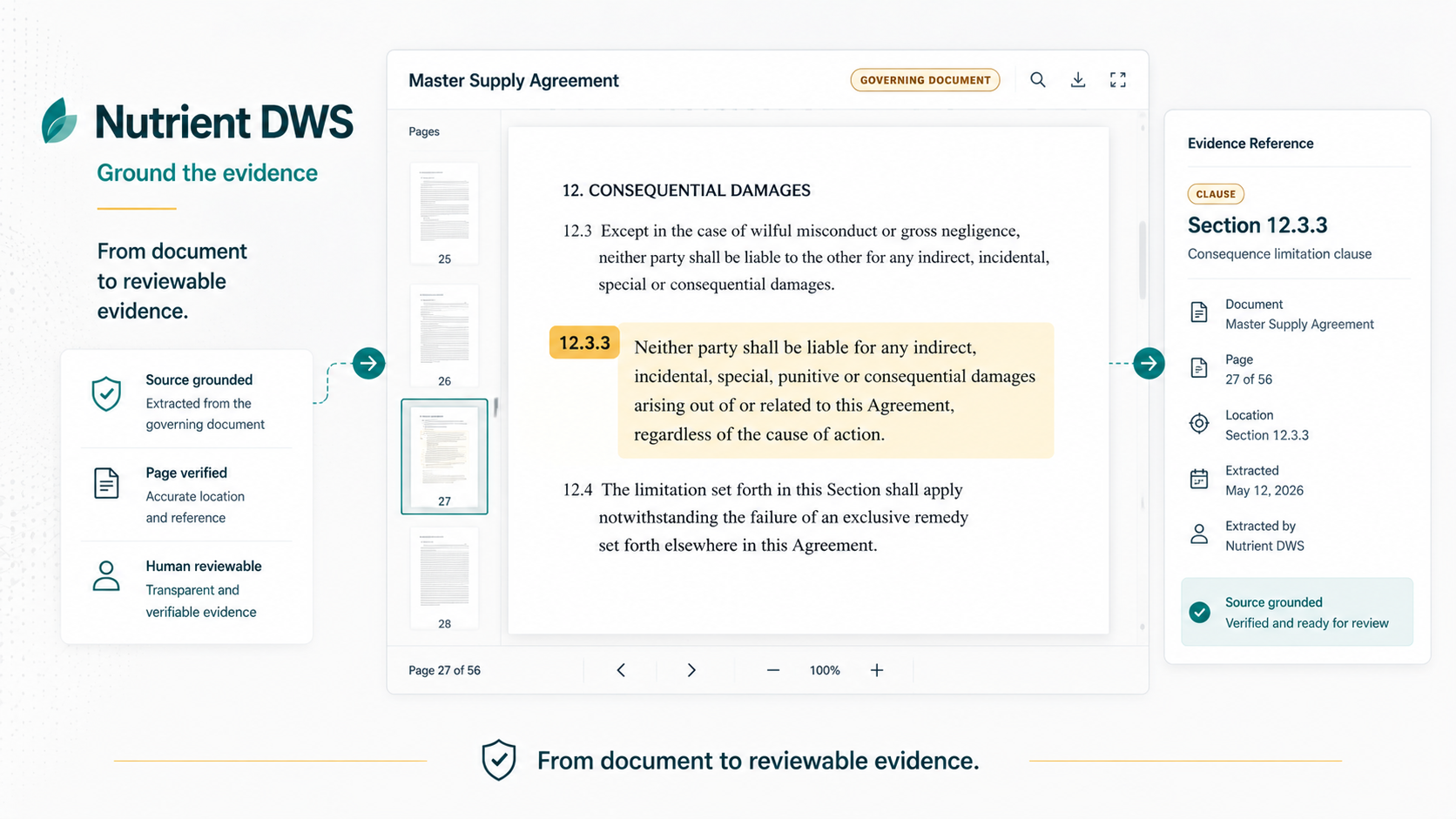
Nutrient DWS gives Claim Ready source-grounded, human-reviewable document evidence.
A reviewer can open the governing agreement, move directly to the relevant clause, and verify the source context before Claim Ready relies on it.
Where DWS does the heavy lifting: Nutrient DWS turns the governing contract into source-grounded, human-reviewable evidence so Claim Ready can test a recovery line against the actual document instead of relying on an AI interpretation.
Nutrient grounds the evidence.
Claim Ready determines what that evidence supports.
How Xano helps
Finding evidence is only half of the problem.
Knowing what the evidence supports does not automatically mean a claim is authorized for release.
Xano provides the governed backend workflow behind Claim Ready.
It preserves case state and audit history and supports server-side release control, so a blocked claim remains blocked when the required evidence or approvals have not passed.
Xano governs what happens next.
What I replaced
Claim Ready reimagines a fragmented workflow that today can involve spreadsheets, PDF folders, email, quality-system lookups, ERP lookups and manual approval chains.
Instead of asking reviewers to reconstruct the entire claim manually, Claim Ready creates one governed reference where the evidence, calculations, blockers and required decisions can be reviewed together.
How I built it
I built the hackathon version over roughly 18 days using verified vertical slices rather than trying to build everything at once.
I used:
- OpenAI ChatGPT for product reasoning, research, architecture and review
- OpenAI Codex for implementation, testing and iterative corrections
- Nutrient DWS for source-grounded document evidence
- Xano for governed backend workflow and audit control
- TypeScript, React and Node.js for the application
- deterministic schemas, fixtures and regression tests for repeatable verification
AI accelerated implementation, testing, review and documentation.
Without AI-assisted development and Xano, building and validating the backend workflow, evidence contracts, audit controls and regression coverage would have taken substantially longer.
Trust and safety
Claim Ready is deliberately designed around a strict trust boundary:
AI may assist. Rules calculate. Humans authorize.
The system never uses AI to determine legal liability.
Financial release, supplier communication and other high-impact actions require human authority.
The hackathon demonstration uses synthetic evidence only.
What I am proud of
The most important accomplishment is not simply that the application produces an answer.
It shows why.
A reviewer can trace the evidence behind the decision, understand what is supported, see what is missing or contradictory, and understand why release remains blocked.
That makes the recovery process more defensible for the buyer, clearer for the supplier, and safer for finance.
What’s next
The long-term vision is to turn Claim Ready into a governed supplier-recovery workspace that can connect enterprise quality, procurement, finance and document systems while preserving the same core principle:
Every source connected. Every euro explained. Every release human-approved.
Built With
- chatgpt
- codex
- dws
- json
- node.js
- nutrient
- openai
- react
- schema
- typescript
- xano

Log in or sign up for Devpost to join the conversation.