
Inspiration
What it does
How we built it## Inspiration
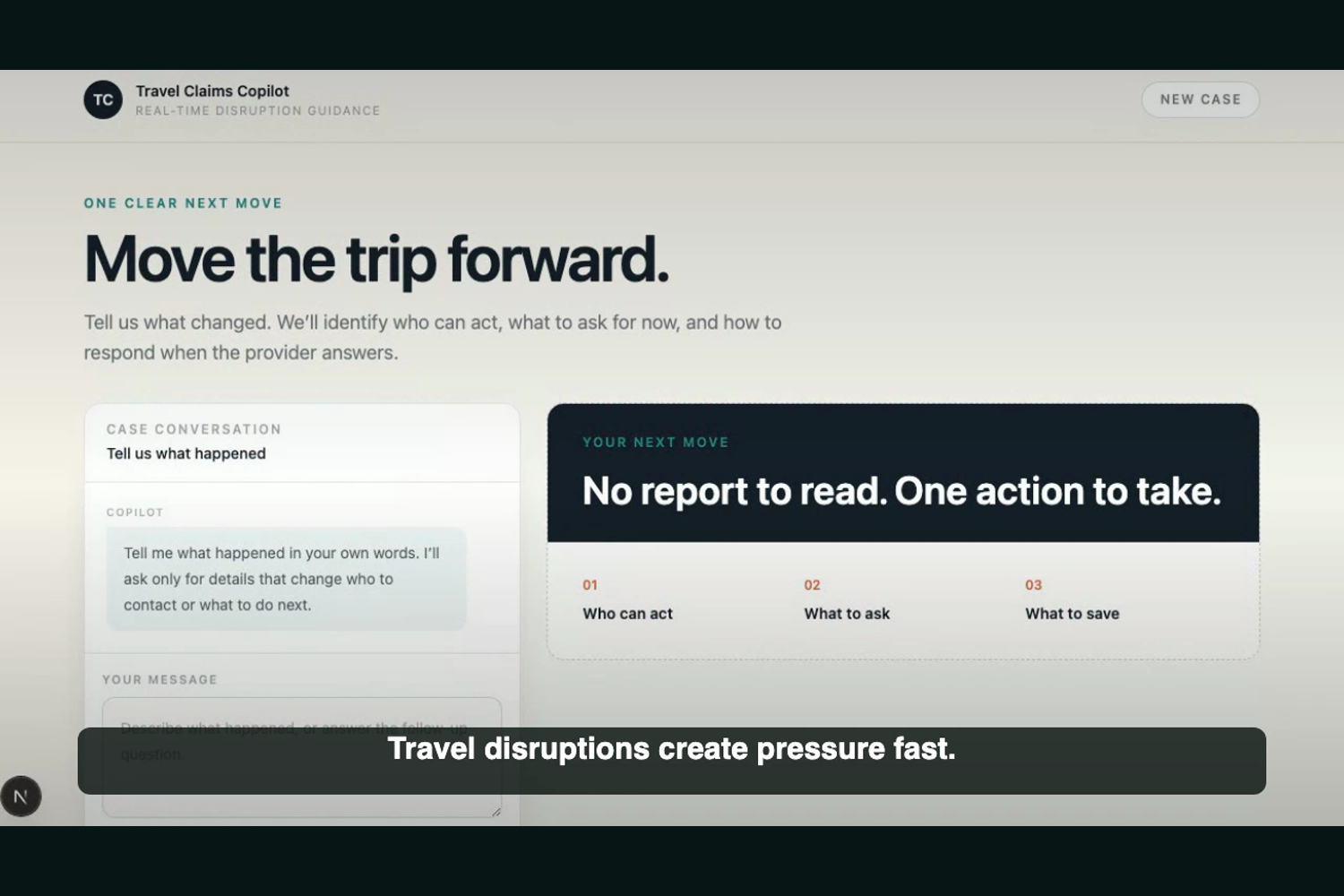
Travel disruptions are stressful because travelers must quickly understand who can act, what to ask for, what evidence to preserve, and when to escalate. The relevant information is often scattered across regulations, provider policies, community reports, and incomplete conversations with hotels or airlines.
Travel Claims Copilot turns that uncertainty into one clear next action.
What it does
Travel Claims Copilot is an action-first decision-support assistant for hotel and airline disruptions.
A traveler describes what happened in natural language. The application then:
- identifies the supported disruption type;
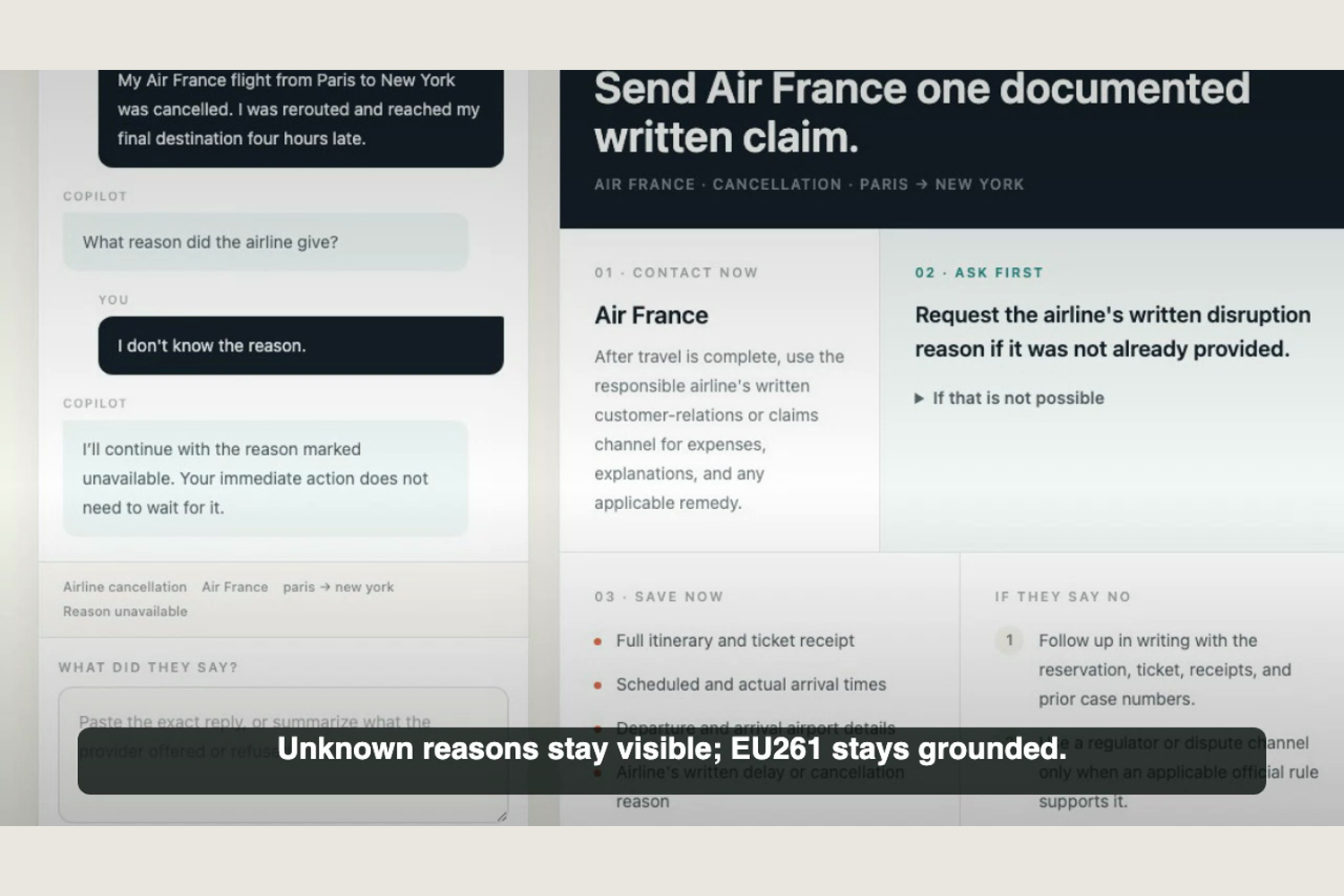
- collects only the missing facts that could change the recommended action;
- determines who the traveler should contact first;
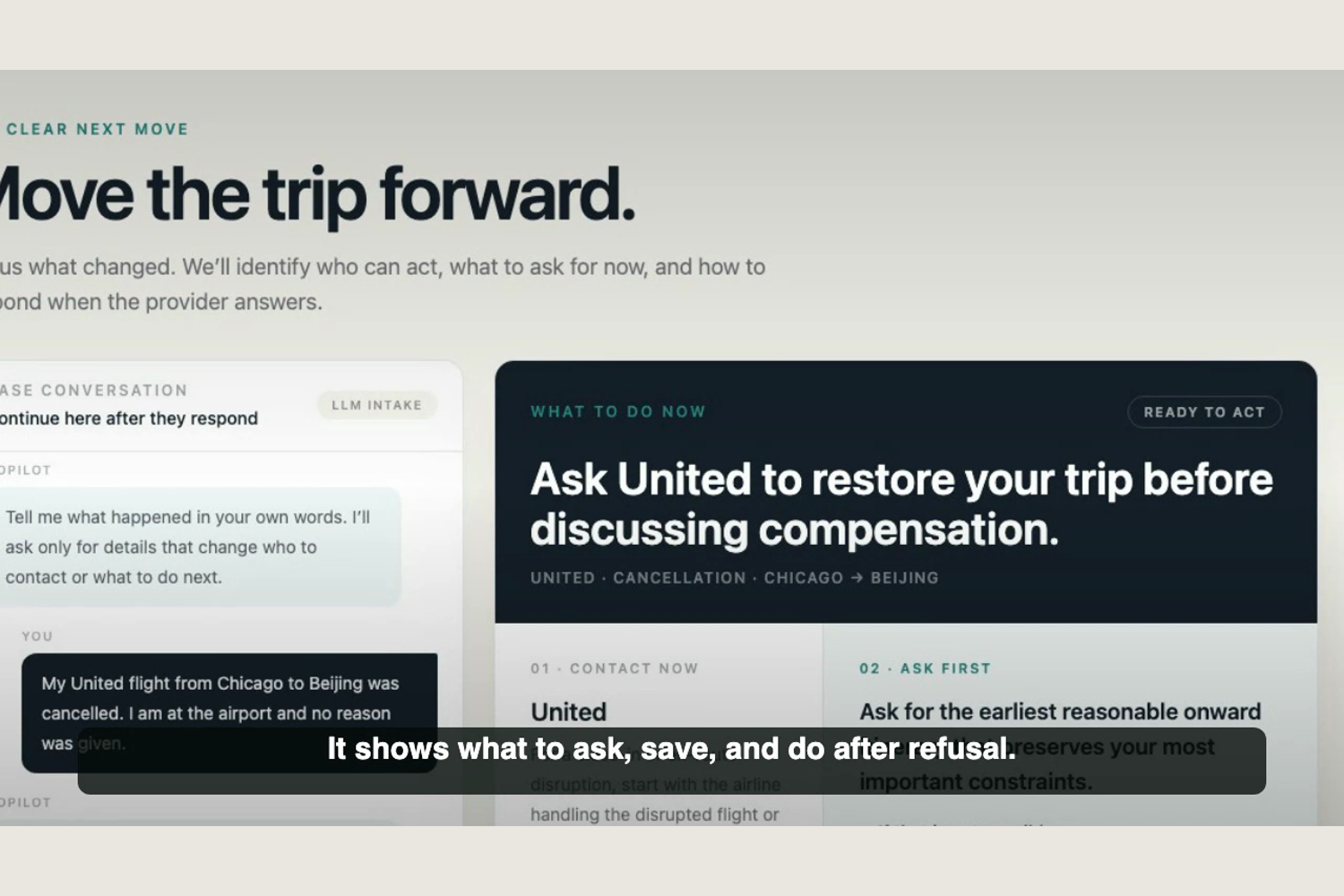
- generates a grounded first request and fallback steps;
- lists the evidence the traveler should preserve;
- links to relevant official policies and provider commitments;
- generates reusable front-desk, phone, chat, and escalation scripts;
- accepts the provider's reply and recommends the next action.
The current competition scope supports four canonical incidents:
- hotel walk;
- airline delay;
- airline cancellation;
- denied boarding.
The product provides informational guidance only. It does not provide legal advice, guarantee compensation, or automatically submit claims.
How we built it
The application is built with Next.js, React, TypeScript, Tailwind CSS, and a reviewed local knowledge base.
GPT-5.6 can act as a constrained semantic fact extractor through the OpenAI Responses API. It returns a strict JSON Schema response with store: false. The server validates the response before accepting any extracted facts.
GPT-5.6 does not decide legal eligibility, policy applicability, compensation, or the final recommended action. Those decisions remain in deterministic, testable TypeScript logic backed by reviewed policy, provider, and case records.
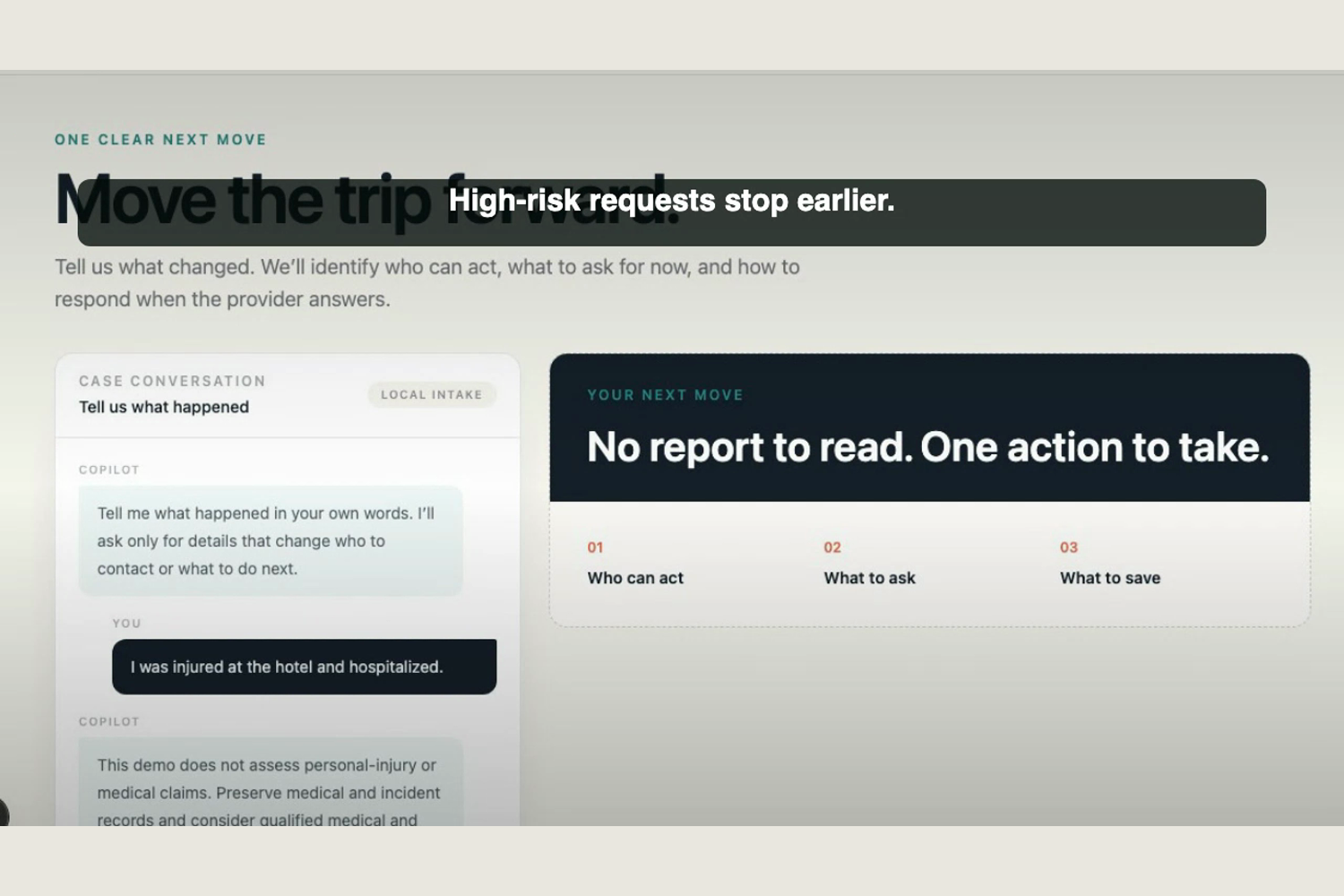
If an external model is unavailable, the same interface uses a deterministic local extractor and clearly labels the result as Local intake. This keeps the core workflow testable and usable without API credits.
The current knowledge base contains:
- 10 policy and regulatory records;
- 55 reviewed case records;
- 14 reusable communication scripts;
- 1 carrier-specific commitment record.
How we used Codex and GPT-5.6
We used Codex with GPT-5.6 throughout architecture review, scope definition, test-driven development, contract design, debugging, privacy review, source-grounding work, and release verification.
Codex helped us:
- freeze the four-incident public scope;
- separate user-observable facts from derived legal and geographic context;
- design strict API and model-output contracts;
- build deterministic policy and remedy evaluation;
- add input, privacy, safety, and model-failure controls;
- create unit, API, regression, and browser tests;
- review the repository architecture and deployment workflow.
Human team members retained responsibility for product scope, policy interpretation, source approval, safety boundaries, release decisions, and the final submission narrative.
Trust and safety
The system separates model extraction from deterministic assessment.
It does not ask the model to invent policies, cases, sources, or compensation amounts. Unsupported high-risk matters are routed away from the normal workflow, and the interface clearly states that its output is informational rather than legal advice.
External model calls use bounded inputs, bounded outputs, strict validation, safe failure handling, and a deterministic fallback.
Testing
The current main branch passes:
- 1,010 unit, API, contract, privacy, and regression tests;
- 8 Playwright end-to-end browser tests;
- TypeScript type checking;
- ESLint;
- tracked-file secret scanning;
- production Next.js build verification;
- the GitHub Actions offline release gate.
Challenges we ran into
The hardest part was preventing an AI-assisted product from becoming an opaque policy engine.
We addressed this by separating raw traveler facts, deterministic context resolution, policy applicability, remedy assessment, retrieval ranking, and presentation into explicit layers. We also designed the product so that model failure does not make the entire workflow unusable.
What we are proud of
Instead of producing another long claims report, Travel Claims Copilot gives the traveler one immediate action, one grounded request, and a clear continuation path after the provider responds.
The product combines a polished user experience with deterministic domain logic, source awareness, privacy boundaries, and extensive automated testing.
What's next
Next steps include expanding reviewed provider commitments, improving outcome feedback, completing additional human source review, adding more supported travel jurisdictions, and measuring the optional GPT-5.6 extraction workflow across a larger bilingual evaluation set.
Challenges we ran into
Accomplishments that we're proud of
What we learned
What's next for Travel Claims Copilot
Built With
- codex
- github-actions
- gpt-5.6
- json-schema
- next.js
- openai-responses-api
- playwright
- react
- tailwind-css
- typescript
- vercel
- vitest

Log in or sign up for Devpost to join the conversation.