Inspiration
As law students, we were interested in a problem that is becoming increasingly relevant: self-represented persons (SRPs) are already turning to publicly available Generative AI tools when they do not understand legal procedures or how to prepare their claims. However, we realised that simply giving SRPs access to AI does not necessarily solve the problem. For example, a frustrated claimant might ask an AI, “The contractor scammed me. Tell me how to sue him and get my money back.” A general-purpose chatbot may respond based on the claimant’s one-sided framing, potentially reinforcing their assumptions instead of encouraging them to critically assess their case. There is also the risk of inaccurate or hallucinated legal information.
This inspired us to create Claim Companion, a guided preparation tool for SPRs considering a claim before Singapore’s Small Claims Tribunals (SCT). Our idea was simple, which is that an SRP does not need an AI that simply agrees with them but one that helps them prepare responsibly. We therefore designed Claim Companion around three principles: structure the facts, challenge assumptions, and verify before filing.
What it does
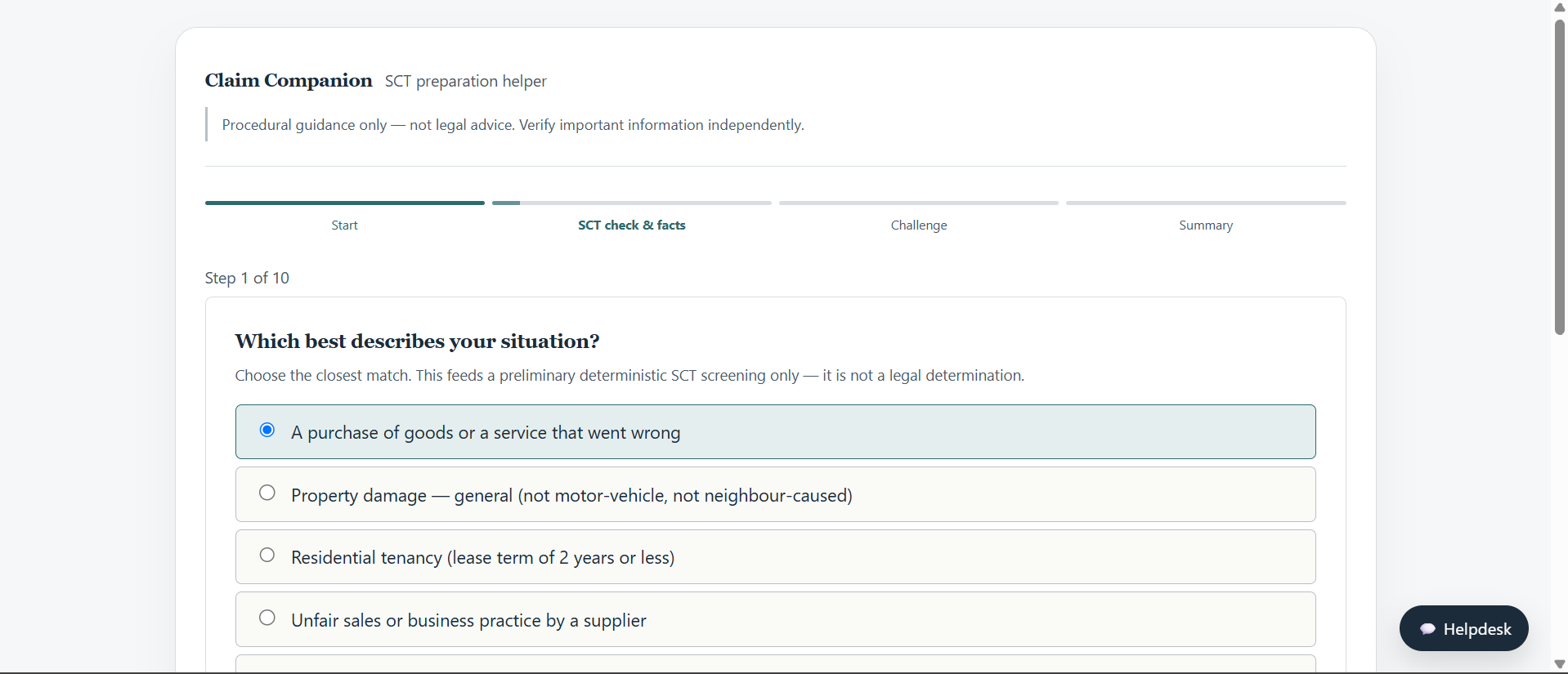
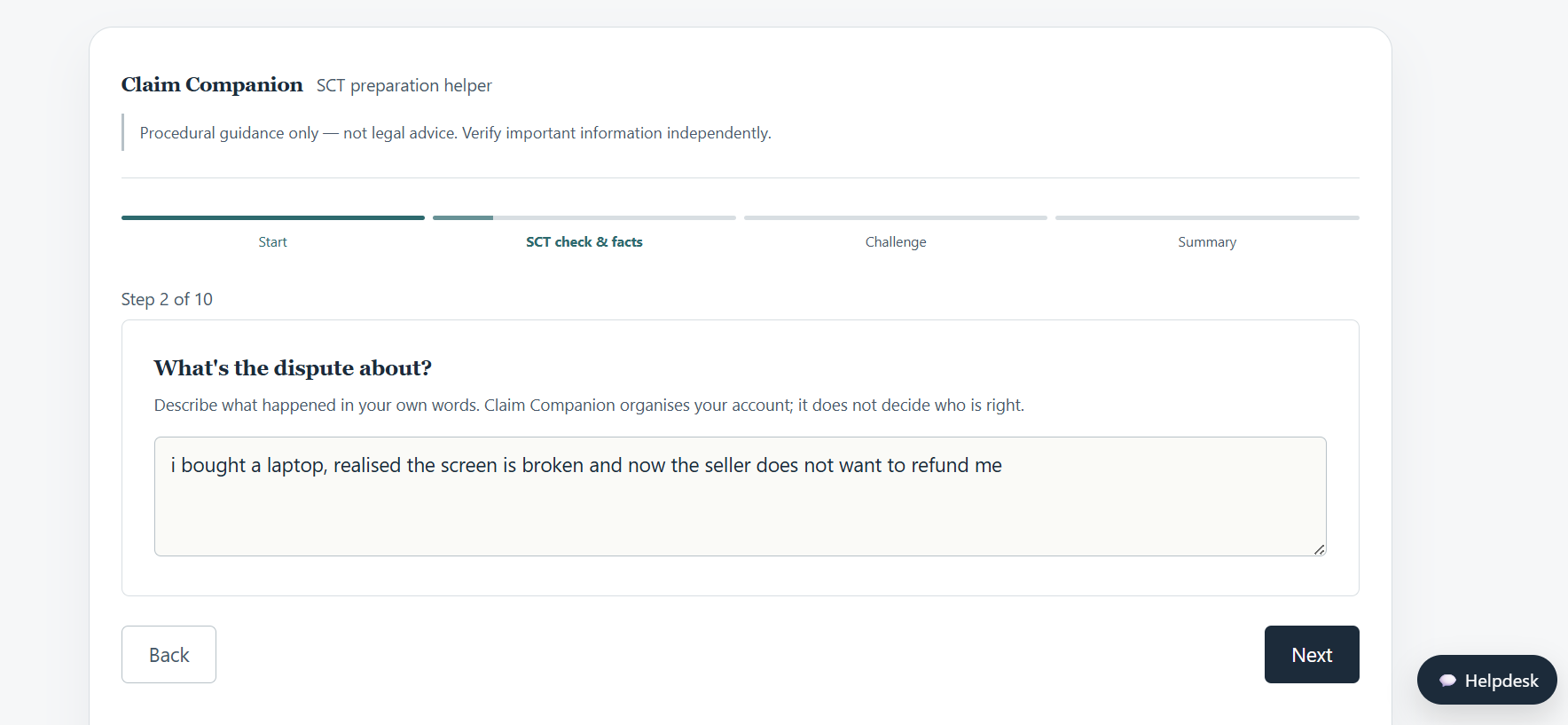
Claim Companion is a guided pre-filing preparation assistant for self-represented persons (SRPs) considering a claim before Singapore’s Small Claims Tribunals (SCT). Instead of immediately placing the user into an open-ended chatbot, it guides them through a structured, step-by-step preparation process.
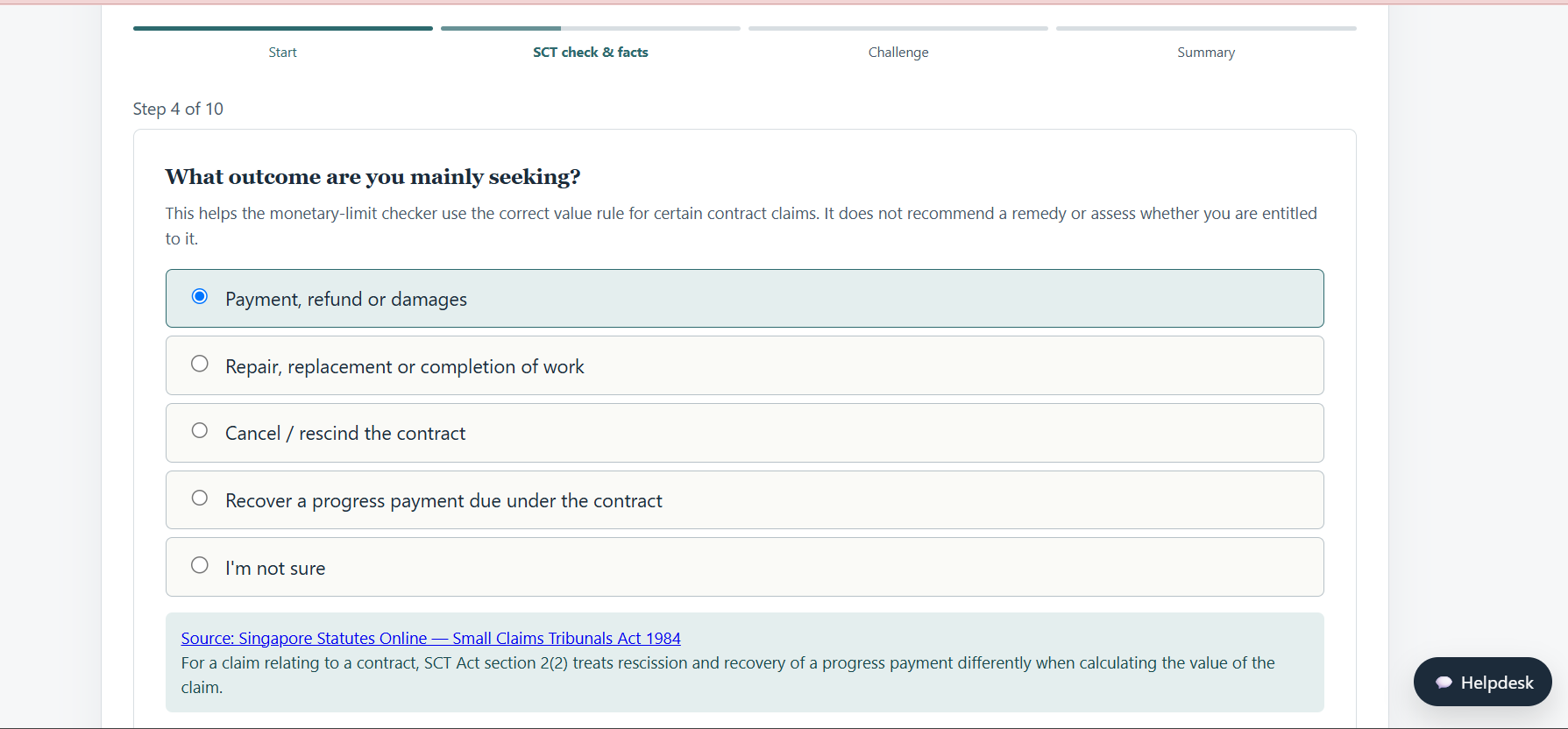
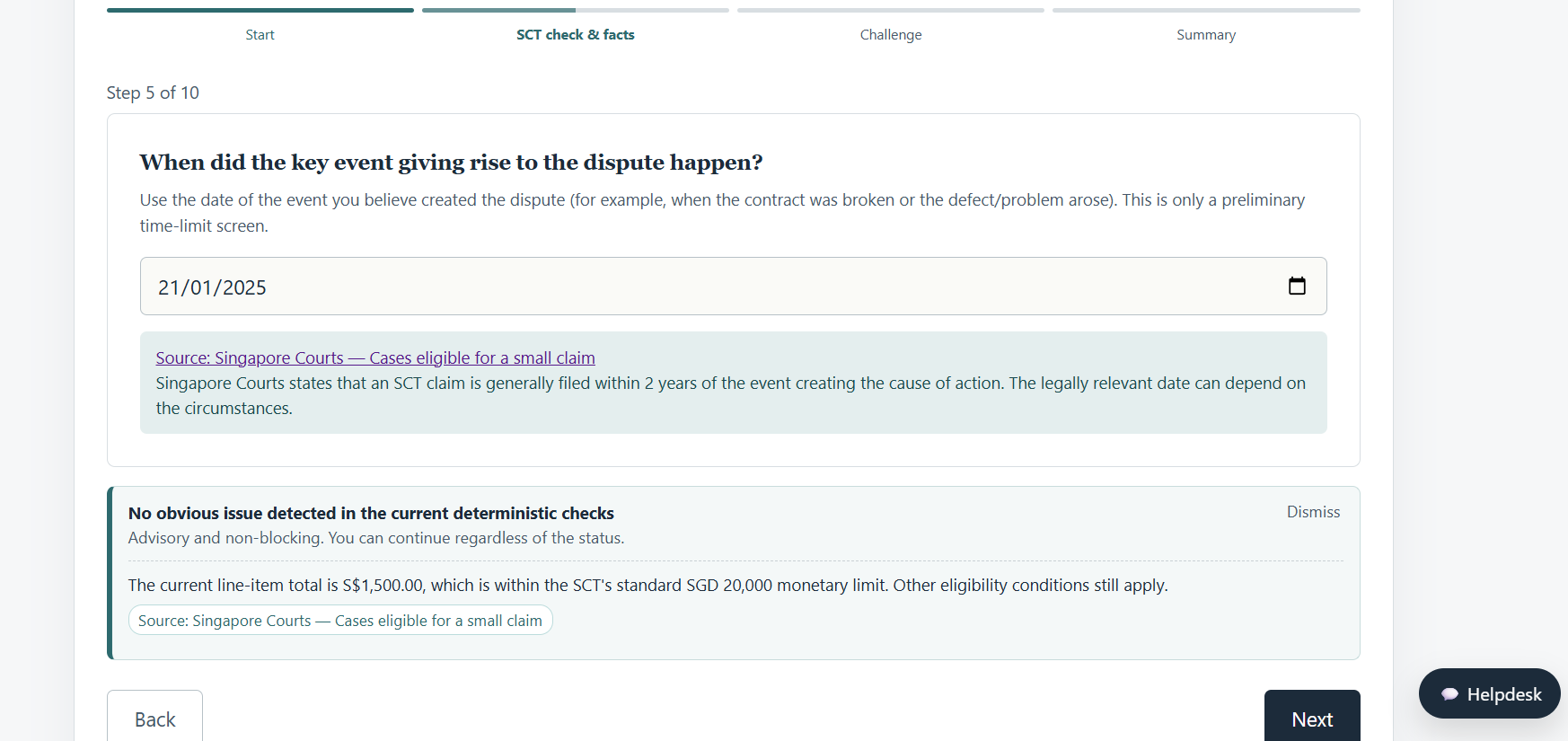
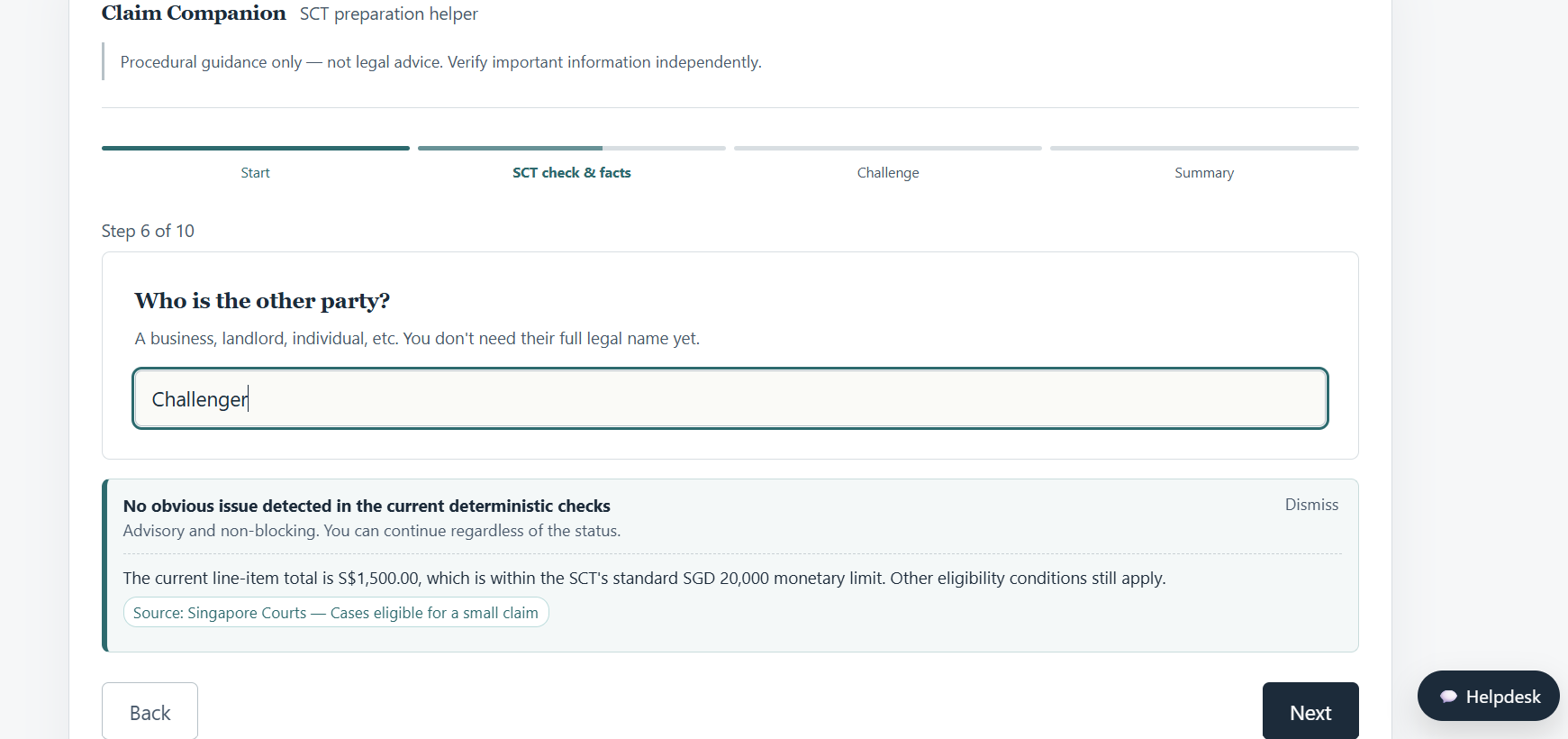
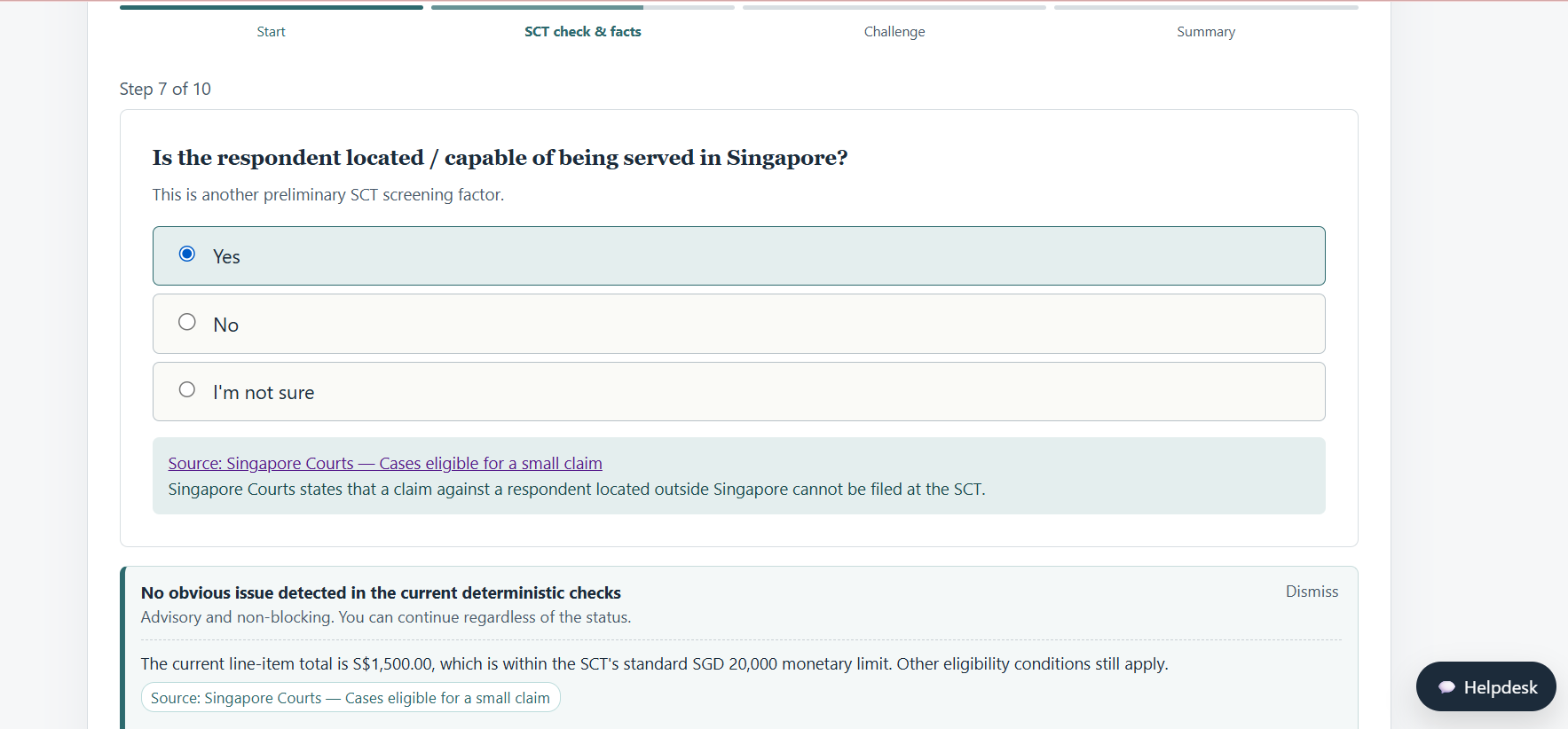
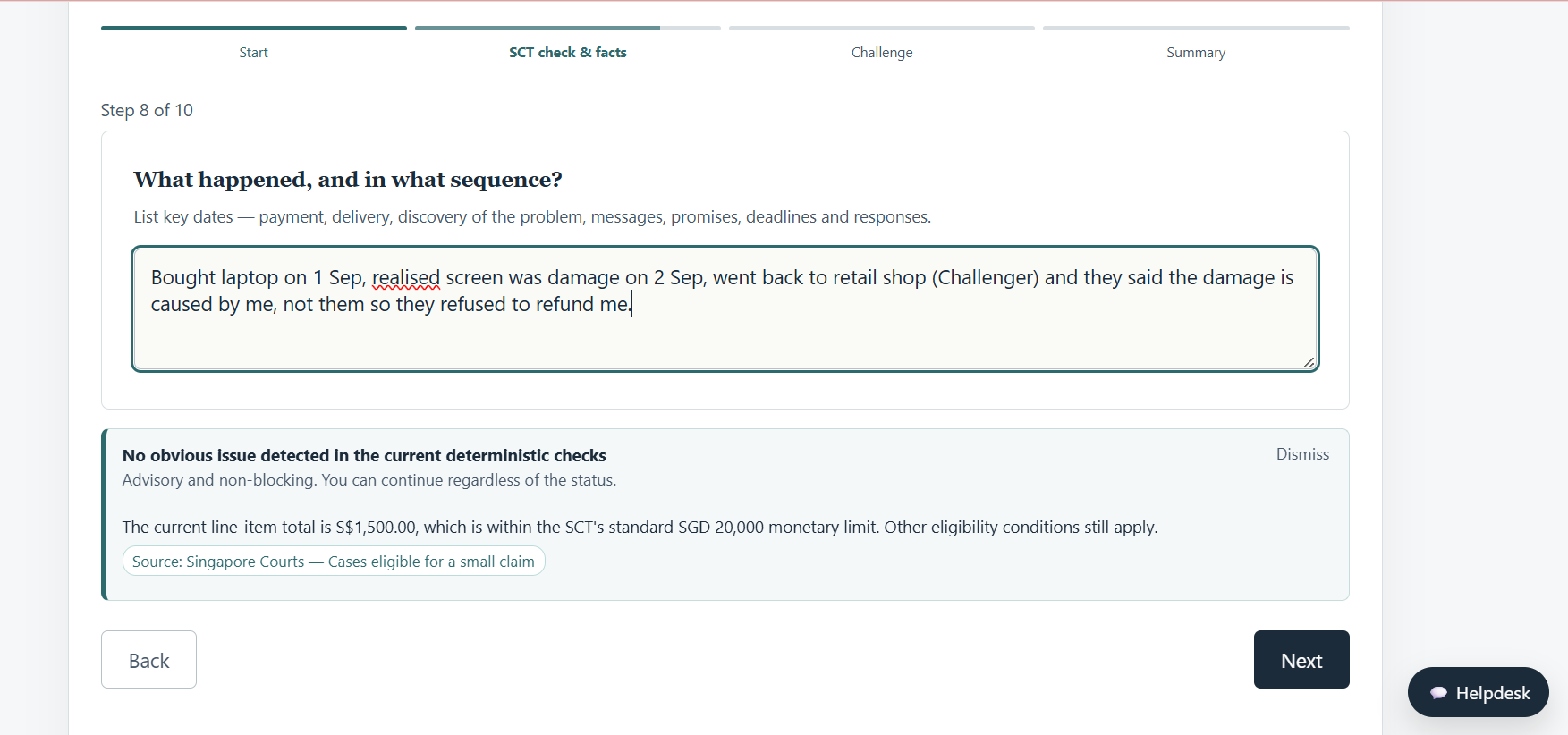
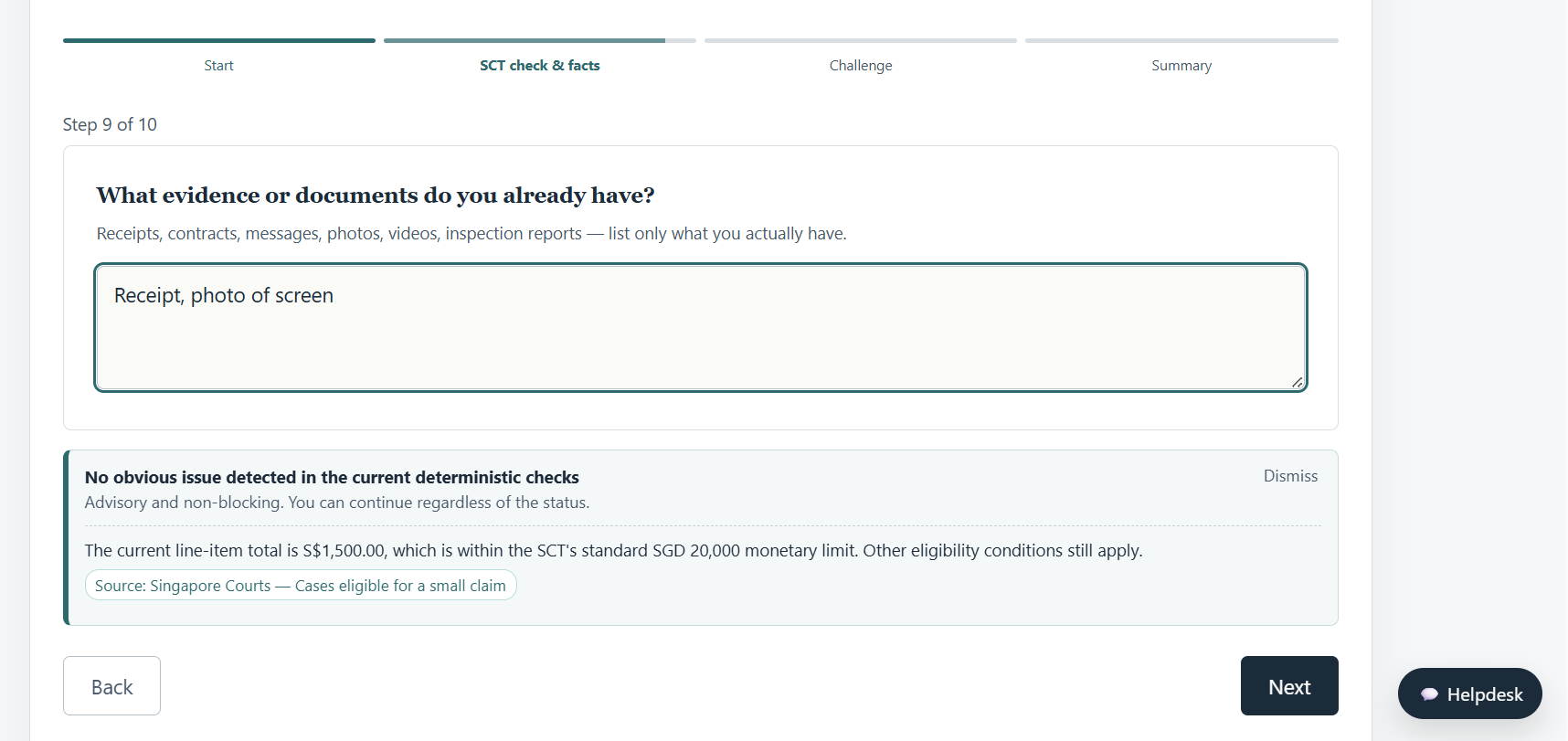
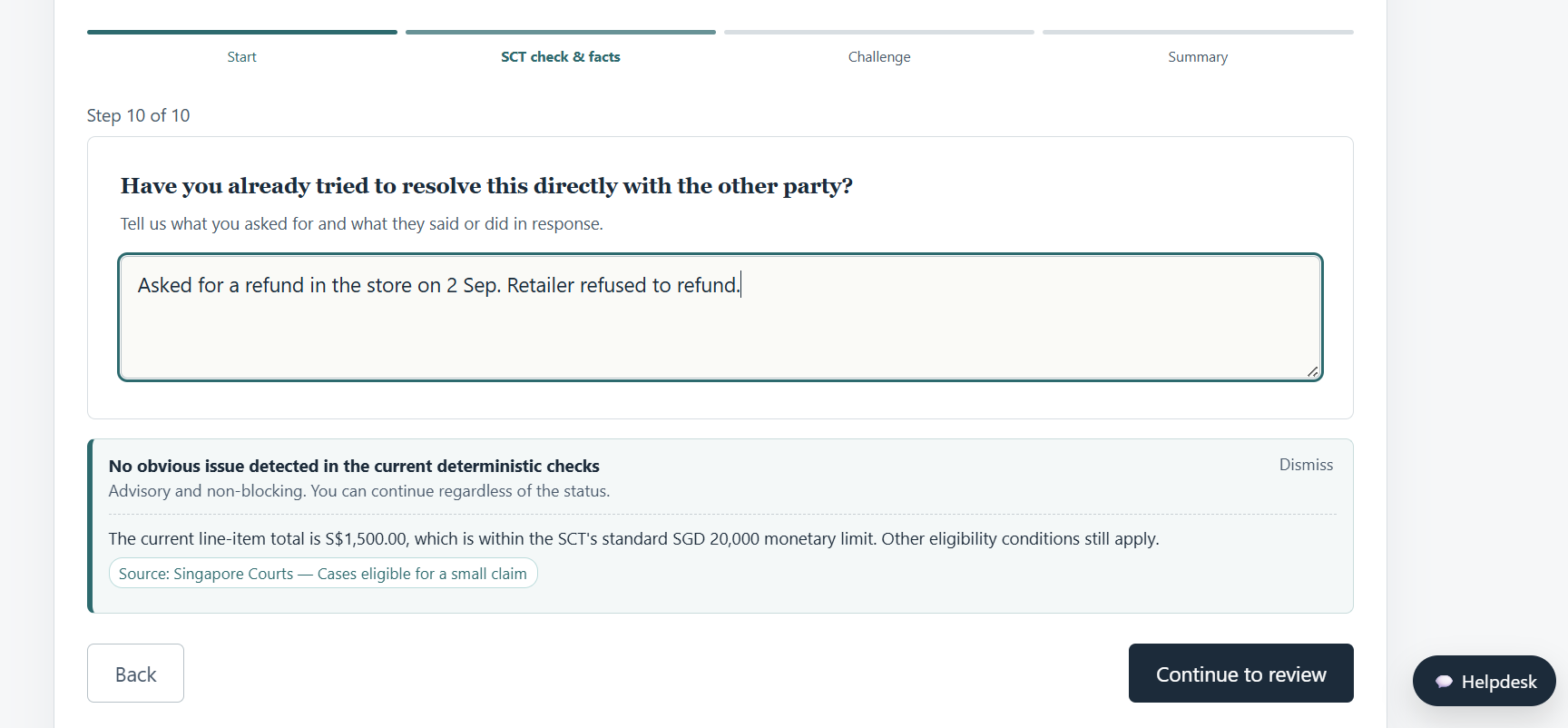
First, the user provides key information about their dispute, including the type of claim, what they are claiming for, the relevant dates, the other party, the evidence they currently have, and any previous attempts to resolve the matter. As the user enters this information, Claim Companion performs a preliminary SCT eligibility screening using deterministic rules and provides real-time, source-linked warnings where potential issues are detected.
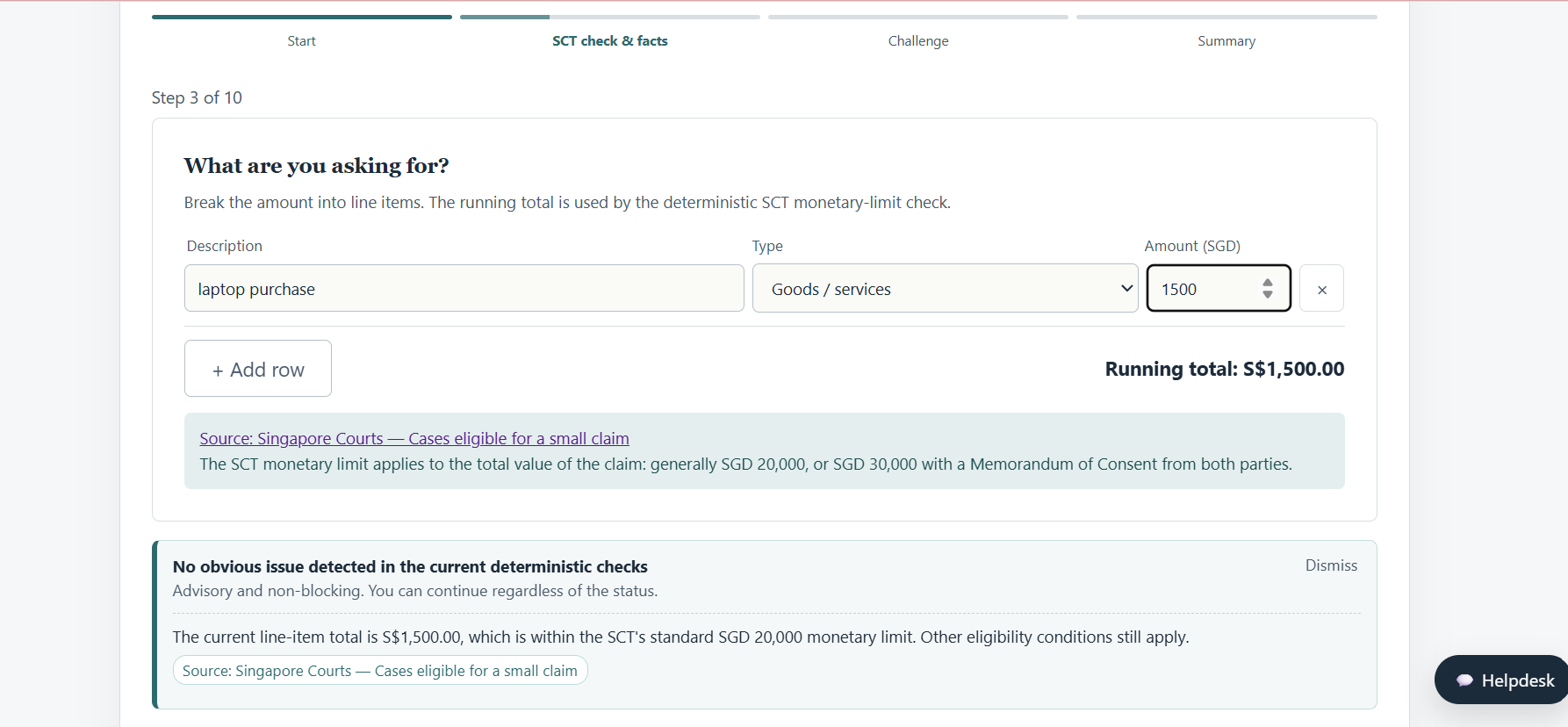
For example, when a user enters the amount they are claiming, Claim Companion automatically calculates the running total. If the amount raises an issue with the SCT monetary limit, the system immediately flags it. For a claim of S$30,000, for instance, Claim Companion warns the user that a Memorandum of Consent from both parties has not yet been confirmed for the extended S$30,000 limit, while displaying the relevant Singapore Courts source.
Most importantly, the warning is advisory and non-blocking. The user can still continue because Claim Companion is not designed to make a final legal determination on their behalf. Instead, it identifies a potential issue early, explains what requires attention, and gives the user an authoritative source to independently verify the position.
Similarly, where the dates entered by the user appear to raise a potential SCT filing time-limit issue, Claim Companion can flag this for the user to verify rather than allowing them to complete the entire preparation process under the assumption that their claim necessarily falls within the SCT framework.
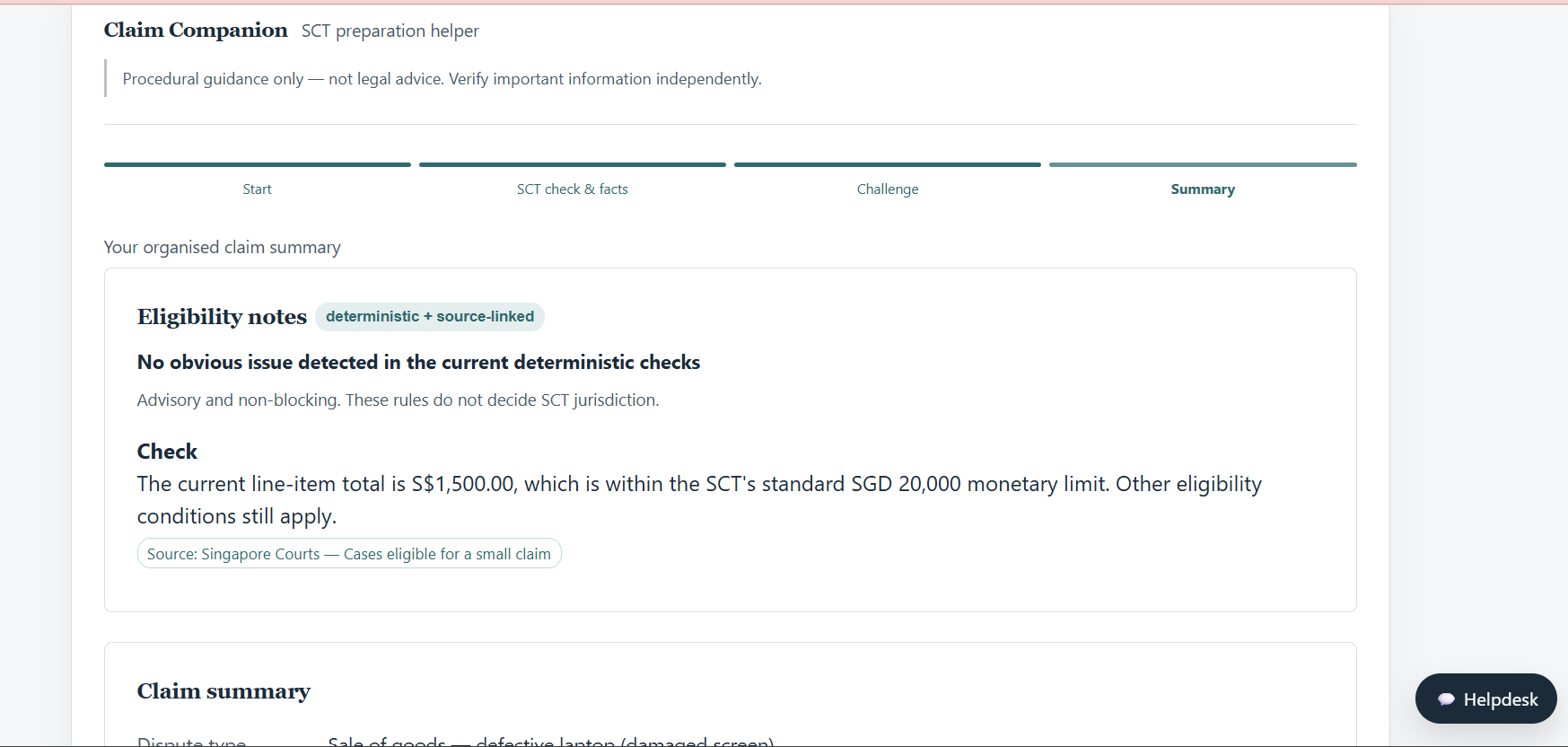
We deliberately designed these checks using deterministic, rule-based logic rather than generative AI wherever the criteria can be assessed predictably. This means fixed thresholds are not left for an AI model to guess or improvise.
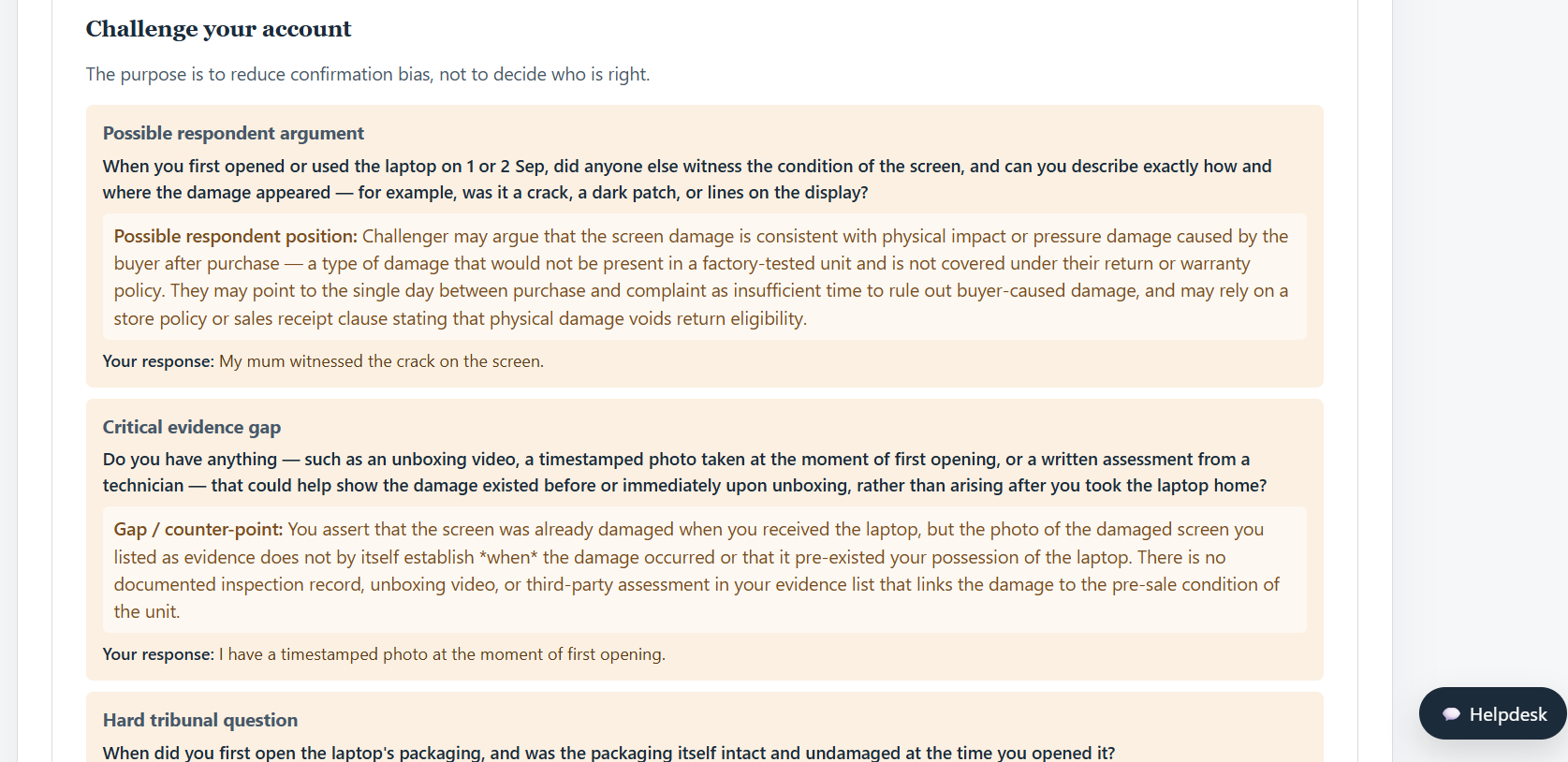
Next, the user enters our Counter-Perspective Stress Test. Rather than simply accepting the claimant’s version of events, Claim Companion identifies possible respondent arguments, evidential gaps, inconsistencies and alternative explanations. It then asks questions that encourage the user to consider how their own account could be challenged. Where their answers reveal further issues, users can request additional follow-up questions.
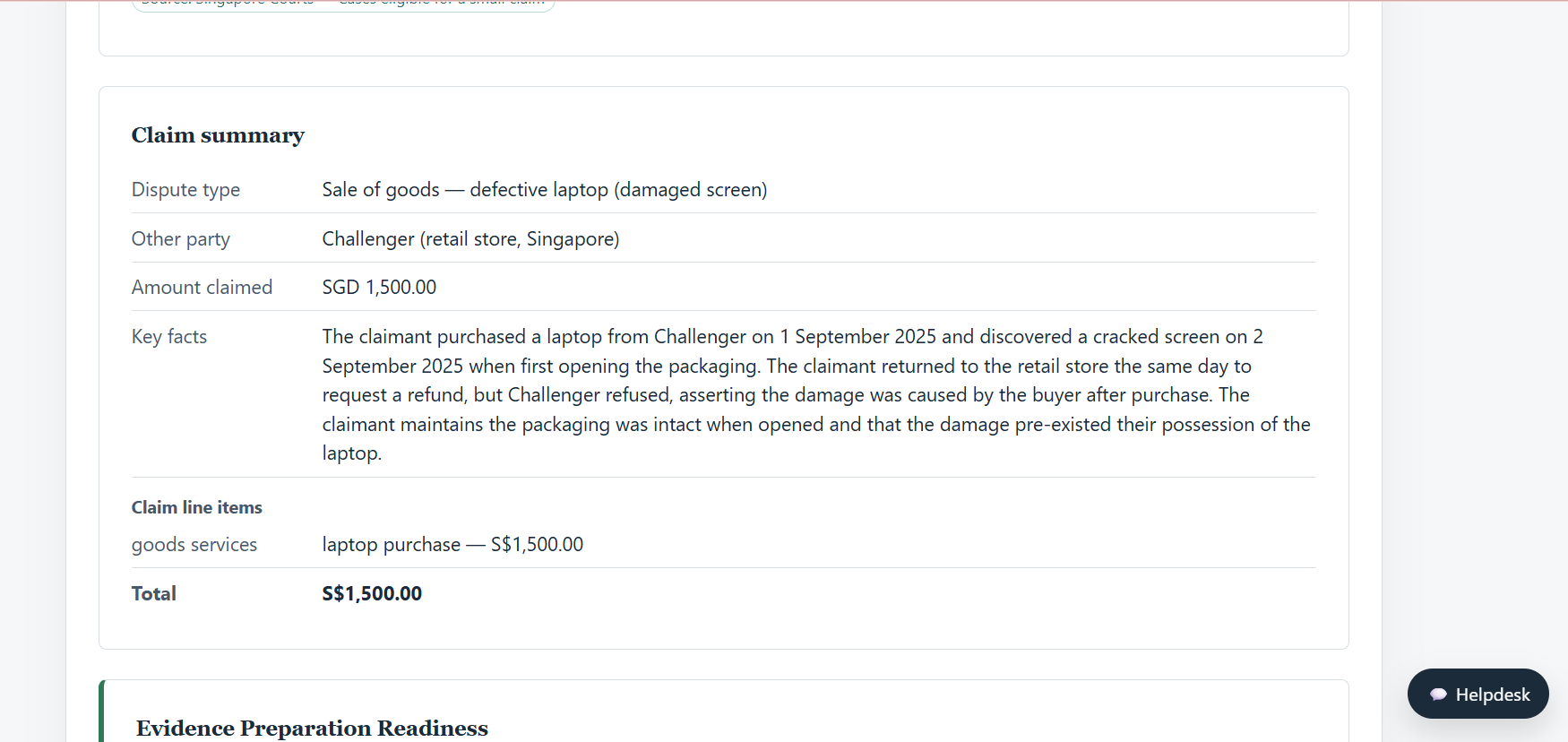
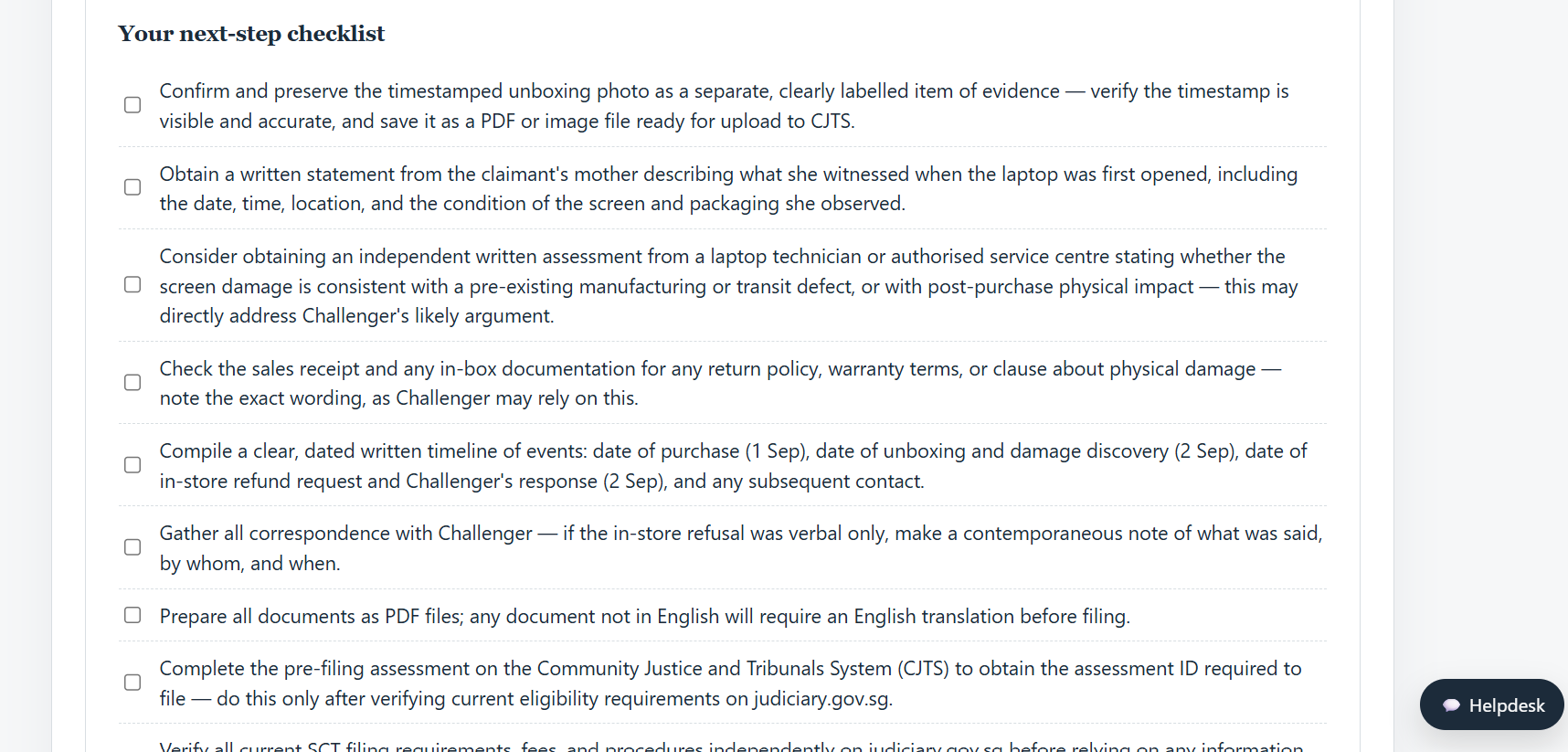
After this, Claim Companion produces an organised claim-preparation summary, highlighting the key facts, counter-perspectives considered, unsupported assertions, evidence gaps and a clear next-step checklist.
It also provides an Evidence Preparation Readiness indicator showing how completely the user has organised relevant information and evidence. Importantly, this is not a prediction of whether the claim will succeed; it measures preparation and organisation, not case strength.
Finally, a bounded AI Helpdesk is available throughout the process to provide plain-language explanations of SCT terminology and procedure. The Helpdesk does not decide who is right, predict whether the user will win, or tell the user how to argue their case.
Overall, Claim Companion helps an SRP to Check → Structure → Challenge → Organise → Verify so that they can approach the SCT process better prepared, less overconfident, and more aware of what still requires independent verification.
How we built it
Claim Companion was built as a single-page web application using HTML, CSS and JavaScript, with Claude used only for selected generative tasks. We deliberately chose a hybrid architecture rather than making every part of the system AI-driven.
At the frontend, HTML structures the interface, CSS controls the visual design and responsiveness, and JavaScript manages the user journey, stores the user’s answers, performs rule-based checks and renders the final output. The application is organised as a guided workflow rather than multiple separate webpages, allowing the user to move through intake, SCT screening, the counter-perspective challenge and the final preparation summary within one interface.
For rules that can be assessed predictably, we use deterministic JavaScript logic rather than asking the language model to decide. For example, the system calculates the user’s claim total, checks the preliminary SCT screening value and displays source-linked warnings when the information entered requires attention. These warnings are deliberately advisory and non-blocking, so the system flags a possible issue without pretending to make a final legal determination.
Similarly, the same principle is used for our Evidence Preparation Readiness feature. The score is calculated from predefined preparation indicators such as whether the claim line items are complete, whether the user has organised a dated chronology, identified transaction documents, correspondence and other relevant evidence. This calculation is handled in ordinary code rather than generated by the AI.
Further, we use Claude where contextual language understanding is more useful. For example, after the intake, the model generates case-specific counter-perspective questions aimed at identifying possible respondent arguments, evidence gaps and difficult factual questions. Follow-up prompts are separately constrained to focus on contradictions, unclear explanations and unsupported assertions, while expressly prohibiting the model from inventing facts, evidence, law or what the respondent actually thinks.
For the final preparation summary, Claim Companion combines the user’s intake answers with the deterministic SCT screening result and the user’s responses to the counter-perspective questions. This structured information is then sent to the model as JSON.
The frontend does not communicate directly with the model provider using a visible API key. Instead, it sends a POST request to our own /api/claude serverless endpoint. The API credential therefore remains on the server side rather than being exposed in the browser or public repository.
We also require the AI to return structured JSON instead of unrestricted prose. This allows the application to reliably separate information into specific sections such as the claim summary, counter-perspective review, unsupported assertions and next-step checklist before displaying them to the user.
Another important part of our design is graceful failure. If the Claude API cannot be reached, returns an error or produces a response that cannot be parsed correctly, Claim Companion does not leave the user stuck. The system falls back to a rule-based preparation summary built from the user’s own answers and static SCT reference material.
We also built a bounded AI Helpdesk for questions about legal terminology and SCT procedure. It uses selected official Singapore Courts and Singapore Statutes sources, and its system prompt limits it to explaining terminology and procedures rather than deciding who is right or providing case-specific legal advice.
Next, the legal grounding layer includes selected material from sources such as the Small Claims Tribunals Act 1984, Consumer Protection (Fair Trading) Act 2003 and Singapore Courts SCT guidance. The prototype intentionally uses a curated and clearly scoped reference set rather than allowing the model to answer freely from its general training knowledge.
Overall, our technical approach can be summarised as: User input → deterministic checks → AI where language understanding is useful → structured JSON → organised output → independent verification
Our main design principle was simple: we did not use AI for a task just because AI was available. Where ordinary rule-based code could produce a more predictable and explainable result, we used ordinary code. We reserved generative AI for the parts where understanding and challenging natural-language information added genuine value.
Challenges we ran into
One challenge was deciding when AI should be used and when it should not. We wanted Claim Companion to be helpful without turning into an unrestricted legal-advice chatbot. We also had to make the AI responses reliable, structured and safe enough to use in a legal-preparation context.
Another challenge was technical. Our only IT member dropped out of the competition and as law students with limited coding experience, we had to learn quickly, test constantly, and make sure the legal logic and technical implementation matched each other.
Accomplishments that we're proud of
We are especially proud of turning our idea into a working end-to-end prototype within the hackathon. Our favourite feature is the Counter-Perspective Stress Test, because it does more than warn users about confirmation bias as it actively challenges their assumptions before preparing the final summary. We are also proud that Claim Companion combines deterministic rule-based checks with AI, instead of relying on AI for everything.
What we learned
We learned that responsible legal AI is not just about writing a good prompt. The workflow, interface, rules, safeguards and fallback mechanisms are just as important as the AI model itself. Additionally, sometimes ordinary code is actually the better choice. AI should be used where it adds value, not simply because it is available.
What's next for Claim Companion
With more time, we would strengthen Claim Companion by adding more comprehensive authoritative-source retrieval, passage-level citations and stronger automated verification. We would also explore secure document uploads so users can organise their receipts, contracts and messages, while ensuring that the system never creates or alters evidence.
Most importantly, we would test Claim Companion with real SRPs and legal practitioners to improve its accuracy, usability and effectiveness before any real-world deployment.
Built With
- claude
- css
- html
- javascript
