-
-
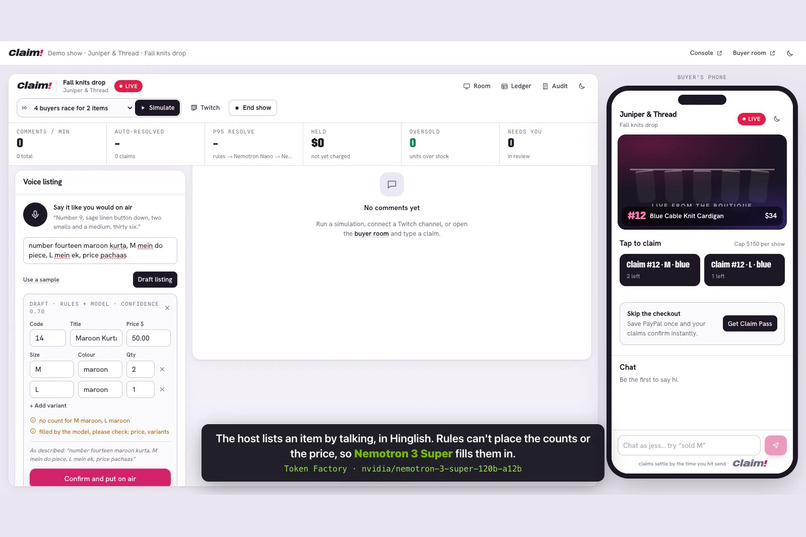
Voice listing in Hinglish: Nemotron 3 Super fills the counts and price, and every model-filled field is flagged
-
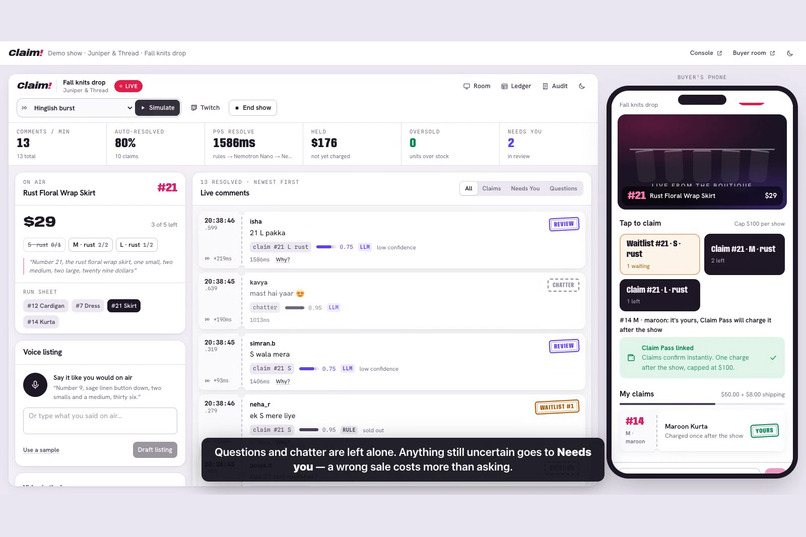
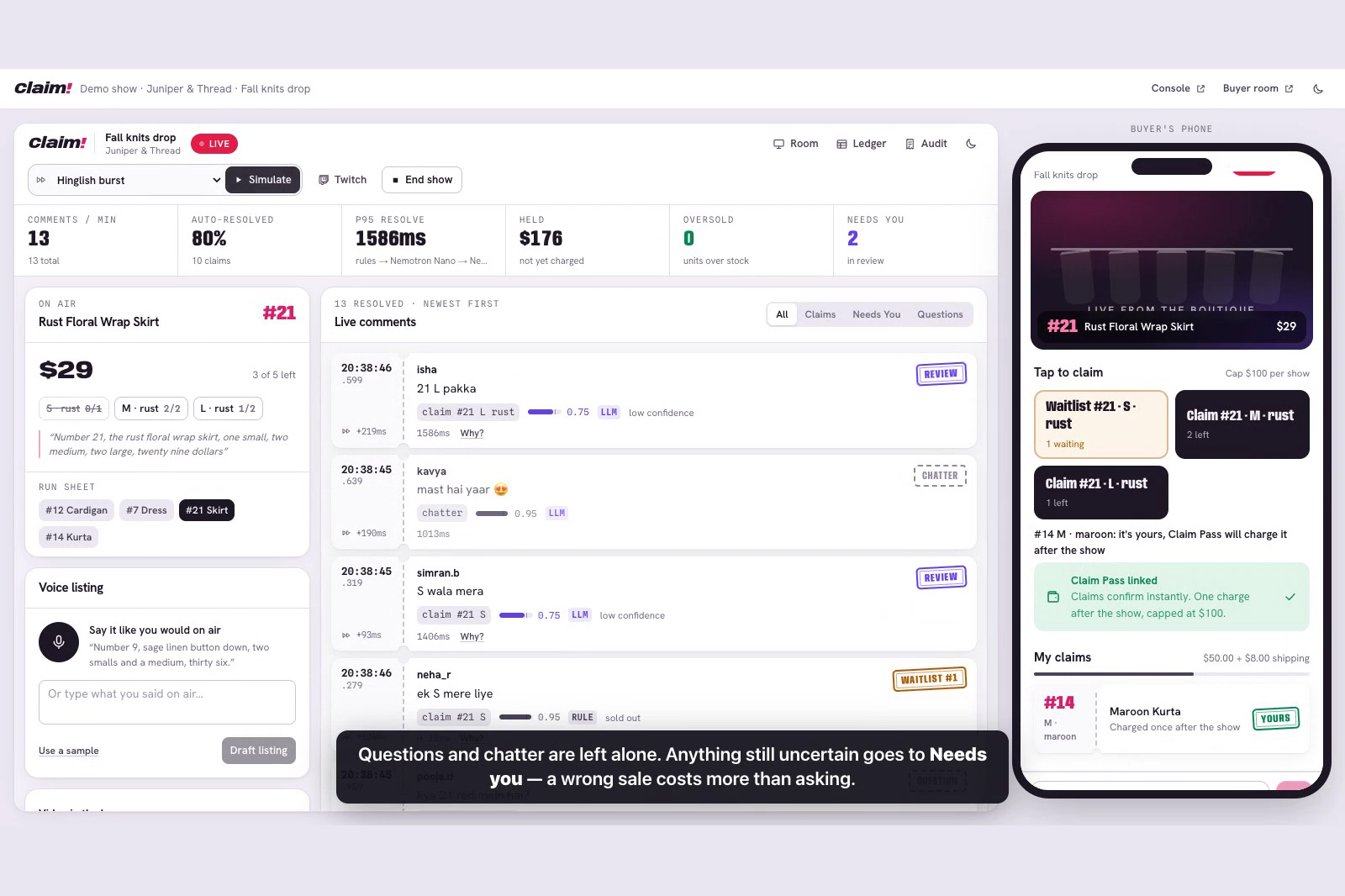
Hinglish burst: unclear comments go to Nemotron 3 Nano, and uncertain ones land in Needs you
-
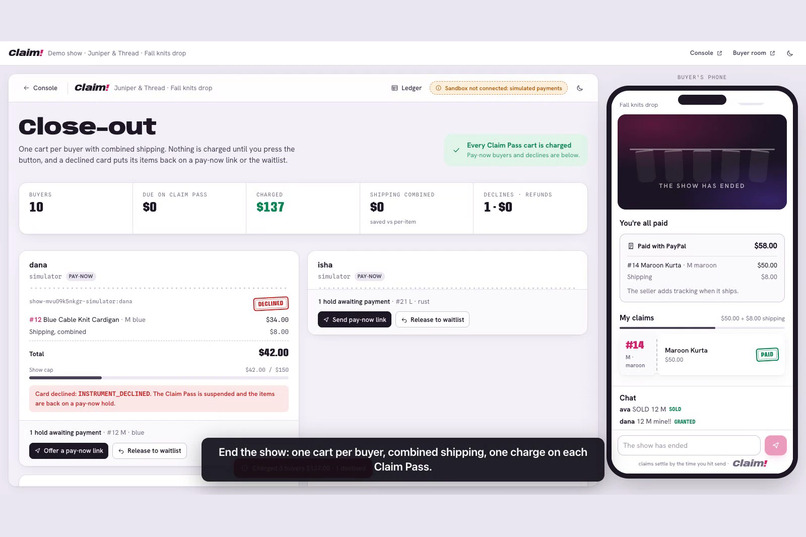
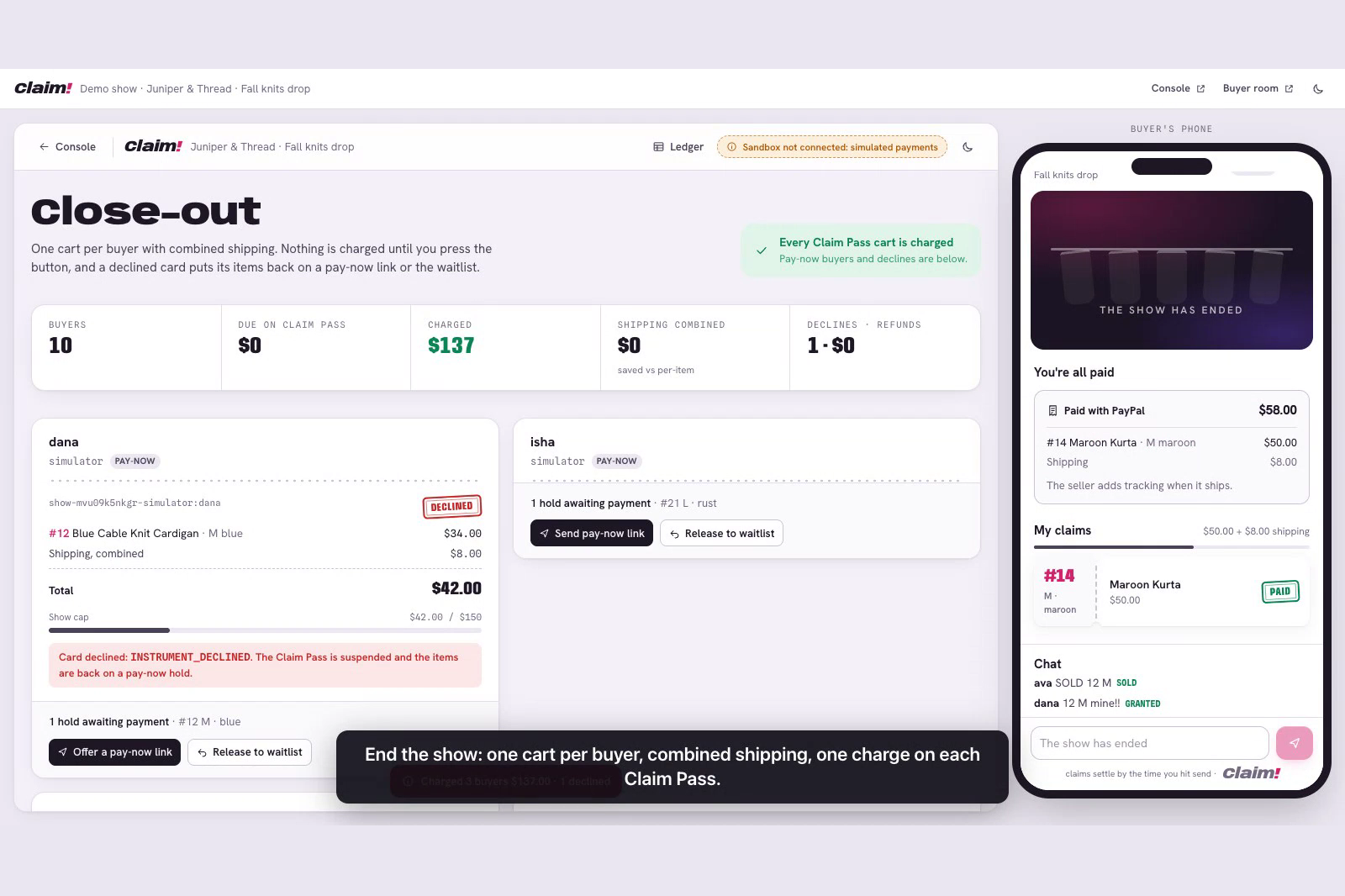
Close-out: one cart per buyer, combined shipping, one charge per Claim Pass (simulated)
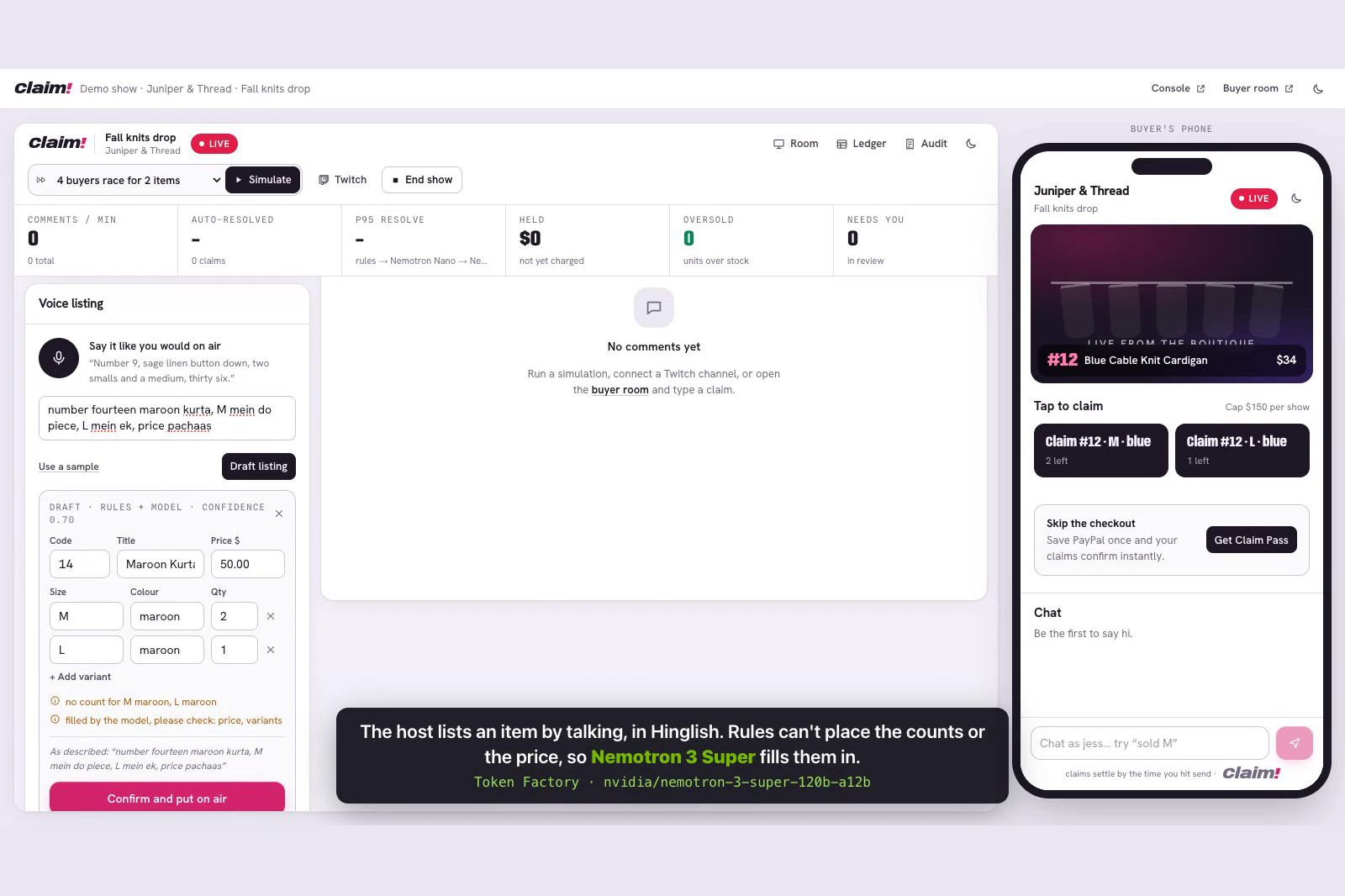
Try it: https://claim-nemotron.onrender.com. Press Start a demo show. The seller console and a buyer's phone open side by side. The free host sleeps when idle, so the first load can take about a minute. Payments are simulated in this build.
Inspiration
Independent boutiques sell on live video. When an item is on camera, the chat fills within seconds with "sold 12 M", "me!!", "mujhe 21 S chahiye" and "how much is shipping?". The host has to work out who was first, who gets the last medium, and who was only asking. After the show, someone chases every buyer for payment. Sales get lost in the scroll, and buyers argue that they were first.
What it does
Claim! sits beside the stream and runs the sale.
- Voice to listing. The host says "number fourteen maroon kurta, M mein do piece, L mein ek, price pachaas". The rules get the code, title and sizes but not the counts or the price, so Nemotron 3 Super fills them in: $50, two mediums, one large. Every field the model filled is flagged, and nothing goes on air until the seller confirms.
- Comments to claims. Every comment is read as a claim, cancel, size change, waitlist request, question or chatter, in English, slang and Hinglish.
- Rules settle the clear ones in under a millisecond, with no model call.
- Nemotron 3 Nano reads the rest in batches, with JSON-schema output.
- When Nano returns nothing, or is less than 0.7 sure, Nemotron 3 Super takes a second look, and the surer answer wins.
- Anything still uncertain goes to the seller's review lane instead of being sold. A wrong sale costs more than asking.
- Fair allocation.
- Claims are ranked by the platform's own timestamp, not by arrival.
- An earlier comment that arrives late still wins inside a 2-second settle window.
- Holds, waitlists, spend caps and duplicate deliveries are handled, and the board never oversells.
- Every decision has a "Why?" and an audit line. An answer from Super is tagged as escalated.
- One cart per buyer. "End show" builds one cart per buyer with combined shipping and charges each saved Claim Pass once (simulated in this build).
How we built it
- Nebius Token Factory, through its OpenAI-compatible API, as the
nebiusprovider inpackages/llm:nvidia/NVIDIA-Nemotron-3-Nano-30B-A3Bis the fast pass;nvidia/nemotron-3-super-120b-a12bhandles escalation and voice listings;- reasoning is switched off (
enable_thinking: false) so a comment batch stays inside the live latency budget.
- A validator between the model and the money. Every model answer is checked against the comment text:
- invented item codes are dropped;
- a claim without a claim word is capped below the auto-grant line.
- So Nemotron can fill a gap or lower confidence, but cannot push an unclear comment into a sale on its own.
- A hard token budget.
withTokenBudgetreserves each call's worst case before sending it and corrects to the reported usage. Past the budget, or past a switch-off date, calls stop before reaching the provider and the app runs on rules alone. A public demo URL therefore cannot run up a bill. - Next.js 16 / React 19 / TypeScript as npm workspaces:
core(an event-sourced allocation engine),resolver,listing,llm,paypalandweb. The UI updates live over server-sent events. - Hosted on Render as one Docker web service (
render.yaml). - Tests: 552 Vitest tests, including the Nebius preset, the escalation path and the budget.
Measured results
Held-out v3, 350 comments, scored once with Nemotron (not tuned on):
| config | auto-grants | harmful | real claims sent to review | noise in review |
|---|---|---|---|---|
| rules only | 10 | 0 | 20 | 23 |
| rules + Nemotron 3 Nano | 11 | 1 | 22 | 28 |
| rules + Nano → Nemotron 3 Super | 11 | 1 | 21 | 27 |
- Latency: one comment through Nano took p50 711 ms, p95 1,359 ms (n=12). That fits inside the 1.5 s fairness window; the p95 of our earlier providers did not.
- Cost: the whole 350-comment run (39 calls, about 102k tokens) cost about $0.015.
- Honest result: on chat, Nemotron did not beat our rules on this set. It surfaced two more real claims for the seller, and made one wrong sale ("did you get me for 35 …", a question). The rules stay in charge of who gets sold what.
Held-out v3 is 350 real comments from seven public live-sale replays. A second annotator agreed with the gold labels at Cohen's kappa 0.989. The set is scored once, never tuned on.
Challenges we ran into
- Latency against fairness. A live sale cannot wait for a model, so clear claims never touch one. The model's answer can pre-empt only a grant made less than 2 seconds earlier.
- Hinglish and slang. "mujhe 21 S chahiye", "M pls", "me!!": the model has to tell a claim from a question, and the rules have to stop it from guessing an item code.
- Spend control on a pay-per-token key behind a public URL. This led to the shared token budget and the switch-off date.
Accomplishments that we're proud of
- Uncertain comments go to the seller instead of being sold, and every grant can be explained.
- Two Nemotron models, each used where it pays: Nano on every unclear comment, Super only on the doubtful ones.
What we learned
- Measure before you route. We expected the model to lift auto-grants. On a held-out set it didn't, so Nemotron's job became the parts rules can't do: filling in a Hinglish listing, and sorting what goes to the seller.
- Thinking off matters for live use. Nemotron 3 reasons by default; with
enable_thinking: falsea single comment came back in about 0.7 s. - Flag every model-filled field. In a spot check of six host lines, Super got four fully right and one field wrong in the other two. The seller's confirm step catches exactly that.
What's next for Claim!
- Instagram and TikTok Live comment sources (Twitch is wired, read-only).
- A fresh held-out set, v4, scored once with Nemotron.
- Per-seller accounts and authentication.
Built With
- docker
- nebius-token-factory
- nemotron-3-nano
- nemotron-3-super
- next.js
- node.js
- nvidia-nemotron
- react
- render
- typescript
- vitest

Log in or sign up for Devpost to join the conversation.