

Inspiration
My inspiration for CIVIX stemmed from observing the common, minor acts of public negligence—a casually tossed wrapper, a few seconds spent illegally parked, a quick queue jump. While seemingly insignificant, I realized these small actions collectively create a massive drag on society, leading to pollution, chaos, and a breakdown of community trust. I was driven by a fundamental question: What if I could make the invisible consequences of poor civic sense visible? I wanted to shift the public mindset from "this small action doesn't matter" to "this small action is the start of a damaging ripple effect." The project is built on the core belief: Small Actions, Massive Impact.
What it does
CIVIX is an interactive web experience designed to educate and motivate positive civic behavior. Its primary function is the "Real Stories, Real Impact" section, where users tap seemingly minor missteps (like "The Wrapper Effect" or "The Midnight Music") to reveal a chain reaction of hidden negative consequences—from environmental pollution to delayed emergency services and social disharmony.
Beyond visualizing the negative ripple, CIVIX provides:
A clear definition of civic sense across five dimensions (Safety, Respect, Environment, Noise, Community).
Video lessons and detailed guides on common civic violations, outlining both the wrong way and the right way.
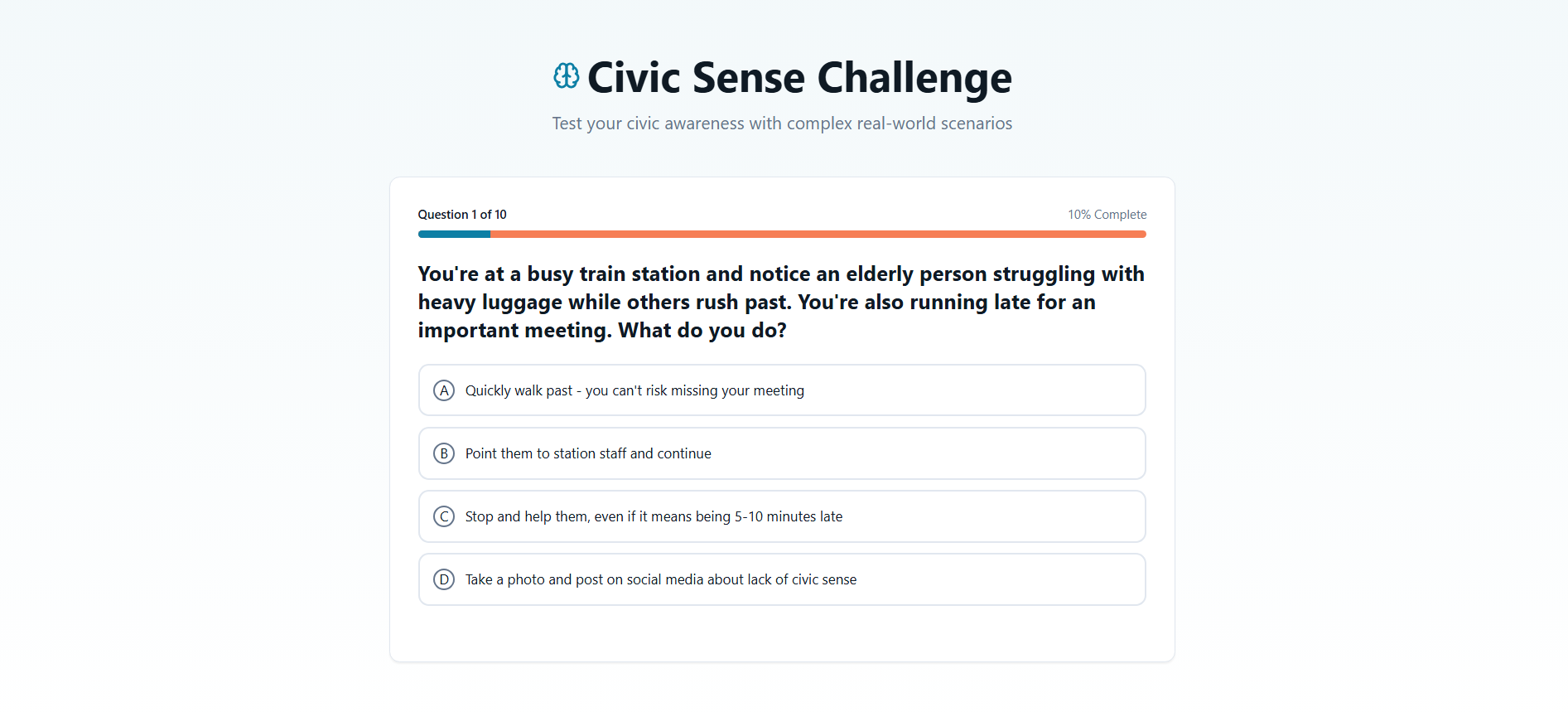
A Civic Sense Challenge quiz to test awareness in complex real-world scenarios.
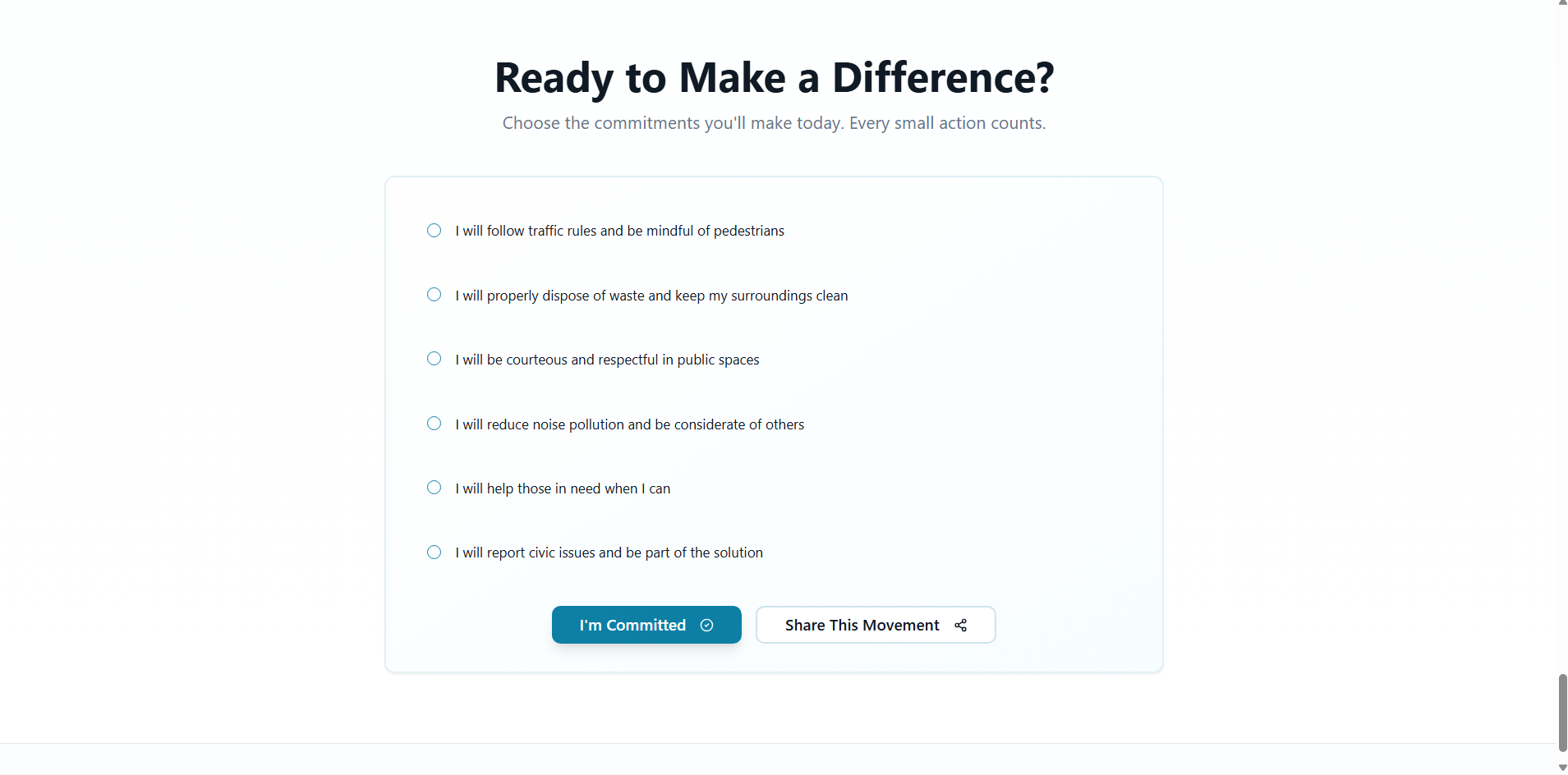
*A commitment section, allowing users to select personal pledges and share their commitment to civic responsibility.
How i built it
I built CIVIX as a clean, single-page, and fully responsive web application using standard HTML, modern CSS (leveraging utility classes for rapid styling and responsiveness), and Vanilla JavaScript for interactivity. The core feature—the ripple effect visualization—was implemented using:
Dynamic Content Toggling: JavaScript was used to manage the state of the interactive cards, quickly swapping the initial violation description with the detailed "Ripple Effect" list upon a tap event.
Responsive Design: I focused heavily on ensuring the visual structure, especially the interactive cards, was intuitive and aesthetically pleasing on both mobile devices and desktops, utilizing CSS flexbox and media queries.
Data Visualization: The section showing the exponential math (e.g., impacting 15,625 people within 6 steps using a factor of 5) was designed to be instantly digestible, reinforcing the mathematical reality of civic influence. The simple formula for the exponential growth is Impact=BaseInfluence Steps , illustrating the concept clearly.
Challenges we ran into
The primary challenge was finding the right emotional and tonal balance. I needed the consequences of bad behavior to be impactful enough to motivate change without sounding overly preachy or accusatory. I struggled to make the connections between cause and effect feel immediate; for example, linking a piece of litter to a downstream healthcare cost required careful, concise phrasing.
Another technical challenge was ensuring the smooth, dynamic transitions on the "Real Stories" cards, especially to prevent Cumulative Layout Shift (CLS) when the content expanded, which is crucial for a modern web experience. I had to use calculated heights and precise CSS transitions to manage the visual flow.
Accomplishments that I'm proud of
I am most proud of successfully visualizing the exponential power of both good and bad actions and the clear, data-driven section showing how one person's influence can quickly multiply to thousands. I believe the "Real Stories, Real Impact" format is a highly effective way to teach accountability. Furthermore, the development of a comprehensive resource covering not just what to do, but why it matters—from traffic safety to noise awareness—into a single, easy-to-navigate interface is a significant accomplishment.
What I learned
I learned that when tackling behavioral change, specificity is paramount. Generic pleas for "being responsible" are less effective than connecting an action (leaving the tap running) to a tangible consequence (wasted energy in water treatment). This project was a powerful lesson in applying design and technology to social issues, confirming that simplification and visualization are the best tools for conveying complex social dynamics.
What's next for CIVIX
For the next phase of CIVIX, I plan to focus on integrating more tangible, real-world tools:
Gamification:
Introduce a user profile system with badges and streaks for completing the "Civic Sense Challenge" and fulfilling commitments.
Local Integration (Mockup):
Develop a mock "Report an Issue" feature that uses geolocation to identify the local municipal body, simulating the process of reporting a civic violation directly to the relevant authority.
Language Expansion:
Translate the content into major regional languages to ensure the powerful message of CIVIX can reach the widest possible audience.
Built With
- bun
- react
- shadcn
- vite

Log in or sign up for Devpost to join the conversation.