-
-
-
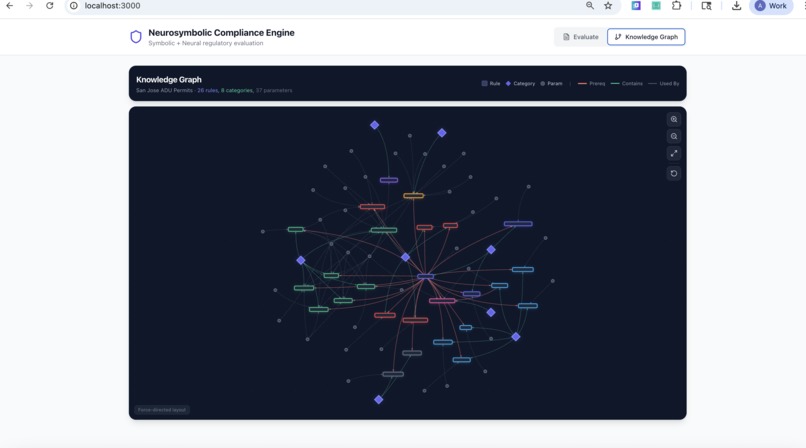
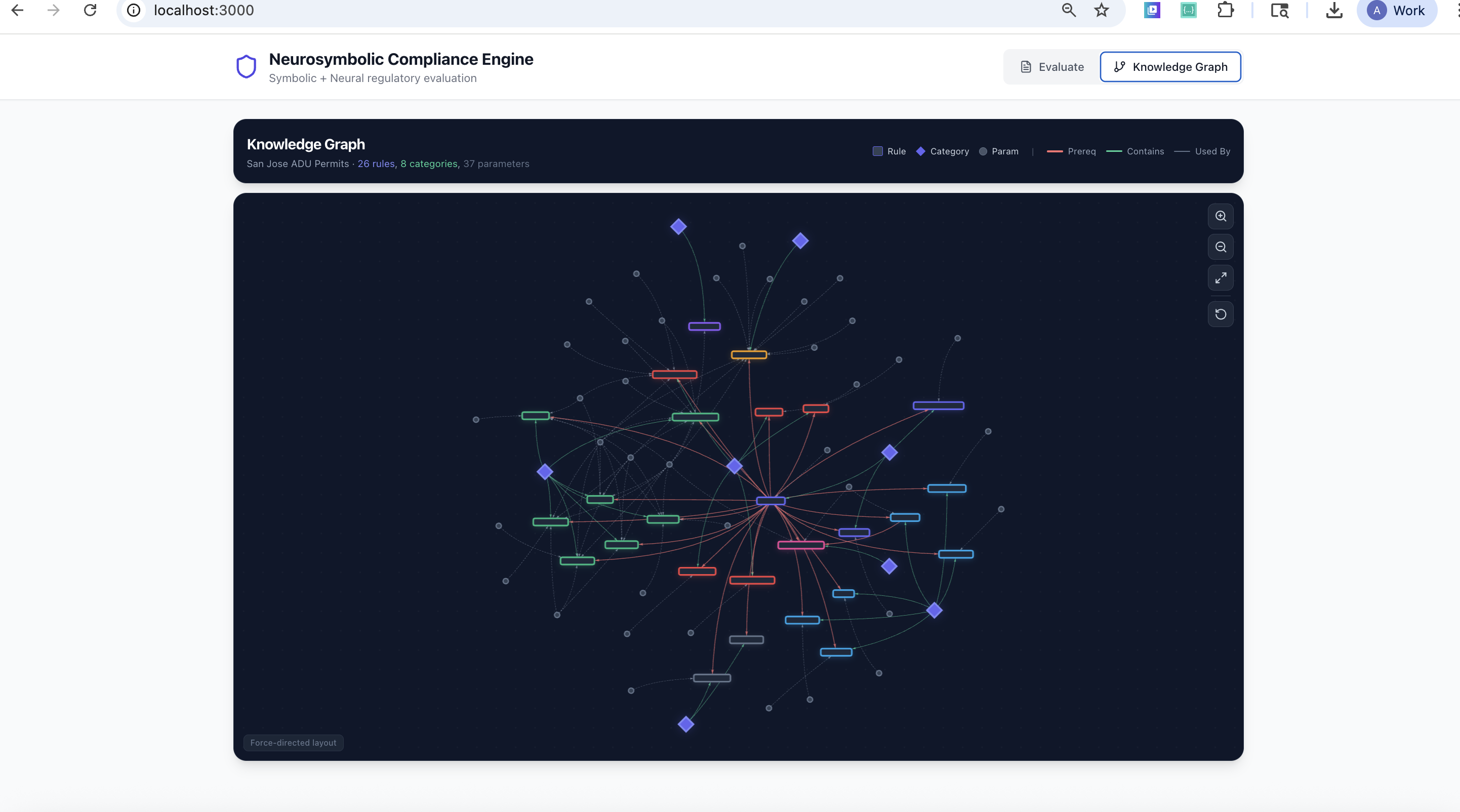
Knowledge Graph
-
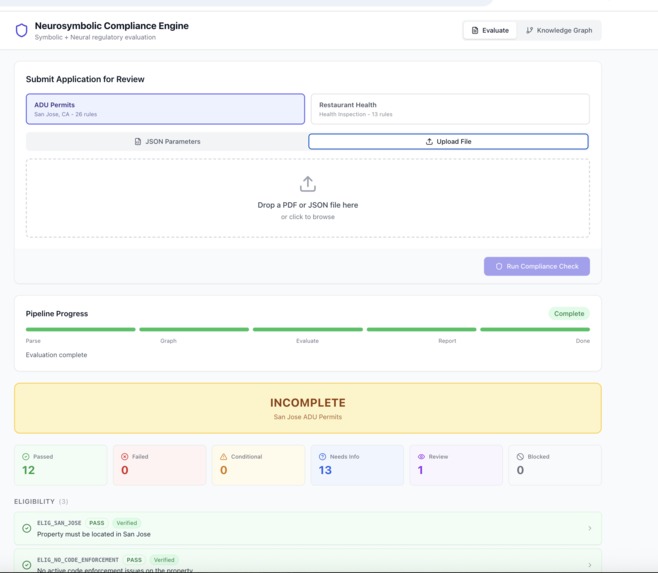
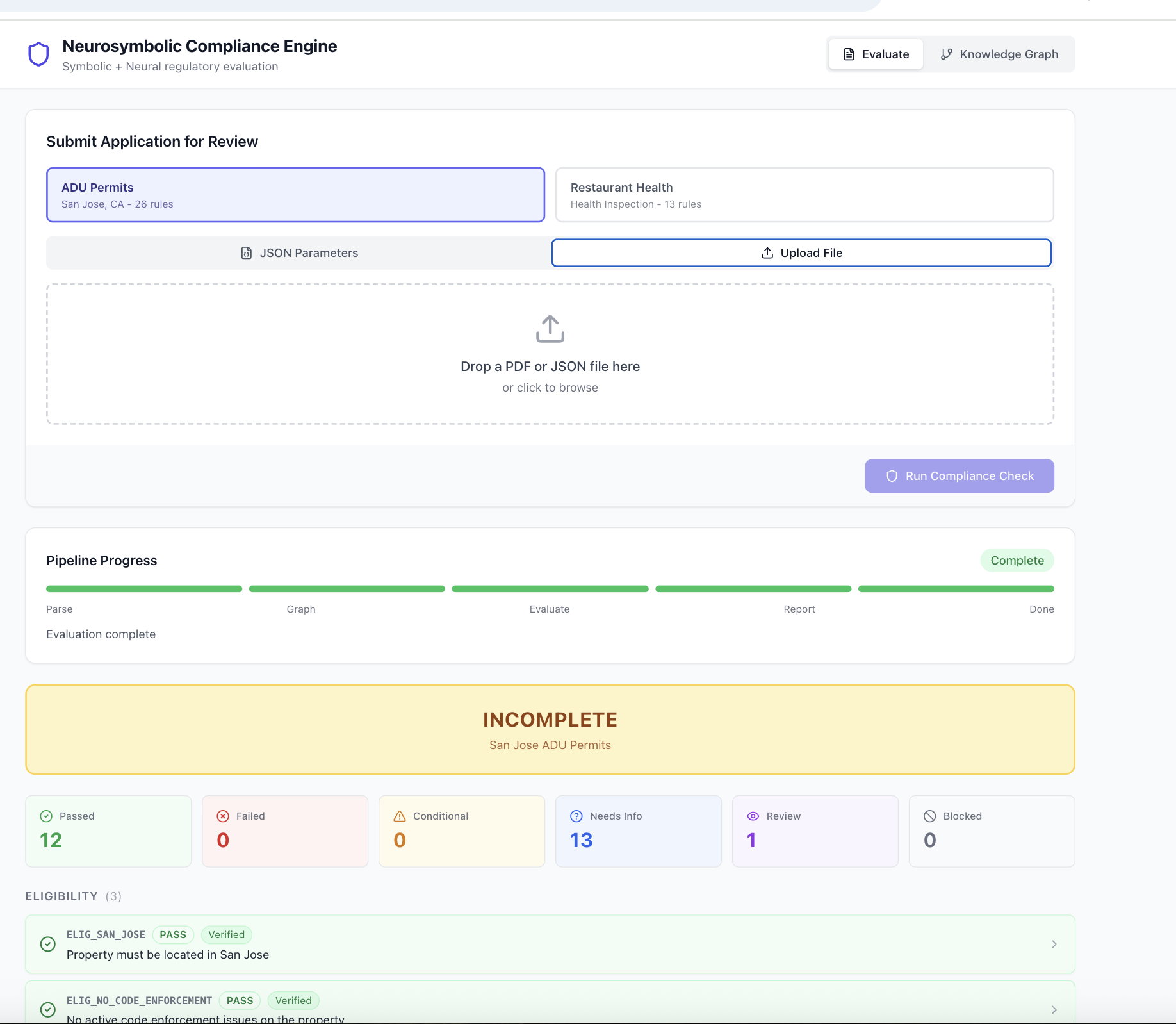
Web Application UI
-
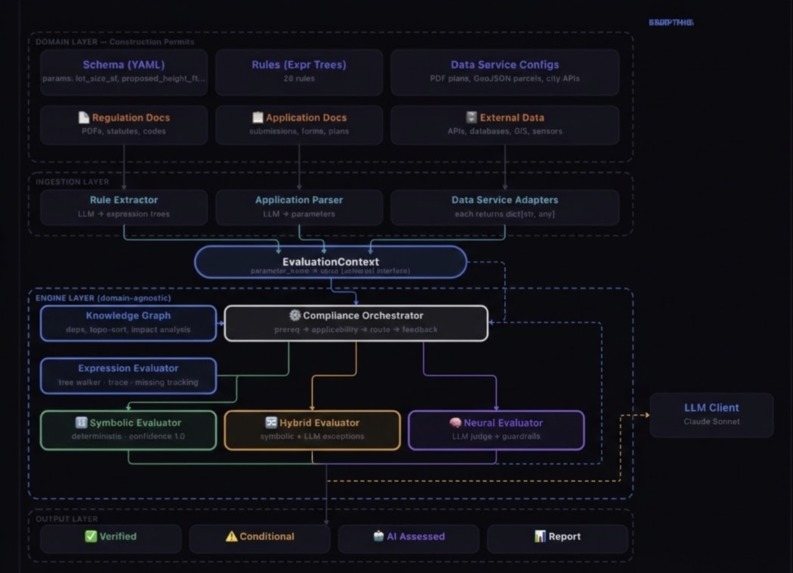
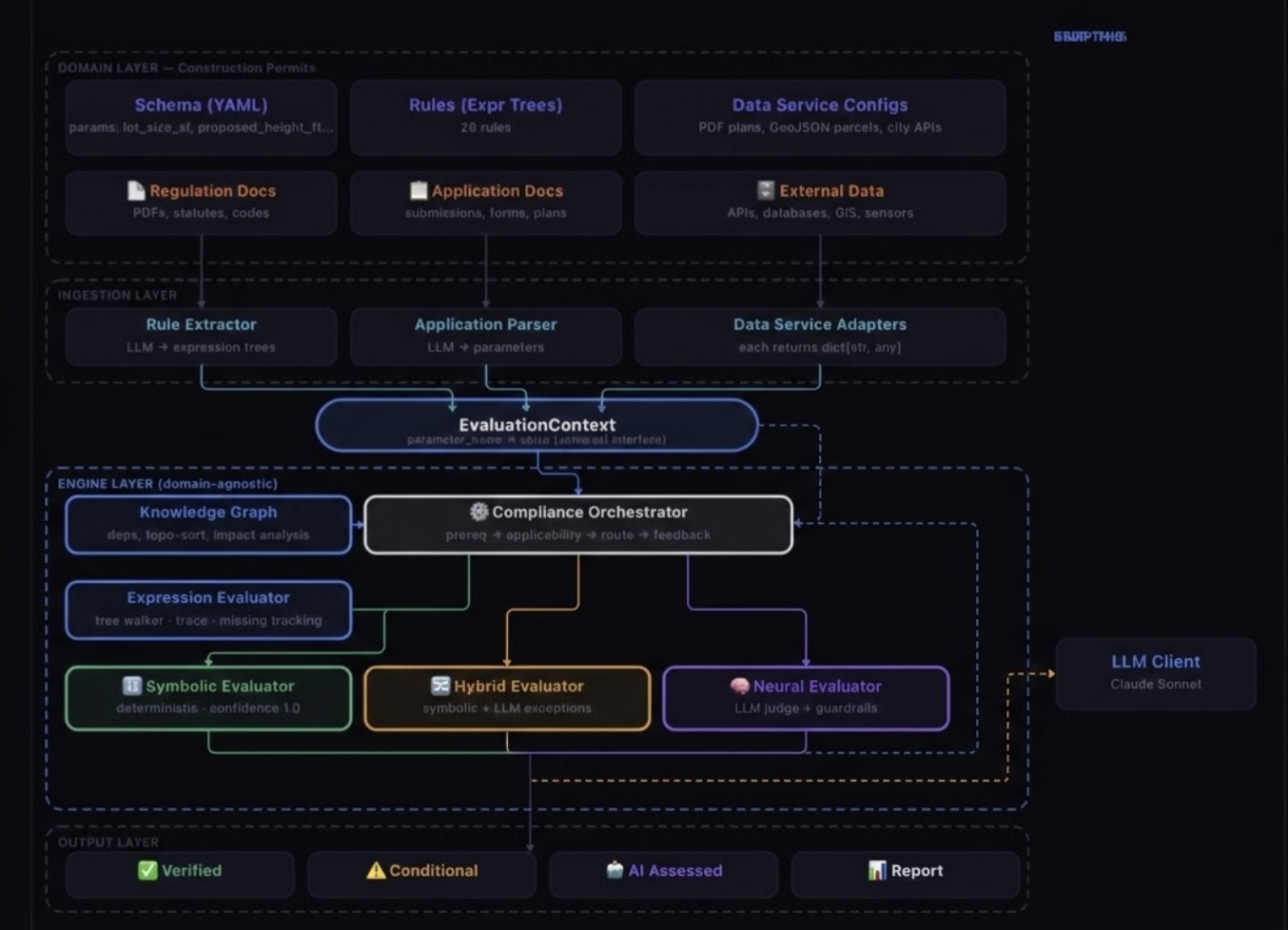
Architecture Diagram
Inspiration
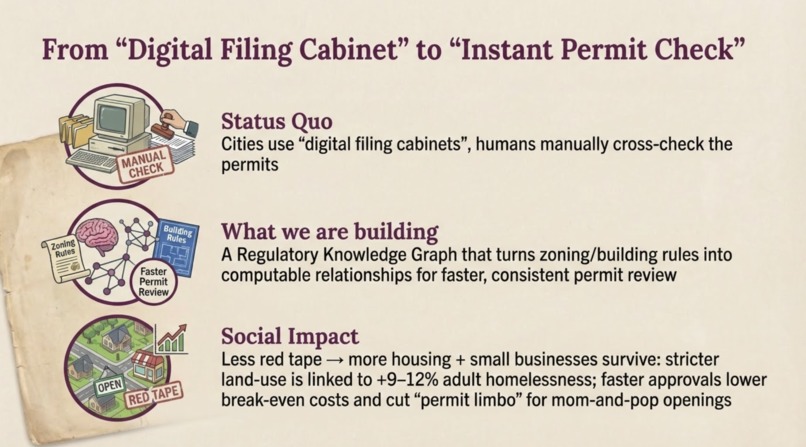
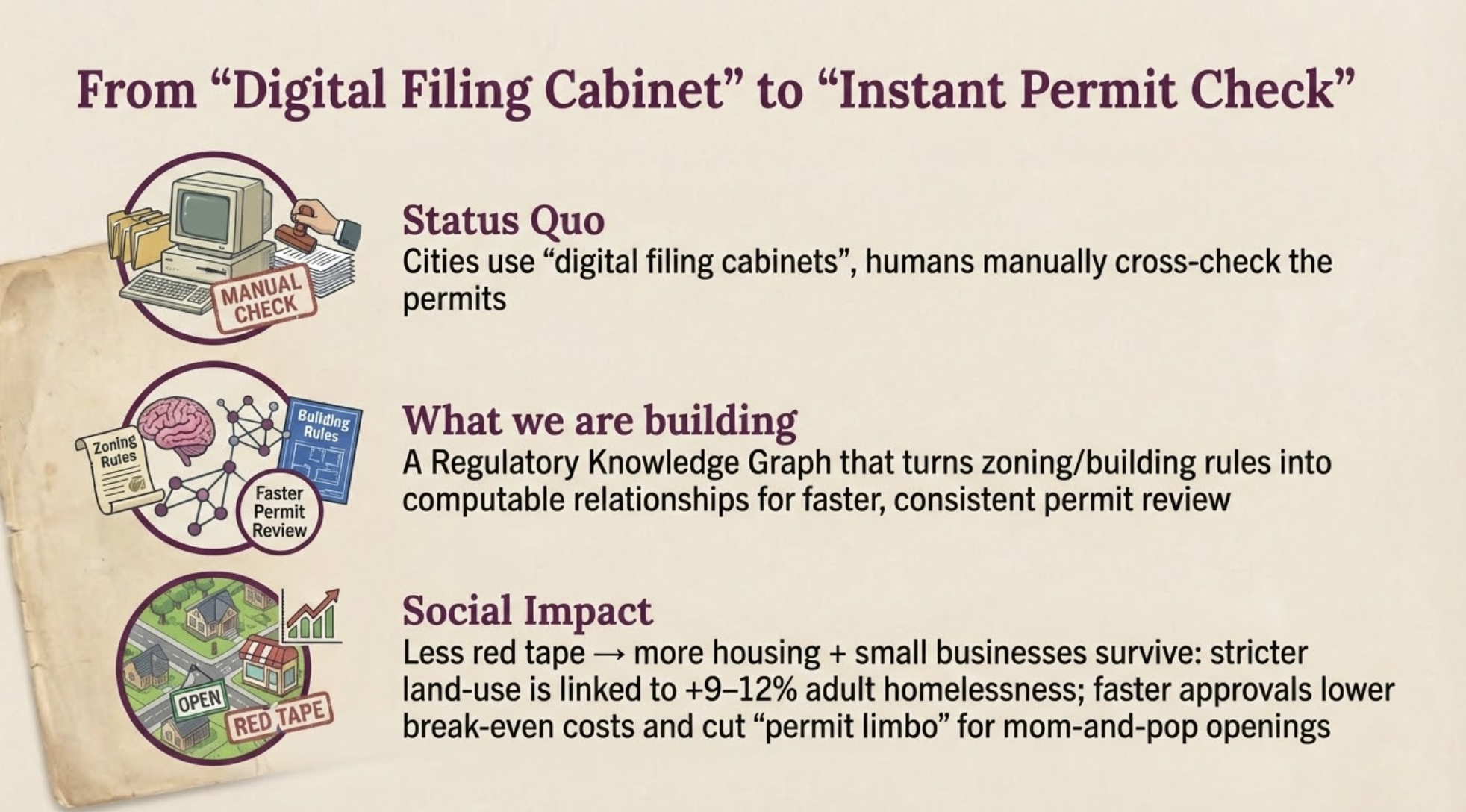
Regulatory systems are everywhere - construction permits, health inspections, financial audits - and they are expensive, slow, and brittle.
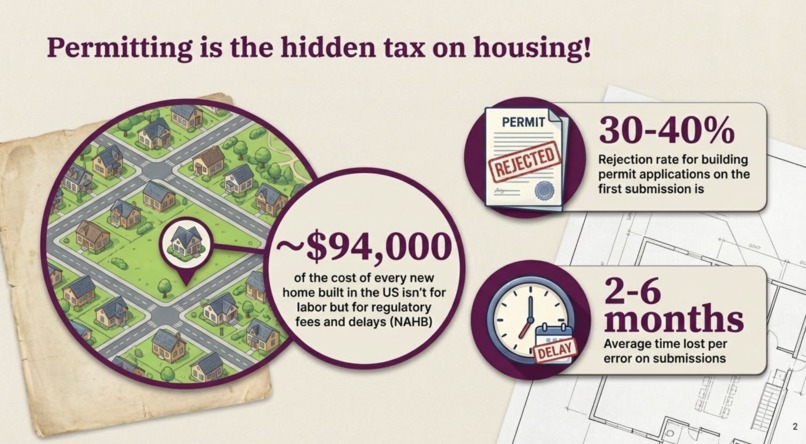
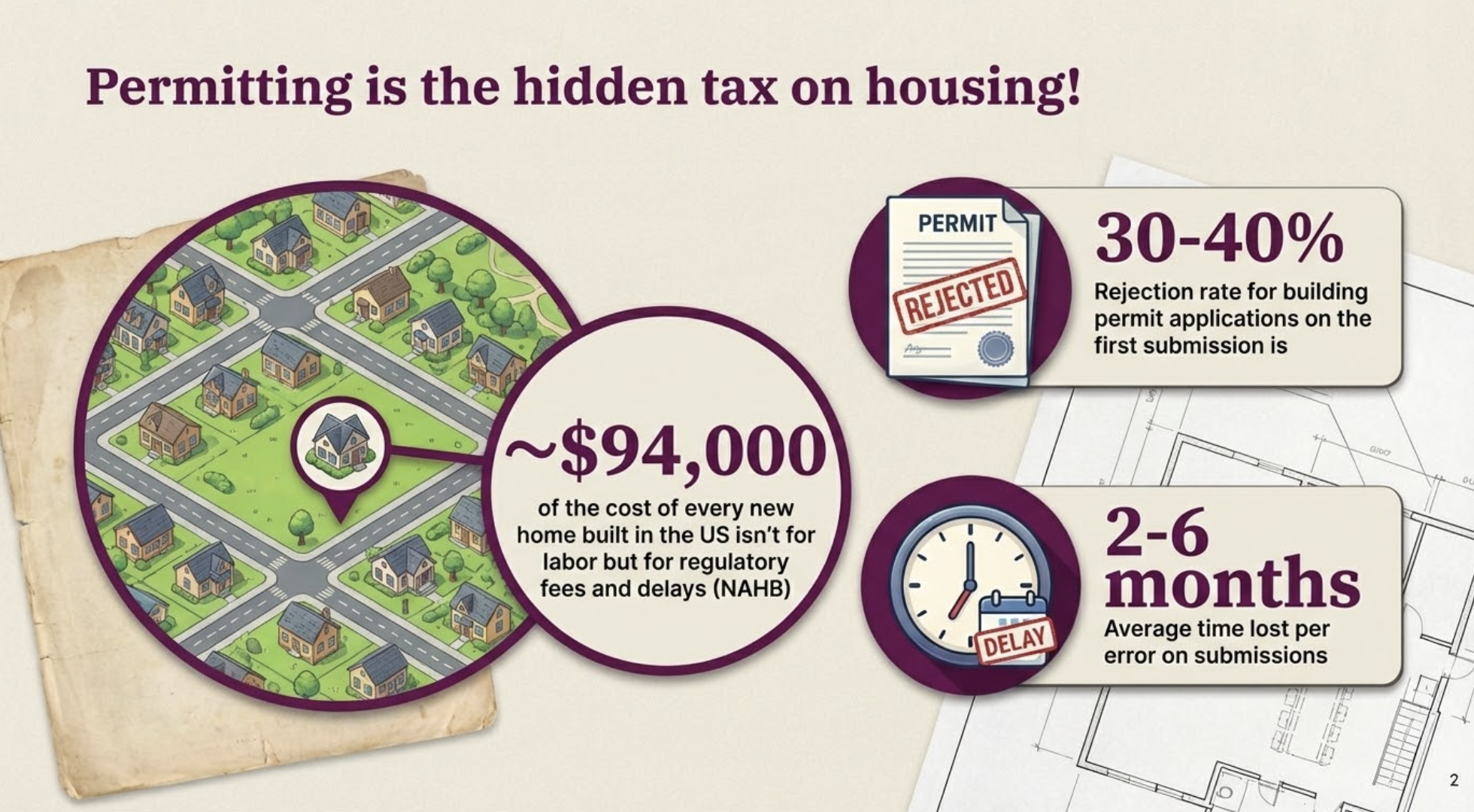
The first example we targeted was automating city approvals for building permits. Nearly $94,000 of the cost of every new U.S. home comes from regulatory overhead and delays. Major cities report extremely high revision rates on permit submissions due to preventable compliance errors. A single 6-month delay on a mid-sized project with $150,000 monthly carrying costs adds:
Almost $1 million lost before construction begins. The deeper issue isn’t just bureaucracy, it’s system design. Regulatory automation today forces a tradeoff:
- Symbolic rule engines are precise but brittle.
- Pure LLM systems are flexible but unreliable for strict compliance. We wanted to break that tradeoff.
So we built a Neurosymbolic Compliance Engine that combines deterministic logic with controlled AI reasoning without sacrificing the explainbility and trust.
What it does
Neurosymbolic Compliance Engine(NEC) is generalizable across verticals.
It evaluates regulatory documents against inputs needed for compliance. The system routes each rule to the correct reasoning engine:
- Symbolic Lane → deterministic math & logic (fully reproducible)
- Hybrid Lane → logic first, AI for exceptions (flagged for review)
- Neural Lane → structured AI evaluation for subjective standards
Every result is categorized as PASS, FAIL, BLOCKED, NEEDS_INFO, or REQUIRES_REVIEW and includes a full trace.
How we built it
The engine is domain-agnostic and schema-driven.
- YAML schema defines parameters and rule categories
- All data collapses into an Evaluation Context:
- parameter_name → value
- Rules are normalized into expression trees
- A compliance orchestrator:
- Orders rules via dependency graph (topology sort)
- Checks applicability
- Routes to symbolic / hybrid / neural evaluators
- Feeds computed outputs back into the context
Deterministic rules never call an LLM. AI is used only where subjective interpretation is required.
Challenges we ran into
Neurosymbolic systems are complex to build and we had to write a custom expression language in order to accomodate our queries on the knowledge graph.
Accomplishments that we're proud of
- Built a fully domain-agnostic compliance engine
- Designed a three-lane neurosymbolic routing architecture
- Achieved deterministic evaluation for numeric and logical rules
- Built structured AI evaluation with guardrails
- Created an auditable trace system for every decision
- Showed horizontal scalability across regulatory verticals
What we learned
- Regulatory friction is often computational, not political.
- Deterministic systems build trust; AI should augment, not replace logic.
- Decoupling the reasoning engine from domain knowledge unlocks scalability. Compliance doesn’t need to choose between precision and flexibility, it needs both.
What's next for NEC
- Expand into healthcare, financial, and inspection compliance
- Improve automated rule extraction pipelines
- Strengthen confidence calibration for neural evaluations
- Launch a compliance-as-a-service API
The long-term vision: An operating system for regulatory intelligence - where laws are executable, compliance is instant, and review cycles are dramatically reduced.
Built With
- claude
- fastapi
- neurosymbolic
- pdfplumber
- pydantic
- python
- restapi
- typescript
- yaml

Log in or sign up for Devpost to join the conversation.