-
-
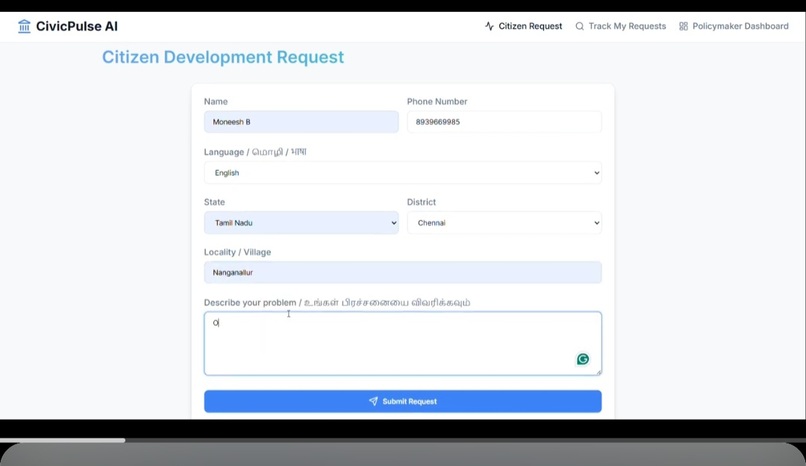
The input page
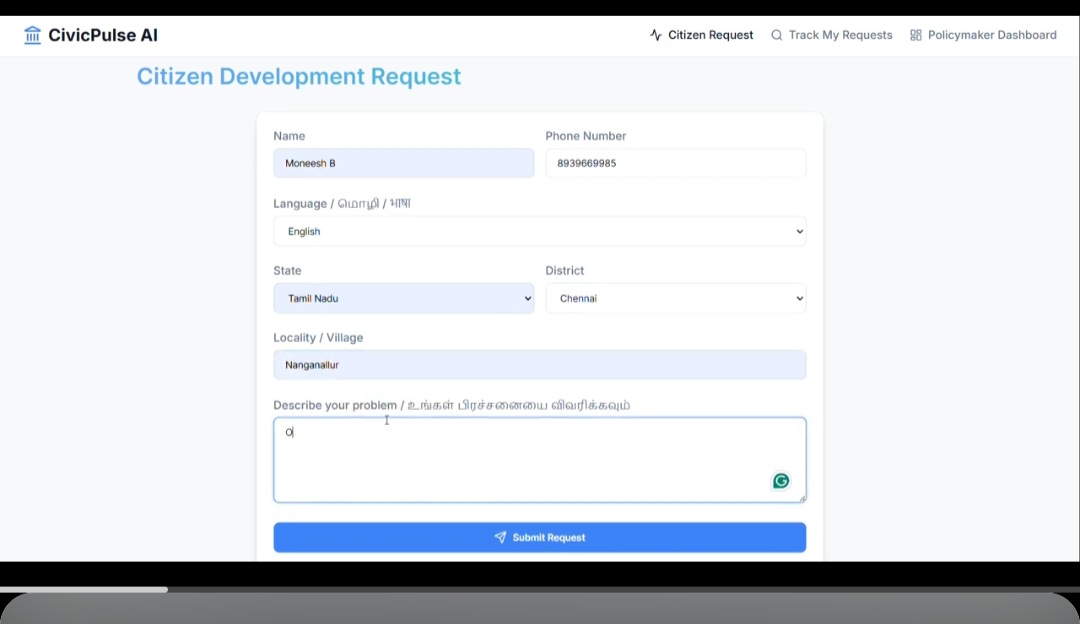
Inspiration
We wanted to bridge the gap between citizen needs and government decisions by turning scattered, multilingual complaints into actionable insights for smarter public investment.
What it does
The platform collects citizen complaints, supports multiple languages, maps issues geographically, tracks complaint status, identifies recurring problems, and helps policymakers prioritize areas needing urgent infrastructure investment.
Challenges we ran into
Handling multiple languages, accurately categorizing complaints, connecting different datasets, identifying priority regions, and designing a system that remains simple for citizens while providing meaningful insights to policymakers.
Accomplishments that we're proud of
Accomplishments that we're proud of We created a unified platform that transforms individual citizen complaints into structured, location-based insights, enabling transparent tracking and helping governments make more data-driven infrastructure decisions.
What we learned
We learned that solving civic problems requires more than collecting data. Connecting citizen voices with reliable data, AI, and visualization can turn complaints into actionable decisions and measurable public impact.
What's next for Civilic AI
Civilic AI will evolve into a real-time civic intelligence platform that connects citizens and governments. We plan to add predictive analytics to identify emerging infrastructure problems, integrate more government datasets, expand multilingual and voice-based reporting, and provide AI-driven investment recommendations. We also aim to enable department-level workflows, automated complaint routing, and transparent progress dashboards so citizens can track how their issues move from complaint → action → resolution.

Log in or sign up for Devpost to join the conversation.