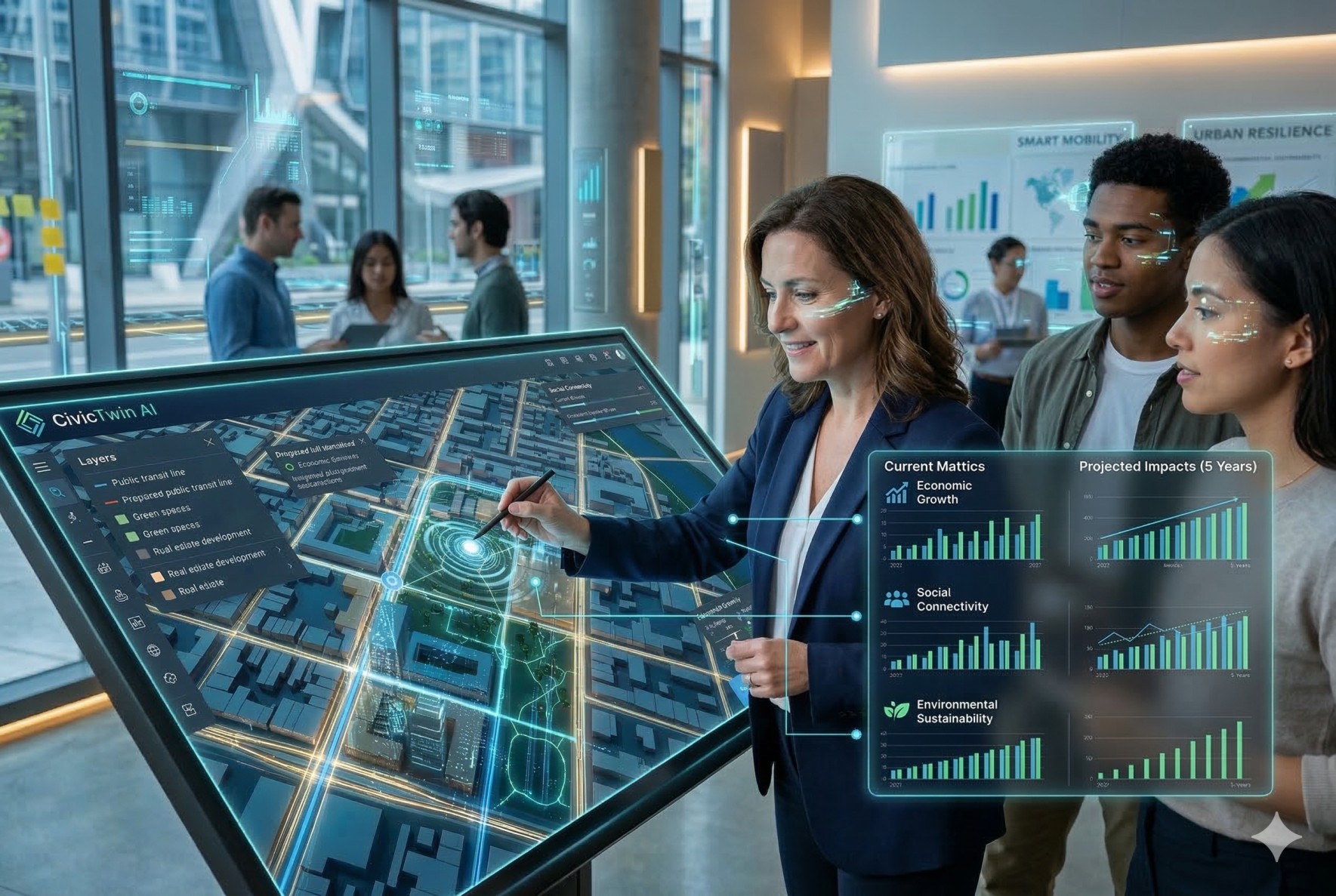
CivicTwin AI – My Hackathon Journey Inspiration
The idea for CivicTwin AI came from observing how many infrastructure and development decisions are made without fully understanding their long-term consequences. Governments, bureaucrats, and NGOs often invest large amounts of money in projects like roads, irrigation systems, hospitals, or markets. However, the real impact on the economy, environment, and society usually becomes visible only years later.
I started thinking about how we could make these decisions smarter and more data-driven. What if we could test development ideas before they are actually built?
That’s when the concept of a digital twin inspired me. A digital twin is a virtual representation of a real-world system where different scenarios can be tested safely. Instead of waiting years to see whether a project succeeds or fails, we could simulate its outcomes instantly.
My goal became clear: build a platform that allows people to explore development strategies and understand their potential impact before investing real resources.
What I Built
I developed CivicTwin AI, an AI-powered platform that allows users to simulate infrastructure development in a specific location.
Using an interactive map interface, users can:
Select a geographic location
Add infrastructure projects such as roads, hospitals, irrigation systems, or markets
Define project parameters such as budget, scale, and timeline
Run simulations to predict development outcomes
The system then generates insights such as:
Predicted economic growth
Environmental impact
Healthcare and education access improvements
Transportation efficiency
Social development indicators
To summarize the results, the system calculates an impact score by combining several development indicators. This provides a simple way for decision-makers to understand whether a development plan is beneficial overall.
How I Built the Project
CivicTwin AI combines several technologies to simulate development outcomes and generate insights.
The main components include:
A map-based user interface for selecting locations and adding infrastructure projects
A simulation engine that evaluates how projects influence different development indicators
Amazon Nova models to analyze complex scenarios and generate explanations
A visual dashboard to display predictions and insights
The workflow of the system is simple:
The user selects a location on the map
The user adds infrastructure projects
The system gathers contextual information about the region
Amazon Nova analyzes the scenario
The platform generates predictions and explanations
Results are displayed in a visual dashboard
This approach allows users to explore multiple development scenarios and compare their outcomes.
Challenges I Faced
One of the biggest challenges during development was changing the AI models used in the project.
Initially, I built the system using other AI APIs. The architecture, prompts, and response parsing were designed specifically for those models. Later, when I decided to integrate Amazon Nova, I had to redesign parts of the system.
Some of the challenges included:
Replacing the previous AI API calls with Amazon Bedrock integrations
Adjusting prompts so Nova models produced structured responses
Updating the backend logic to parse new model outputs
Testing different models to find the best balance between speed and reasoning
Although this required additional work, the transition was valuable because it improved the system’s reasoning capabilities and flexibility.
What I Learned
Building CivicTwin AI taught me several important lessons.
First, AI can be used not only for generating content but also for decision support systems. By combining AI with simulations and real-world data, we can create tools that help people make better decisions.
Second, architecture flexibility is important. AI tools and APIs evolve quickly, so systems should be designed in a way that allows models to be replaced or upgraded easily.
Finally, I learned how powerful the concept of digital twins can be for solving real-world problems. Simulating scenarios before implementing them can reduce risk, save resources, and improve planning outcomes.
Final Thoughts
CivicTwin AI demonstrates how artificial intelligence can help decision-makers explore development strategies before investing real resources. By combining simulation with AI reasoning, the platform allows users to understand the potential impact of infrastructure projects in advance.
Instead of guessing the future, we can simulate it.
This project is only a starting point, but it highlights how AI-powered planning tools could transform how governments, NGOs, and communities approach development in the future.
Built With
- amazon
- amazon-web-services
- bedrock
- charts.js:
- express.js
- lite
- node.js
- nova
- rule-based
- sdk
- vite:-ultra-fast-build-tool-and-dev-server.-vanilla-javascript-&-html5:-high-performance

Log in or sign up for Devpost to join the conversation.