Inspiration
Public records contain important distinctions that are easy to lose in an AI-generated answer. A council authorizing a purchase does not establish that the money was paid. A city reporting a project phase does not independently prove construction is complete.
I built CivicTrace to make those distinctions visible and traceable. The goal is a tool people can download, use with their own selected records, and inspect when an answer needs closer review.
What it does
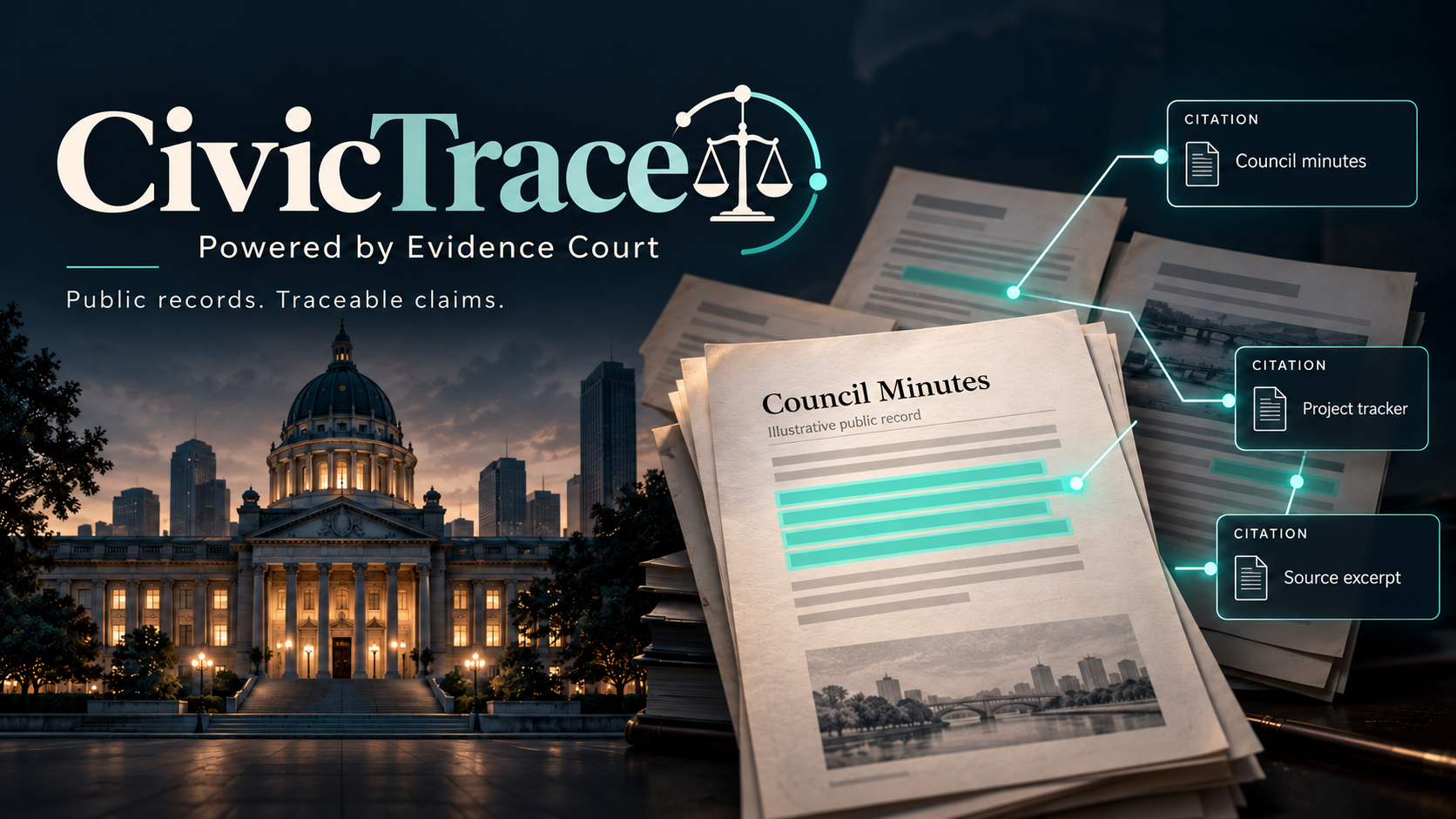
CivicTrace lets a user create a local case, upload a UTF-8 text file or paste an excerpt, record its source and date, and map exact passages to structured facts. Those mappings have an explicit review step before they can support confirmed claims.
For a live investigation, NVIDIA Nemotron runs through Nebius Token Factory, reads case-scoped evidence through tools, and proposes citations. Evidence Court then applies deterministic rules to decide what the selected evidence supports. The model’s proposal and the Court’s result remain separate and visible.
The included Exeter case demonstrates council authorization and a city project tracker. The challenges test whether the system incorrectly turns authorization into spending or an administrative event into proof of construction. Unsupported conclusions remain unverified or require review.
How I built it
The application uses Python, FastAPI, a browser-based workbench and persistent local storage. The demonstrated model is nvidia/nemotron-3-super-120b-a12b, accessed through the Nebius Token Factory API.
The portable launcher starts offline. Live inference requires explicit activation and a privately entered API key. Durable spending reservations survive restarts, and uncertain provider outcomes retain their allowance instead of automatically refunding it. Local limits are conservative estimates, not a provider-enforced billing cap.
I used AI-assisted development and review, then exercised the actual product through offline checks and real Nebius investigations. The submission video shows the working interface and genuine provider execution.
Challenges and lessons
The hardest work was connecting useful model reasoning to evidence rules that remain strict when a citation is wrong, a source has the wrong role, or a request fails halfway through. Exact-excerpt validation, case isolation, persistent accounting and clear review states became essential parts of the product.
I learned that a convincing answer is not enough. Users need to see which records were selected, which passages support a claim, and where the evidence stops.
What is available now
The public MIT-licensed release includes the application, setup instructions, a first-case walkthrough, sample text excerpts, tests and dependency notices. It runs locally without a GPU. The documentary workflow works offline; live Nemotron investigations require a Nebius account, model access and usage allowance.
Honest limits and next steps
CivicTrace currently imports text, not PDFs or scanned documents. Source URLs are recorded but not fetched. Imported-text hashes do not authenticate original documents, and human review is not an independent fact audit. This is a single-user local workbench, not a publicly exposed hosted service.
Future work would focus on easier evidence intake, stronger original-document verification and usability, while preserving the separation between model suggestions and evidence-bound decisions.
How to test
Download the portable build from the linked GitHub repository and follow the README and first-case tutorial. The local evidence workflow runs without an API key. Live NVIDIA Nemotron investigations require a Nebius Token Factory API key with model access and available usage credits; provider charges may apply. No API key is included. The demonstration video shows genuine live inference.
Built With
- css
- fastapi
- html
- javascript
- nebius
- nvidia-nemotron
- python
- sqlite
