Inspiration
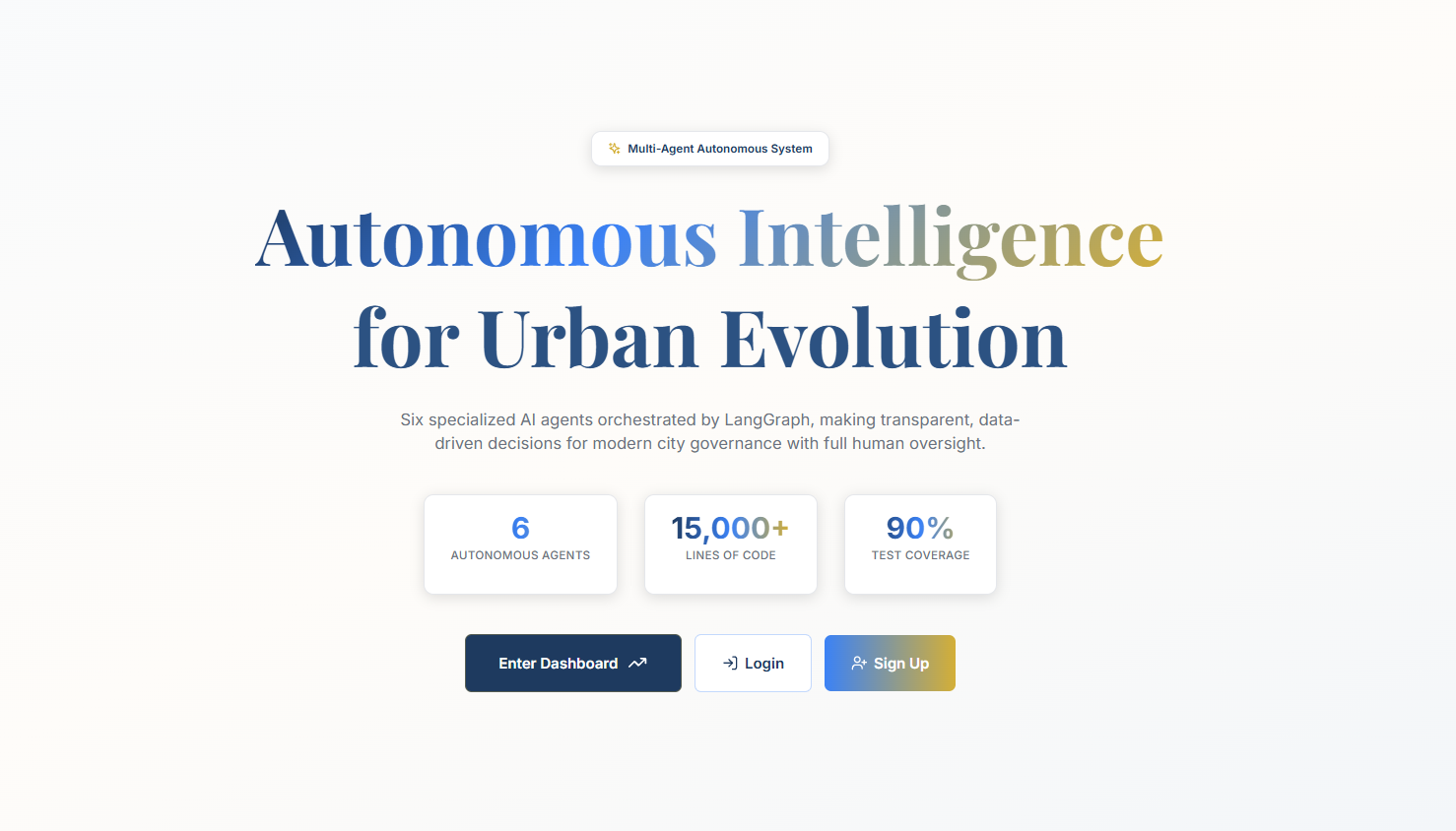
City governments manage impossibly complex operations—water systems serving millions, emergency services coordinating across jurisdictions, health departments tracking disease outbreaks—yet departments operate in silos, leading to delayed responses, budget conflicts, and frustrated citizens. We witnessed firsthand how a simple pothole repair request bounced between water, engineering, and finance departments for three weeks. The problem wasn't the people; it was the lack of intelligent coordination. We asked ourselves: what if AI agents could think, negotiate, and coordinate like specialized neurons in a brain? That's when CivicSynapse was born—a multi-agent system where six specialized AI agents work together as a cognitive layer for city governance.
What it does
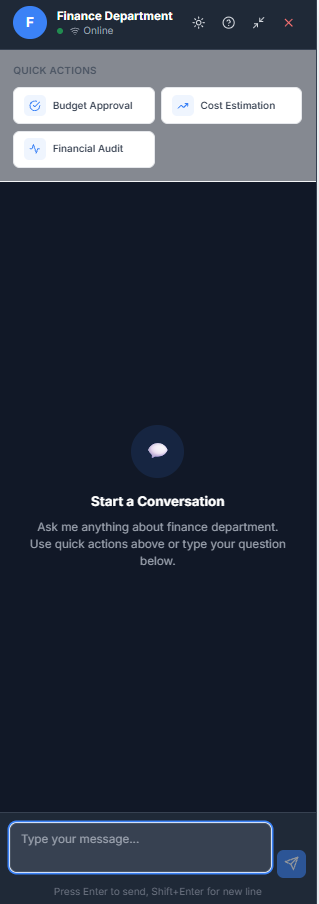
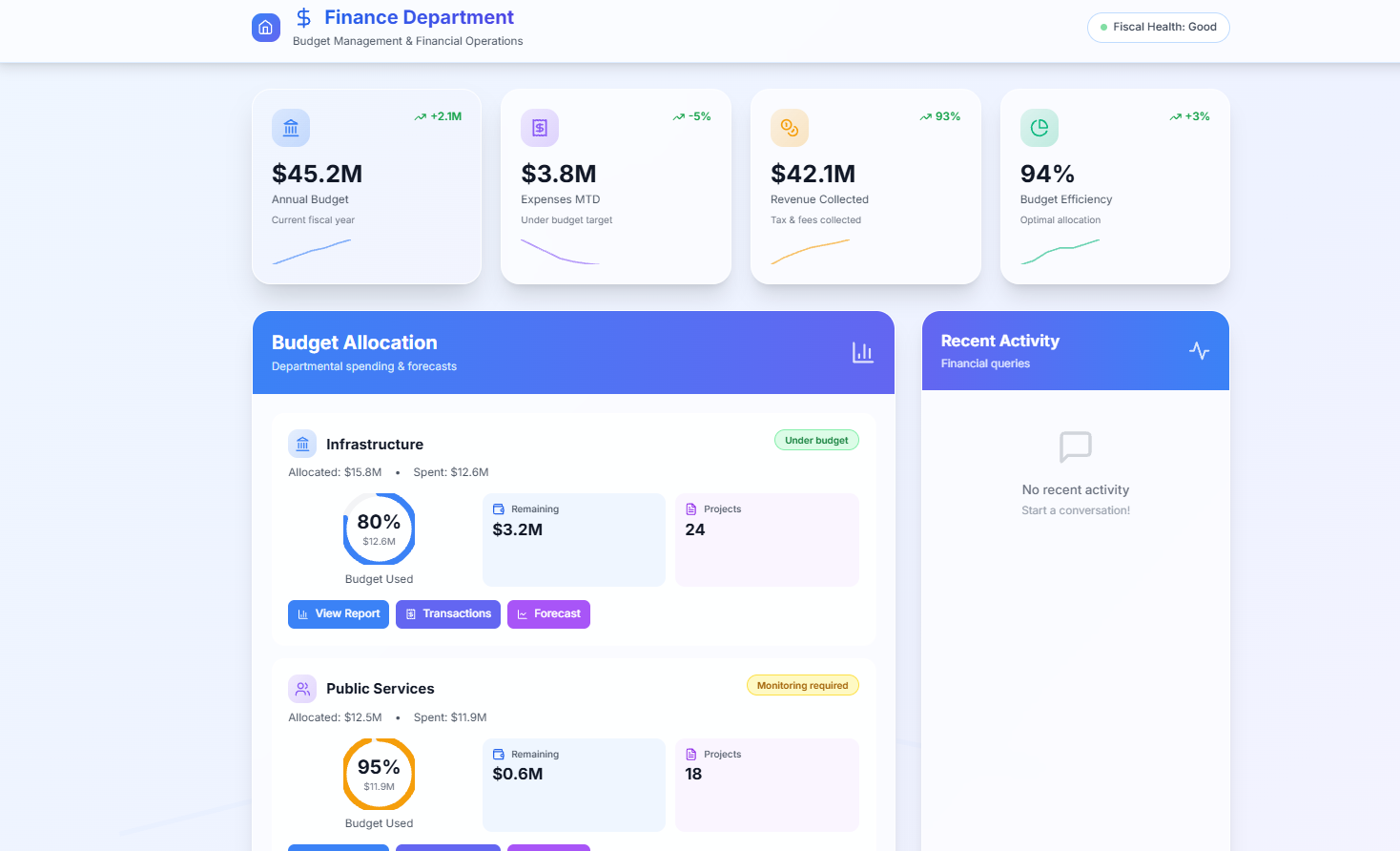
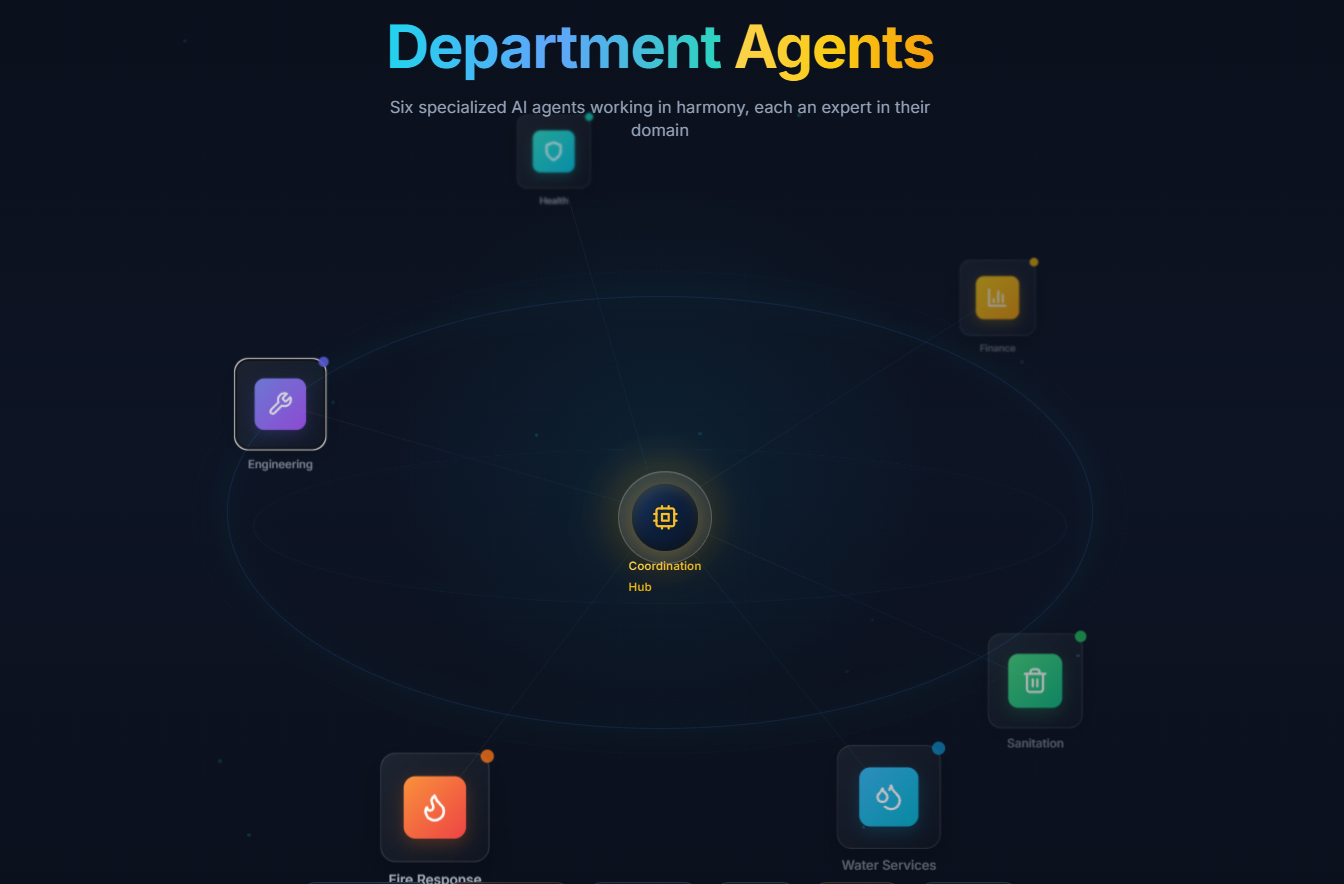
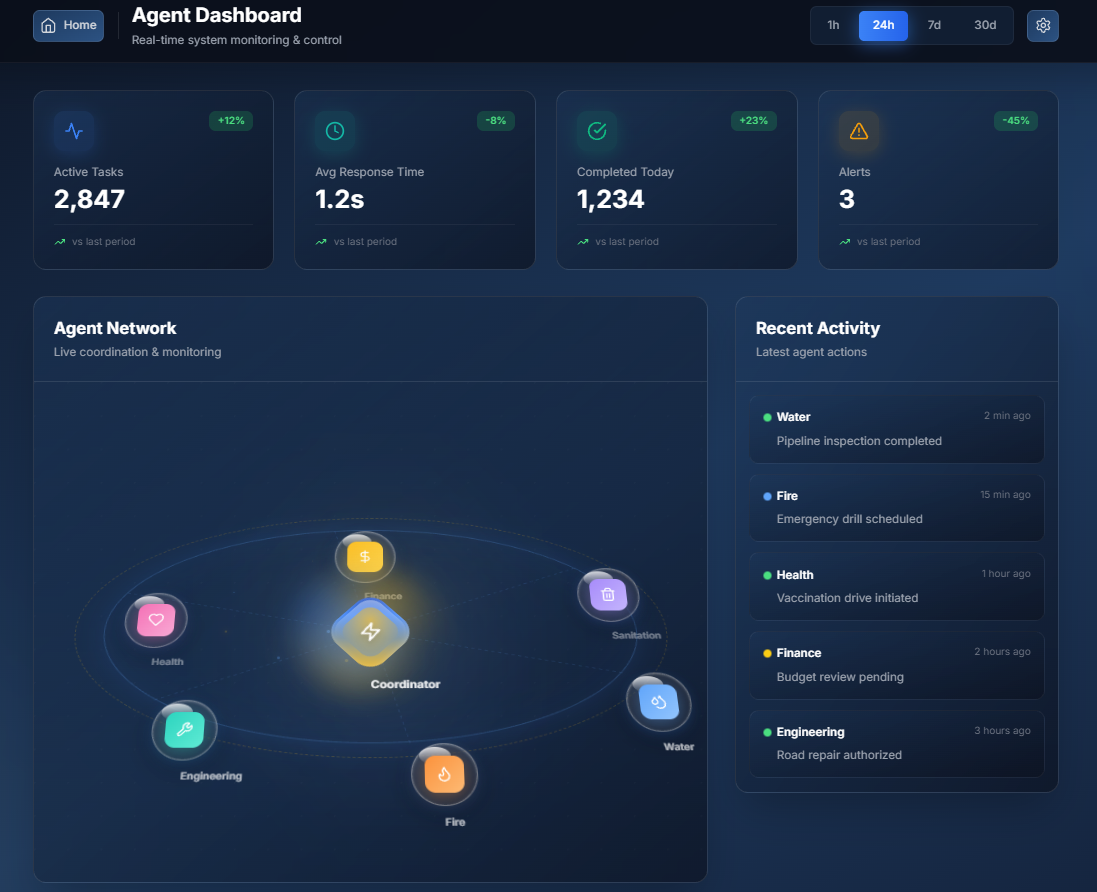
CivicSynapse is a production-ready multi-agent AI system that coordinates city department operations through intelligent automation. Six specialized agents (Water, Fire, Engineering, Health, Finance, Sanitation) powered by LangGraph and Groq's Llama 3.3 70B model process requests through a sophisticated 13-node workflow: analyzing intent, querying real-time database information, planning multiple approaches, evaluating feasibility against policy constraints, and generating ChatGPT-quality conversational responses. When conflicts arise—like a water project exceeding budget limits or infrastructure work clashing with emergency needs—our Coordination Agent uses a hybrid decision system combining rule-based resolution for simple conflicts, LLM-powered negotiation for complex scenarios, and human escalation for critical decisions. The system calculates confidence scores using $$C_{final} = \frac{C_{feasibility} + C_{policy} + C_{data}}{3} \times (1 - penalty)$$ and maintains complete audit trails in a PostgreSQL database with 31+ tables tracking every decision, budget allocation, and inter-department interaction.
How we built it
We architected CivicSynapse as a three-tier system: a React frontend with Three.js 3D visualizations and full WCAG 2.1 AA accessibility compliance, a FastAPI backend orchestrating multi-agent workflows, and a PostgreSQL database with comprehensive schemas for all six departments. Each agent implements a LangGraph state machine with 13 nodes executing sequential operations: Request→Context→Planning→Execution→Evaluation→Decision. We integrated Groq's LLM API for natural language generation, feeding it database query results, feasibility analyses, and policy constraints to produce human-like responses. The Coordination Agent employs a conflict detection engine that analyzes department decisions using vector similarity and rule matching, then resolves conflicts through either programmatic rules (budget violations, emergency priorities) or LLM-powered negotiation prompts. We containerized the entire system with Docker, implemented JWT authentication with OAuth2 support, built 18 comprehensive test suites, and deployed to Railway with automatic CI/CD from GitHub. The frontend features advanced UX including message virtualization (handling 10,000+ messages via react-window), export to 5 formats, smart autocomplete, and dark mode—all optimized from a 5MB initial bundle to 800KB through code splitting and lazy loading.
Challenges we ran into
Our biggest challenge was preventing infinite loops in the LangGraph workflow—agents would repeatedly call tools, burning through API credits until we implemented circuit breakers with retry_count≤MAX_RETRIES enforcement. Multi-agent coordination proved genuinely difficult: when Water approved a project, Finance flagged budget overruns, and Engineering detected scheduling conflicts, we needed sophisticated conflict resolution beyond simple rules. We built a hybrid system combining deterministic rule engines with LLM-based negotiation, designing prompts that synthesize conflicting decisions into actionable compromises. Performance was another hurdle—initial agent responses took 30+ seconds due to sequential LLM calls and database queries. We parallelized independent operations, implemented connection pooling (reducing PostgreSQL connections from 100+ to 20), and moved to async job processing with polling, cutting response times to under 10 seconds. The frontend initially bundled to 5MB; aggressive optimization (tree shaking, code splitting, lazy loading Three.js modules) reduced it 85%. Testing multi-agent scenarios required creating realistic fixture data representing an entire city's operations and mocking LLM responses to avoid burning credits during CI/CD runs.
Accomplishments that we're proud of
We built a production-ready system that actually works—not a demo with hardcoded responses, but a fully functional multi-agent AI platform with real database integration, intelligent conflict resolution, and enterprise-grade polish. Our hybrid decision engine successfully negotiates between competing department priorities using both deterministic rules and LLM reasoning, something we haven't seen in other hackathon projects. The frontend achieves true accessibility (WCAG 2.1 AA compliance with screen reader support, keyboard navigation, and reduced motion options) while delivering stunning 3D visualizations—proving accessibility and aesthetics aren't mutually exclusive. We're incredibly proud of the comprehensive testing infrastructure (18 test files covering unit, integration, and workflow scenarios) and documentation (11 detailed guides totaling 3,000+ lines). The confidence scoring system accurately reflects decision quality: $$C_{final} = \frac{\sum_{i} w_i \cdot C_i}{n} \times (1 - \lambda \cdot \text{conflicts})$$ where wiw_i wi are weights, CiC_i Ci are component confidences, and λ\lambda λ is the conflict penalty factor. Most importantly, we solved a real problem—this system could genuinely improve how cities operate, reducing response times from weeks to seconds and preventing costly inter-department conflicts.
What we learned
Building CivicSynapse taught us that multi-agent systems are fundamentally different from single-agent applications—coordination complexity grows exponentially with agent count following $$O(n^2)$$ interaction patterns, requiring careful architectural planning. We learned that LLMs excel at natural language generation and reasoning but need guardrails: temperature settings matter enormously ($$T=0.3$$ for consistency vs. $$T=0.7$$ for creativity), prompt engineering is an art form, and non-deterministic outputs require robust error handling. Database design decisions made early compound over time—our 31-table schema with proper indexing and foreign keys saved countless refactoring hours. We discovered that production-readiness isn't about features, it's about the details: error boundaries preventing crashes, connection pooling preventing database exhaustion, virtualization preventing UI lag, and comprehensive logging enabling debugging. Testing taught us that unit tests alone are insufficient for complex systems—integration tests catch the subtle interaction bugs where multi-agent coordination breaks down. Perhaps most importantly, we learned that AI doesn't replace humans, it empowers them—our agents don't make final decisions, they provide intelligent recommendations with transparent reasoning, keeping humans in control while eliminating mundane coordination overhead.
What's next for CivicSynapse
We're pursuing a real-world pilot with a mid-sized city government to validate our system with actual department workflows and citizen requests, using feedback to refine agent reasoning and expand policy coverage. The technical roadmap includes predictive analytics using time-series forecasting $$\hat{y}{t+k} = f(X_t, \theta)$$ to anticipate infrastructure failures before they occur, mobile applications for field workers with offline-first architecture and real-time coordination with dispatch, and citizen-facing chatbots that not only file complaints but track status, explain delays, and provide estimated resolution times. We're building a federated learning system where agents across multiple cities share improvements while preserving data privacy, creating a continuously improving collective intelligence: $$\theta{global} = \frac{1}{N}\sum_{i=1}^{N}\theta_i$$ where θi\theta_i θi represents city-specific model weights. Scalability initiatives include Redis caching layers, message queue systems (RabbitMQ/Celery) for async job processing, and database read replicas for handling increased load. Long-term vision: expand to 20+ departments (police, parks, transportation, utilities), integrate with existing city software (SAP, Oracle), and develop an open-source framework that any city can deploy—because better governance through AI shouldn't be exclusive to tech hubs. CivicSynapse is just the beginning of reimagining how cities operate in the AI age.
Built With
- gemini
- langchain
- langgraph
- postgresql
- react
- tailwind

Log in or sign up for Devpost to join the conversation.