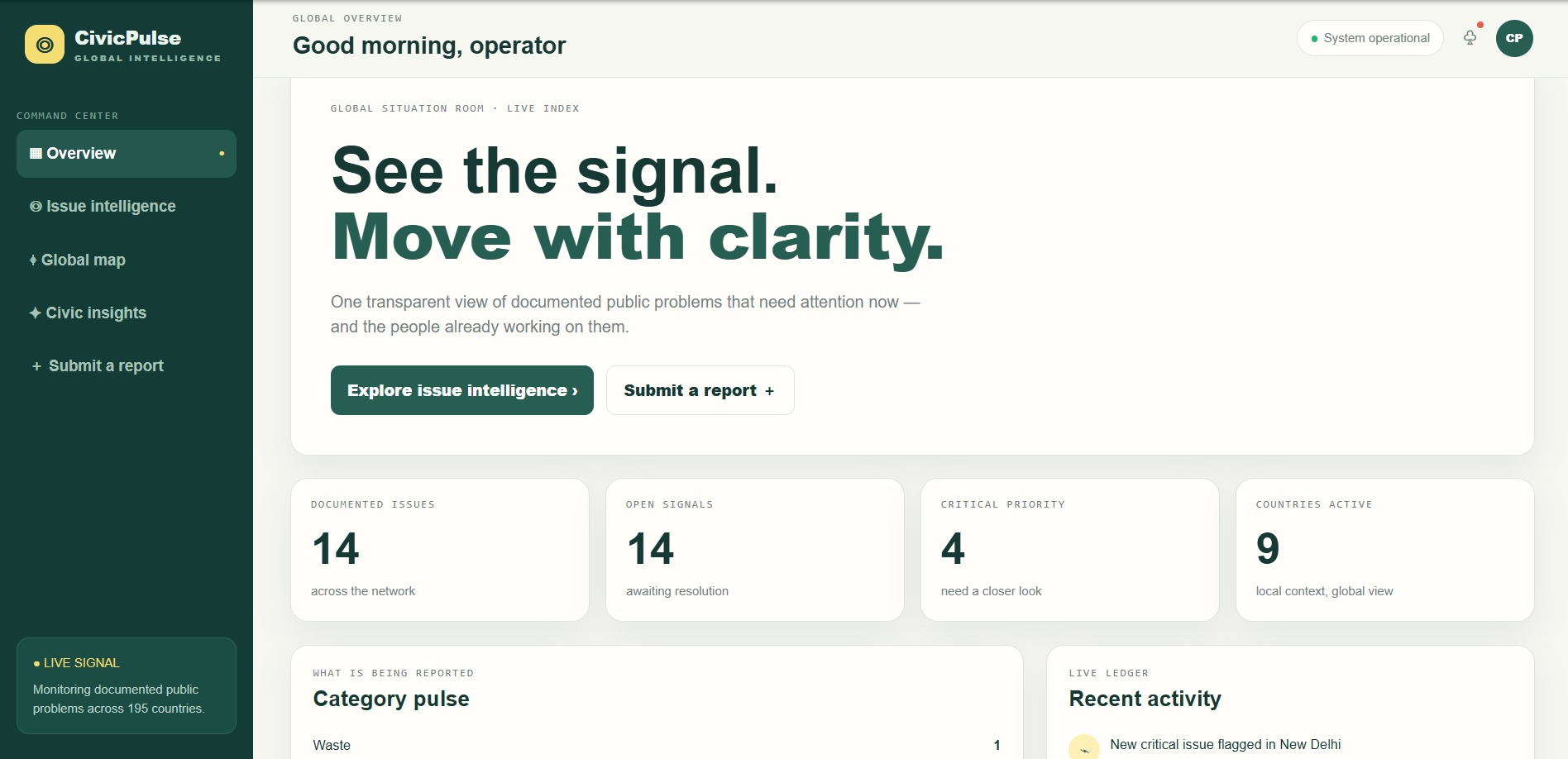
#CivicPulse — See the Signal. Move with Clarity.
Inspiration
It's easy to hear about problems happening around the world, but much harder to see them all in one place and understand where attention is actually needed.
I wanted to build something that felt like a command center for civic issues — a place where someone could quickly see what problems are being reported, where they're happening, how urgent they are, and what kind of issues are becoming common.
That idea became CivicPulse, a global civic-intelligence dashboard for exploring documented public problems.
What it does
CivicPulse brings civic issues into one interactive interface. Users can:
- Explore documented issues by category and priority
- View issues geographically on an interactive world map
- See which issues are open, being investigated, monitored, or in progress
- Look at patterns across the current issue dataset
- Submit a new civic report with context and a source organization
- Receive notifications about important updates
The dashboard currently demonstrates issues involving flooding, air quality, water pollution, infrastructure, climate, housing, and waste across multiple countries.
How I built it
I built CivicPulse as a standalone web application using HTML, CSS, and JavaScript.
The interface is organized around five main sections:
- Overview — a high-level snapshot of the current civic situation
- Issue Intelligence — a list of documented issues and their priority
- Global Map — an interactive geographic visualization
- Civic Insights — a quick analysis of patterns in the dataset
- Submit a Report — a form for adding new civic signals
The project uses JavaScript to generate the dashboard dynamically from a structured issue dataset. Each issue contains information such as its title, city, country, category, priority, status, latitude, and longitude.
For the map, I built the visualization directly into the frontend using SVG and JavaScript rather than relying on a large mapping framework. Users can drag the map, zoom in and out, reset the view, and select individual issue markers.
I also designed the interface to be responsive so the dashboard can adapt to smaller screens.
Challenges
One of the biggest challenges was making a large amount of information understandable without overwhelming the user.
A civic dashboard can quickly turn into a wall of numbers and lists, so I experimented with different ways of presenting the same information. I ended up combining statistics, category bars, a live activity feed, an issue list, and a map so users can approach the information from different angles.
Another challenge was building the interactive map. Instead of simply displaying a static image, I wanted it to feel like an actual tool. I implemented coordinate conversion, markers, zooming, panning, and marker interactions directly in JavaScript.
I also had to think carefully about how reports should be presented. Civic information is much more useful when people can understand its context, which is why the report form asks for details such as the issue description, location, category, and source organization.
What I learned
This project taught me that building a useful interface isn't just about making something look good. Information architecture matters just as much as the code.
I learned more about dynamically rendering UI with JavaScript, handling interactive maps, working with geographic coordinates, designing responsive layouts, and thinking about how users navigate large datasets.
Most importantly, I learned how much easier it is to understand a complicated problem when you can approach it visually and from multiple perspectives.
What's next
CivicPulse is currently a frontend prototype, but I would like to take it much further.
Future versions could connect to real public datasets and APIs, allow users to verify and update reports, provide stronger source attribution, add user accounts, and use real-time data to keep the issue map continuously updated.
The ultimate goal is simple:
Make civic problems easier to see, understand, and act on.
AI generated text with human review

Log in or sign up for Devpost to join the conversation.