Inspiration
Our inspiration began with a standard problem: citizens need a better way to report local issues like potholes and broken streetlights. We noticed, however, that reporting is only half the battle. The real challenge lies in the slow, often opaque process of getting those issues fixed. This led to a bigger question: What if a community didn't have to wait? What if we could empower residents to take direct ownership of their neighborhood's well-being?
CivicOS was born from the desire to transform passive complaint reporting into active community governance. We were inspired by the principles of circular economies and decentralized autonomous organizations (DAOs) to create a self-sustaining ecosystem where civic action is not just a duty, but a rewarding and collaborative experience.
What it does
CivicOS is a "Community Operating System" that empowers residents to govern, fund, and fix their own neighborhoods. It integrates four key features into a seamless platform:
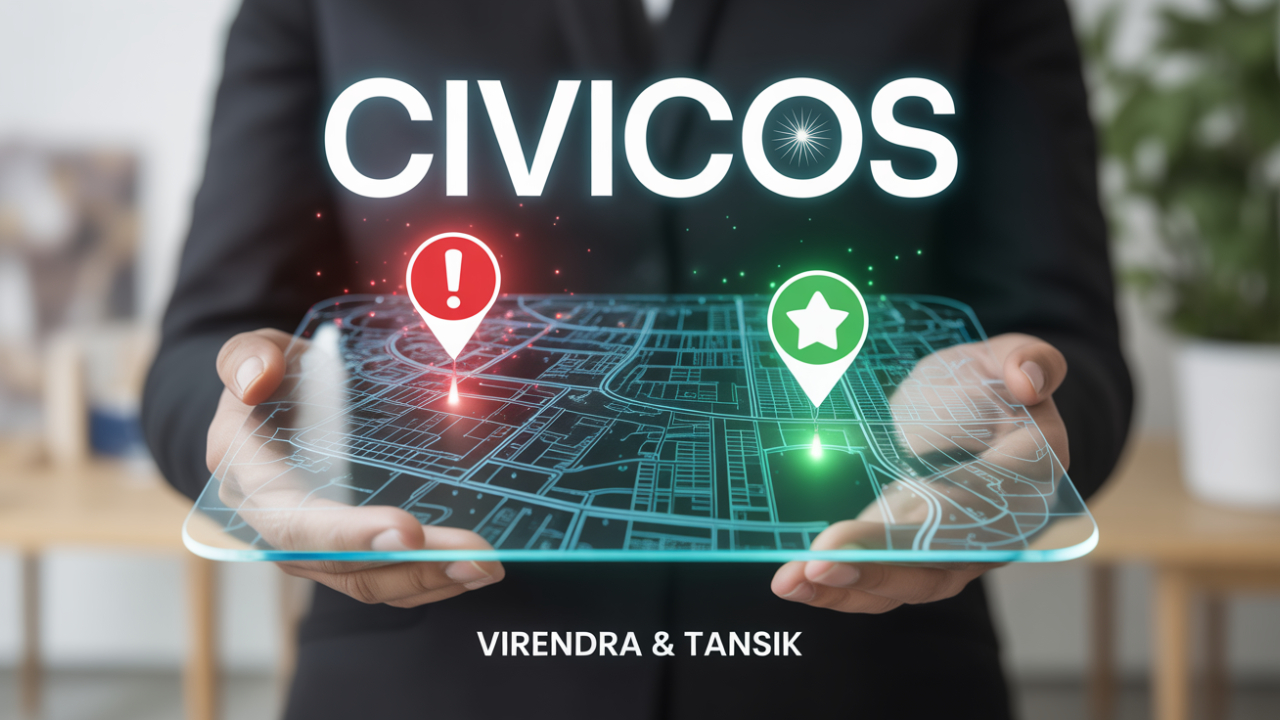
- The Living Map: A geo-social hub where users can pin not only civic issues (like garbage overflow) but also positive community stories and landmarks. This builds a rich, emotional connection to the neighborhood.
- The Fixer Marketplace: When an issue is reported, it's simultaneously posted as a job to a marketplace of vetted, local tradespeople ("Fixers"). This creates a direct path to a quick resolution.
- CivicCoin Economy: A digital token, "CivicCoin," is the lifeblood of the platform. Users earn it for positive actions like reporting issues or verifying fixes. They can then spend their CivicCoin at participating local businesses, creating a vibrant local economy fueled by civic good.
- Neighborhood DAO: A Decentralized Autonomous Organization gives residents real governing power. The community can vote to use a shared treasury to instantly fund jobs from the Fixer Marketplace, bypassing bureaucracy entirely.
How we built it
CivicOS is a full-stack web application built with a modern, robust, and scalable architecture.
- Frontend: We initially prototyped with a pure HTML, CSS, and Vanilla JavaScript stack to ensure stability and rapid development, loading libraries like Mapbox GL JS and Ethers.js directly. The production version is built on Next.js (React) for a powerful, component-based UI, styled with Tailwind CSS.
- Backend: The API is powered by Node.js with the Express.js framework, providing a fast and reliable connection between the client and the database.
- Database: We chose PostgreSQL for its reliability, combined with the PostGIS extension for high-performance geospatial queries, which are critical for the Living Map.
- Blockchain: The decentralized components are built using Solidity smart contracts deployed on the Ethereum Sepolia testnet. This includes the
CivicCoin (ERC-20)token and theNeighborhoodDAOvoting contract. Ethers.js on the frontend handles all Web3 interactions, from connecting wallets to casting votes.
Challenges we ran into
Our biggest initial challenge was technical. The complex dependencies required for a modern web application, especially in a web-based development environment, led to significant build and compilation errors. We learned to be agile and pivoted our initial prototype from a complex React build to a more direct HTML and Vanilla JS approach. This allowed us to prove the concept quickly before building out the full Next.js application.
Conceptually, designing a system that was both decentralized and user-friendly was a major hurdle. We had to carefully balance which operations should occur on-chain for transparency (like voting and final payments) and which should be off-chain for speed and cost-efficiency (like creating initial proposals and bidding).
Accomplishments that we're proud of
We are incredibly proud of successfully weaving four complex ideas—a social map, a gig marketplace, a token economy, and a DAO—into a single, intuitive user journey. The platform feels like one cohesive system, not four separate features bolted together.
Our greatest accomplishment is the design of the circular economy. The CivicCoin doesn't just reward users; it creates a tangible link between civic action and local economic prosperity. Seeing a user earn a token for reporting a pothole and then use it to get a discount at their local coffee shop is the core vision of CivicOS brought to life.
What we learned
This project was a deep dive into both technology and community dynamics. We learned the importance of architectural flexibility and the power of starting with a simple, functional prototype to overcome technical roadblocks.
Furthermore, we gained immense insight into designing for a Web3 world. We learned that for decentralized applications to achieve mass adoption, they must abstract away the complexity. The user experience should be seamless, with the blockchain operating powerfully but invisibly in the background.
What's next for CivicOS
The future is bright and focused on growth and integration. Our roadmap includes:
- Mobile-Native Applications: Developing dedicated iOS and Android apps to enhance the user experience and enable features like push notifications for DAO votes and job alerts for Fixers.
- Municipal Partnerships: Creating official API integrations with city governments, allowing our "Track One" reports to flow directly into their work order systems.
- Expanding the Economy: Onboarding more local businesses to accept CivicCoin and introducing new ways to earn and spend, such as paying for municipal services.
- Advanced Governance: Evolving the DAO with more sophisticated voting mechanisms and allowing the community to propose and vote on a wider range of neighborhood improvement projects.
Built With
- machine-learning
- react
- tailwind-css


Log in or sign up for Devpost to join the conversation.