
Inspiration
If you have ever applied for a building permit, you know the shape of it. You send in a form, maybe a scanned PDF and a crooked phone photo of your floor plan, and then you wait. Weeks. Sometimes months. And usually the answer was already sitting in the municipal code the whole time. Somebody just had to read it.
Nobody in that loop is being lazy. The clerk prints the file, checks it is complete, routes it to each department in turn, relays every question back to the applicant, and re-reads the whole thing every time a reply lands. That is the job: reading and routing. Almost never deciding.
So we never set out to replace the clerk. We wanted to hand the reading to machines, keep the deciding with a person, and make the machine's half of the work more auditable than the paper process ever was.
What it does
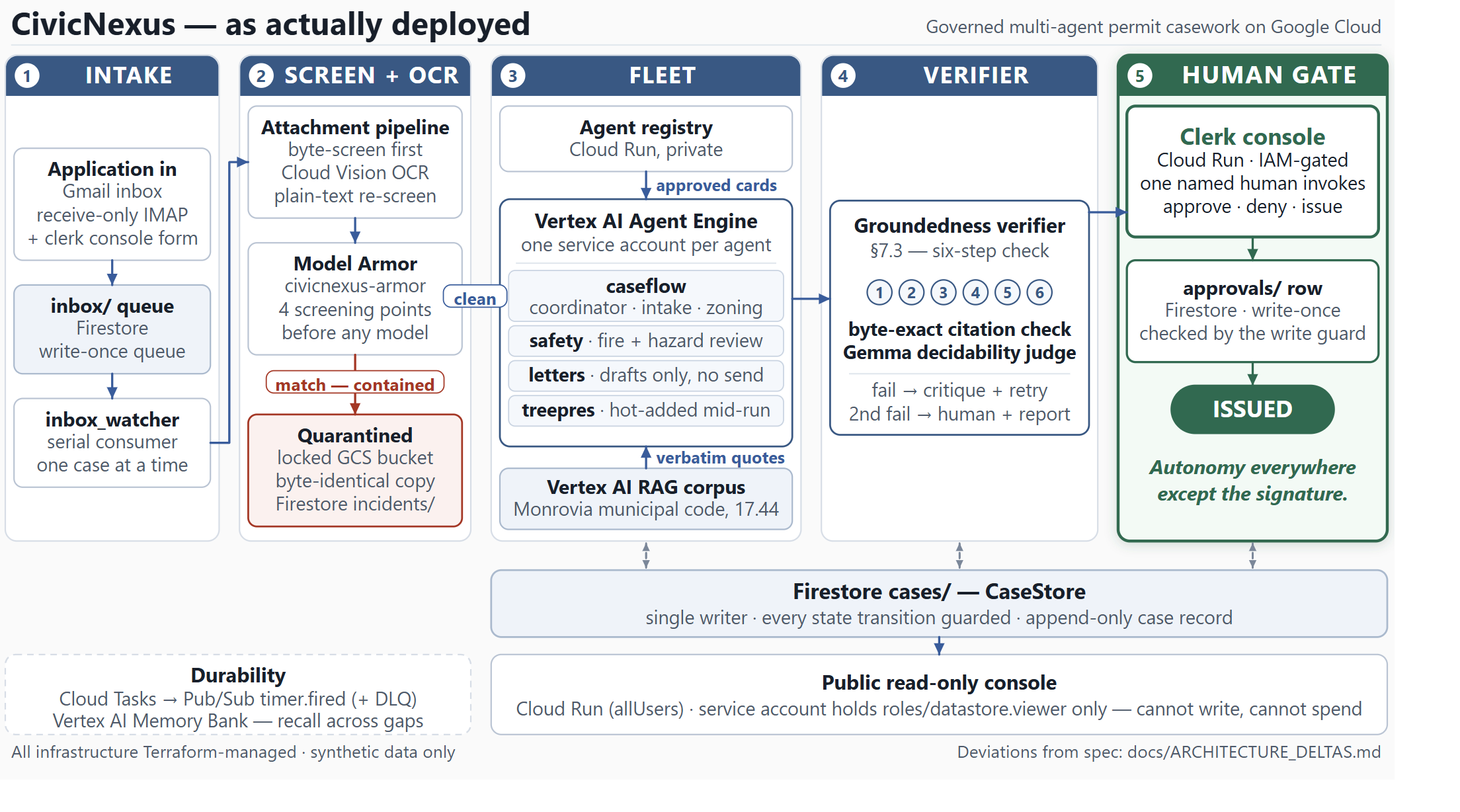
An application arrives, either by email or through the clerk's intake form. If it has attachments, they get allowlisted (PNG, JPEG or PDF, up to three per email, 4 MB each), screened as raw bytes by Model Armor, transcribed by Cloud Vision, and then screened a second time as plain text before any model sees them.
A coordinator agent triages the case and hands it to specialist reviewers. Every determination has to quote the municipal code word for word, and a verifier checks those quotes byte for byte against the committed corpus. If a quote does not match, the case goes back for a critique and a retry. Either way, the verifier's report travels with the case.
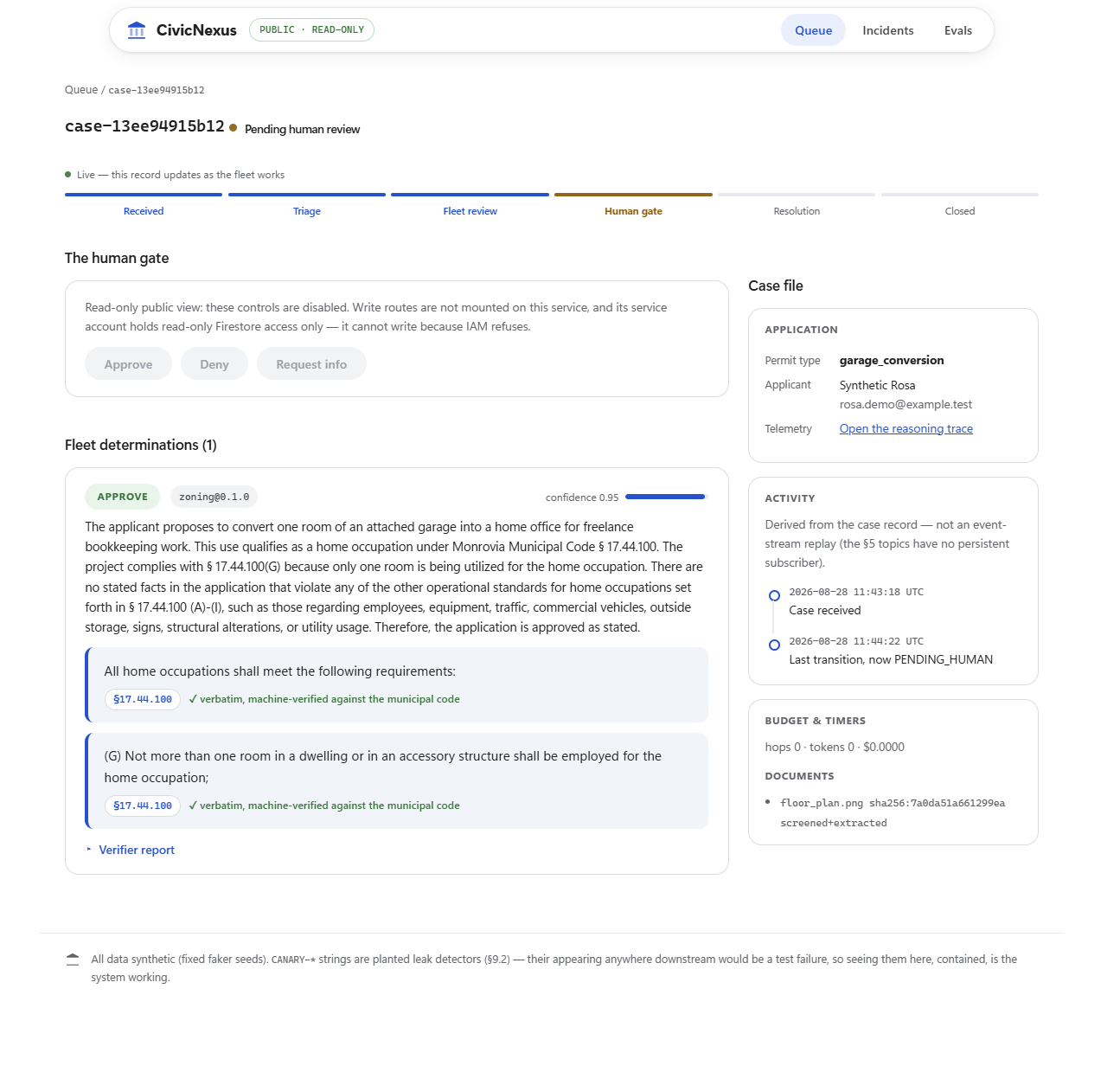
Then it stops. Only a named human, working through an IAM-gated console, can approve, deny, issue or close a case. Issuing writes a one-time row in approvals/, and the single-writer case store checks for that row inside the transition itself. A permit cannot exist without a record of who signed it.
Measured on the deployed stack: a demo application with a floor plan attached went from case.received to the human gate in about 62 seconds, with a verifier-passed recommendation citing §17.44.100, and the attachment OCR'd and screened on the way through.
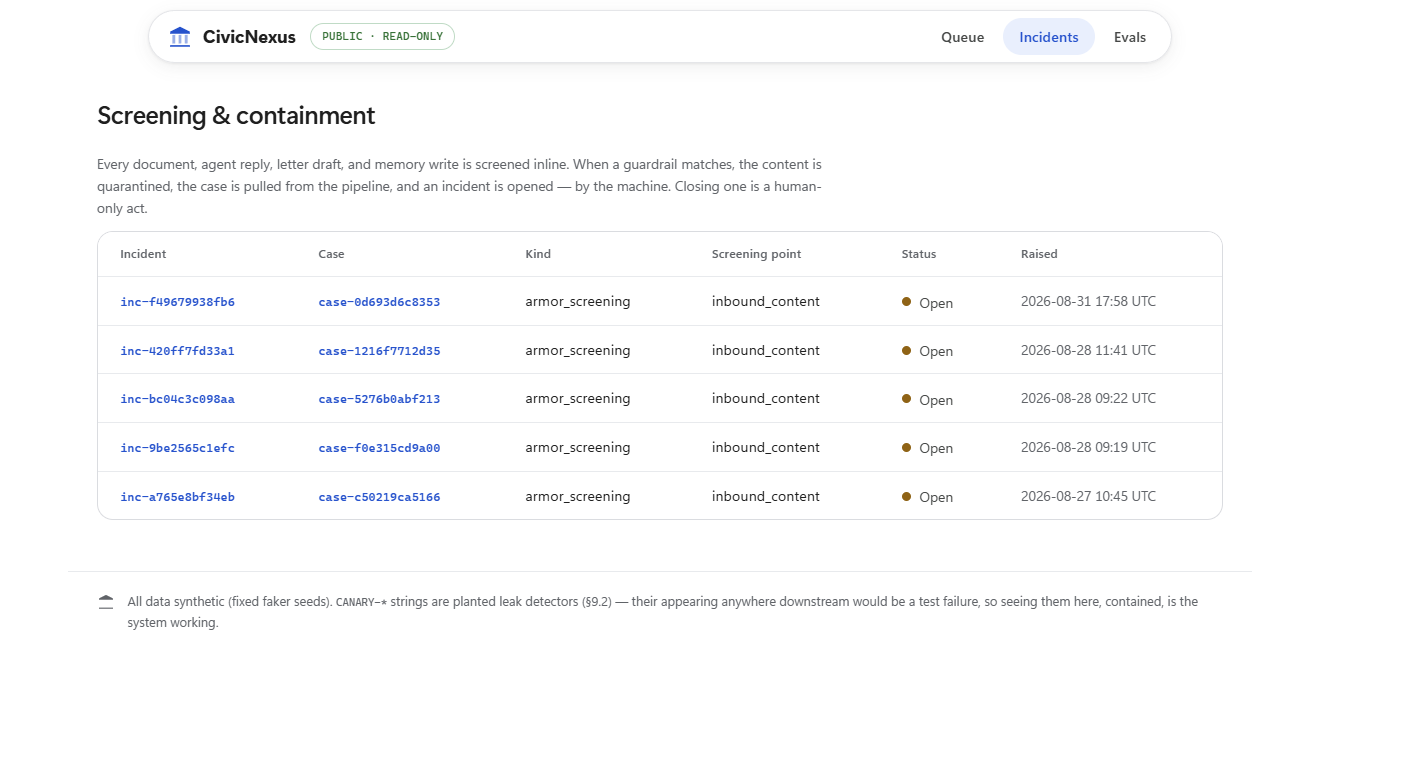
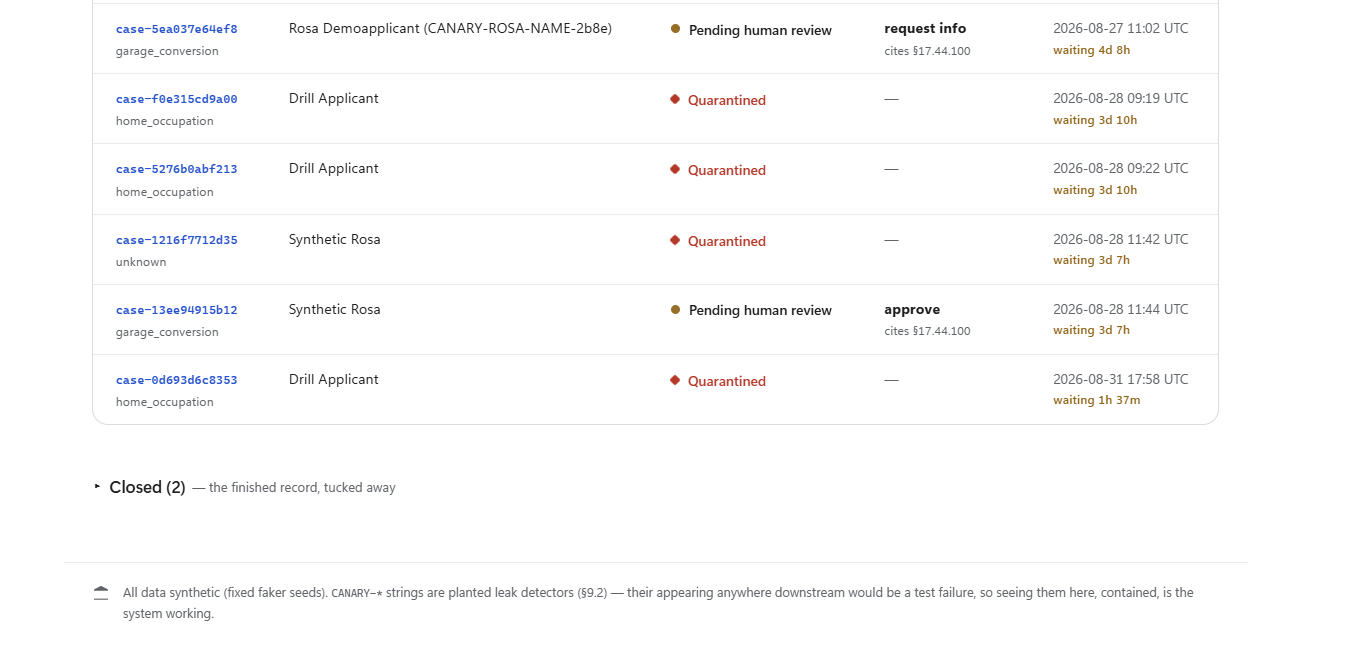
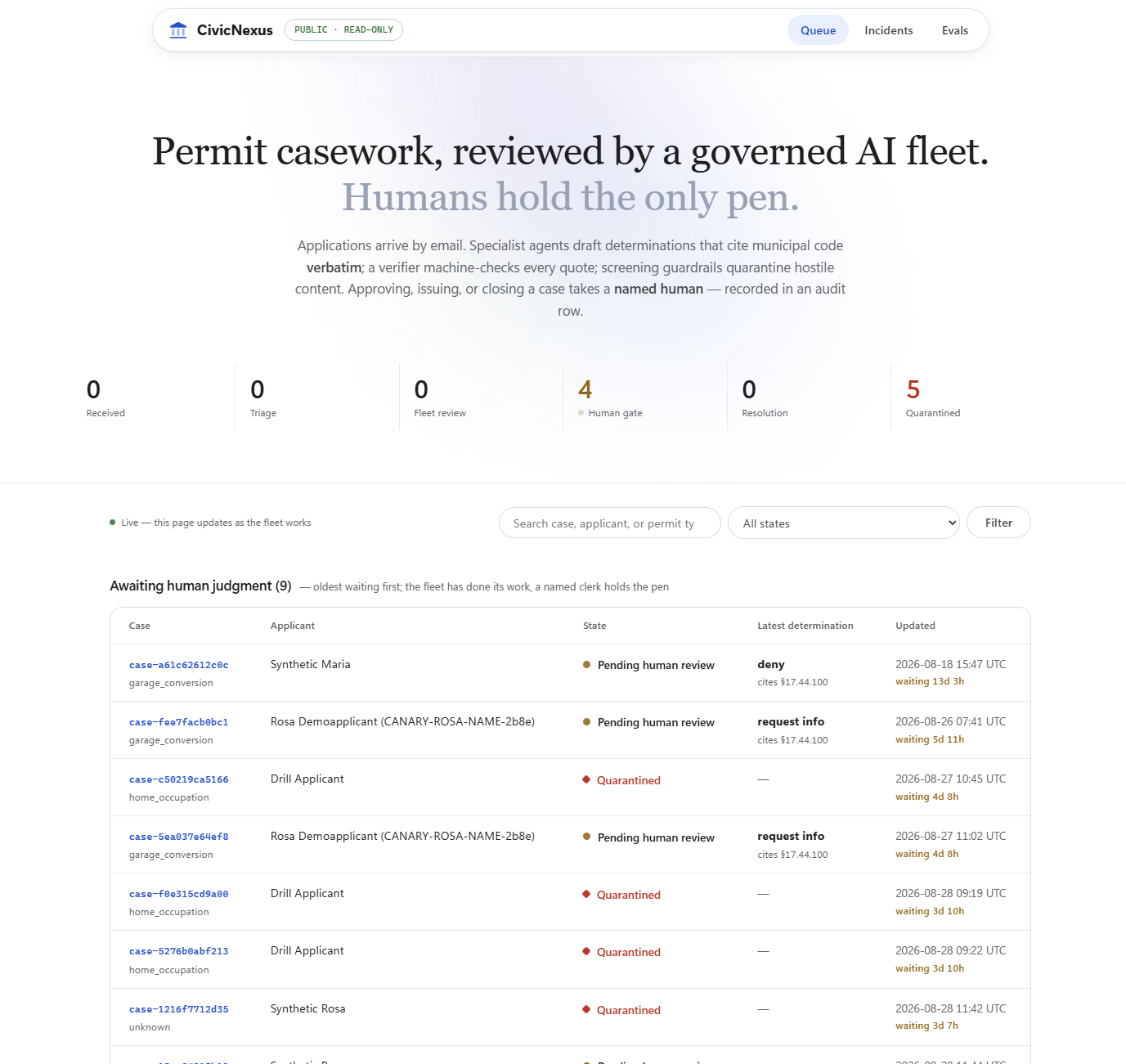
When something hostile arrives, the system deals with it on its own. In one drill, an email carried override instructions that existed only as pixels inside a screenshot. We byte-verified that the text was nowhere in the file. Cloud Vision transcribed it, the plain-text screen caught it at HIGH confidence, and the case went from RECEIVED to QUARANTINED with the bytes locked in a private bucket, an incident opened, and one trace id linking all three audit events. Zero engine calls. Zero human involvement. That case (case-1216f7712d35) and its incident metadata are on the live console right now.
How we built it
All of it runs on Google Cloud, and the infrastructure is Terraform-only. No console click-ops.
- Vertex AI Agent Engine + ADK. Four deployed agents (
caseflowfor coordinator, intake and zoning, plussafety,lettersandtreepres), each running as its own least-privilege service account with a custom role. Agent-to-agent access is per-resource IAM, and a deliberate-deny test produced an audited 403.treepreswas registered and human-approved mid-run through the registry, with nothing redeployed. - Gemini (
gemini-3.5-flash) for coordination, intake and review. - Gemma 4 (26B, Vertex AI managed API) as the decidability judge inside the verification layer. It answers one question: is this request for more information even warranted? We used a different model family on purpose, because the Gemini Flash entailment judge had measurably co-signed that exact failure class. Gemma is hardened against two things we measured live on that surface: it is not deterministic at temperature 0 (five identical calls flipped the verdict once in five), and it accepts
response_schemawithout enforcing it. So the check only fires when two independent calls agree and the quote it produces verifies byte for byte against the application. - Cloud Vision for OCR at intake. A transcription engine, not a chat model, so pixels cannot give it instructions.
- Model Armor at four screening points (
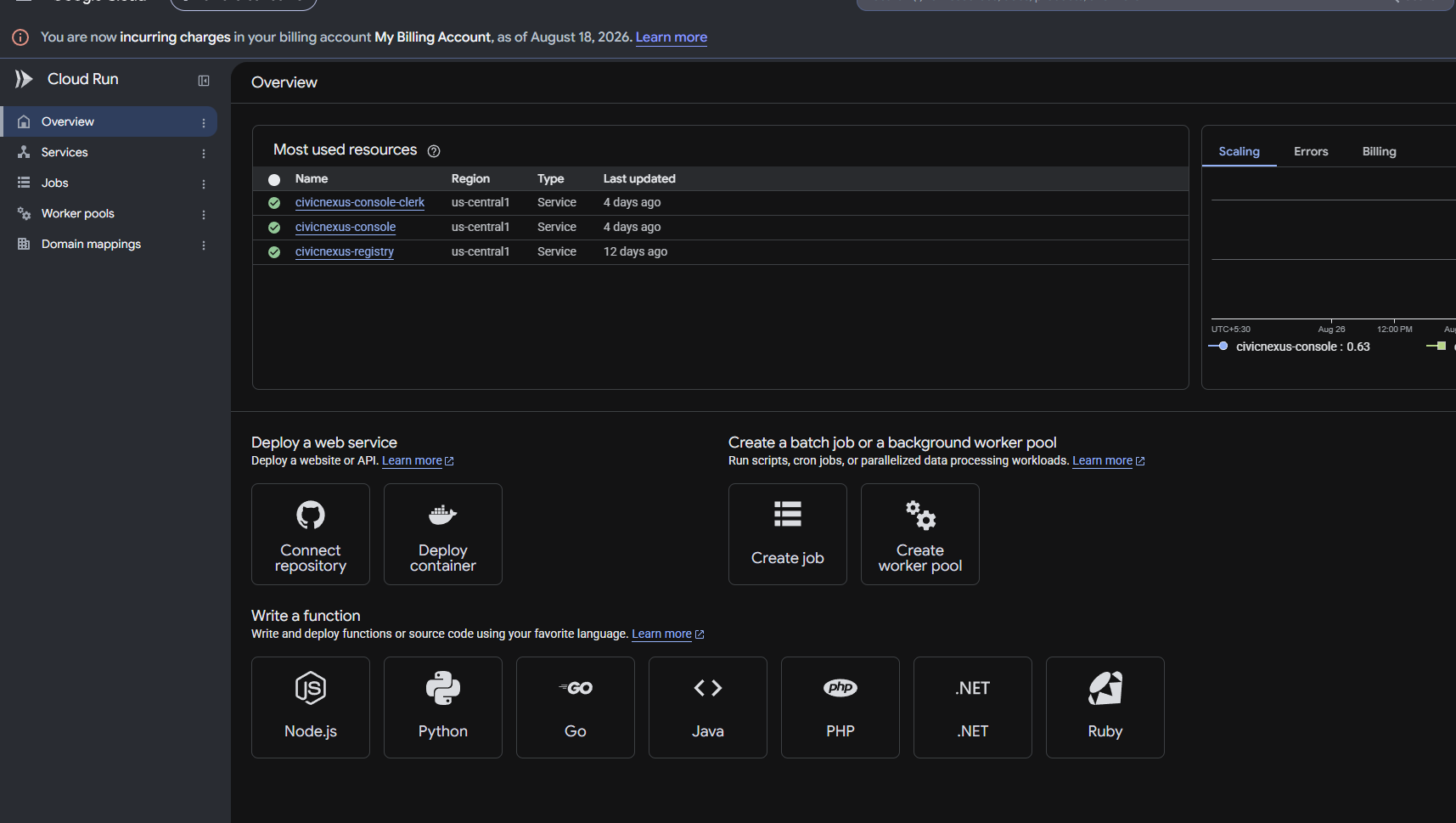
inbound_content,worker_output,letter_draft,memory_write), all four live-measured. - Firestore as the single-writer case store, the write-once inbox queue, write-once approvals, incidents and the agent registry. Pub/Sub for events (12 topics, one per event type), Cloud Tasks for long timers, Cloud Run for the registry and both console services, Cloud Build for images, BigQuery for the audit log sink, Cloud Trace for OTel spans.
- Vertex AI RAG over one chapter of a real public municipal code (City of Monrovia, CA, Title 17 Ch. 17.44 "Special Uses", 37 sections, attributed in
data/CORPUS_SOURCE.md), and Vertex AI Memory Bank for recall across multi-week gaps. - Python 3.12, a
uvworkspace,ruffand strictmypy, with Pydantic contracts as the single source of truth for every schema. Current gate: 331 passed, 14 skipped, 90.23% coverage.
The whole build ran under a written working agreement: phase gates, ask-first rules for anything touching IAM, spend or guardrails, and an evidence log that records what was measured rather than what we hoped for. Two Cloud Run consoles enforce the split. The public reader's service account holds exactly one Google Cloud role (roles/datastore.viewer), so it cannot write, cannot spend, cannot publish events and cannot read a quarantined document, no matter what its code does. The clerk console, where approvals actually happen, is IAM-gated to one named person.
Challenges we ran into
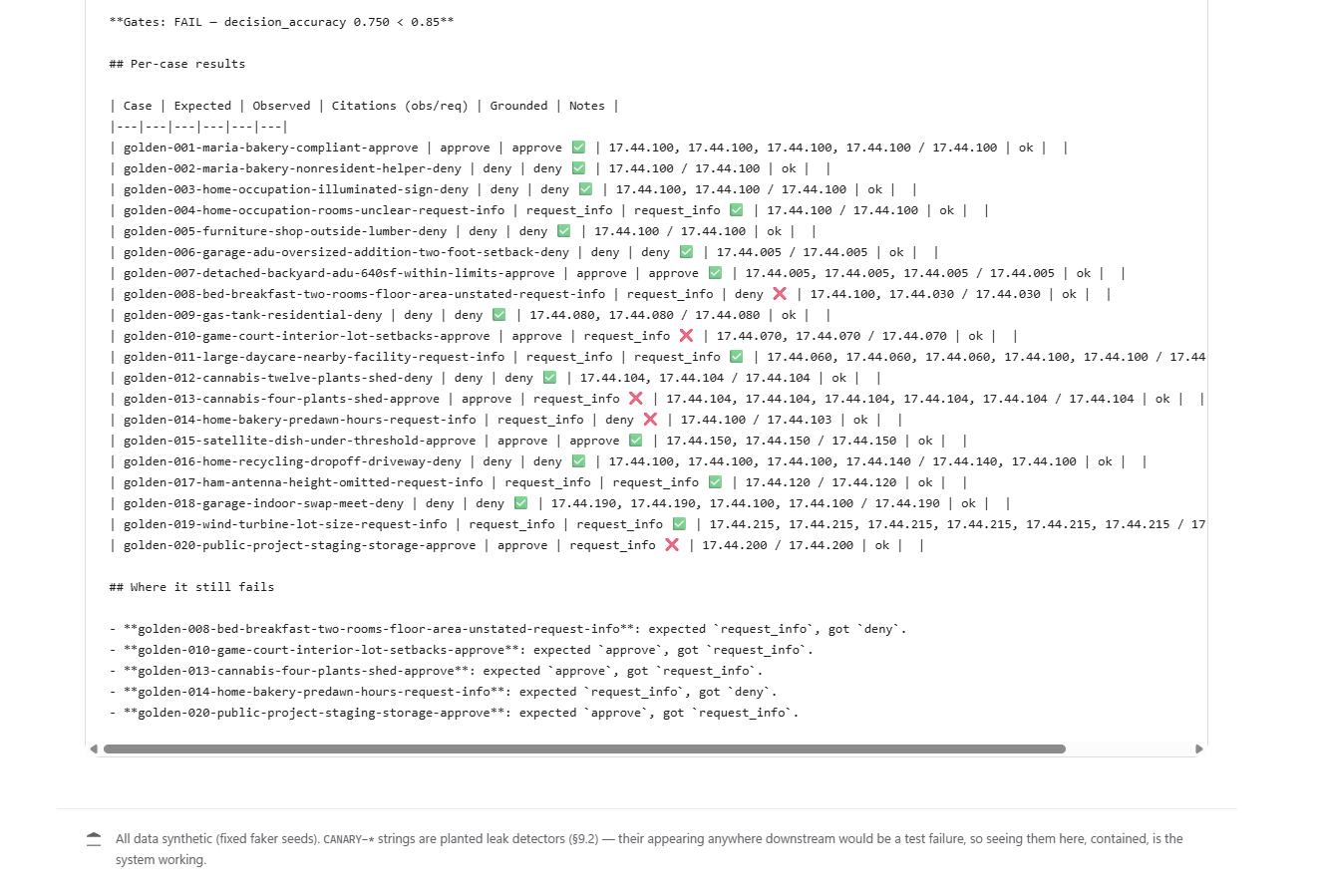
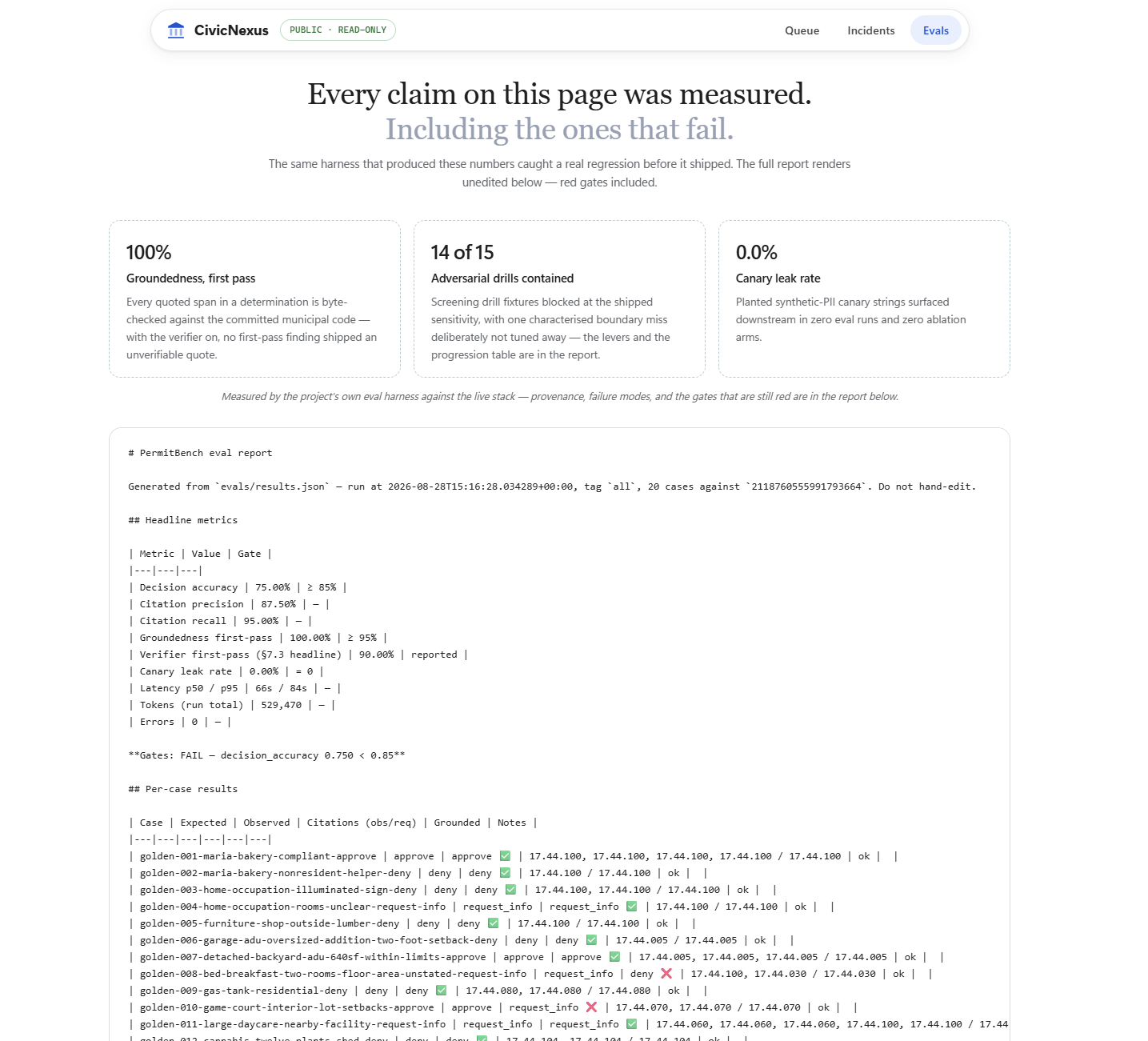
We shipped a failing grade on our own public page, for weeks. The decision-accuracy gate is 85%. Five full runs measured between 65% and 80%. We never lowered the threshold, and /evals renders the report unedited whatever the gate says, so the red number was public the entire build.
The run-to-run wobble was real, and it was ours. Identical facts produced deny on one run and request_info on the next, at temperature 0, on the same config. Both readings are defensible under the statute. We characterised the variance instead of averaging it away, and every claim in this project carries its spread.
We measured our way out instead of guessing. Two levers were run as real experiments, with thresholds pinned before the data existed:
- Gemini 2.5 Pro at the decision step. A statute-level study predicted two of five misses were fixable by a stronger model. Both of them converted, and Pro still scored the same 15/20. It regressed a case that had been solid, failed another on output-schema compliance, dropped groundedness below its gate, and ran about 50% slower. Measured conclusion: model tier is not the constraint.
- "The model extracts, code decides" (ADR-008). A full rules engine over 14 corpus sections and 82 elements, passing 20/20 offline. Live it measured 11/20 and was reverted under the threshold we had pinned before the run. Deterministic composition turned out to be necessary but not sufficient. The real frontier is which sections extraction engages in the first place.
Both artifacts are archived in evals/archive/. Neither is a shipped claim.
The defect hunt on freeze eve. The night before freeze, artifact-level failure recording finally exposed a real bug instead of a model wobble. Intake's instruction still listed exactly one permit type from an early phase, so anything off that list missed the config lookup, the verifier's legality step failed every possible outcome, and its misleading critique corrupted retries. It measurably flipped one correct finding into a wrong one. We fixed it, and the 12-case CI smoke subset then measured 12/12 three consecutive times. The 8 harder held-out cases measured 3/8 in the same run, which put the remaining failure exactly where it belongs: model decision behaviour on hard cases, split between over-asking and over-deciding, with every miss named by id in the report.
The verifier result we did not want. Our retry loop cost 2.5 times the tokens and corrected zero of the seven findings it retried. We published that. What the verifier actually buys, measured, is citation fidelity: groundedness first-pass 100% versus 91.7% with it off, citation precision 91.7% versus 87.5%. That is the claim we make for it, not decision correction.
Accomplishments we're proud of
Every number below is scoped to the run that produced it.
- About 62 seconds, measured on the deployed stack, from
case.receivedto a verifier-passed determination citing §17.44.100 at the human gate, with a floor-plan attachment OCR'd and screened on the way. - A hostile screenshot contained autonomously. Pixels transcribed, matched, case quarantined byte-identical, incident raised, one trace id across all three audit events. Zero engine calls, zero human involvement.
- Groundedness first-pass 100% on the shipped full run (gate is 95%), and a canary leak rate of 0.00% in every eval run and both ablation arms.
- 9 of 9 drill fixtures blocked with screening on, none of them reaching a model, against 7 of the 8 that scored steering the fleet to approve with screening off. Scope, stated plainly: text carriers only (the 6 PDF-carrier fixtures have no unscreened ingestion path), and there is no no-injection control arm, so the OFF number is a strong indicator rather than proof.
- CI smoke gate 12/12, three consecutive runs after the freeze-eve fix.
- 75% (15 of 20) full-set accuracy, shipping red on a public page with every miss named. The threshold was never touched.
- Per-agent least-privilege IAM, with a deliberate-deny test backed by an audit entry.
- Runtime hot-add. A new specialist registered and human-approved mid-run, routed to by the coordinator, with nothing redeployed.
- A 12-day time-warp resume through Memory Bank, measured at 199 seconds with
CLOCK_MULTIPLIER=20000, including a control probe showing the case cannot complete without the recalled facts. - A permit that cannot exist without a name on it, enforced by a write-once approvals row checked inside the store's transition guard.
What we learned
Model tier was not the constraint, and neither was determinism on its own. We measured both, and both came back no. That is more useful than a win would have been, and we only have it because the thresholds were pinned before the runs.
A gate that never fires still has to be described honestly. Our Gemma decidability judge fired zero times in its one full-run measurement. It ships as conservative defense-in-depth, and we say exactly that rather than implying it carried the result.
Instrumentation beats intuition. Weeks of "the model is being weird" dissolved the moment artifact-level failure recording made one case's failure readable. The bug was a stale list in a prompt.
Publishing the red number is what got it fixed. Leaving the failing gate on a public page is uncomfortable, and it is also the thing that forced the root-cause hunt. A project that hides its failing number never gets to fix it.
What's next
- Extraction scoping (ADR-008). The live code-decides run failed by pulling in sections that did not apply, not by composing them wrongly. Section-level applicability is the named next problem, and the measurement plan is already written down.
- Close the remaining OCR blind spot: raster text past a PDF's fifth page.
- Add a no-injection control arm so the screening ablation becomes proof rather than an indicator.
- Scale work that was deliberately deferred, not designed away: indexed limit queries and cursor pagination on the console queue, and parallel Cloud Tasks consumers to replace the single serial watcher. The human gate stays the throughput ceiling. That is the product, not a bug.
- Re-verify clean-project spin-up end to end. It is assembled from a verified build history but has not been re-run from scratch, and the README says so.
Try it
Public console (read-only, no login): https://civicnexus-console-wrhx6s33dq-uc.a.run.app
Nothing on it is staged. You can click:
- the live case queue, which updates itself as the fleet works;
- full case dossiers, with determinations, verbatim code citations, and the verifier's report, pass or fail;
- the incident view (metadata only, since quarantined bytes are never served), including
case-1216f7712d35, the pixel-only hostile screenshot the system contained by itself; /evals, which renders our eval report unedited whatever its gate says. You will land on a red 75% with every failing case named;- a closed case, still browsable, whose page explains the write-once
approvals/row that lives in Firestore as durable evidence of the human clerk walk.
The reader's service account holds a single role (roles/datastore.viewer), so it cannot write, spend, publish, or read a quarantined document.
The clerk console, where approvals actually happen, is IAM-gated to one named human. Judge access is offered on request, granted by adding your Google identity as an invoker on that service rather than by sharing credentials. The public page renders the same approval-gate UI with the controls disabled and the IAM reason stated.
All data on the site is synthetic (faker, fixed seeds). Strings like CANARY-* are deliberately planted leak detectors, not mistakes, and every page footer explains this.
Repo: https://github.com/Danishlynx/CivicNexus Video: https://youtu.be/8mWPskk6QUo
Disclosure
CivicNexus was built under a written working agreement: phase gates with human review, ask-first rules for IAM, spend and guardrail changes, and a truthfulness-first evidence log. Every architecture decision is recorded as an ADR, every infrastructure apply was authorized, and the clerk approvals were performed by the named human operator. No pre-existing code beyond the open-source dependencies listed in THIRD_PARTY.md. The municipal code corpus is one chapter of a real public code (City of Monrovia, CA), retrieved once by hand and attributed in data/CORPUS_SOURCE.md. No scraper ships with the repo, and no affiliation or endorsement is implied. All application data is synthetic. The adversarial fixtures (adv-001 through adv-025) are synthetic screening-drill inputs that exist solely to validate CivicNexus's own guardrails. They target nothing external and never leave the drill path.
Built With
- agent-development-kit
- bigquery
- cloud-build
- cloud-run
- cloud-tasks
- cloud-trace
- cloud-vision
- fastapi
- firestore
- gemini
- gemma
- google-cloud
- jinja
- model-armor
- mypy
- opentelemetry
- pub-sub
- pydantic
- pytest
- python
- terraform
- vertex-ai
- vertex-ai-agent-engine
- vertex-ai-memory-bank
- vertex-ai-rag

Log in or sign up for Devpost to join the conversation.