-
-
Problem
-
Agentic AI Loop
-
Cover
-
Solution
-
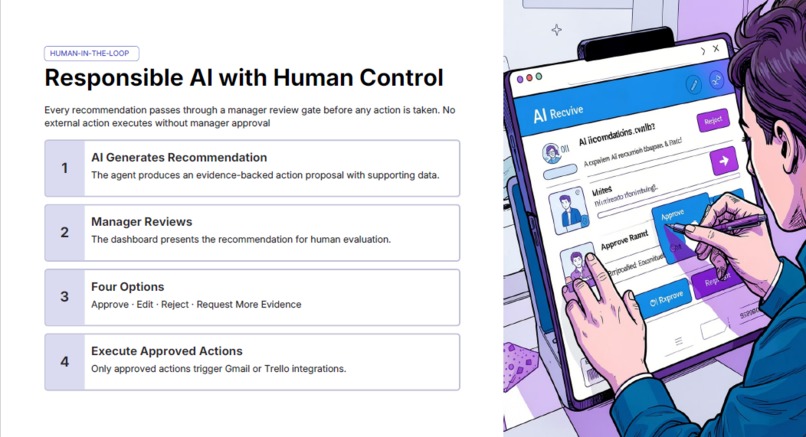
Human-in-the-Loop
-
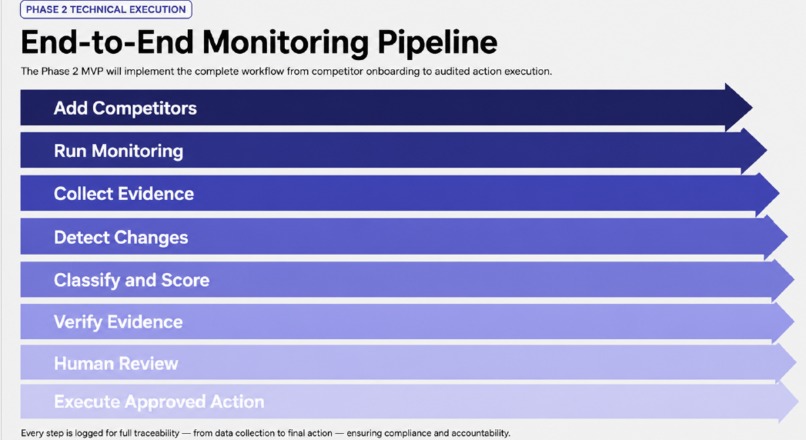
Phase 2 Monitoring Pipeline
-
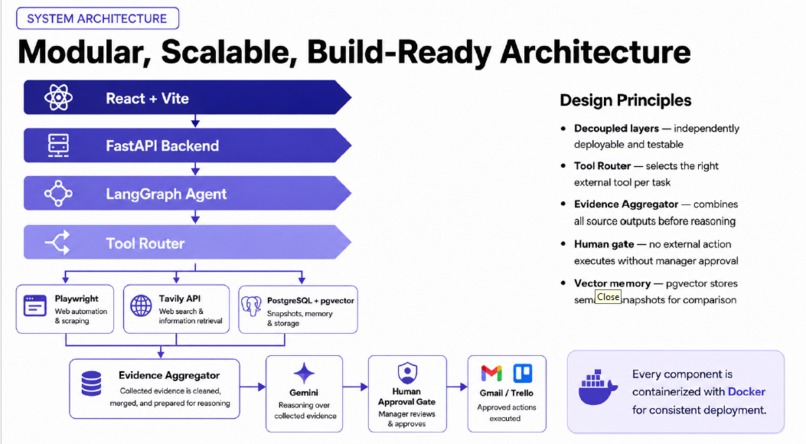
System Architecture
-
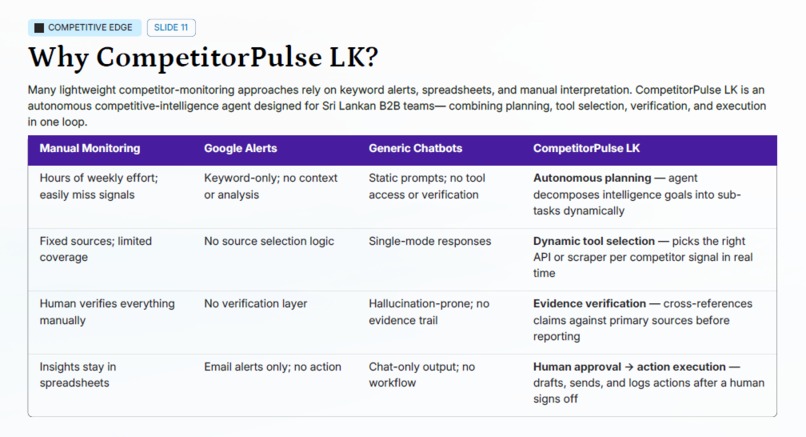
Competitive Edge
-
Roadmap
Inspiration
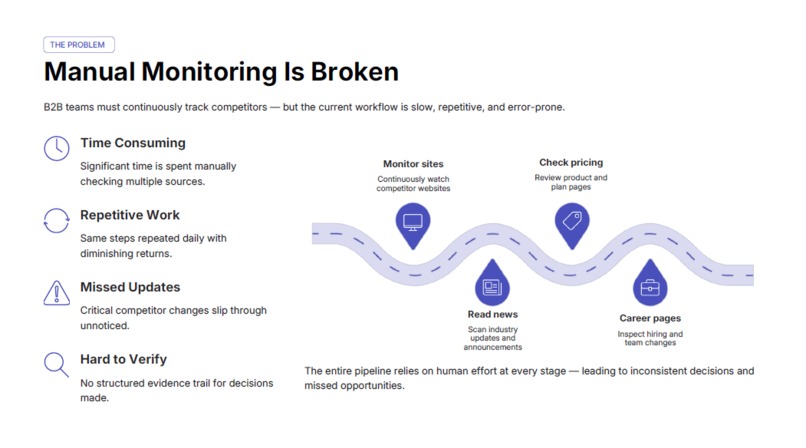
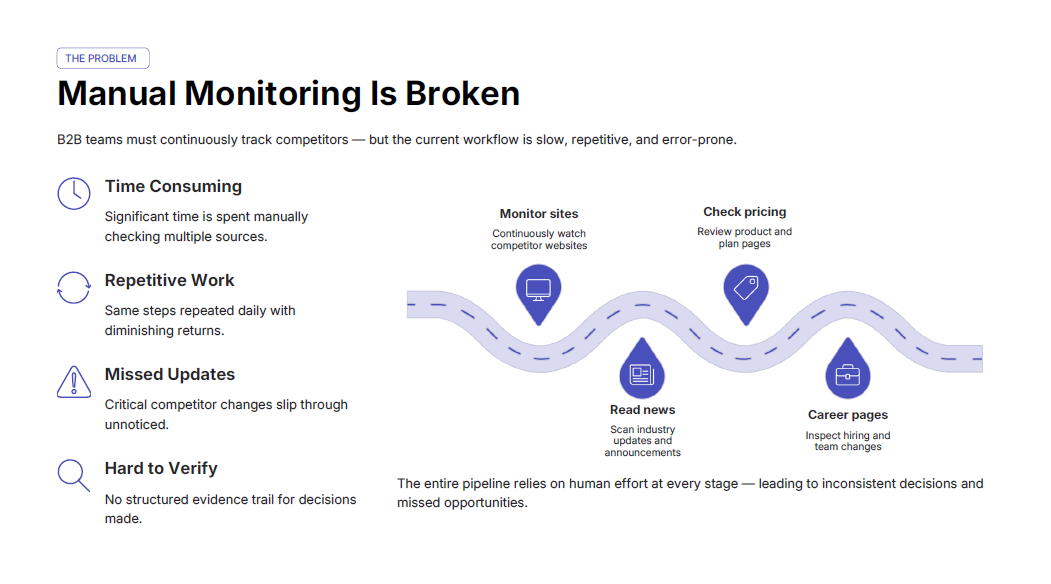
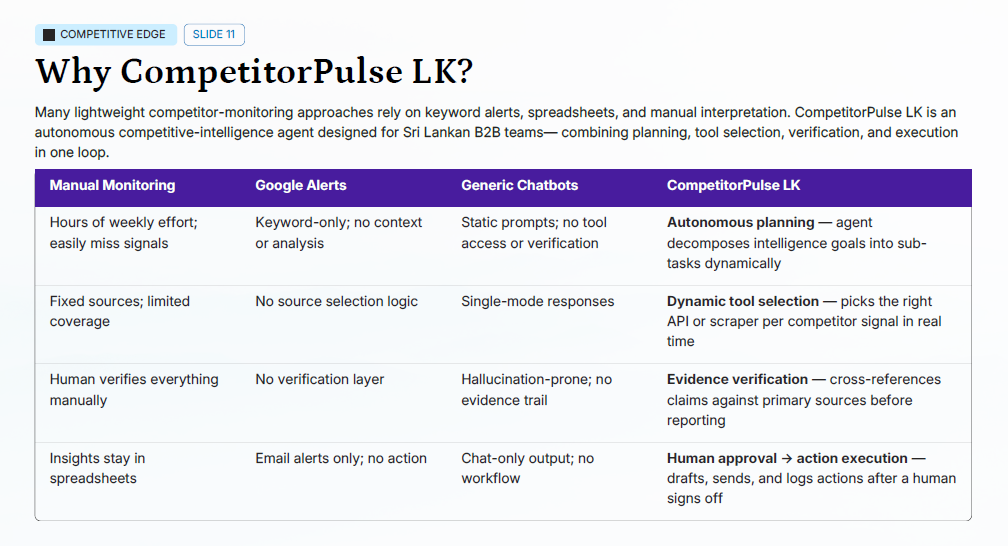
Sri Lankan B2B teams often monitor competitors manually by checking company websites, news articles, career pages, product updates, pricing pages, and public announcements. This process is repetitive and time-consuming, and important updates are easy to miss.
A business may discover too late that a competitor has launched a new product, changed its pricing, started hiring for a new market, or announced an important partnership. Smaller companies may also be unable to justify the cost and complexity of enterprise competitive-intelligence platforms.
This inspired us to design CompetitorPulse LK, an affordable, evidence-focused competitive-intelligence agent for Sri Lankan B2B teams.
What it does
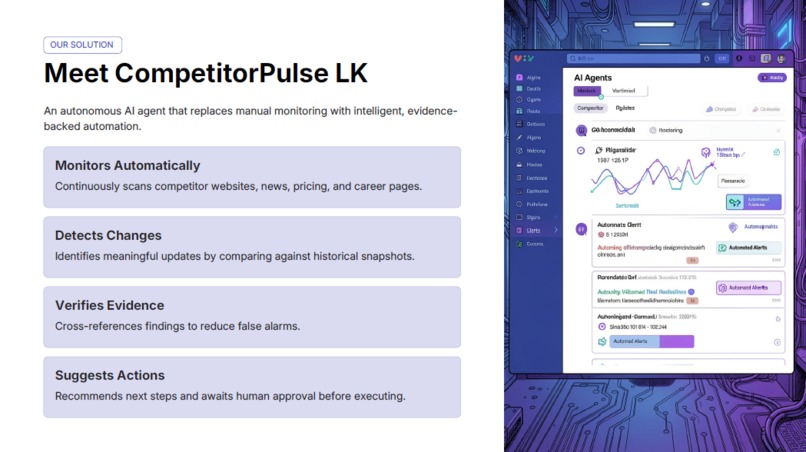
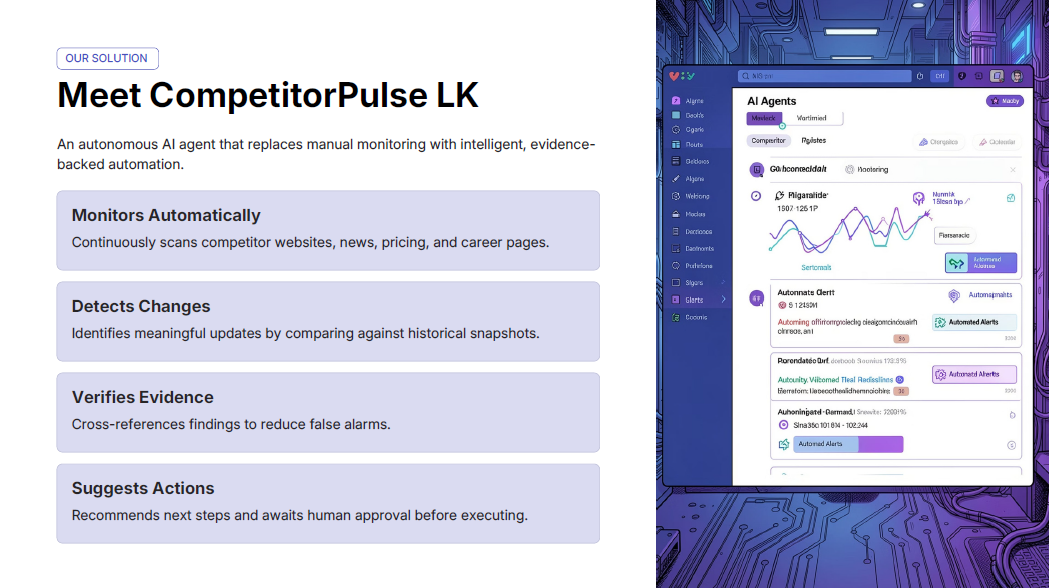
CompetitorPulse LK monitors selected public competitor sources and converts scattered market signals into structured, evidence-backed business intelligence.
The agent can:
- Monitor competitor websites, news sources, pricing pages, and career pages
- Compare current content with previously stored snapshots
- Detect meaningful changes while filtering minor page noise
- Classify changes such as product launches, pricing updates, hiring, partnerships, campaigns, or market expansion
- Calculate confidence and business-importance scores
- Explain why a detected change may matter
- Recommend follow-up actions
- Generate draft weekly competitive-intelligence briefs
- Route alerts and tasks through human approval before execution
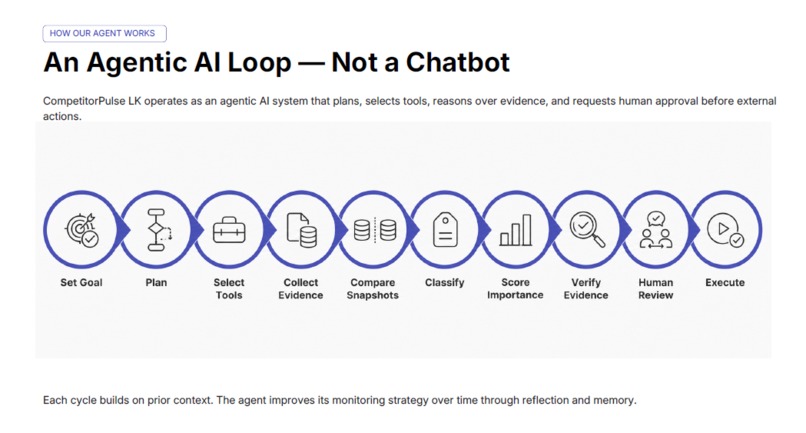
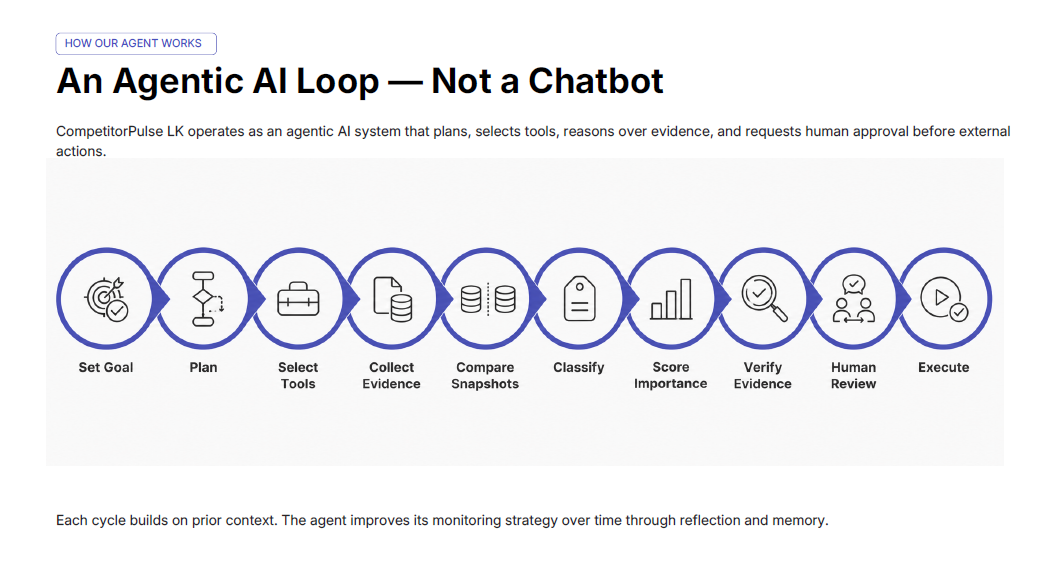
The system is not designed as a simple chatbot. It follows an agentic workflow in which it selects tools, gathers evidence, compares historical context, evaluates confidence, handles failures, and requests human review when information is uncertain.
How we designed it
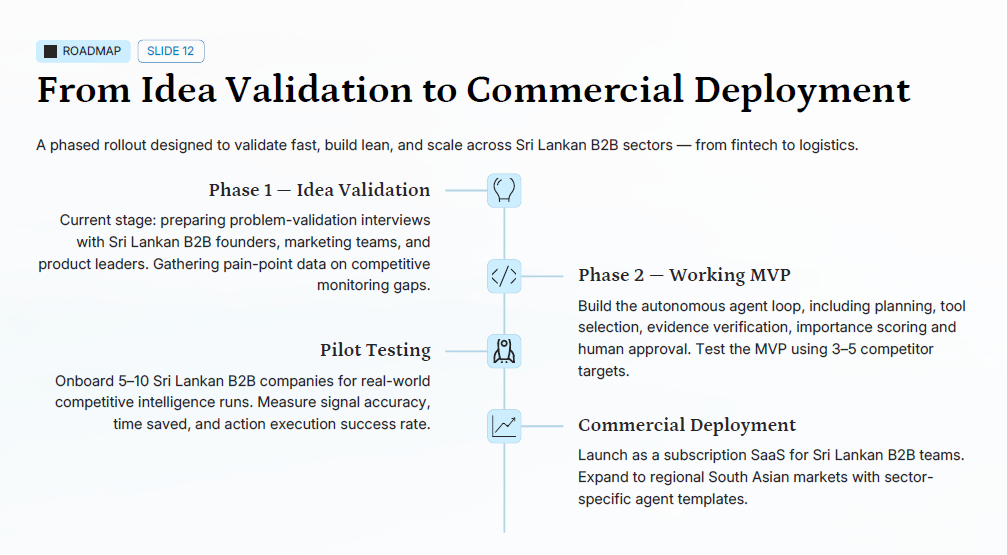
For Phase 1, we designed a technically feasible architecture, agentic reasoning loop, Human-in-the-Loop policy, and one-week MVP implementation plan.
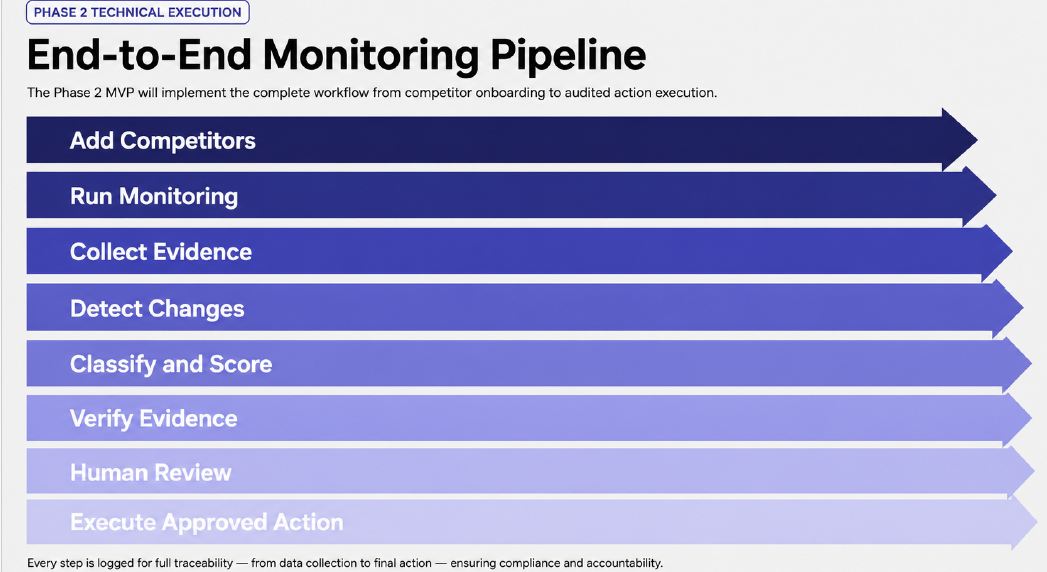
The planned workflow is:
- Receive a competitor-monitoring goal
- Read the configured competitor watchlist
- Select the appropriate data-collection tool
- Collect signals from websites, news, and career pages
- Compare the collected data with stored baseline snapshots
- Detect and filter meaningful changes
- Classify the change type
- Calculate confidence and importance scores
- Check whether the available evidence is sufficient
- Search for additional evidence when necessary
- Generate an evidence-backed recommendation
- Send the recommendation to a human review gate
- Execute only approved alerts or tasks
- Record the decision and execution result for traceability
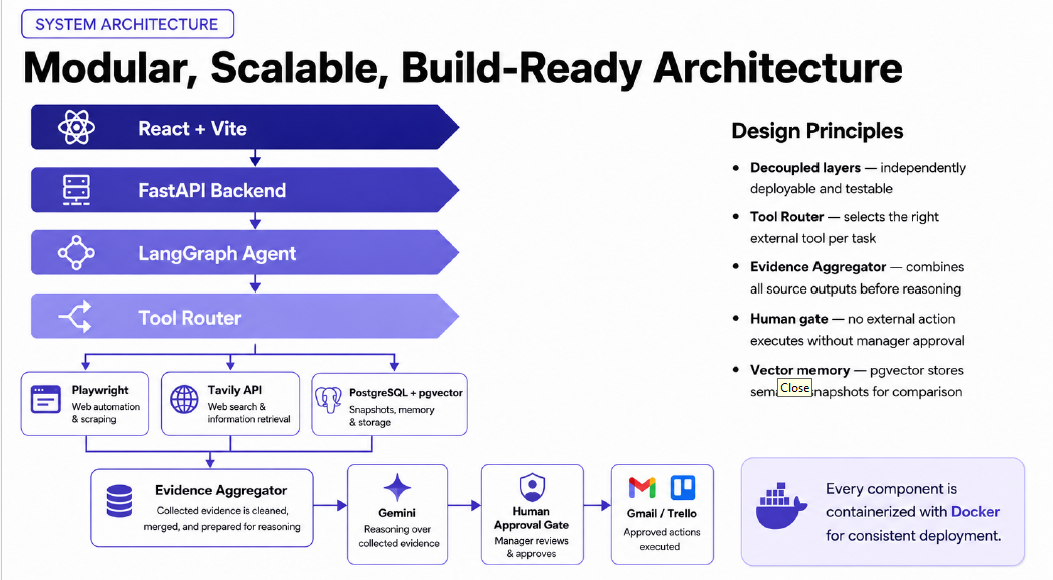
The proposed architecture uses a React dashboard, FastAPI backend, LangGraph agent orchestrator, Playwright website collector, Tavily Search API, PostgreSQL with pgvector, Gemini reasoning, an evidence-aggregation layer, and approved Gmail or Trello actions.
Human-in-the-Loop
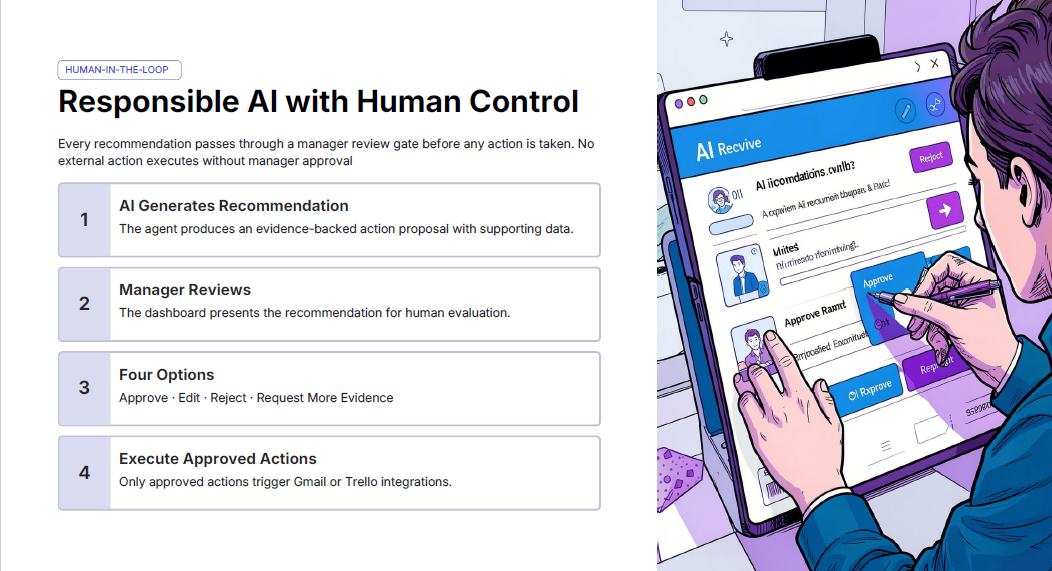
Human control is a central part of CompetitorPulse LK.
Before an important alert, report, or task is sent, a manager can:
- Approve the recommendation
- Edit the recommendation
- Reject it
- Request more evidence
- Change the importance level
- Reclassify the result
- Mark it as a false positive
Low-confidence or conflicting information never triggers an external action automatically. All approved actions are recorded in an audit log.
Challenges we faced
One major challenge was ensuring that the system represents genuine agentic reasoning rather than a fixed automation pipeline.
We addressed this by including:
- Dynamic tool selection
- Confidence-based decisions
- Evidence-sufficiency checks
- Replanning when evidence is weak
- Recovery from API and website failures
- Duplicate-signal handling
- Conflict detection between sources
- Human approval before action execution
Another challenge was keeping the MVP realistic for a one-week build. Therefore, the initial scope is limited to 3–5 competitor targets and three signal types: websites, news/search results, and public career pages.
What we learned
Through this project, we learned that a useful AI agent must do more than summarize information.
It must:
- Select the right tools for the current task
- Compare historical and current data
- Reason about business impact
- Handle incomplete or conflicting information
- Explain its conclusions using traceable evidence
- Stop or replan when confidence is inadequate
- Keep humans in control of high-impact actions
We also learned the importance of designing a modular and failure-tolerant architecture that can be adapted to the specific problem statement released during Phase 2.
What is next
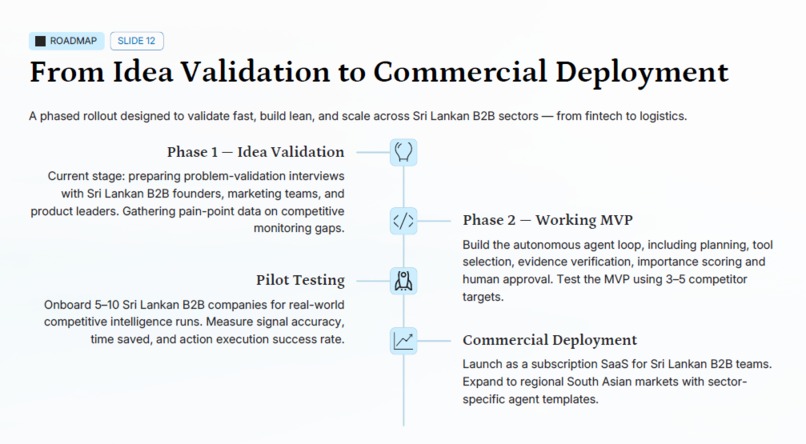
If selected for Phase 2, we will adapt this architecture to the exact problem statement issued by NeuroX and develop a working MVP containing:
- A competitor watchlist
- Website and news monitoring
- Career-page monitoring
- Baseline snapshot storage
- Meaningful text-change detection
- AI classification, confidence, and importance scoring
- Evidence-backed insight cards
- A draft weekly intelligence brief
- An approval-based Action Center
- One approved alert or task-management integration
- An audit log for decisions and executions
Our goal is to build a practical, affordable, and scalable competitive-intelligence solution for Sri Lankan B2B teams.

Log in or sign up for Devpost to join the conversation.