-
-
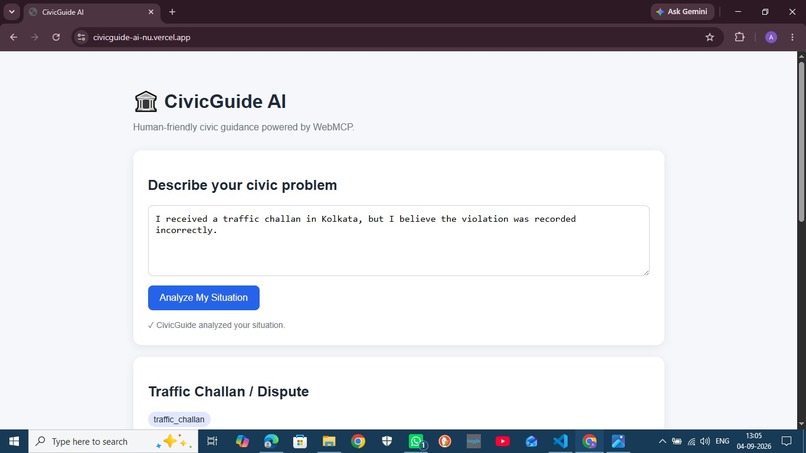
CivicGuide AI
-
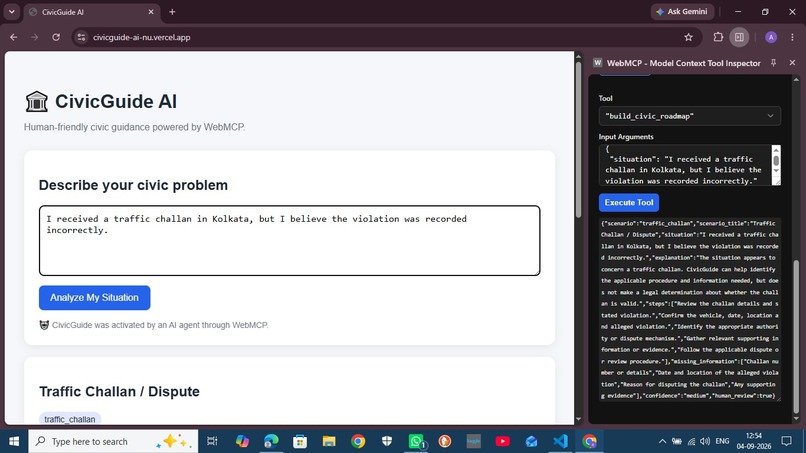
CivicGuide AI with MCP Inspector
Inspiration
Every day, people encounter civic and administrative problems that are difficult to navigate without knowing which procedure, authority, or information is relevant. Traffic challans, starting a small business, and accessing government services can involve unfamiliar terminology and multiple procedural steps.
The idea for CivicGuide AI came from a simple observation: people often know that they have a problem, but do not know what the appropriate next step is.
Rather than building another general-purpose chatbot, I wanted to create a focused tool that turns a plain-language civic situation into a structured roadmap. The goal is not to provide legal advice or replace lawyers or government officials, but to help people understand their situation and organize the information they may need.
What it does
CivicGuide AI is a WebMCP-powered civic guidance application.
The current prototype focuses on three scenarios:
- Traffic challans and disputes
- Small-business setup
- Government and administrative services
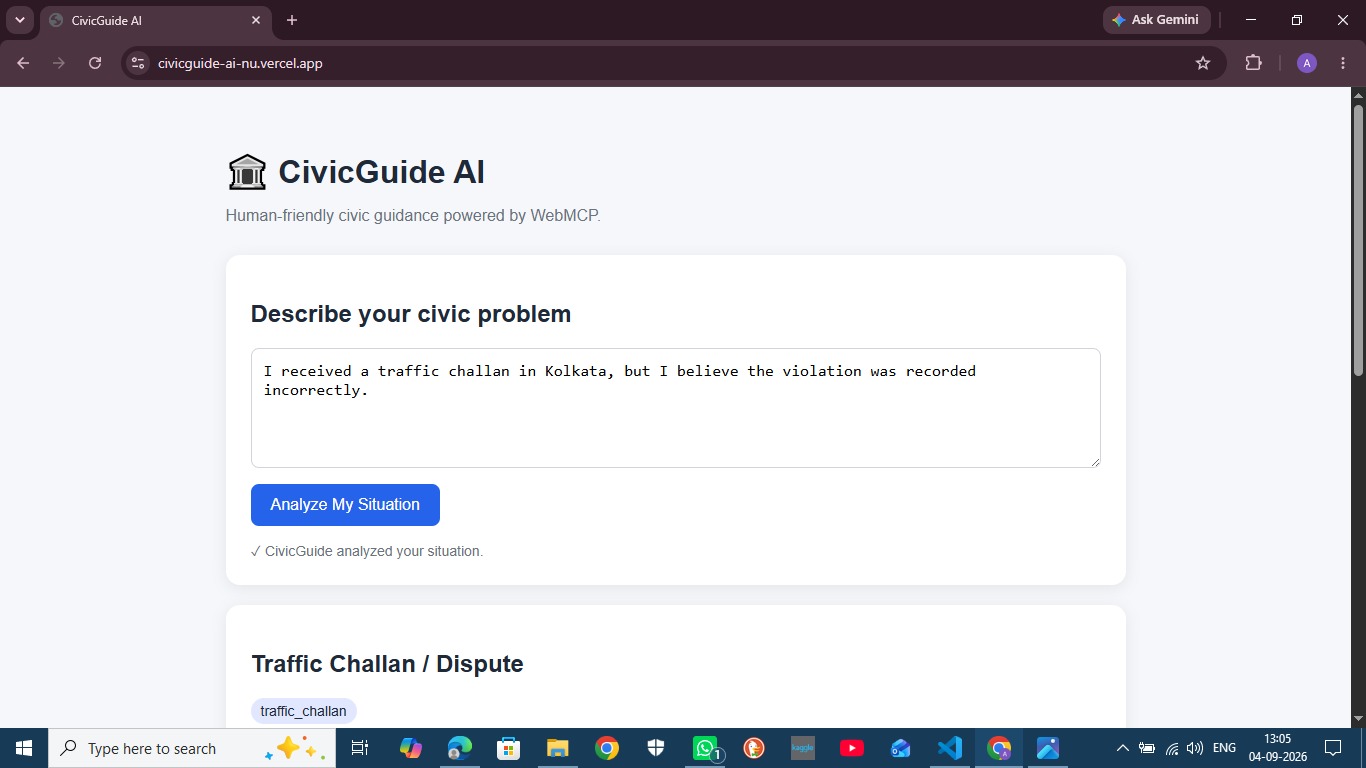
A person describes their situation in plain language. CivicGuide identifies the relevant scenario and produces a structured roadmap containing suggested next steps, potentially missing information, a confidence level, and an indication of whether human review may be appropriate.
The application is deliberately focused. Instead of pretending to solve every legal or civic problem, it demonstrates how a website can expose useful, structured capabilities directly to an AI agent through WebMCP.
How I built it
I built CivicGuide AI as a lightweight web application using HTML, CSS, and JavaScript.
The core WebMCP integration uses "document.modelContext.registerTool()" to expose two tools:
- "identify_civic_issue" — identifies which CivicGuide scenario is relevant.
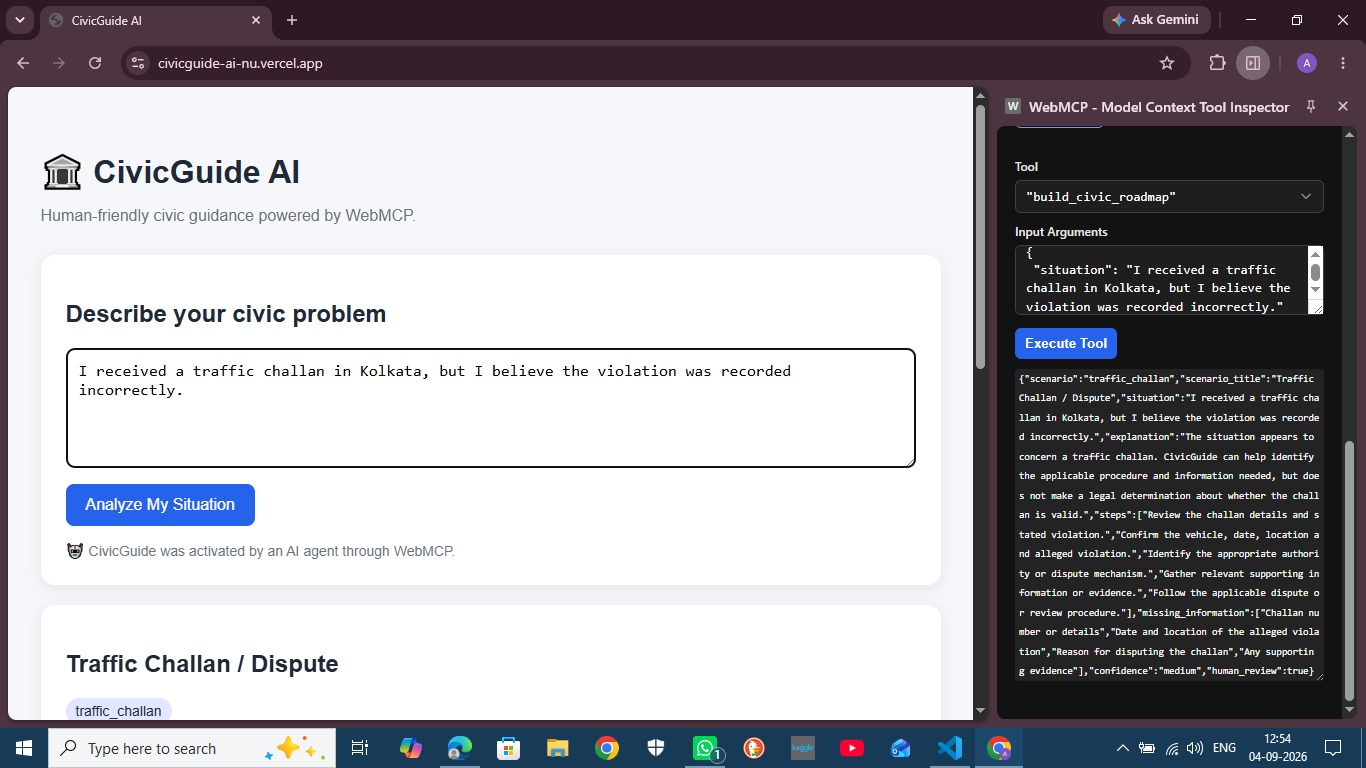
- "build_civic_roadmap" — generates the structured civic roadmap.
When an agent invokes the roadmap tool, CivicGuide returns structured data and also updates the human-facing interface. This creates a shared interaction where the agent can use the application's capabilities while the person can see and review the resulting guidance.
The implementation is intentionally simple and does not require a server-side API key.
Challenges I ran into
The hardest challenge was designing the experience so that AI assistance remained useful without presenting uncertain information as authoritative legal advice.
Civic and administrative situations can depend heavily on context. I therefore chose a narrow MVP instead of attempting to build an all-purpose legal assistant. The current prototype focuses on three scenarios and explicitly surfaces missing information, confidence, and the need for human review.
Another challenge was making WebMCP meaningful rather than simply adding tool registration for demonstration purposes. I wanted the tools to perform useful application functions and connect the agent interaction back to the human interface.
Finally, I had to balance the broader vision of CivicGuide with what could realistically be built and demonstrated within a hackathon.
Accomplishments I'm proud of
I'm proud that CivicGuide AI is more than a conventional chat interface.
It demonstrates:
- WebMCP tool discovery and invocation.
- Structured tool outputs.
- Human and agent interaction through the same application.
- Scenario-specific civic guidance.
- Explicit missing-information and confidence fields.
- Human review for situations where automated guidance should not be treated as definitive.
Most importantly, the prototype demonstrates a practical pattern: an AI agent can use capabilities exposed directly by a civic application instead of simply trying to interpret and navigate the interface like a human.
What I learned
Building CivicGuide AI reinforced an important lesson: useful civic AI is not only about generating an answer. It is also about knowing the scope of the information being provided and making uncertainty visible.
I also learned that WebMCP can change the relationship between a website and an AI agent. Instead of treating the website as something an agent merely reads or navigates, the website can expose structured actions that the agent can invoke directly.
Finally, I learned that a strong prototype does not need to solve every possible civic problem. A focused workflow that clearly demonstrates the value of human-agent collaboration can be more useful than an overly ambitious system with capabilities that are difficult to verify.
What's next for CivicGuide AI
The current prototype is intentionally focused on three scenarios, but the underlying concept can be expanded significantly.
Future modules could cover:
- Government schemes and benefits
- Business registration and licensing
- Property and land procedures
- Consumer rights and complaint guidance
- Environmental regulations
- Healthcare administration
- Passport, visa, and identity-document procedures
- Municipal services and local regulations
- Tax and compliance checklists
Future versions could also connect the guidance workflow to official government sources, add retrieval-augmented generation (RAG), provide stronger citations and traceability, support multiple languages, and introduce deeper human review for complex or high-impact situations.
The long-term goal is not to build an AI that replaces lawyers or government officials. It is to build an AI-assisted civic navigation layer that helps people understand public procedures more clearly while keeping humans in control.
Built With
- css
- github
- html
- javascript
- vercel
- vscode
- webmcp
- windows

Log in or sign up for Devpost to join the conversation.